Health Literacy & Community Assessment Models
 Call Kai
 Learn
Learn Practice Test
 Spaced Repetition
 Match
Match Flashcards
 Knowt Play
1/18

There's no tags or description
Looks like no tags are added yet.
Name | Mastery | Learn | Test | Matching | Spaced | Call with Kai | Chat |
|---|
No analytics yet
Send a link to your students to track their progress
19 Terms
Defining Health Literacy
individuals can obtain, process, understand, an communicate health information needed to make informed decisions
knowledge, motivation, and competences to access, understand, appraise, and apply health information
to make judgements and take decisions in healthcare, disease prevention, and health promotion to maintain or improve quality of life
digital health literacy
digital skills and ability to search for, understand, use, and evaluate health information on digital media
actively participate in health information exchange and interaction
use the obtained information to address or solve health problems
Sorensen’s 4 operational competencies of health literacy
accessing - ability to seek, find, and obtain health information
understanding - ability to comprehend accessed health information
appraising - ability to interpret, filter, evaluate and judge the credibility of health information
applying - ability to communicate and use information to make informed choices
Health Literacy Stats
88% of adults have substandard rates of health literacy
older population (65+) have the lowest levels of health literacy
42% of those who reported poor health have below basic knowledge of health literacy
low health literacy creates up to 238$ billion in annual healthcare costs in the US
every $1 invested in health literacy yields 25$ in systemic savings
National action plan to improve health literacy
accessible information: deliver accurate, actionable health and safety content
healthcare system reform: improve care communication, access, and informed decision-making
education integration: teach health and science concepts from early childhood through university
community support: expand adult education, ESL instruction, and culturally tailored health services
Policy and partnerships: build cross-sector alliances, issue guidance, and update health policies
research and evaluation: advance research to test and refine health literacy interventions
scale proven practices: expand the adoption of evidence-based health literacy strategies
Health literacy as SDOH
organizational health literacy - degree which organizations enable all individuals to find, understand, and use information and services (helps them make health-related decisions and actions for themselves and others)
leadership and universal precautions - clear communication into leadership, strategic planning, and workforce training to apply health literacy across all patient care without stigma
access and community engagement - partner with patients and local communities to design services, create plain-language print and digital content, and ensure transparent accessible care environments
patient and interpersonal barriers
anatomical knowledge gaps - patients often lack basic anatomical understanding
cultural incongruence - deeply rooted religious or community beliefs collide with biomedical models
linguistic and translation risks: replying on family members due to a lack of professional interpreters leads to misinterpretation, privacy breaches, and safety risks
shame and concealment: intimidation and fear of appearing unintelligent cause patients to nod along and conceal
provider assessment and communication barriers
6 to 1 overestimation - nurses estimated ~68% of patients have adequate health literacy, whereas formal testing reveals only 22% actually do
educational proxy fallacy: using formal grade completion as a proxy is unreliable
40% of high school graduates still demonstrate limited health literacy
jargon and curricular deficit
medical terminology dominates clinical dialogue and there is minimal health literacy training in nursing curricula
systemic barrier
lack of institutional support: healthcare organization advocate for patient education in policy without dedicating time tracking or support structures
organizational barriers
time constrains: high patient to nurse ratios force rapid explanations
translator shortages: facilities frequently lack 24/7 professional interpreter access and low literacy materials
informational barriers
health misinformation - deficits in public health communication invites community misinformation that spread rapidly
unreliable internet sources - patients turn to search engines and social media, exposing them to misleading marketing and false cures
digital health literacy barriers
“digital native” fallacy - device familiarity in younger populations does not equal ability to critically evaluate online health information
platforms and usability barriers - technical lockouts, software conflicts, and complex navigation interfaces prevent efficient access to digital health tools
AHRQ - Health Literacy Universal Precautions Toolkit
structures services so everyone can easily understand and act on health information
core actions
simplify communication and confirm patient understanding
ease office and system navigation
support patients in improving health
Evidence-Based Clinical Communication Frameworks
Teach back (chunk and check) loop
explain 1-3 concepts and ask the patient to restate instructions in their own words, clarify missteps, recheck and document in the EHR
Ask me 3 program
empower patients to ask
what is the main problem
what do i need to do
why is it important for me to do this
the LEARN model
listen to perceptions
explain nursing view
acknowledge differences
recommend options
negotiate a mutual plan
Osborne’s Communication Rules
use private spaces
fit facing the client
maintain eye contact
5th grade level materials
ask open ended questions
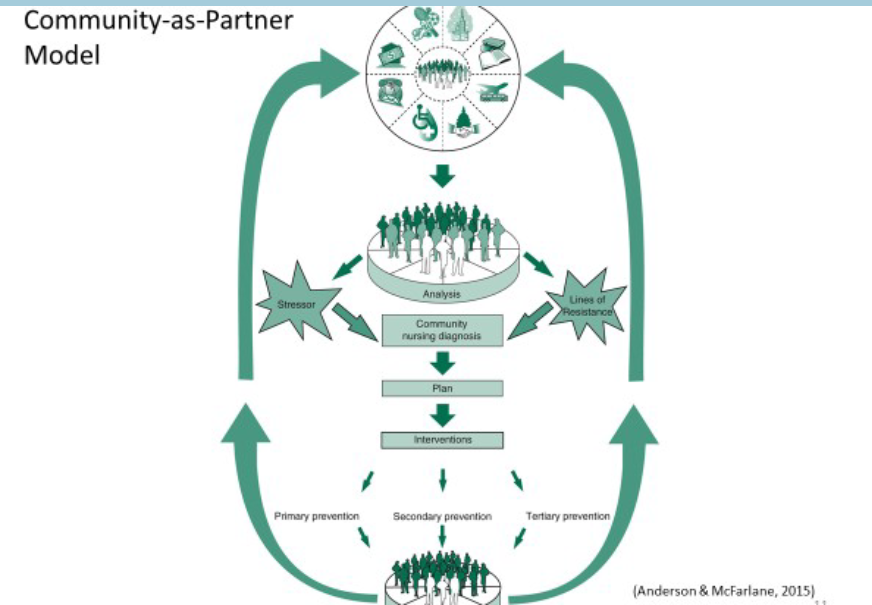
Community as a Partner Model (CAPM)
developed to illustrate public health nursing as a synthesis of public health and nurses
definitions of the four concepts that are central to nursing: person, environment, health, and nursing provide
framework for the community as a partner model
developed by Elizabeth Anderson and Judith McFarlane

Community Assessment Wheel (CAPM)
represents people who make up the community: demographics, their values, beliefs, and history
8 subsystems - influence each other not separate
physical
environment
education
safety and transportation
politics and government
health and social services
communication
economics
recreation
Most understand all subsystems and assessment of people
normal line of defense (solid line) - level of health of the community (eg. high rate of immunity, low infant mortality, middle-income level,)
flexible line - buffer zone representing a dynamic level of health resulting from temporary response to stressors (flooding, unwanted adult bookstore)
Community as Partner Model cont.
degree of reaction - amount of disequilibrium or disruption that result from stressors crossing community’s lines of defense
eg. mortality/morbidity rates, unemployment, or crime statistics
stressors - tension-producing stimuli that have potential of causing disequilibrium
can originate outside or inside the community
penetrate flexible and normal lines of defense - disruption in community
inadequate, inaccessible, or unaffordable services
Community Assessment
comprehensive evaluation of the status of a community based on interactions between people, health, and the environment
important for finding ways to improve health status of a risk populations and conducting outreach activities
allows for community’s strengths, weaknesses, assets, and deficits
examine, psychosocial, biological, and sociocultural influences of the environment
identifies vulnerable populations, determines unmet needs, and document community resources - used to set goals, plan programs for interventions, and evaluate outcomes
informal
Windshield Survey
used to learn about neighborhood in which their client live
descriptive way of understanding what appears to be physical expression of community - through a windshield of car
observe 8 subsystems: economic, physical, educational, safety/transportation, health/social services, communication, politics/government, and recreation