Lecture 18: Bioenergy production using microalgae, part 1
 Call Kai
 Learn
Learn Practice Test
 Spaced Repetition
 Match
Match Flashcards
 Knowt Play
1/36

There's no tags or description
Looks like no tags are added yet.
37 Terms
explain the top 6 reasons we need bio energy
- Climate challenge mitigation (Reduce carbon emission): Bioenergy, in principle, uses CO₂ that was recently fixed from the atmosphere by photosynthesis, so the carbon cycle is much shorter and potentially carbon-neutral
- Renewable energy supply (Sustainable and continuous energy source): fossil fuels are finite. Bioenergy, as long as we have sunlight and biological material, is continuously replenishable
- Energy security (Increased resilience amid geopolitical instability): the reliance on imported fossil fuels make some countries vulnerable in certain situations and crisis- locally produced bio energy reduces this
- Energy diversification (Beyond direct electrification): Liquid and gaseous biofuels are important complements to renewable electricity- may be needed for ex the driving of large shipping vehicles etc that can not be run entirely on electrical power
- Resource valorization (Use of biological residues and side streams): we generate enormous amounts of biological waste — agricultural residues, sewage sludge, food waste. Bioenergy systems, including algae, can use these as inputs rather than just discarding them.
- Circular bioeconomy (Carbon and nutrient recycling): we want carbon and nutrients to cycle continuously
why should we use micro algae as opposed to land crops?
- Alternative to crops
- Lower pressure on arable land and food systems- microalgae can be grown on marginal or non arable land or in oceans etc- eliminating the fuel vs food competition
- Fast growth and high productivity per area- no aditional energy wasting structures- high productivity
- Flexible metabolism and diverse product potential- depending on the environment- elgae can be pushed toward increased production of certain compounds such as accumulation of oils (for biodiesel), starch (for bioethanol) or hydrogen- making them very versatile
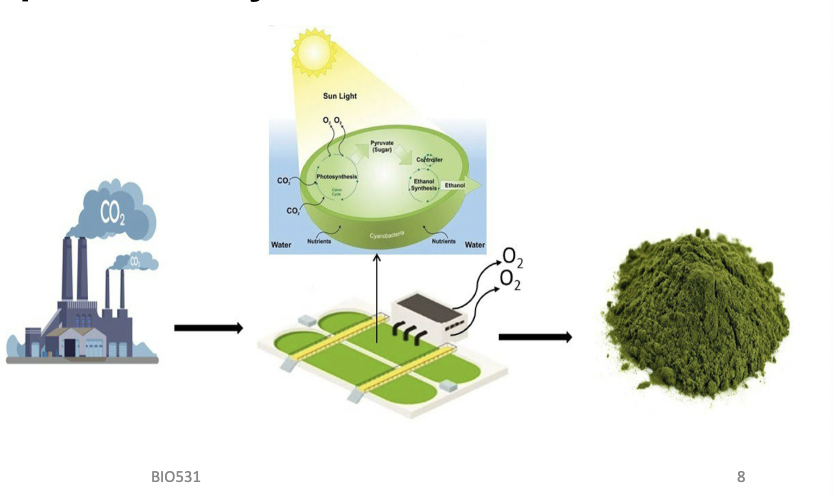
- Potential integration with industrial CO₂ sources- since algae use CO2 for growth, you can link industrial CO2 emissions to micro algae farming as feedstock
- Flexible use of wastewater resources- algae can grow on nutrient rich waste water- simultaneously producing biomass and cleaning the water.
talk about the diversity of microalgae as a biotech platform
· Broad phylogenetic diversity- sincne algae is not a taxanomic group but rather a functional category of photosynthetic microorganisms- the variation in phylogeny and traits vary a lot- drastically different evolutionary lineages means difference in favoured traits among the different species.
· Found in freshwater, marine, and extreme environments
· Large variation in size, morphology, and metabolism
why does diversity matter
· Different species favor different bioenergy routes
· No single strain is ideal for all applications
compare cyanobacteria and micro algae
distinct but related
· Microalgae: eukaryotic photosynthetic microorganisms
· Cyanobacteria: prokaryotic photosynthetic bacteria
· Similar functional roles in aquatic primary production
· Both are relevant in bioenergy
—> Biologically distinct, but often discussed together in applied biotechnology
talk about microalgae as an aquatic production system- advantages?
· Aquatic photosynthetic microorganisms
· Use light, CO₂, water, and nutrients for growth
· Convert solar energy into biomass and metabolites
· Function as living cell factories
—> very suitable for being used as “living cell factories” since microalgae can grow only through input of sunlight, CO2 (eg CO2 emissions from other industries), nutrients and water (eg nutrient rich waste water). One main advantage is that the algae can be manipulated to overproduce target products such as lipids etc- making them very efficient, both from an economical and sustainable perspective.
what are the four trophic modes
photoautotrophic, heterotrophic, mixotrophic and photoheterotrophic.
explain phototrophic microalgae
- Classical mode of algal photosynthesis: uses light as energy source, CO2 as carbon source
- Most relevant to sustainable solar driven biomass production- good on a larger scale production since no purchased carbon source need to be added, as well as sunlight being readily available and free (if utilized outdoors)
- Advantage: sustainable use of light and CO2
- Disadvantage: limited by light penetration: as the culture becomes denser shading ooccur and the inner cells may die due to light deprevation.
explain heterotrophic microalgae
- Uses organic carbon as carbon and energy source (eg sugars).
- Non photosynthetic microalgae
- Do not depend on light
- Can support high cell density (since they do not need sunlight, you can grow these at much higher densities in enclosed fermenters- allowing for simpler harvesting and space efficiency)
- Limited to species able to assimilate organic substrates.
- Advantage: high cell density and easier process to control
- Disadvantage: dependence on costly organic carbon sources
explain mixotrophic microalgae
- Combines photosynthesis with uptake of organic carbon- both using light and CO2 for photosynthesis, as well as assimilating organic carbon as heterotrophes- this can yield higher growth rates and biomass production then either mode alone
- Uses both light and reduced carbon sources
- Can enhance growth and productivity
- offers flexibility, but adds process complexity
- advantage: higher potential productivity and metabolic flexibility
- disadvantage: more operational complexity and contamination risk
explain photoheterotrophic micro algae
- uses light for energy
- organic carbon as carbon source (can not fix inorganic carbon- CO2, unlike mixotrophes)
- less commonly emphesised than other modes
- useful fo runderstanding metabolic flexibility
- advantage: flexible use of light with organic carbon assimilation
- disadvantage: limited practical rlevance for large scale bioenergy systems
explain Chlamydomonas reinhardtii as a model microalga:
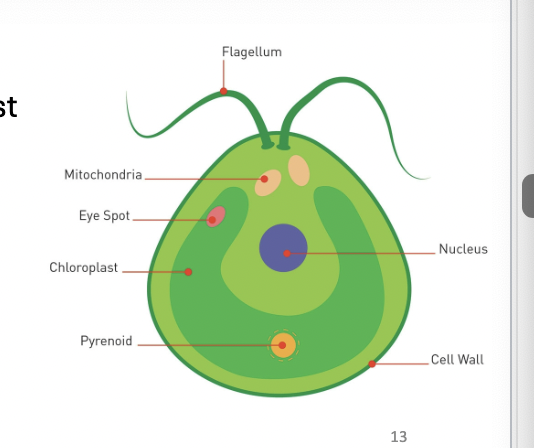
- Unicellular green microalga
- Grows under multiple trophic conditions: photoautotrophic, heterotrophic, and mixotrophic- ideal for trophic mode studies.
- Important model for photosynthesis and chloroplast biology
- Links fundamental biology with applied bioenergy research
—> it also has a fully sequenced genome, is easily transformed and has a very well studied photosynthetic machinery
what are the main micro algal cultivation modes
Batch, Fed-batch, semi continuous, continuous and two stage cultivation.

describe batch cultivation
- Closed culture sustem with no medium replacement during growth
- Cells grow through lag, exponential and stationary phases (due to the limited nutrient supply)
- Simple and widely used in research and lab scale studies: good because they are technically simple and reproducable however not optimal fo rinustrial production because of the declined growth rate over time.
- Advantage: simple operation and low technical complexity
- Disadvantage: productivity declines as nutrients are exhausted
describe fed-batch cultivation
- Culture starts as batch, but then selected nutrients are added over time: (without any culture being removed- you can eg push the algae to produce a larger amount of certain limitation linked compounds such as induce higher lipid production by adding the needed nutrients for growth, while limiting the nutrient supply of certain nutrients such as nitrogen- stress encourages lipid accumulation without halting growth)
- Extends growth phase and improves control over nutrient supply
- Can reduce nutrient limitation and increase biomass yield
- Advantage: better conrol of growth and biomass accumulation (compared to batch cultivation)
- Disadvantage: more complex operation then batch cultivation: (nutrient levels need to be monitored etc)
describe semi continuous cultivation
- Part of the culture is periodically removed and replaced with fresh medium: (This way, nutrients are replenished, cell density is kept manageable, and the culture remains in active growth rather than crashing into stationary phase.)
- Maintains the culture in a productive growth phase
- Often used in pilot-scale and applied cultivation studies (it is more productive since the nutrient supply is never fully exhausted – but still more simple than continuous cultivation since you do not need constantly running pumps)
- Advantage: more stable productivity over time
- Disadvantage: require regular intervention and process monitoring
describe continuous cultivation
- Fresh medium is continuously added while culture is continuously removed: fresh medium is constantly added simultaneously as the same amount of culture is constantly removed- replacement of nutrients and cells constantky- keeping conditions and growth rates almost constant.
- Maintains cells near a steady state growth condition
- Highly useful for physiological studies and steady biomass production
- Advantage: stable growth conditions and sustained productivity
- Disadvantage: technically demanding and more sensitive to contamination
—> the rate of which new medium is added is called the dilution rate: by adjusting the dilution rate you can control the growth rate of the cells- good for studying how nutrient limitations etc impct the growth rates of algae. At steady state, the rate of cell growth exactly matches the rate of cell washout, so cell density, nutrient concentrations, and metabolic state remain constant
explain two stage cultivation
- Growth is seperated into two phases with different objectives
- Stage 1) maximise biomass production
- Stage 2) induce accumulation of target compounds or desired traits
- Common strategy for improving productivity and product quality
- Advantage: balances high biomass yield with targeted product formation
- Disadvantage: more complex process design and operation
—> the conditions that maximise cell growth are often not the same conditions that maximise product accumulation. For example, nitrogen is essential for cell division and protein synthesis, so if you want maximum growth, you keep nitrogen high. But lipid accumulation in many algae is triggered by nitrogen starvation. for eg biodiesel production you want hich lipid contents- in order to maximise the biomass yield as well as lipid accumulation you grow the algae in two phases- first favourable conditions with high growth rates, followed by stress conditions where the cels are deprived of nutrients and start accumulation lipids as a stress response.
what are the two forms of bio energy derived from micro algae
- biomass based energy: biodiesel, bioethanol, biogass/biomethane, thermochemical fuels. Biomass derived meaning that you grow the algae- then harvest its biomass and convert it into fuel- ie the energy is stores in the algae but the conversion to energy happens after harvesting)
- process based as well as biomass based energy: Hydrogen, H2: process based meaning that the energy, H2 is produced directly by the cell, you capture the energy without harvesting the biomass.

rank the algal biofuels based on Relative carbon intensity of the fuel: ie how much CO2 is released per unit of energy produced from the fuel. From highest to lowest
- Biodiesel → relatively higher carbon intensity: composed of lipids, hence releases substancial amounts of CO2 in combustion.
- Bioethanol → intermediate: lower carbon to hydrogen ratio compared to biodiesel (which contain long hydrocarbon chains) hence releases less CO2 in combustion
- Biogas → lower carbon intensity among carbon-based fuels: has a high energy to carbon ratio and hence efficient
- Thermochemical fuels → variable, depends on composition
- H₂ → no carbon, no CO₂ release- when it burns it produces only water vapour- clean energy with zero CO2 emissions.
explain micro algal biodiesel
- A liquid fuel made from oils or lipids
- Mainly derived from triacylglycerols (TAGs)
- A renewable alternative to petroleum diesel
—> one advantage is that existing diesel driven engines can be run on biodiesel as well. Many microalgae species start accumulating high amounts of lipids (TAGs) under stress conditions (especially nitrogen deprivation)
explain the biodiesel production process
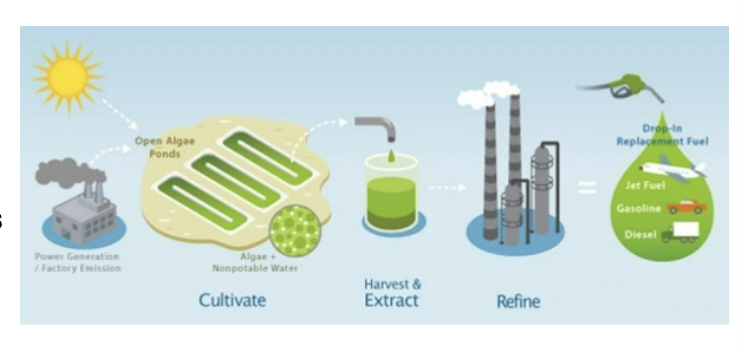
- Cultivation of lipid-producing microalgae: lipid rich strain is grown under conditions that promote lipid accumulation. (nitrogen limitation being most common- when nitrogen is limited cells start redirecting carbon into TAG (lipid) storages)
- Harvesting: Getting the algal cells out of the water- challenging- costly and energy intensive process.
- Lipid extraction from algal cells: the lipids need to be extracted from the algal cells- costly process.
- Conversion of lipids into biodiesel by transesterification: the extracted lipids (TAGs) are chemically reacted with an alcohol in the presence of a catalyst to produce biodiesel (and glycerol as by product)
describe the challenges with algal biodiesel
- High lipid content often comes at the expense of growth: the conditions that maximise lipid accumulation also slow/stop cell growth. Both can not be maximised at the same time.
- Harvesting and drying are expensive: very large amounts of water needs to be processed
- Lipid extraction adds further processing cost: breaking the algal cell walls and successfully getting the lipids out is tchnically challenging and costly
- Large-scale fuel production is difficult to make economically competitive- either the biodiesel production costs need to be significantly reduced, or the price of regular diesel needs to increase.
- Often more realistic within a biorefinery concept: by extracting not only biodiesel from the algae, but multiple valuable products, such as pigments, proteins, omega 3 fatty acids alongside to the biodiesel, the economics could work even when fuel prices (regular diesel) are low
describe micro algal bio ethanol
- An alcohol-based liquid biofuel
- Mainly produced from carbohydrate-rich biomass
- Polysaccharides are hydrolyzed to sugars and then fermented to ethanol
- Biomass derived biofuel route
- Attractive in principle, but dependent on pretreatment efficiency (theoretically good substitution to wood/straw usually used for ethanol production since microalgae do not contain lignin (expensive to break down) – however algae also have rigid cell walls which complicates the pre treatment- the ethanol yields are lower compared to sugar cane)
explain the bioethanol production process step by step
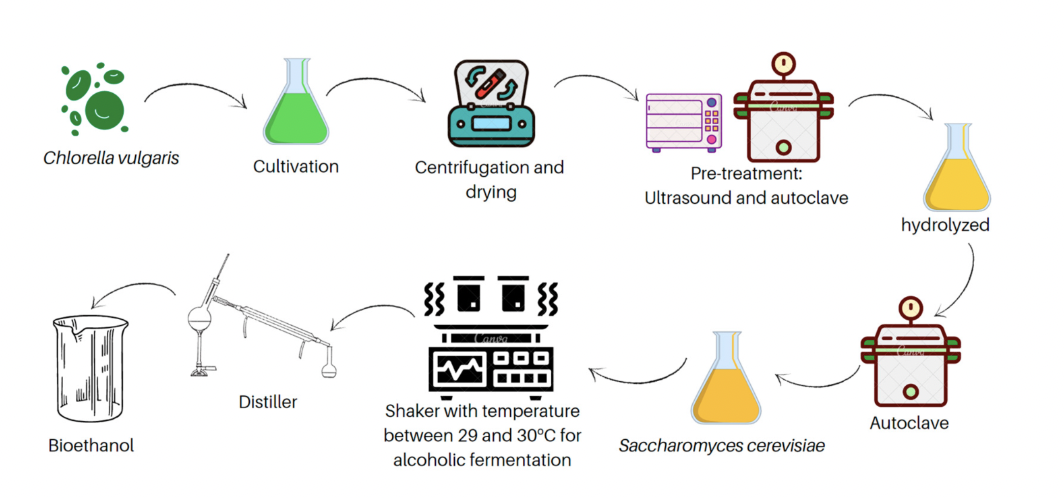
1) micro algae cultivation- growing carbohydrate rich strains. 2) centrifugation/”harvesting”- concentrating the biomass. 3) drying: reducing water from the algae. 4) pre-treatment/cell disruption: breaking the cell wall and making the carbohydrates accessible through ultrasound and autoclave- energy intensive. 5) hydrolysis: enzymatic or acid based conversion of polysaccharides into fermentable sugars. (additional step: autoclave to sterilise?) 6) alcoholic fermentation: with either yeast or bacteria at controlled temperature and pH- produces ethanol from the sugars. 7) distillation: the fermented broth is distilled to concentrate and purify the ethanol. —> bioethanol is produced
explain bioethanol challenges
- Carbohydrate availability depends on species and cultivation conditions: carbohydrate content vary among different species- could be sensetive to light, CO2 levels and growth phases- the right conditions need to be found and managed.
- Pretreatment may require extra energy, chemicals, or enzymes: rigid cell walls require pre treatments prior to fermentation in order to make the carbohydrate contents accessible
- Harvesting and dewatering still add cost
- Ethanol route competes with other uses of algal biomass: the carbohydrates in algae could eg be directed to animal feed- competes with those markets since the biomass directed to ethanol production is essentially “lost” to that cause
- Often more attractive in integrated biorefinery systems: as with biodiesel, co-producing ethanol alongside proteins and pigments in a biorefinery framework is the most economically rational approach.
explain bio-H2 through fermentation (Biomass derived)
- The biomass-derived route for H₂ production
- Occurs in the absence of light and oxygen (anaerobic fermentation)
- Use algal biomass or algal hydrolysates: you grow algae to accumulate biomass, the biomass is then used ass feedstock for microbial fermentation which produce H2. The algae themselves are not the ones producing the H2- but rather the food to the H2 producing microbes.
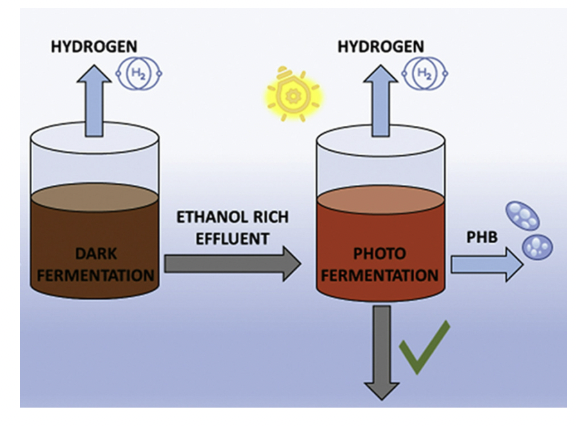
explain bio-H2 through fermentation production process
Bio-H2 through fermentation production process: 1) algal biomass (the feedstock in this case) is pretreated through hydrolysis to break complex biomolecules into simpler fermentable sugars (eg polysaccharides into simple sugars such as glucose- improves microbial accessibility). 2) Dark fermentation: The fermentable sugars are converted by anaerobic microbes in the absence of light which result in H2, CO2 and organic acids. 3) Photo-fermentation: the organic acids and residual organics from the dark fermentation are further processed by photosynthetic bacteria under lgiht conditions- here the organic acids are consumed, additional H2 is generated and more CO2 is released.
—> the system combines dark fermentation with light fermentation to maximise the H2 production and utilization of the biomass.- the dark fermentation mainly produce rapid initial H2 production, whereas the photo fermentation produces some additional H2 from fermentation by (products from the initial fermentation). The end products are H2, CO2 and residual organic matter

explain the challenges with bio-H2 from fermentation
- Low H₂ yield → incomplete conversion of substrate energy: much of the energy stays locked in the organic acid byproducts- photo fermentation recovers some of that- but not all of it.
- Byproduct formation → reduced overall hydrogen recovery
- Pretreatment requirement → added cost and process complexity: as with bioethanol the algal cell walls need to be broken prior to fermentation- costly
- Process sensitivity → strong dependence on operating conditions: dark fermentation is highly sensitive to conditions such as pH, temperature etc- keeping all of these optimal constantly could be difficult.
- Scale-up limitations → difficult economic feasibility: the two coupled biological systems could be hard to scale up in practice
explain biogas- advantage?
- A gaseous biofuel resulting from anaerobic digestion of organic matters
- 45%–75% Methane (CH₄)
- The rest CO₂
—> anaeobic digestion is the most complete form of energy recovery from biomass: almost all organic matter can be digested including whole algal cells (not just lipids/carbohydrates) and you get biogas which can be used for heat and electricity, you can get eg biomethane which can be used for fuel. The organic byproducts from the digestion (= the digestate) can be used as fertiliser etc closing the nutrient loop
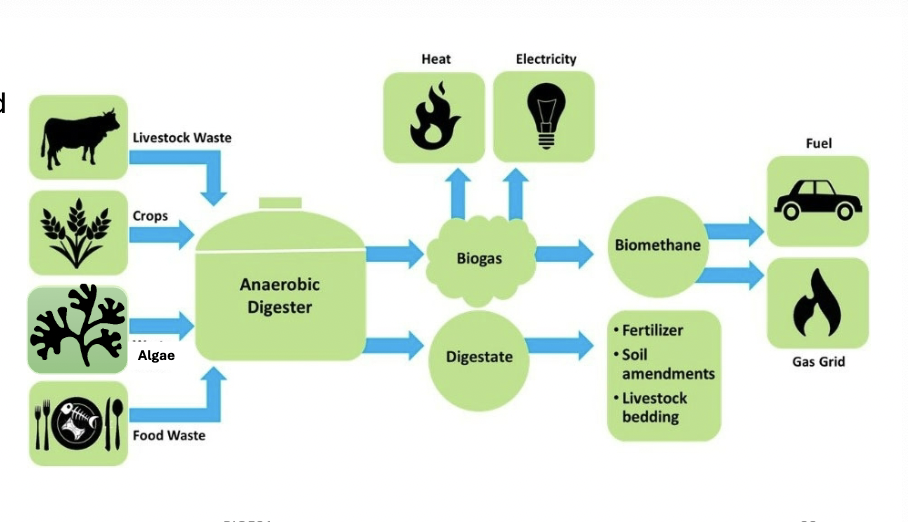
explain the biogas production process
- Anaerobic digestion of organic matters into methane
- Methanogenesis: acetic acid, H2 and CO2 being converted into methane CH4 and CO2 by two kinds of archaea
- The most complete form of energy recovery from the biomass
—> organic feedstock such as livestock waste, crops, algae or food waste is hydrolyzed by bacteria: complex polymers (proteins, carbohydrates and lipids) are broken down into monomers (amino acids, fatty acids, sugars). The monomers are then processed and converted by acidogenic bacteria into volatile fatty acids (VFAs) and alcohols which is then further converted by acetogenic bacteria into acetic acid (acetate), H2 and CO2. The acetate, CO2 and H2 is then converted into methane by methanogenic archae in the methanogenesis process: two groups of archaea are involved in the methanogenesis: acetoclastic archaea which convert acetic acid into methane (and CO2), along with hydrogenotrophic archaea which uses H2 and CO2 and convert that to methane (and water)
—> biogas production is a multi-organism, multi-step process, and maintaining the right balance of microbial communities is essential for stable, high-yield methane production.

describe the challenges with biogas
- Low digestibility → resistant cell walls can limit methane formation: many microalgal species have very ough cell walls- without disruption of the cell wall through pre treatment a lot of biomass risks to pass without being digested
- Ammonia risk from protein-rich biomass → may inhibit anaerobic digestion: algaea are protein rich which becomes a problem since ammonia is released in protein breakdown At high concentrations, ammonia is toxic to the methanogens
- High water content → dilute biomass complicates handling and processing
- Process stability → digestion depends on balanced microbial consortia
- Methane yield optimization → performance varies strongly with species and pretreatment: the right conditions need to be kept in order to keep productuvity of all the involved communties of species
explain thermochemical fuels
- Biomass-derived route based on heat-driven conversion
- Converts algal biomass into energy-rich solid, liquid, and gaseous products
- Does not rely on microbial metabolism: Instead of using microorganisms or enzymes to convert biomass, you use high temperature and pressure to break down the organic material chemically.
- Common applications: heat and power, fuel upgrading, industrial energy and synthesis
explain the thermochemical fuel production process- what are the three ways- describe them
Three main processes for algal biomass:
- Torrefaction: mild heat treatment (200–300°C) in the absence of oxygen. Produces a solid, coal-like material (biochar/torrefied biomass) with higher energy density than raw biomass.:
- Pyrolysis: thermal decomposition at 400–600°C without oxygen. Produces both: a liquids such as aromatics, alcohol, phenols etc , and a solid (biochar).
- Gasification: high-temperature (600–1000°C) conversion with limited oxygen or steam. Converts biomass almost entirely to a gaseous compounds such as H2, CH4, CO2 etc, which can be burned directly or used for chemical synthesis, along with some liquids.

summarise the temperature gradient and products from the three thermochemical fuel production
temperature gradient: torrefaction is the mildest, gasification is the most extreme. As temperature increases, you get progressively more gas and less solid/liquid product. All of the processes occur under near athmospheric pressure,
torrefaction → solid biochar; pyrolysis → liquid bio-oil; gasification → gaseous syngas (H₂ + CO).

what do the biomass based biofuels have in common
- Microalgae can support several biomass-derived bioenergy routes: These include biodiesel, bioethanol, biogas/biomethane, fermentative H₂, and thermochemical fuels
- In all of these cases, biomass is produced first and then converted—> But microalgae can also generate energy through a different logic—> process-based H₂ production by living cells