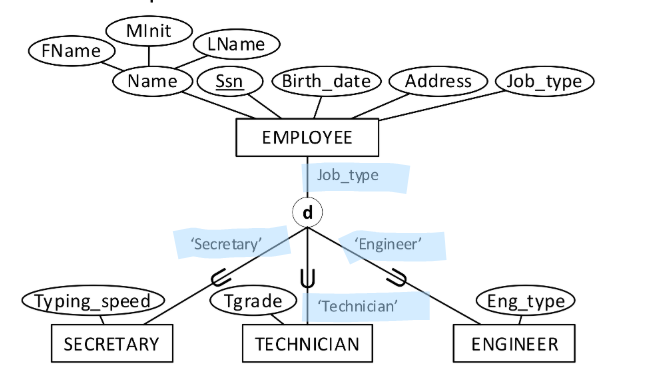
IE 4/512 Midterm 1 Content
 Call Kai
 Learn
 Practice Test
 Spaced Repetition
 Match
 Flashcards
 Knowt Play
1/84

There's no tags or description
Looks like no tags are added yet.
85 Terms
Define “data”
Known facts that can be recorded and have implicit meaning
What is a “database”?
A collection of related data
What is a “miniworld”?
Some part of the real world about which data is stored in a database
What is a Database Management System (DBMS)?
A general-purpose software that facilitates in defining, constructing, manipulating, processing, and sharing databases among various users and applications.
What are some characteristics of a database?
Logically coherent
Data has inherent meaning
Built for a specific purpose
What is a database system? What can you do on a database system?
A platform with the DBMS software and the data itself
Issue queries or complete transactions
What does it look like to define a particular database?
Split it up in terms of its
Data types
Structures
Constraints
What does it look like to construct or load a database?
“Instantiating” a database. load the database’s contents on a secondary storage medium (DBMS)
What are two ways to manipulate a database?
Retrieval
Modification
What does it mean to retrieve information from a database?
Generate reports through queries
What does it mean to modify a database?
Initiate insertions, deletions, or updates to the contents of the database.
What is a database query?
Accessing different parts of the data to create a result after a request
“Asking a question” to the database
Is a query the same as a simple search?
No
Are changes made to the data during a query
No
What is a database transaction?
Making changes to a database by updating certain values, or generating new data to store in the database
In what way is a transaction a modified query?
There is a question asked to the database but that question changes something in the database
Define scalability
The process of keeping up with changing user requirements as more information is updated
What are business rules in database design?
Logical statements which describe the relationship between entities in a conceptual schema.
What is a DBMS catalog? And what does it store?
A place that stores the description (metadata) of a particular database
Structures
Types
Constraints
What is metadata?
Data that provides information about other data
“Data about data”
What can the DB approach be compared to?
A file processing approach
Customized programs are written to access the data stored in files
What does it mean for a database to contain a single repository?
A single place where data is modified once and then access by various users through queries and transactions
What is Program Data Independence? And what does it allow for?
In which the structure of the data files in the DBMS catalog is stored separately from the access programs.
Changing data structures/organization without changing the DMBS access programs
What is a Data Abstraction?
A diagram which represents the structure of the data
Define what a data model is
A set of concepts that describe the structure, operations, and constraints, of a database.
How are constructs used in a data model?
Used to define the database structure
What is the purpose of a data model? What do the constructs in them contain?
To hide storage details and show users a conceptual view of the database
Objects and Object Properties
Elements (and their data types)
Groups of Elements (ATTRIBUTES)
Relationships among such groups
What are data model operations?
Actions used to specify database retrievals and updates by referring to the constructs of the data model
What are the basic model operations?
Inserting Data
Deleting Data
Updating Data
Name two examples of user-defined data model operations
“Compute-Student-GPA”
“Update-Inventory”
What is a conceptual data model? And what can they include?
A conceptual overview that allows users to understand the data and relationships within the system (E-R Diagram)
Entities
Attributes
Relationships
What is a physical data model?
A way to provide concepts that describe details of how the data is stored in the computer
Usually specified through DBMS design and admin manuals
What is an implementation data model?
A way to provide concepts that fall between a physical and conceptual data model
Used in many commercial DBMS implementations
What’s the benefit in supporting multiple views of the data?
Each user can see a different view of the database, seeing data of interest to the user
What are three benefits to sharing data, and multi-user transaction processing?
Many users to retrieve information from and update the database
Concurrency control
Recovery
Online Transaction Processing (OLTP)
Define Concurrency Control
Each transaction is correctly executed or aborted
Define Recovery Subsystem
Each completed transaction has it's effect permanently in the database
Define Online Transaction Processing (OLTP)
Allows hundreds of concurrent transactions to occur per second
What is redundancy and why do we want to reduce it in database design?
The presence of the same data in multiple places. We want to decrease:
Duplication effort
Wasted storage space
Inconsistencies
What is an integrity constraint and how can we implement it in a database?
A way of restricting the attributes of a database. You do this by
Having a data type for each item
Restricting value ranges
Having key's or uniqueness
Referential Integrity
What is a Database Schema? And what does it include?
A description of a database
Database structure
Data types
Constraints
What is another name for a database schema?
An intention (permanent, independent of time)
What is a schema diagram?
An illustrative display of most aspects of the database schema
What is a schema construct? Name an example of the miniworld of a university course system.
A component of the schema , or an object, within the schema
STUDENT, COURSE

What is a database state? What is another name for it?
All the actual data stored in a database at a particular moment in time.
Also known as an “instance”, “occurrence”, or “snapshot”
What is an initial database state?
The database state when it is initially loaded into the system.
What is a valid database state?
A state that satisfies the structure and constraints of the database.
At what rate does a database schema change?
Very infrequently
At what rate does the database state change?
Every time the database is updated.
What is a Data Definition Language (DDL)?
A language used to set up the physical description/conceptual schema of the database.
Set SQL commands like CREATE, ALTER, DROP
What is a Data Manipulation Language (DML)?
Used to specify database retrievals and updates (queries + transactions).
SQL stands for
Structured Query Language

Outline the database conceptual design process
First design the Model which contains the rules for structuring data and concepts used to describe a set of data.
Then the schema which contains the perception of data in reality (general structure of the data)
Then the instance which gives a description of reality at a given time

What is an entity
Specific things or objects in the miniworld that are represented in the database
Could be physical or conceptual
What are attributes, and what could they include?
Attributes are properties used to describe an entity
List the different kinds of attributes
Simple
Composite
Multi-Valued
What is a simple attribute?
Each entry has an atomic value for the attribute
What is a composite attribute?
The attribute may be composed of many elements
Example:
Address can have apartment number, street, city, zip, etc.
Name can have first name, middle name, last name
What is a multi-valued attribute? State an example.
An entity that has multiple values for that attribute
Example:
Color of a var, or PreviousDegrees of a STUDENT
What are NULL values for attributes? List an example or two.
An entity does not have an applicable value for that attribute
Example
Phone extension
Apartment number
What is a key attribute?
An attribute of an entity type for which each entry must have a unique value

What is an entity set, and how many sets are listed in this image?
Each entity set has a collection of entities stored in the database (described in subscripts)
This example has THREE CAR entity instances in the entity set for CAR

What is a value set? What is an example of one?
Specifies the set of values associated with an attribute
Example:
LastName has a value which is a character string up to 15 characters
Date has a value consisting of MM-DD-YYYY where each letter is an integer
What is a relationship?
A verb that relates two or more distinct entities with a specific meaning
Works
Manages
Participates
What is a relationship set? What can you create with it?
The current set of relationship instances represented in the database
These instances create a Relationship Instance Diagram
What are structural constraints (constraints on relationship types)?
Cardinality ratios and existence dependency constraints that are determined by the miniworld situation that the relationships represent.
What is a cardinality constraint?
specifies the max number of relationship instances that an entity can participate in
What is an existence dependency constraint?
Specifies if the existence of an entity depends on it being related to another entity instance through the relationship type.
What is a recursive relationship type? Name an example.
A relationship type between the same participating entity type in distinct roles
Example:
Employee participates twice in two distinct roles
Supervisor (or boss) role
Supervisees (or subordinate) role
What is a weak entity type?
An entity that does not have a key attribute and is identification-dependent on ANOTHER entity type
What is unique about the relationships surrounding a weak entity type?
A weak entity type always has a total participation constraint with respect to its identifying relationship

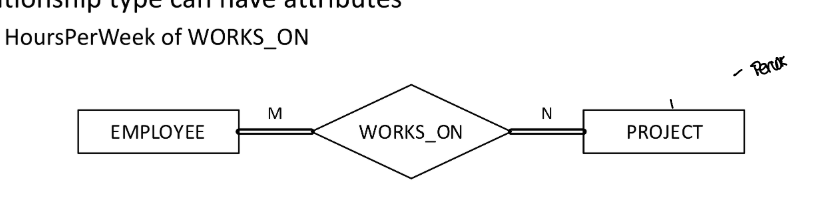
A relationship type can have ___. Explain how this is shown in the following diagram
Can have attributes.
Here the value of the attribute for each relationship instance describes the number of hours a week that an EMPLOYEE works on a PROJECT.
Like filling out a data table with the two entities in them.

What kinds of relationship types can you have in the higher degree?
Degree 1 called unary
Degree 2 called binary
What we have studied so far
Degree 3 called ternary
Degree n called n-nary
What is a unary relationship?
A relationship between the instances of a single entity type, you can have a one-to-one or one-to-many relationship. But it is the same entity

What is a binary relationship?
The relationship between the instances of two entities

What is a ternary relationship?
The simultaneous relationship between three entities

What’s the difference between relationship constraints for E-R and EE-R database models?
Existence vs. Membership
How are EE-R diagrams split up?
Subclasses/Superclasses
Specialization/Generalization
Categories
Attribute and Relationship Inheritance
What connects an entity in a subclass with an entity in their superclass?
Inheritance
What is specialization? What is this process based on?
The process of defining a set of subclasses of a superclass
Based on distinguishing characteristics of the entities in the superclass
What do you call an attribute associated to an entity in a subclass?
Specific or Local attribute
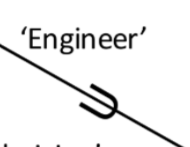
What does this “U” symbol refer to? And what is it pointing to?
A proper set. It is placed on top of a subclass pointing to its superclass
What is Generalization?
A processes in which many classes with common features are generalized into one superclass. The reverse of specialization.
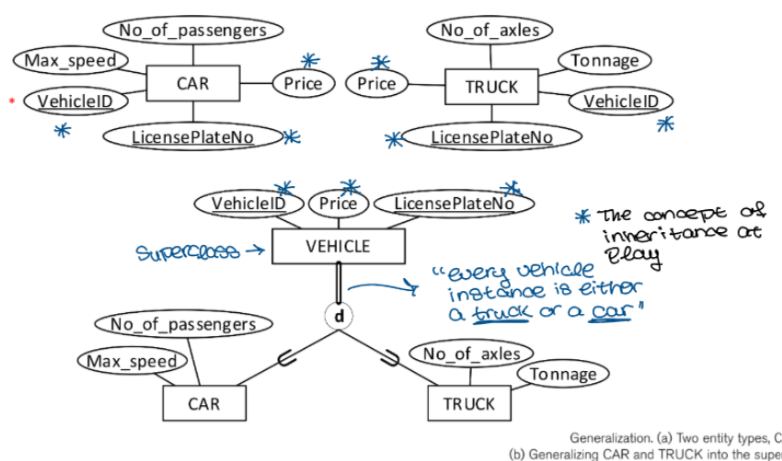
What does it mean for an entity to be predicate-defined?
A type of specialization defined by placing a value of some attribute to an entity in a subclass.

What does it mean for an entity to be attribute-defined?
All subclasses in the specialization have their membership condition based on the same attribute of the subclass.