Botany 440: Lecture Exam 2
 Call Kai
 Learn
 Practice Test
 Spaced Repetition
 Match
 Flashcards
 Knowt Play
1/27

There's no tags or description
Looks like no tags are added yet.
28 Terms
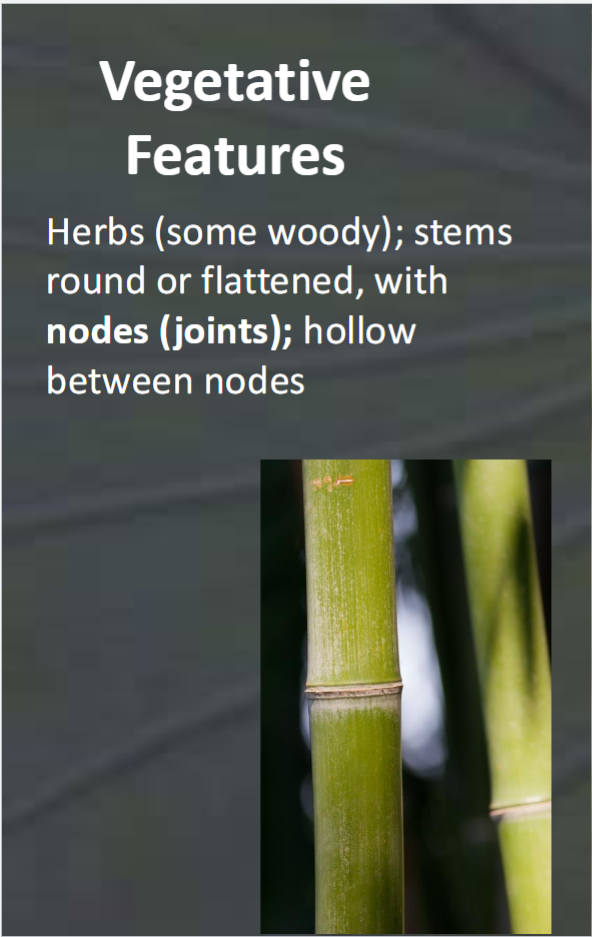
Poaceae (monocot)
Poaceae Floret

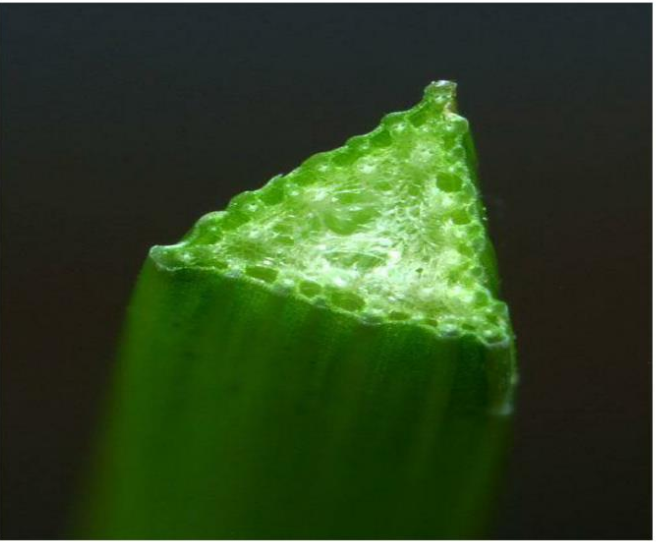
Cyperaceae

What is the largest genera in Poaceae and Cyperaceae?
What are the distinguishing traits among Poaceae, Cyperaceae, and Juncaceae?
Grasses (Poaceae)
Hollow stems with nodes, spikelets, caryopsis, widespread and ecologically dominant
Sedges (Cyperaceae)
triangular stems, bracted flowers, achene, adapted to wet habitats
Rushes (Juncaceae)
round stems, tepals, capsule fruits, prefer moist or waterlogged soils
What are important plants in Poaceae?
Corn/maize (zea)
Wheat (triticum)
Barley (hordeum)
Rye (secale)
Oats (avena)
Rice (oryza)
Bamboo (many genera)
Bluegrass (poa)
Reed (phragmites)
Sugarcane (saccharum)
What are the Asteraceae head types?
Radiate Head
Ligulate Head
Discoid Head

What is the size (in number of species) of the Asteraceae family compared to other angiosperm families?
Asteraceae: Major Traits to Know
Inflorescence:
Flower (and its parts):
Fruit:
What is the largest genus in the Euphorbiaceae family?
What are important plants in Euphorbiaceae?
Poinsettia and Euphorbs (euphorbia)
Castor Beans (ricinus)
Cassava and Manihot (manihot)
Rubber Tree (hevea)
Euphorbiaceae: Major Traits to Know
Leaves (with milky sap):
Inflorescence (cyathium):
Floral Parts:
What are important plants in Polygonaceae?
Rhubarb (rheum)
Buckwheat (fagopyrum)
Smartweed
Persicaria (polygonum, persicaria, fallopia)
Sorrel (rumex)
Highly Invasive Species: Japanese Knotweed (reynoutria japonica)
Polygonaceae: Major Traits to Know
Stems with swollen nodes
Presence of Ocrea and Ocreoles
Tepals present
What is the largest genus in Solanaceae?
What are important plants in Solanaceae?
Potato/Tomato (solanum spp.)
Chili Pepper/Sweet Pepper (capsicum)
Angel Trumpet (brugmansia)
Tobacco (nicotiana)
Petunia (petunia)
Tomatillo (physalis)
Jimsonweed (datura)
Solanaceae: Major Traits to Know
Leaves alternate, often lobed or compound
Sepals: 5, fused
Petals: 5, with varying degrees of fusion, corolla can be star-, trumpet-, funnel-shaped or tubular
Stamens: 5, anthers often connivent, somtimes fused or free
Epipetalous stamens
Superior Ovary, axile placentation
What is the largest genus in Lamiaceae?
What are important plants in Lamiaceae?
Basil
Mint
Sage
Thyme
Rosemary
Lavendar
Catnip
Dead Nettle
Coleus
Lamiaceae: Major Traits to Know
Aromatic, with essential oils; often hairy, with glandular hairs
Leaves opposite, simple, arranged at 90 degrees
Stem usually quadrangular
Flowers in groups forming verticillasters
Corolla 2-lipped, gynobasic style
Fruits: 4 nutlets hidden inside the calyx
What are the economically important members of Arecaceae?
Cocos nucifera
Elaeis spp.
Arecaceae: Major Traits to Know
Leaf Types: pinnate, palmate, costapalmate
Why is a coconut considered a drupe?
It has the three distignuishing layers - exocarp, mesocarp, and hard endocarp enclosing a seed
Orchidaceae: What are the native lady-slipper orchids discussed in lecture?
Cypripedium Reginae (Showy Lady-Slipper)
Cypripedium Calceolus (Yellow Lady-Slipper)
Both have highly modified petal/pouch
What is the total number of species and size of the Orchidaceae family compared to other angiosperm families?
Second largest angiosperm family
~30,000 species (divided into nearly 750 genera)
Orchidaceae: Major Traits to Know
Perianth with labellum, column, anther cap, pollinia, viscidium, rostellum
Orchid Flower Resupination: describe this trait

Taxonomic Nomenclature and Database: What are the differences between Synonym, Homonym, and Basionym?
Synonym
A scientific name for a taxon that is not accepted under the rules of nomenclature
If there are multiple names for a taxon, only one name is valid and the others are synonym
Homonym
A single scientific name applied to two different taxa
Only one name can be legitimate; the other one must be renamed/replaced
Basionym
“An earlier valid scientific name of a species that has since been renamed and from which the new name is partially derived”
Taxonomic Nomenclature and Database: What are the differences between a checklist, flora, taxonomic revision, and a monograph?
Checklist
Lists accepted names and synonyms for a region or group
Includes authors, publication info, sometimes distribution
Flora
Regional or national database
Include identification keys, descriptions, distribution
Essential for biodiversity inventories
Taxonomic Revisions
Updates classifications for a specific group
Evaluate morphological and molecular data
Provide keys, synonym, distribution
Monograph
Comprehensive treatment of an entire genus or larger group
Global scale
Include: species accounts, keys, maps, illustrations, phylogenies
Taxonomic Nomenclature and Database: What major floras of the U.S have we used in lab?
Taxonomic Nomenclature and Database: Global Floras and Checklists
