USP 797 - Facilities & Engineering Controls: Part 1
 Call Kai
 Learn
 Practice Test
 Spaced Repetition
 Match
 Flashcards
 Knowt Play
1/18

There's no tags or description
Looks like no tags are added yet.
19 Terms
airbone contamination and air quality
USP <797> requires sterile compounding facilities to be designed to help minimize airborne contamination:
the anteroom, buffer room, and SCA must be separated from areas not directly related to compounding
critical factors that may affect air quality:
number of personnel in the compounding area and adjacent areas
personnel movements
the number and complexity of the operations being performed
equipment, supplies, and components used
sterile compounding facilities must be designed and controlled to provide a well-lit and comfortable working environment
exposing critical sites to air
exposing critical sites to air can subject the CSP to particulate contamination, including microorganisms
critical sites are locations that include component or fluid pathway surfaces or openings that are exposed to and at risk of direct contact with:
air (e.g., ambient room air, HEPA-filtered air)
moisture (e.g., oral or mucosal secretions)
touch contamination
examples of critical sites:
vial septa
injection ports
opened ampules
needle hubs
room air can have 35 million or more microscopic particles per cubic meter (e.g., bacteria, spores, and fungi)
personal garb cannot protect critical sites from contamination by airborne contaminants
to help reduce the risk fo airborne contamination, USP <797> requires category 1, category 2, and category 3 sterile compounding—with the exception of immediate-use CSPs—to occur in areas where the amount of particulate contamination in the air is controlled
air quality—ISO
determining air quality:
international organization for standardization (ISO) standards classify air by the number of particles per cubic meter
ISO class 1 air contains the fewest number of particles, and ISO clas 9 contains the greatest number of particles
areas where the air quality is controlled are sometimes called classified areas
areas where the air quality is not controlled are called unclassified areas
high-efficiency particulate air filtration (HEPA) is classified ares is designed to remove 99.97% of air particles measuring 0.3 micron or greater
the 0.03% or less of particles that do penetrate the HEPA filter can still constitute a signifcant number
although the air in classified areas is cleaner than room air, it is not sterile
UPS <797> specifies that air quality must be at least ISO class 5, ISO class 7, or ISO class 8, depending on the area
ISO classifications
secondary engineering controls (SECs) are areas or rooms that lead to and contain the ISO class 5 PEC
they include cleanroom suites (i.e., anteroom and buffer room) and segregated compounding areas (SCAs)

DCA (direct compounding area): the most critical area in any sterile compounding facility is the direct compounding area (DCA) located within the PEC. the DCA is where the manipulation and preparation of CSP occur and where critical sites are exposed to air
compounding within the DCA helps protect critical sites, such as exposed vial septa, injection ports, beakers, opened ampules, and other sterile fluid pathways or components, from potential contamination
primary engineering control (PEC) ISO class 5: PECs are devices or zones located within the buffer area that provide an ISO class 5 enviroment for the exposure of critical sites when compounding. the ISO class 5 air in PECs has no more than 3520 particles of greater than or equal to 0.5 micron per cubic meter. this is 10000 times fewer airborne particles than typical room air
types of PECs include laminar airflow system (LAFS), integrated vertical laminar flwo zone (IVLFZ), biological safety cabinents (BSCs), restricted access barrier systems (RABSs), and pharmaceutical isolators
category 1, category 2, and category 3 CSPs must be prepared in an ISO class 5 or better PEC
buffer room - ISO class 7: you then go through a door into the buffer area. this room, classified as ISO class 7, has air with no more than 352,000 particles of greater than or equal to 0.5 micron per cubic meter. this is 100 times fewer airborne particles than typical room air.
this is also where the ISO class 5 PEC is located, commonly known as a “hood".” activities in the buffer room must be controlled to minimize any effects on air quality in the area where CSPs are prepared
anteroom - ISO class 8 or cleaner: this is an ISO class 8 or cleaner room with fixed walls and doors. personnel hand hygiene, garbing procedures, and other activities that generate high particulate levels may be performed here
the anteroom is a transition room between the unclassified area of the facility and the buffer room. the anteroom’s air has no more than 3,520,000 particles of greater than or equal to 0.5 micron per cubic meter. this is 10 times fewer particles in the air than typical room air
cleanroom suites
additional USP <797> requirements for cleanrooms:
the ISO-classified anteroom and buffer room must be separated from the surrounding unclassified areas of the facility by fixed walls and doors
controls must be in place to minimize the flow or lower quality air into the more controlled areas
air supplied to the cleanroom suite must be introduced through HEPA filters that are in the ceiling of the buffer room and anteroom
air returns in the cleanroom suite must be low on the wall unless a visual smoke study demonstrates an absence of stagnant airflow
smoke studies must be repeated when there is a change to placement of equipment or there are alterations that affect airflow. they are performed by using a smoke-generating device that allows personnel to visualize airflow in the area or device being tested
requirements for cleanroom suites
cleanroom suites for sterile compounding must have adequate HEPA-filtered airflow to sweep particles away from work areas
this airflow is measured in terms of the number of air changes per hour (ACPH)
ACPH may need to be higher to maintain the required ISO classification and microbial state of control. factors that should be considered include:
number of personnel permitted to work in the area
number of particulates that may be generated from activities and processes in the area
equipment located in the room
room air pressure
ISO-classified areas must be capable of meeting ISO air classification under the dynamic conditions in the environment where they will be used
the anteroom within the cleanroom suite must have a positive pressure gradient to help prevent unclassified air from entering classified areas
this pressure must be monitored continuously and reviewed and documented at least daily on days when compounding takes place
additional requirements for cleanroom suites
USP <797> additional requirements for help minimize the risk of CSP contamination in cleanroom suites:
line of demarcation:
the anteroom must have a line of demarcation to separate the clean side from the dirty side
facilities may be designed with two separate anterooms: a clean anteroom and a dirty anteroom
tacky mats must not be placed within ISO-classified areas
temperature and humidity:
temperature should be maintained at 20 degree C or cooler
relative humidity should be maintained at 60% or below
knowledge check

segregated compounding areas (SCAs)
an ISO class 5 PEC in an unclassified area is known as an SCA
only category 1 CSPs can be compounded in an SCA
SCAs must be located away from areas and activities that may affect the air quality in the PEC
a visible perimeter must establish the boundaries of the SCA

primary engineering controls (PECs)
types of PECs include:
laminar airflow systems (LAFSs)
restricted access barrier systems (RABSs)
pharmaceutical isolators
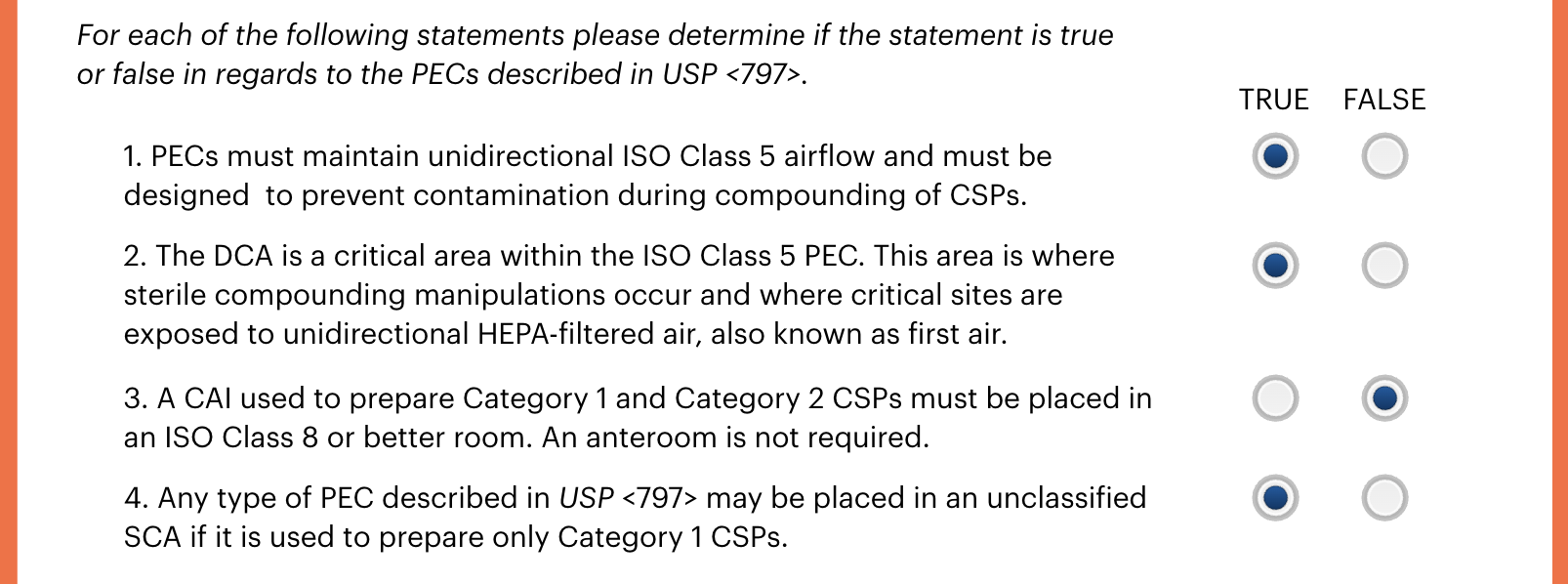
PECs must provide a unidirectional ISO class 5 or better environment for sterile compounding
the DCA is a critical area within the ISO class 5 PECs. this is where sterile compounding manipulations occur and where critical sites are exposed to unidirectional HEPA-filtered air, also known as first air
the unidirectional airflow within PECs must have sufficient velocity to sweep particles away from the DCA, protecting the DCA from process-generated contamination
proper design, control, and use minimize turbulence and creation of eddies or stagnant air in the PEC
PECs must be certified to meet ISO class 5 or better conditions during compounding
laminar airflow systems
USP <797> describes three different types of laminar airflow systems (LAFSs):
laminar airflow workbenches (LAFWs)
integrated vertical flow zones (IVLFZs)
class II biological safety cabinents (BSCs)
LAFSs:
are used to prepare category 1, category 2, and category 3 CSPs
must be placed in a cleanroom suite for category 2 and category 3 CSPs
placement in SCA qualifies for making only category 1 CSPs
a LAFS must be located out of traffic patterns and away from room air currents that could disrupt the intended airflow patterns inside
a dynamic airflow smoke pattern test must be performed in the PEC initially and at least every 6 months
types of laminar airflow systems
laminar airflow work benches
LAFWs provide either horizontal or vertical unidirectional HEPA-filtered airflow
they must not be used for preparing antineoplastics or hazardous APIs
integrated vertical laminar flow zone (IVLFZ)
a designated ISO class 5 area serving as the primary engineering within an ISO class 7 or cleaner buffer room
unidirectional airflow is created by placing HEPA filters over the entire surface of the work areas and effective placement of air returns. the unidirectional HEPA-filtered zone must be separated from the ISO class 7 area with a physical barrier to direct the airflow downward over the work area, to separate the DCA from potential sources of contamination
strategic location of air returns in addition to full coverage of HEPA filters above the work surface is required. this type of PEC must not be used to prepare antineoplastic or hazardous APIs.
both static and dynamic smoke studies verifiying a continuous flow of HEPA-filtered air void of turbulence, dead air zones, and refluxing from the HEPA filters to and across the entire work area and to the air returns must be documented (ex; with video)
class II biological safety cabinets (BSCS)
a BSC is a ventilated cabinet with an open front and inward and downward unidirectional HEPA-filtered airflow and HEPA-filtered exhaust
this design provides both worker protection from exposure to airborne drugs and an ISO class 5 or better environment for preparing CSPs
the exhaust air from the PEC must externally vented for preparing antineoplastics or hazardous APIs
restricted access barrier systems (RABS)
enclosures that provide HEPA-filtered ISO class 5 unidirectional air
allow for the ingress/egress of materials through defined openings that have been designed and validated to preclude the transfer of environmental air contamination
generally are not to be opened during compounding operations
two different types of RABS:
compounding aseptic isolators (CAIs)
compounding aseptic containment isolators (CACIs)
glove ports provide physical separation between the surrounding area and the aseptic manipulations
a RABS used to prepare category 1, category 2, and category 3 CSPs must be placed in a cleanroom suite
a RABS used to prepare only category 1 CSPs may be placed in an unclassified SCA
regardless of the environment in which a RABS is placed, it must be located out of traffic patterns and away from room air currents that could disrupt the intended airflow patterns inside of it
recovery time to achieve ISO class 5 air quality must be documented (by the manufacturer) and procedures developed to ensure adequate recovery time is allowed after material transfer
a dynamic airflow smoke pattern test must be performed in the RABS initially and at least every 6 months thereafter
two types of RABS
compounding aseptic isolator (CAI)
is designed for compounding non-hazardous compounded sterile preparations. it is designed to maintain an ISO class 6 environment throughout the compounding and material transfer processes
air exchange into the compounding aseptic isolator from the surrounding environment must not occur unless the air has first passed through a HEPA filter
compounding aseptic containment isolator (CACI)
is designed to provide worker protection from exposure to undesirable levels of airborne drug throughout the compounding and material transfer processes, and to maintain ISO class 5 environment for compounding sterile hazardous drug preparations
pharmaceutical isolators
pharmaceutical isolators provide isolation from the surrounding area and maintains ISO class 5 air quality during dynamic operating conditions
a pharmaceutical isolator is composed of four elements:
controlled workspace
transfer device(s)
access device(s)
integral decontamination system
CAIs and CACIs are not pharmaceutical isolators
if used to prepare category 2 or category 3 CSPs, they must be placed in an ISO class 8 or better room
if used to prepare only category 1 CSPs, they may be placed in an unclassified SCA
for placement of a pharmaceutical isolator used for the preparation of HDs, see USP <800>
robotic enclosure
when a robotic enclosure is used as a PEC, a dynamic airflow smoke pattern test must be performed initially and at least every 6 months thereafter to ensure that:
it is properly integrated into the facility
there is no turbulence or refluxing at any critical site
room air does not enter PEC where sterile products and/or preparations may be exposed
all processes can be performed without introducing contamination to the DCA(s)
knowledge check
additional requirements for facilities
additional requirements for facilities that prepare CSPs from nonsterile starting ingredients or components:
pre-sterilization:
procedures for category 2 and category 3 CSPs, such as weighing and mixing, must be completed in no worse than an ISO class 8 environment
procedures must be performed in a single-use containment glove bag, containment ventilated enclosure (CVE), BSC, or CACl. A CVE, BSC, or CACl used for pre-sterilization procedures must be certified at least every 6 months.
procedures must not adversely affect the required air quality of the SEC as demonstrated during certification under dynamic operating conditions
personnel must follow the hygiene and garbing requirements described in USP <797>
knowledge check
