Bio Midterm 3
 Call Kai
 Learn
 Practice Test
 Spaced Repetition
 Match
 Flashcards
 Knowt Play
1/103

There's no tags or description
Looks like no tags are added yet.
104 Terms
Protist
A Eukaryote that is not an animal, plant, or fungus
Eukaryotes originated through endosymbiosis
Nuclear membrane formed from infolding of plasma membrane
Endosymbiosis: mitochondria and plastids such as chloroplasts were formerly small prokaryotes - engulfed by host cell
mitochondria and plastids have their own DNA and replicate in a way similar to bacteria
Therefore, both plastids (e.g. chloroplasts) and mitochondria are both organelles with prokaryote-like features and DNA.
Many (but not all) protists are unicellular
Single celled protist can be very complex, as all biological functions are carried out by organelles in each individual cell (processes carried out in subcellular organelles)
In multicellular organisms, some biological activity is relegated to specific tissue types
Algae
major polyphyletic group of photosynthetic protists
Examples
Diatoms
Brown Algae
Dinoflagellates
Red Algae
Green Algae
Planktonic algae
Phytoplankton (e.g. diatoms)
“phyto”: something that is plant like
“plankton” drift in the water
Secondary Endosymbiosis
Some algae are the result of eukaryotic heterotrophic cells engulfing autotrophic (often that host acquires photosynthetic ability) eukaryotic (already went through primary endosymbiosis) cells
E.g. dinoflagellates (engulfed red algae)
E.g. Euglena (engulfed green algae)
red algae and green algae already went through endosymbiosis
Protist Diversity
Dinoflagellates have cellulose cell walls
Both unicellular and multicellular
Flagellum in groove (cell spins as it moves)
Many are photosynthetic (phytoplankton): secondary endosymbiosis
Dinoflagellate blooms cause ‘red tides’
A red tide, often toxic algal bloom
Diatoms and brown algae are both…
Stramenopiles
Have two dif kinds of flagella in certain life stages
some stramenopiles are algae but not all
Diatoms
Protists: algae, stramenopiles
Glass-like cell walls of silica
unicellular
photosynthetic phytoplankton
extremely abundant: important for CO2 absorption in the oceans
Brown algae
Brown algae are closely related to diatoms (similar flagellum - both stramenopiles)
Often large, multicellular algae, attached to the bottom of ocean: kelp forests
Red algae
Red algae have additional pigments that give them red color, or dark reddish-brown
Multicellular or unicellular
Often found much deeper in the sea than green and brown algae
Closely related to green algae (but not brown algae)
Sushi ‘wrapping’ sea weeds are usually red algae
Green algae
Green algae have bright green chloroplasts
Multicellular or unicellular
Closely related to true plants (land plants)
E.g. Chlorophytes (such as ‘sea lettuce’ and Volvox) and charophytes
Some protists are…
mixotrophs: they can switch between autotrophy and heterotrophy (their source of carbon) or photosynthetic vs chemosynthetic (source of energy)
Example: Euglena
can switch its photosynthetic processes on and off (common in freshwater)
I think it can also switch its source of carbon
Examples of protist parasites
Trypanosoma
an example of a parasitic protist genus: sleeping sickness in humans
Related to Euglena (both are Euglenozoans)
long, torpedo shaped cell
Infects bloodstream and nervous system (into the nervous tissue), disrupts sleep cycle
Vector (spreads through the): tsetse fly (Africa)
Plasmodium
another example of a parasitic protist genus (malaria)
Infects and lyses red blood cells
goes into the blood cells (notably red blood cells) and multiplies inside the cells
Vector: mosquitoes
Has historically killed millions
Causes symptoms of fever, sweating, and chills
Lifecycle of Plasmodium (the parasite that causes malaria)
protist parasite
Formation of gametes, fertilization and meiosis happen within the mosquito
Most life stages are haploid
Mosquito bites: immature Plasmodium infects liver first, and matures
Second infective stage is in red blood cells (RBCs)
Mosquito ingests gametocytes, that can produce gametes
Unikonta
Most phylogenies of Eukaryotes find a monophyletic group (“Unikonta”) that contains many protist groups (notably ameobozoans), but also animals and fungi
Amoebozoans include slime molds and various amoebae
Amoebozoans
Eukaryotes: Unikonta: Protists (although not all protists are unikonta - polyphyletic) : Amoebozoans
Amoebae are unicellular heterotrophs
engulf food particles (e.g. bacteria) by phagocytosis (change shape of cell and stretch out to engulf food)
Move by using pseudopodia projecting from the cell
Amoebozoans include slime molds and various amoebae
Which disease is caused by a protist?
AIDS
Malaria
Syphiis
Kuru
Malaria (plasmodium)
Which one is an alga?
Amoeba
Trypanosoma
Plasmodium
Diatom
Diatom
Slime molds
Eukaryotes: Unikonta: Protists (although not all protists are unikonta - polyphyletic) : Amoebozoans: slime molds
Scientific name: mycetozoans (“fungus animals”)
once thought to be fungi
terrestrial but usually need a lot of moisture
fruiting bodies with sporangia (a bit fungus-like)
Two main branches:
Plasmodial slime molds
Cellular slime molds
Plasmodial Slime Molds
Eukaryotes: Unikonta: Protists (although not all protists are unikonta - polyphyletic): Amoebozoans: slime molds": plasmodial slime molds
NOT “plasmodium” which causes malaria
Complex life cycle, main stage = plasmodium: large cytoplasm is undivided by membranes and contains many diploid (2n) nuclei.
This plasmodial stage grows (and moves) on decomposing material, engulfing bacteria and other organic material by phagocytosis.
Unicellular
Cellular Slime Molds
Eukaryotes: Unikonta: Protists (although not all protists are unikonta - polyphyletic): Amoebozoans: slime molds": cellular slime molds
Microscopic to barely visible (fruiting bodies often found about 1 mm.)
Very common in soil around the world
Used as an experimental model for studying the evolution of multicellularity.
The feeding stage of the life cycle consists of solitary cells (haploid amoebae) mainly feeding on bacteria (phagocytosis I think)
When food is depleted, the cells form a multicellular aggregate “slug” that functions as a unit
Cells are still separated by their membranes
Fruiting bodies with sporangia
Life Cycle of Cellular Slime Molds (probably dont need to know)
Eukaryotes: Unikonta: Protists (although not all protists are unikonta - polyphyletic): Amoebozoans: slime molds": cellular slime molds
Asexual reproduction (haploid the whole time):
The mass of aggregated amoebas forms fruiting bodies and spores (in the spore head at the top).
Spores disperse and become emerging amoeba (in favorable environmental conditions).
emerging amoeba hatch to become solitary amoebas
Solitary amoebas reminder: The feeding stage of the life cycle consists of solitary cells (haploid amoebae) mainly feeding on bacteria (phagocytosis I think)
Sexual reproduction:
Sometimes they enter into sexual reproduction
Fertilization: two haploid amoeba fuse to form a diploid zygote
Go through meiosis to produce haploid amoebas (solitary amoebas)
most of what we see of fungi are the fruiting bodies
mushrooms, truffles, the fruiting bodies of mold (what we see)
Eukarya: Kingdom of Fungi
Fungus = Lat: “mushroom”
Mycology = the science of fungi
Fungi are diverse and widespread. Perhaps 100,000 described spp. (estimatied > 1.5 million species total).
Includes molds, yeasts, as well as fungi in soil, forming mushrooms, puffballs, truffles, etc.
Eukaryotes (true nucleus and other organelles present), but neither plant nor animal nor protist
Previously often mixed up with plants; but no chlorophyll and actually closer to animals
Heterotrophic
Get nutrients by absorbing from surroundings
Fungi generally require moisture and organic material
most require oxygen, though some are facultative anaerobes (makes energy (ATP) using oxygen via aerobic respiration when it is present, but can switch to fermentation or anaerobic respiration when oxygen is absent)
e.g. the yeast Saccharomyces cerevisiae
Evolution of Fungi
Fungi: kingdom eukaryotic organisms separate from protists, plants, or animals
Relationships: fungi are actually more closely related to animals, and amoebozoans than to plants
Belong in a (probably monophyletic) group together with animals and amoebozoans
Importance of fungi
Essential decomposers for ecosystems. Fungi decompose dead organisms, fallen leaves, and other organic materials.
Recycle vital chemical elements back to the environment in forms other organisms can assimilate (take in)
Able to break down hard to digest materials such as cellulose
Insects can’t digest cellulose directly - but fungi can
Termites, and some ants, grow “fungus gardens” on cellulose inside their communities
Plants often depend on mutualistic fungi to survive
Humans cultivate fungi for food, antibiotics (some fungi produce antibacterial chemicals) and other drugs, to make bread rise, and to ferment beer and wine. Also, model organisms for lab studies.
The characteristics (body structure) of Fungi
Body forms
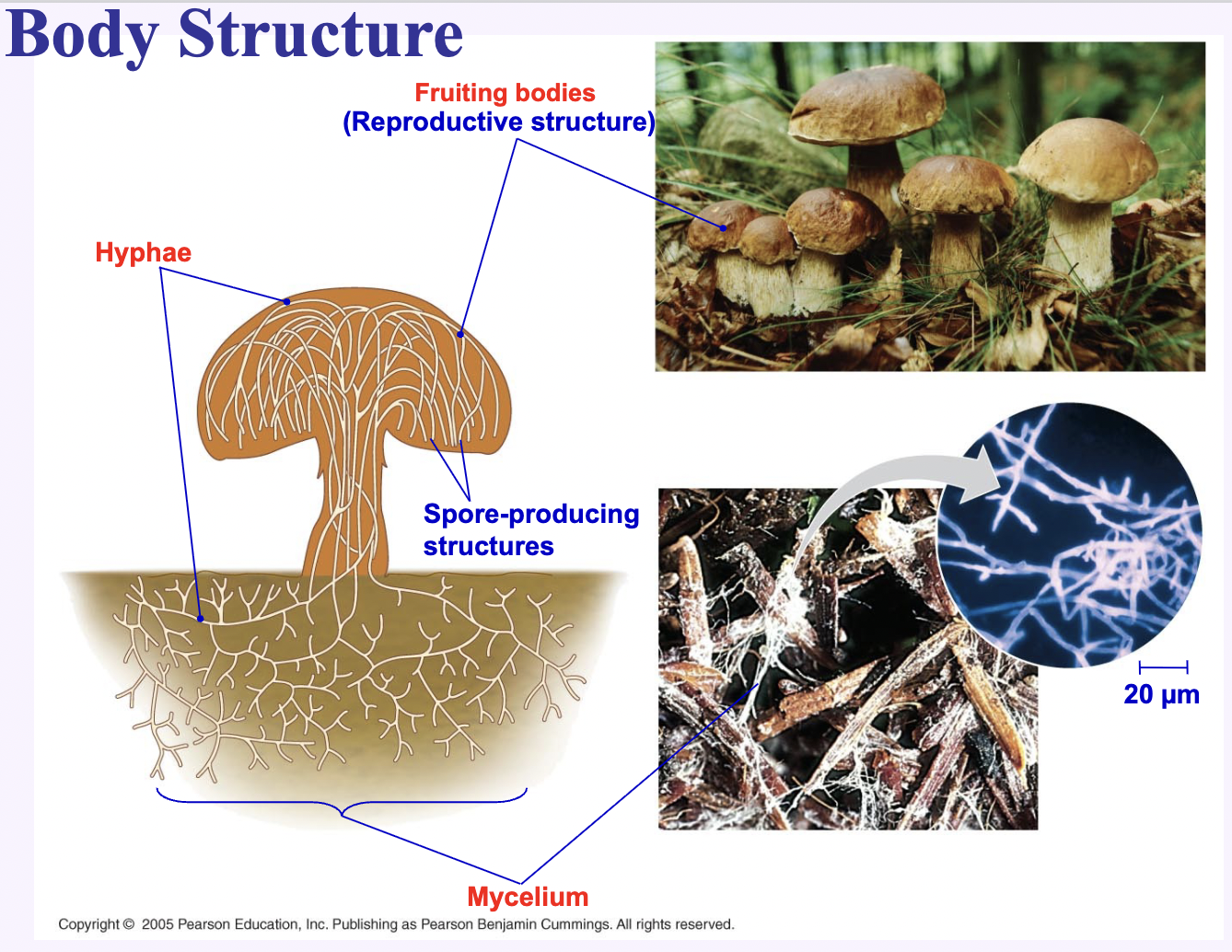
Most species are multicellular: form extensive mycelium (big network of threads) which produce fruiting bodies (e.g. mushrooms)
filamentous tube-like strands that make up mycelium are called hyphae (sing. hypha)
mycelium = aggregate of hyphae
Spores serve in reproduction
can be very resistant e.g. overwintering or drought
Mushroom shape is to specifically help spread spores in the air.
Some are unicellular
yeasts
Fungi lifestyle (obtain nutrition, roles)
Fungi are heterotrophs (but they don’t ingest food)
Obtain nutrition by absorption (through the cell walls)
Diverse lifestyles (Note: categories are not mutually exclusive)
Most are decomposers (saprophytes) - feed on dead tissues or organic waste
Some are parasites
Absorb nutrients from a living host
Responsible for most plant diseases (also some human diseases)
Mutualistic symbionts - mutually beneficial relationship between a fungus and another organism
Root tip fungi and plants - fungi help in nutrient absorption and receive energy and nutrients from the plant (more later)
Fungi produce a wide variety of interesting chemicals
Powerful enzymes break down dead (sometimes living) tissues
Antibiotics - get rid of competition (kill bacteria that is competing for its same resources), major importance to medicine
Other drugs - including hallucinogens
Fly agaric (Amanita muscaria)
Toxins - sometimes highly potent
Metabolic byproducts include alcohol (ethanol, used in brewing) and CO2 (used in baking)
Toxic fungi
typically produce chemicals that destroy the liver and kidneys
E.g. death cap (Amanita phalloides), destroying angel (Amanita virosa)
Bioluminescence in Fungi
Probable function: attracting insects that spread spores
Hyphae
Tough cell walls composed of chitin (polysaccharide)
Grow at tips, branch extensively
Mycelium
Cell (with nucleus) in hyphal tip
Secrete enzymes (exoenzymes) breaking down complex molecules
Products (nutrients) absorbed by hyphae
Four specific fungal forms
molds, yeasts, lichens, and mycorrhizae, have evolved morphological and ecological adaptations for specialized ways of life
These have evolved similarly (but independently) in several groups of fungi
Molds
A mold is a rapidly growing, multicellular, asexually reproducing fungus.
The mycelia of these fungi grow as decomposers or parasites on a variety of substrates
Produce asexsual spores (some molds can also reproduce sexually)
Mycelia
Google: the root-like, vegetative network of a fungus made up of branching, thread-like structures called hyphae.
Yeast
Unicellular fungi that inhabit liquid or moist habitats, including plant sap and animal tissues.
Most yeasts reproduce asexually by simple cell division or budding off a parent cell.
e.g. saccharomyces (used in baking + brewing) “sugar fungus”
Some yeasts also reproduce sexually.
Lichens
a symbiotic association (partnership) of photosynthetic microorganisms (either green algae or cyanobacteria (blue-green algae)) in a mesh of fungal hyphae.
Fungus - provides structure, protection, absorption
Alga or cyanobacterium - provides photosynthesis (nutrients)
E.g. “reindeer moss” - a shrub-like species of lichen
A lichen is classified as single species, even though it’s two organisms in one
Lichens are nature’s biological monitors of pollution and air quality
Many species very sensitive to pollution (which species are present can indicate air quality)
They grow slowly and tend to build up whats in the air
More resistant species can also be analyzed (measured) for pollutants, including bioaccumulation of heavy metals and radioactive isotopes
Mycorrhizae (symbiosis)
Definition: symbiotic (generally mutualistic) association between a fungus and the roots of a vascular plant.
Mycorrhiza: “Fungus root”
Mutualism btw:
Fungus: provides water, nutrients such as phosphates and some protection from root disease
Plant root: provides carbohydrate for fungus
Extremely important ecological role of fungi! The majority of plant species have mycorrhizal fungi (80% of plants get phosphates and other minerals from such symbionts)
Plant growth without mycorrhizae is often stunted.
Mycorrhizae may have been important to the colonization of land by plants (even before roots had evolved)
Genetic evidence - all major groups of plants have genes that code for recognition of symbiotic fungi (shows that the ability to partner with fungi is an ancient trait)
Fossil evidence - early fossil plants associated with structures similar to mycorrhizae.
Examples of fungal groups (based on relationship - phylogenetic - rather than analogous traits)
Chytrids
Mucoromycetes
Ascomycetes
Basidiomycetes
Chytrids (Chytridiomycota)
Fairly primitive
Flagellum on spores
Mostly aquatic: often found in lakes and in moist soil
Some cause infectious disease in animals (e.g. in frogs)
Mucoromycetes
Round sporangia (zygosporangium) often sit on long strands of hyphae
Many molds belong to this group
Some species can cause serious disease in humans
Some have coencytic mycelium (many nuclei, no cell walls in between) and are specialized for mycorrhizae.
Ascomycetes (Ascomycota)
“Sac fungi”
Have microscopic sacs producing spores
Very widespread, land, lakes, oceans
Some species form lichens; together with algae
Also include morels, cup fungus, many yeasts etc.
E.g. Truffles are the subterranean fruiting bodies of certain species of ascomycetes
Smell delicious to many animals → digging them up results in spreading spores.
Basidiomycetes (Basidiomycota)
“Club fungi”: spores on little club-like protrusions called basidia
Long-lived heterokaryotic (dikaryotic) stage (fused cell walls but two separate nuclei)
Prominent fruiting bodies such as mushrooms or puffballs
Also include some plant parasites (plant diseases), such as rusts
Important in decomposing decaying wood, also often form mycorrhizae
Fungus reproduction and life cycle (basidiomycete example)
Sexual reproduction:
Stages: Haploid (n), diploid (2n), and dikaryotic (i.e. n+n)
Fruiting bodies produce haploid (1 set of chromosomes) spores through meiosis.
Spore give rise to haploid mycelia mating types +/-
These mycelia unite (a + mycelium with a - mycelium) and produce dikaryotic mycelium and dikaryotic fruiting bodies
Fusion of nuclei (to become diploid - 2n) (short diploid stage), then meiosis produce new spores (n)
Note: many fungi can also reproduce asexually
Fungi as parasites + pathogens: Plants
About 30% of the 100,000 known species of fungi are parasites, mostly on or in plants
Invasive ascomycetes have had large infestations on forest trees, such as American elms and American chestnut
Some basidiomycetes form bracket fungi (conks) on trees
Other fungi, such as rusts infect grain crops, causing large economic losses each year.
Fungi as parasites + pathogens: Humans (and other animals)
Yeast infections of the vagina
“Ringworms”
Athlete’s foot
Valley fever - bronchitis-like or flu-like symptoms → infects your lungs
Dikaryotic
2 nuclei / heterokaryotic
Plants (Kingdom Plantae)
related to green algae (470 mya.)
Among green algae, the charophytes are especially plant-like (e.g. genus Chara lives in fresh water)
Gradually evolving from an organism similar to Chara, true land plants adapted to the dryness of land:
waxy cuticle on the epidermis retains moisture
differently organized cellulose fibers support an upright structure
stomata exchange gases with the air
roots get resources from the soil
reproduction also changed (resistant spores, seeds (i think to avoid drying out))
Plant life cycle
Fertilization creates a zygote (single diploid cell)
Mitosis and development creates a sporophyte (multicellular + diploid)
over time the sporophyte stage has become more dominant
sporophytes produce spores
Sporophyte undergoes meiosis to produce haploid spores
Mitosis and development creates a gametophyte (multicellular + haploid)
gametophyte produces gametes (through mitosis)
Spores - many plants have two kinds:
megaspores (germinate (grows into a) → female gametophyte)
microspores (becomes a male gametophyte)
True plants (3 main groups)
Nonvascular plants (no vascular tissues - can’t grow very tall)
Seedless vascular plants
Seed plants (monophyletic, also vascular plants)
Nonvascular plants (bryophytes)
Include mosses and similar plants (e.g. liverworts and hornworts)
Probably paraphyletic
Gametophyte (n) is dominant (google: the haploid stage is the main, longest-lived, and most visible part of the organism)
Probably similar to earliest land plants 470mya
No vascular tissue or stomata - need moist habitat (a few species can handle desiccation (no water))
Common in moist forest and boggy areas - build up layers of peat
Sperm cells swim through water from male gametophyte to the female gametophyte (sometime on same plant)
Sporophyte spreads spores into the air
Seedless vascular plants
Include club mosses, ferns, and horsetails (paraphyletic)
True vascular tissue
Gametophyte is small
Sporophyte (2n) is dominant
Reproduction is similar to mosses - disperse by the use of spores
In the Carboniferous Period (ended 300mya) seedless vascular plants were dominant on land
Club mosses + ferns grew to large size; whole forests of club moss trees
These enormous organic deposits turned to coal over time
Seed Plants
Include most of the plants in our daily environments (e.g. from large trees such as conifers, to small shrubs and flowering herbs)
Small (almost microscopic) gametophyte (n) (developed from a spore on the plant), sporophyte (2n) is dominant, has vascular tissue (can grow to large sizes)
Male gametophyte (n) is the pollen grain, fertilizes egg in female gametophyte (less need for moisture)
Female gametophyte sits within the ovule, which becomes the seed (package with plant embryo inside and some nutrients)
Disperse by the use of seeds (embryo inside)
Two main groups: Gymnosperms and angiosperms
Gymnosperms generally use wind pollination, while angiosperms typically have flowers that attract insects.
Gymnosperms
Seed Plants: Gymnosperms
“naked seed” - seeds aren’t covered by a fruit (produced by a cone that opens up → seed is naked)
Mainly conifers, also include a few other groups e.g. cycads and genus Ginkgo (fan like leaves)
Wind pollination
Conifers
Seed plants: Gymnosperms: Conifers
Conifers
Include e.g. pines, firs, redwoods
Very large forests, particularly in the Northern Hemisphere
Leaves are needles
Produce male and female cones (pollen cones, ovulate cones)
Male gametophyte (develops from microspores) - pollen grain produced inside of the pollen cone
Female gametophyte (develops from megaspore) - sits inside of the ovule (which becomes seed) inside ovulate cone
Redwoods (Sequoioideae)
Bristlecone pine trees
Redwoods
Seed Plants: Gymnosperms: Conifers: Redwoods
The largest trees and perhaps the largest organisms, long-lived (more than 2000 years)
Two species in California: coast redwood + giant sequoia +1 smaller species in china (Dawn redwood)
Reddish brown wood and bark
Coast redwood (Sequoia sempervirens)
Seed plants: Gymnosperms: Conifers: Redwoods: Coast Redwood
The world’s tallest tree, 115m (379ft). Second largest tree by volume.
Numerous small ovulate cones
Coast lowlands of Northern California (Oregon)
forests possibly highest biomass/yr production; - only about 5% remains intact.
pretty good at absorbing CO2 (bc that is how tissue is built - CO2 absorbed → photosynthesis etc)
Giant sequoia (Sequoiadendron giganteum)
Seed plants: Gymnosperms: conifers: redwoods: giant sequoia
The biggest tree by volume
Medium size ovulate cones
Up to 3500 years old
Sierra Nevada
Adaptations to frequent fires:
Extremely thick bark, relatively fire resistant
Cones usually open and release seeds after fires
Some fires are needed to get young giant sequoias
Bristlecone pine trees
Seed plants: gymnosperms: conifer: bristlecone pine
Can live for 5000 years
High altitudes in California and Nevada
among the oldest living organisms
Gymnosperm life cycle
Seed plant: gymnosperm
The dominant stage (the majority of the mass of the tree) is the diploid (2n) sporophyte stage
Male gametophyte (n) is the pollen grain (develops form microspore) in pollen cone
Pollen is dispersed to ovulate cones through wind
Ovulate cone: contains ovules - the megaspore develops within ovule to become female gametophyte (n) → which produces an egg
Pollen fertilizes through pollen tube
Embryo (2n) develops within ovule which becomes the seed
The embryo is surrounded by haploid food reserves in the seed.
Angiosperms (flowering plants)
Seed Plants: Angiosperms
Male gametophyte - pollen grain develops from microspore inside of the anthers (in flower)
Female gametophyte develops from megaspore inside of the ovule, which is inside the flowers ovary (becomes the fruit)
Two groups of angiosperms: monocots + eudicots (dicots)
One (monocot) or two (eudicot) seed leaves (cotyledons)
Flowers are designed for pollination by attracting insects
Nectar in flower, plus color and shape of petals attract insects
Pollen produced in the anther (male part of flower) grows a pollen tube when landing on stigma
Ovule will become the seed, and ovary the fruit
Fruits vary a lot in structure
Most stages are similar to gymnosperms, but:
Pollen transfered to the stigma of the flower
Pollen then produces a pollen tube and two sperm cells
Double fertilization (zygote, endosperm in seed)
What is double fertilization?
in Angiosperms (part of seed plants)
Egg is fertilized by the sperm from the pollen tube and produces a diploid zygote (2n) (zygote = cell formed by union of sperm and egg cells)
Seperately, the other sperm cell fertilizes the central cell nuclei, these fuse and become triploid (3n) endosperm (ppl dont rly know why) = nutrient within the seed
The ovule (which holds the egg) becomes the seed, holding/including endosperm and embryo (2n)
Differences between monocots and eudicots
Seed plants: angiosperms: monocots + eudicots
One (monocot) or two (eudicot) seed leaves (cotyledons)
Veins (parallel in monocots but branching in eudicots)
Vascular bundles (vascular tissue in the stem is random in monocots but grow in circles in eudicots)
Flowers/petal numbers (multiples of three in monocots, multiples of four of five in eudicots)
Roots (monocots have fibrous roots)
but not the best way to differentiate bc roots look so dif anyway when grown in desert vs forest etc.
Eudicot examples
Seed plant: angiosperm: eudicot
roses, poppies, apple trees
Oaks: Much of California is relatively dry, dominated by oak savanna, grasslands with scattered oaks
The fruit of an oak is the acorn. Chemicals that make them inedible gradually degrade so animals often store acorns.
Many trees are deciduous, (falling off) recycling nutrients from the leaves (roots reabsorb) and dropping them in winter e.g. valley oak
Others are evergreen e.g. coast live oak (retain their leaves)
Monocot examples
Seed plants: angiosperms: monocots
Lilies, palm trees, grasses (e.g. bamboo)
Many of our most important grains are grasses (e.g. wheat, barley, rice, rye, maize)
Vascular plant anatomy
a shoot system
includes stems and leaves (main photosynthetic organ), and reproductive organs (such as flowers). Absorb CO2 and light, produce carbohydrates (sugars etc.)
shoots rely on water and minerals absorbed by the root system
a root system
plants take up water and minerals from the soil
roots rely on sugar produced by photosynthesis in the shoot system.
Shoot system
Vascular plant anatomy
Leaves
The leaf is the main photosynthetic organ of most vascular plants
Leaves generally consist of a flattened blade and a petiole which joins the leaf to the stem
Leaves usually have stomata underneath (small openings for gas exchange of CO2 and O2 in photosynthesis)
Stomata control transpiration
guard cells (on either side of the stoma) control the amount of water evaporation by opening or closing
Turgidity from water pressure controlled by ion transportation and osmosis.
As water is inside it opens up, water leaves it closes
a way to contradict desiccation (drying out)
Root system
Vascular plant anatomy
A root is an organ with important functions:
anchoring the plant
Absorbing minerals and water (occurs in the root hairs, increase the surface area)
Usually connected to mycorrhizae
Storing carbohydrates
Note: carrots and sweet potatoes are roots, but potatoes are stem tubers (not roots))
Primary Growth of Shoots and Roots
Vascular plant anatomy
An apical meristem is a dome-shaped mass of dividing cells at the shoot or root tip
A root cap protects the root apical meristem
Cell division and specialization of meristem cells lengthens shoots and give rise to plant organs (e.g. leaves)
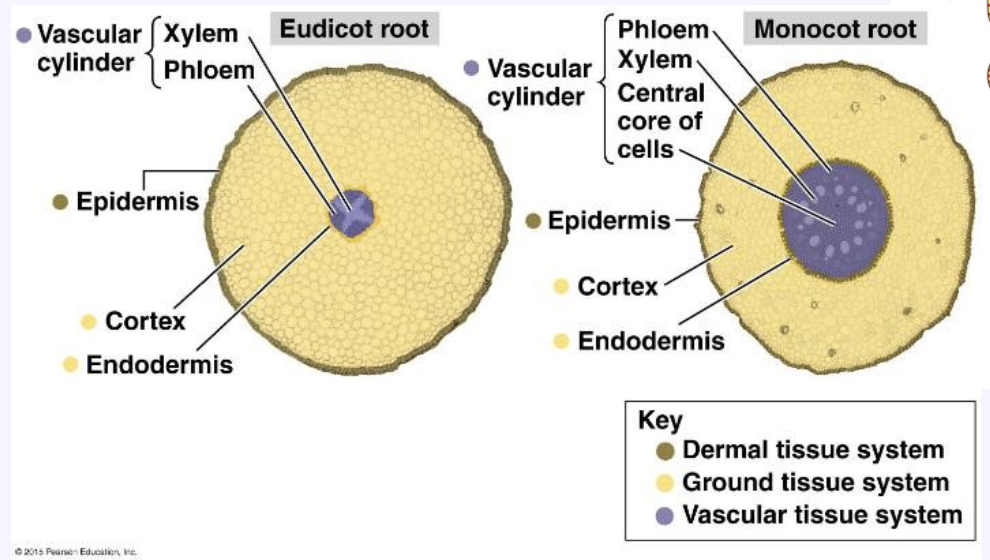
All vascular plants have three tissue systems
Dermal tissue system - epidermis (made of epidermal cells) with waxy cuticle - in woody pants supplanted (replaced) by a thick layer of cork and cork cambium (layer of actively dividing plant stem cells - role to produce new outer armor - pushing out layers of cork (make up part of the bark)) in the bark
Vascular tissue system - phloem and xylem, often in vascular bundles
Ground tissue system - photosynthesis, storage and support - often subdivided into cortex (close to epidermis) or pith (center of the stem)

Tissues are differently oriented in roots
Vascular tissue at the core, then cortex (ground tissue), and epidermis on the outside
Root hairs are dermal tissue (epidermal)
Phloem
one of two major components of vascular tissue (in vascular plants)
Living cells with sieve plates at the ends, plus supporting cells around.
Transport sugary water, other organic materials
Xylem
one of two major components of vascular tissue (in vascular plants)
Consists of dead tube-like cells that transmit water and minerals
Found in all parts of the plant. Wood is almost pure xylem.
Secondary Growth of wood
Vascular plants
A lateral meristem consists of a vascular cambium and cork cambium (these are cylindrical in shape and consists of dividing cells (producing new cells) along the stem and root)
The vascular cambium lays down (creates) secondary xylem (wood) to the inside and secondary phloem to the outside
The cork cambium layer (derived/originated from secondary phloem) produces cork
Bark is the cork layer together with the phloem and the cork cambium
In a section through a wooden stem, the living cells are the vascular cambium, secondary phloem, and cork cambium.
Wood (secondary xylem) is cellulose fibers (strong structure) in a matrix (surrounding glue) of lignin (which is cross linked hydrocarbon rings bound to carbohydrates)
strong structural support for larger plants
Sapwood consists of newer layers of wood that are actively transporting xylem sap
very important for the transport of water
sapwood eventually transforms to heartwood as the tree grows (just fills up with resin)
Heartwood consists of older layers of wood that are infused with resins to protect from e.g. fungal infection (mainly structural)

Xylem and phloem transport
Vascular plants
Xylem sap movement is pulled by transpiration (loss of water through evaporation)
Water molecules stick to each other (hydrogen bonds) and move up through the plant through the xylem
In addition plants also pump ions from soil into xylem, creating root pressure
Sugary water in phloem, phloem sap, can move both up and down the plant from sugar sources to sugar sinks (part diffusion, part active transport)
Coast redwoods (another method of water uptake?)
absorb water from fog
Importance of bark
Protective (fire, damage, infection etc.)
contains vital phloem
A tree needs a continuous connection of bark to live, can survive as long as there is continuous connection of bark from root to shoot
can’t cut a horizontal ring of bark off
Natural gums and resins (not the most important thing)
fluids produced by plants to protect in areas where they have been cut or damaged and to prevent against infection
Gums: contains hydrophilic polysaccharides (milky emulsion) often produced by angiosperm trees. Dry solid by evaporation of water
generally easier to extract from angiosperms
Resins: contains hydrophobic hydrocarbons (such as terpenes and terpenoids: “turpentine”), resin can harden over time (fossilize) and become amber.
generally easier to extract from gymnosperms
Uses: Latex are mixes of gums and resins, gum arabic for watercolors and medicine (pills), ___
Plants depend on bacterial and fungal symbionts
The Earth’s atmosphere consists of about 80% nitrogen (N2)
However, nitrogen deficiency is the most common nutritional problem in plants (amino acids, nucleic acids, etc.)
Plants cannot absorb nitrogen directly from the air
Nitrogen fixing bacteria convert N2 (nitrogen gas) to ammonia (NH3), which can be absorbed (as ammonium ions, converted to aminoi acids, etc.)
Some plants (e.g. legumes such as beans, peanuts) have mutualistic Rhizobium bacteria in nodules of the roots. The bacterium provides NH3, while the plant supplies sugars
Nitorgen fixing bacteria thus help to supply nitrogen into the nitrogen cycle (circulation of nitrogen between organisms and environment)
Fungal mycorrhizae supply minerals, phosphate, stimulate root growth, make antibiotics to protect against plant pathogens.
also helps to fight off other fungi (?)
Asexual reproduction in plants
Asexual reproduction is also called vegetative propagation (new plants grow from parts of the old ones), and the resulting asexually produced offspring, often called a clone, is genetically identical to its single parent.
Asexual reproduction in many plants is an extension of their capacity to grow throughout life.
Example: redwoods in a circle often stem from a “parent” root system of a felled tree
Example: Asexual reproduction in willows
can also do sexual reproduction
Willows have relatively brittle new shoots
These often break off and fall into a stream
Set down a root system at the bank and develop into a new tree
Variations of plant growth and nutrition
Epiphytes grow on other plants but are not really parasites (e.g. orchids)
Parasitic plants tap into host plant vascular tissue. Absorb sugar, water, minerals. E.g. mistletoe.
Indian pipe (ghost plant) is unusual in that it is a parasite on mychorrizal fungi (fungus is connected to plants near by obtaining sugar and the Indian pipe is stealing it from the fungus)
Carnivorous plants:
Nitrogen-poor soil - so this is the primary way the plant obtains nitrogen
Trap small animals (mostly insects) and produce enzymes to digest them
Animals: Kingdom Animalia, or Metazoa
Animals = closest protist relatives: choanoflagellates
General characteristics (all animals)
multicellular eukaryotes
have Hox genes
cells lack cell walls (unlike plants and fungi), but often reinforced with protein fibers (connecting cells to each other and for protection)
heterotrophic (unlike autotrophic plants) - always have to obtain organic molecules from other organisms
obtain nutrients by ingestion (unlike fungi)
General characteristics (most animals)
sexual reproduction
male: produces haploid motile sperm
female: produces haploid immobile egg cell
have true tissues (exception: sponges)
tissues are derived from 3 germ layers: ectoderm, mesoderm, endoderm (exception: sponges, cnidarians)
highly mobile (nervous system, muscular system; exception: sponges and few others)
Typical/generalized animal life cycle (example: echinoderm)
a small flagellated (motile) haploid sperm fertilizes a larger, haploid, nonmotile polarized egg.
Forms diploid zygote
Mitotic cell divisions lead to the formation of the hollow blastula (mammals: blastocyst)
Gastrulation (reorganizing) leads to the formation of a gastrula with 3 germ layers (ectoderm, endoderm, mesoderm)
Tissues continue to differentiate, eventually forming the adult animal. Specialized gonads (testes, ovaries) in the body then produce new haploid gametes (sperm, egg (through meiosis)

General body structure found in most animals including humans (not sponges, cnidarians)
Three germ layers - ectoderm, mesoderm, endoderm, and many animals have a coelom (body cavity)
Digestive tract (from endoderm)
Gaps in mesoderm = coelom
Muscles etc. (from mesoderm
Body covering (from ectoderm)

Some animals undergo metamorphosis (Larva → adult)
Some animals have a gradual development form juvenile to adult (e.g. mammals)
Other animals have a distinct larval stage, which is radically different from the adult - different anatomy, metabolism, eating different food etc.
Life cycles of many insects, amphibians etc. include a metamorphosis, during which the animal takes on different body forms as it develops from larva to adult
Example: butterflies and beetles
Type of symmetry in animals
Animals can be categorized according to body symmetry (or lack of it)
In general - symmetry fits lifestyle
Animals (except sponges) either have radial or bilateral symmetry
Radial symmetry: have a top and bottom but lack back and front or R and L sides
either don’t move or move very slowly
Bilateral symmetry have mirror-image right and left sides and front (anterior) vs back (posterior)
tend to have a more active lifestyle (sensory systems for the most part go at the front because thats where they encounter things first)
Animal Phyla: we will cover some important invertebrate phyla + chordates which include vertebrates
Animal phyla: radically different body plans “bauplan”
Invertebrates: a paraphyletic taxon - animals without vertebral column (backbone)
Phylum Porifera (Sponges)
Phylum Cnidaria
Bilaterians
Choanocytes (cyte = ?)
cell
Phylum Porifera (Sponges)
Very primitive (protist-like)
No symmetry
No true tissues
Suspension feeders (filter feeders) obtain food particles from water
Sponge anatomy: a highly porous structure
Have protist-like cells: e.g. Collar cells (choanocytes (cyte = cell)): create a water current through sponge. Resemble choanoflagellate cells
Amoebocytes: amoeba-like cells create spicules and protein fibers.
Spicules: structural “skeletal” elements found in most sponges that provide ___
Phylum Cnidaria
Cnidarians are radially symmetrical carnivores (marine or fresh water) with a simple gastrovascular cavity, and only two germ layers
Two basic forms: polyp or medusa (some go through both stages, but usually one is dominant)
Cnidocytes are unique venomous stinging cells that capture prey and function in defense.
Include sea anemone (cnidarian ployp) and jellyfish (cnidarian medusa)
Corals are colonial cnidarians
build up over many years
usually have a symbiotic relationship with algae
Some cnidarians have extremely toxic cindocytes
e.g. sea wasp, portuguese man-of-war
Bilaterians
The rest of the animal phyla are Bilateria
Most Bilaterians have bilateral symmetry (except echinoderms - which lost the trait), and all have three germ layers (endoderm, mesoderm, ectoderm)
Bilaterians
Protostomes: Spiral cleavage. The first opening to occur during gastrulation becomes mouth
E.g. arthropods, molluscs
Deuterostomes: Radial cleavage. The first opening becomes anus
E.g. echinoderms, also chordates and vertebrates.
Flatworms (Phylum Platyhelminthes): the simplest bilateral animals
Flatworms are the most primitive bilaterians
3 germ layers, but no coelom
Live in marine, freshwater, and damp terrestrial habitats, eating various organic materials (e.g. algae, bacteria)
Some are parasitic (e.g. tape worms)
Many flatworms (e.g. the black planarian, a freshwater sp.) have the ability to regenerate the entire body from a small piece
Cut in half, it will regenerate into two flatworms
This is due to the entire body containing stem cells within the tissues
Sometimes reproduce asexually by pinching themselves in half
Phylum Mollusca
Animal phylum
Over 100,000 spp.
Very numerous in the oceans, also in fresh water. Some species on land.
Anatomy varied, but with important underlying similarities
Soft-bodies (but often with a hard shell)(probably ancestor had a shell)
Muscular foot
Muscular mantle, and mantle cavity (usually with gills inside)
Many have a radula (rasping tongue)
Missed a slide
Mollusks are important predators, filter feeders, and herbivores
They are a very important food sources for other animals (e.g. sperm whale eating giant squid)
Also a major food source for humans (e.g. oysters, calamari, snails)
Mollusk Taxonomy - example classes:
Chitons
Common in oceans along shores
close to primitive mollusk body plan
shell consists of eight plates, large foot
eat algae using radula
Gastropods
The largest group of mollusks; snails and slugs
Found in fresh water, marine, and terrestrial environments
the only mollusks that have species on land. Terrestrial spp. use the mantle cavity as a “lung”
often protected by a single, spiral shell (slugs have lost their shell).
Herbivores or predators
Bivalves
Include clams, oysters, mussels, scallops
Have shells divided into two halves that are hinged together. The shells are placed on the sides (laterally)
Bivalves are suspension feeders
Many can move using the foot
Sometimes attached to teh substrate by strong threads
Cephalopods
Fast, agile predators
Muscular foot modified into arms/tentacles witih suckers
Mantle functions in “jet propulsion” (draw water in and squirt it out to propell)
Relatively complex brains
Well-developed eyes
Shell is large in a nautilus, small and internal in a squid and cuttlefish, missing in octopus.
Many can change colors rapidly
Many can squirt ink (defense)
Squid and cuttlefish are fast-swimming, streamlined predators
Octopuses: active predators on or near the seafloor.
Giant squid and colossal squid are the largest invertebrates (up to 46ft)
Toxic Mollusks
Bivalves sometimes accumulate poisonous algae
Some mollusks can deliver a deadly sting/bite (e.g. cone snail + blue ringed octopus)
Phylum Annelida: The segmented worms
Annelids have segmentation, the subdivision of the body along its length into a series of repeated parts
Most are hermaphrodites
Annelids are found in damp soil, the sea, and most freshwater habitats.
Examples
Earthworms ingest soil and extract nutrients, aerating soil and improving its texture
Ragworms have appendages with stiff bristles or chaetae. Active predators.
Tube worms are filter-feeders in the sea
Leeches are free-living carnivores; or blood suckers.
Have suckers on each end
Blood-sucking leeches use razor-like mouth parts, secrete an anesthetic and an anticoagulant.
Phylum Nematoda
Nematodes or roundworms (phylum Nematoda) are abundant and diverse, with thousands of species (25,000 - 500,000?)
Very simple bilateral symmetric structure
three tissue layers, and pseudocoelom body cavity (not a “true” coelom)
Moist habitats: most eat bacteria, decomposing matter, but some are parasites (e.g. Guinea worm and Trichinella)
Phylum Arthropoda
by far the most abundant animal phylum - well over 1 million insects (within arthropods)
Insects = largest subgroup
Most closely related sister taxon: velvet worms (Onychophora; not true arthropods)
Arthropods have
an open circulatory system - hemolymph (not blood) pumped from heart through short vessels then to spaces surrounding organs
an exoskeleton of chitin (external skeleton that is periodically molted to permit growth), sometimes reinforced with calcium carbonate (crustraceans)
Jointed appendages - most are legs, but some of these hae become modified to other functions e.g. mouth parts
Some still have similar and repeated body segments, but today man have distinct body segments; head, thorax, abdomen
many have compound eyes
Groups of Arthropods
Crustaceans (multicrustacea)
Arachnids
Myriapods
Insects