Biliary Tree Lecture 9
 Call Kai
 Learn
 Practice Test
 Spaced Repetition
 Match
 Flashcards
 Knowt Play
1/44

There's no tags or description
Looks like no tags are added yet.
45 Terms
Which has the greater internal diameter, CBD or CHD?
CBD
Normal CHD diameter
less than 4mm
Normal CBD
6mm or less
Dilated CBD
8-10mm
Post cholecystectomy the CBD may measure
greater than 10mm
What two enzymes may be elevated with biliary dilation?
ALP and conjugated bilirubin
Where is the most common biliary obstruction located?
Distal CBD
What direction do bile ducts expand when obstructed?
Centrifugally (away)
What will distend if there is a distal CBD obstruction?
entire system including gallbladder
What will dilate if there is only a CHD obstruction?
CHD and intrahepatic ducts, gallbladder may be contracted
What will dilate if there is an obstruction at the RHD and LHD?
intrahepatic ducts, gallbladder may be contracted
What does the “shotgun sign” refer to?
Dilated intrahepatic duct adjacent to normal portal vein

Which sonographic sign is seen? What is dilated?
Shotgun sign, the intrahepatic duct is dilated adjacent to a normal portal vein
Formation or presence of stones in the bile ducts
Choledocholithiasis
Primary form of choledocholithiasis
due to disease causing bile stasis
Secondary form (most common)
most stones in the bile ducts have migrated from the gallbladder, usually associated with calculous cholecystitis

What biliary pathology is seen here?
Choledocholithiasis
Why is it important for surgeons to check the CBD when removing the gallbladder?
Stones tend to migrate to the ampulla of vater, surgeons need to evaluate and make sure no stones are left in the CBD.
What is the name for the syndrome that is due to an impacted stone in the cystic duct?
Mirizzi Syndrome

What biliary pathology is seen?
Mirizzi syndrome, an impacted stone in the cystic duct
Inflammation of the bile ducts
Cholangitis
Most common secondary cause of cholangitis?
Choledocholithiasis
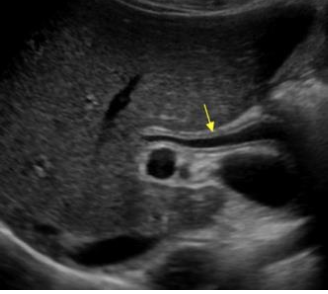
What biliary pathology is seen? Clinical findings: RUQ pain, fever,jaundice, elevated WBC
Cholangitis, bile duct wall thickening
What is the primary type of cholangitis that involves inflammation disease of the intrahepatic ducts and extrahepatic ducts leading to cirrhosis and liver failure?
Primary sclerosing cholangitis
What is the primary type of cholangitis that is due to destruction of the small intrahepatic bile ducts leading to cirrhosis and liver failure? More common in females over 40
Primary biliary cholangitis

What is seen here?
Biliary atresia, triangular cord sign echogenic triangular structure anterior to the portal vein
Absence of extrahepatic bile duct, associated with polysplenia syndrome, situs invertus, cardiac anomalies, suspected when jaundice persists beyond 14 days of age
Biliary atresia
Most successful treatment of biliary atresia if performed before 90 days
Kasai portoenterostomy (KPE)
Focal or diffuse cystic dilation of the biliary tree (not a true cyst)
Choledochal cyst
Most common type of choledochal cysts
Type 1, a fusiform dilation of the common bile duct
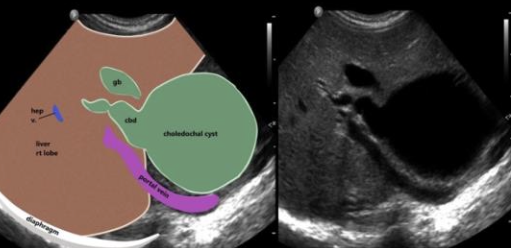
What is seen here?
Choledochal cyst

What is seen here?
Choledochal cyst with intrahepatic ductal dilation
Type 5 choledochal cyst that is characterized by a segmental dilation of the intrahepatic bile ducts, congenital disorder
Caroli’s disease
Differential diagonosis for Caroli’s disease
Polycystic liver disease

What is seen here?
Caroli’s disease, multiple cystic dilations of the intrahepatic ducts

What is seen here?
Caroli’s disease, ducts show a beaded appearance
Cancer of the bile ducts
Cholangiocarcinoma
Most common predisposing condition of Cholangiocarcinoma
Primary sclerosing cholangitis
Where does cholangiocarcinoma typically originate?
Within extrahepatic bile ducts (CHD and CBD)
What is a klatskin tumor?
Cholangiocarcinoma located at the hepatic hilum (junction of right and left hepatic duct) resulting in intrahepatic dilation
Most common metastases sites that can spread to the biliary system are
breast, colon or melanoma
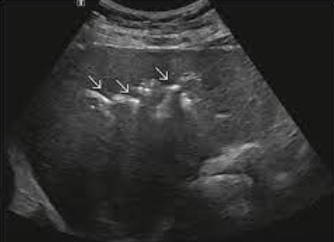
What pathology is seen? Patient just had a ERCP
Pneumobilia (air in biliary tract) echogenic foci in the intrahepatic ducts
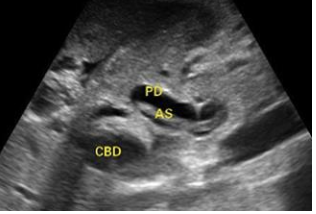
What disease is seen here?
Ascariasis, dilated duct shows movement within, enters the biliary tree through ampulla of vater
What causes ascariasis
Parasitic roundworm called ascaris lumbricoides