SAMPOL 236 - lecture 7 policy and public opinion
 Call Kai
 Learn
 Practice Test
 Spaced Repetition
 Match
 Flashcards
 Knowt Play
1/10

There's no tags or description
Looks like no tags are added yet.
11 Terms
Overview of the main policy instruments
Regulations:
| Government expenditure
|
Voluntary action
| Market based instruments
|
Regulation
Most common policy instrument
Most associated with the traditional environmental paradigm
Typically the gov specify standards of pollution control for products and producers
Enforced by state officials and legal systems
Overall goal - for the government to influence the behaviour of businesses or citizens
e.g. clean air acts, limits the dumping of hazardous waste and control of individuals behaviour e.g. recycling
3 forms
Ambient standards - place limits on the total concentration of pollutants permitted in a particular area e.g. river or bathing waters
Emission standards - limit what an individual source can emit e.g. gases release from factores
Design standards - require the use of a specific type of pollution control tech or production process e.g. catalytic converter in car
Regulation pros and cons
Why is it appealing?
Precision, predictability and effectiveness
all polluters treated identically
Administratively efficient esp when something is completely banned - don't need lots of info
Political, judicial and administrative back up = immune from manipulation and enhanced public legitimacy
Criticisms
Mostly from right wing populists esp in USA
Inefficient - costly regulatory burdens for industries
Ineffective - implementation deficit - failure to enforce and monitor due to costs and time
e.g. US funding shortages limit ability to implement policy - trump trying to reduce EPA's power
Enviro problems still remain e.g. pollution even after many policies introduced in 1970s e.g. in US, UK, Germany
Underestimate of workload
Unrealistic deadlines or excessive administrative rules
Underfunding
A 'right to pollute' to a certain extent?
Depends on the country e.g. in Germany controls are mostly formal and legalistic vs UK more infromal, accomodative, technocratic without legislation - more voluntary and flexible with self-regulation - negotiating specific arrangements with polluters
This is quite generalised though
But some e.g. Vogel say that the UK's techniques were still effective
Gov expenditure (inc pros and cons)
Gov financial assistance or support to help achieve enviro goals when the cost for individual producers is too great - usually subsidies
Encouragement to buy cleaner tech
Support for insulating homes
Reducing taxes or providing benefits
Support for new tech
Feed-in-tariffs
Carbon contracts for difference
Incentives for clean tech that may be more expensive when first starting up
Research and development funding
Inflation reduction act - a lot of investing into clean tech but also tax credit
Very contested - even the name
Cannot determine additionality e.g. would someone have insulated loft anyway? - is it changing behaviour
Costly
But necessary in a lot of areas - could be from private sector but gov has to take the lead
Voluntary action
Voluntary agreements - commitment undertaken by firms or trade associations usually in consultation with public authority - usually no sanctions if not fulfilled
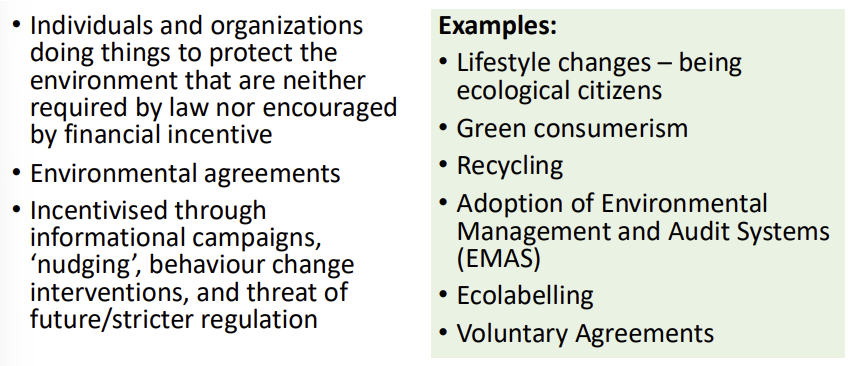
Voluntary action pros and cons
Pros | Cons |
|
|
Market based instruments & eco taxes
Solution to the alleged ineffectiveness and inefficiency - more efficient to concentrate effort on those who can reduce pollution in the cheapest way
Polluter pays principle - aims to prevent market failure - the price of a good or service should fully reflect the total cost of production including the use of public goods e.g. air, water, land etc
e.g. Pant - returnable deposit

MBIs cap and trade
How does it work?
1. Government sets overall target/cap.
2. Permits are allocated/sold/auctioned to polluters
3. Polluters can trade in permits
→ Flexibility and cost-efficient reduction in pollution
→ For those that can reduce pollution cheaply, there is an incentive to
reduce and sell permits. Those who do nothing will at least pay
something.

MBIs Carbon offsetting schemes

MBIs payment for ecosystem services

MBIs pros and cons
ADD THIS IN - need to organise notes here