ASCI 330 - Unit 2 Part 2
 Call Kai
 Learn
 Practice Test
 Spaced Repetition
 Match
 Flashcards
 Knowt Play
1/44

Earn XP
Description and Tags
October 14 -
45 Terms
What is the basis of selection?
The resemblance between parent and offspring
What is the challenge to breeders in genetic prediction?
Identifying parents that have the best “true” breeding value
What is true of true breeding value?
It is never known but can be predicted from different sources of information
What does the emphasis to place on each source of information depend on?
The heritability of the trait (the higher the better), and the number of performance records from each source of information (e.g., number of repeated records, number of sibs or progeny) (the more the better)
What can emphasis on a source of information also depend on outside of heritability and number of performance records?
The relationship between the individual under evaluation and the source of information on it—the closer the relationship the better (e.g., self closer than parent-offspring, which is closer than half sibs)
What can emphasis on a source of information also depend on outside of heritability, number of performance records, and relationships?
The degree to which the individuals providing the information resemble one another phenotypically (family resemblance)
What are the two reasons for family resemblance?
Related genetically (e.g., on average, full sibs have ½ their genes in common), and share a common environment
What describes a common environment, a reason for resemblance in families?
It causes members of the same family to be more phenotypically similar and reduces the value of family information to predict breeding value
What is the common environment effect, something especially important within litters?
An increase in the similarity of performance of family members caused by their sharing a common environment (e.g., swine, sheep, dogs, cats, rabbits, mice)
What are the three components of resemblance within families?
Heritability of the trait (h2), relationship between/among individuals (R), and effect of a common environment (c2)
What is the equation for resemblance within families?
t = Rh2 + c2 — c2 is the proportion of phenotypic variance due to a common environment

In our equation for resemblance within families, what is t for full siblings?
(R = ½ ): tFS = (1/2)h2 + c2

In our equation for resemblance within families, what is t for half siblings?
(R = 1/4): tHS = (1/4)h2 + c2

How may the equation for predicting breeding value be broken down?
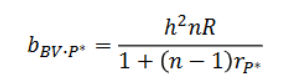
Pi* is the phenotypic information available (e.g., individual’s own phenotype or average performance, average performance of its sibs or progeny), P is the mean performance of the population, and bBV*P is the regression of an indvidual’s breeding value on the available phenotypic information

How may the regression coefficient (bBV*P) be broken down?
R is the genetic relationship between the individual whose breeding value is being estimated and the individuals in P* (e.g., 1 when individual itself, ½ between parent-offspring; ¼ between half sibs), and rP* is the correlation among the records in the source of information (e.g., tFS for full-sib family average; tHS for half-sib family average; repeatability ® for average of repeated records on individual itself)

What is accuracy of prediction?
The correlation between the breeding value of the individual and the source of information used to predict its breeding value—part of the prediction equation itself
For genetic prediction, what is the equation for regression coefficient?
For genetic prediction, what is the equation for accuracy?

What is true of temperament?
Involving injury to animals themselves and their human handlers, growth, feed efficiency, and meat quality, it is a heritable trait (0.2 to 0.3)
What are some considerations of sources of information?
Possible sources of information; What is measured? Is it measured repeatedly?
What are some common measurements for sources of information?
Flight speed/time, and chute score (scoring system with 1 being docile and 5 being flighty/aggressive)
What factors influence the amount of emphasis placed on each source of information?
What is the heritability of the trait? What is the relationship between the individual being evaluated (who you want to predict BV of) and the source of information you are using? To what degree do the individuals providing the information resemble one another phenotypically?
True/False: One way genomics can improve the rate of genetic gain achieved is by increasing the accuracy of selection.
True
True/False: As the intensity of selection increases, so does risk.
True
The first 3 questions are regarding the example we started in class where you are eavluating the rate of genetic gain that can be achieved through selection for flight time in pigs. You will also need the selection intensity table that is found in the Homework module (or your notes).
Information given is as follows:
Measure | Male | Female |
Proportion piglets selected | Best 18% | All are kept |
Generation interval | 1.5 years | 2.5 years |
Parameter | Value |
Heritability | 0.39 |
Repeatability | 0.48 |
Phenotypic Variance | 1025 sec^2 |
Given this information, what is the OVERALL selection intensity?
0.73
The first 3 questions are regarding the example we started in class where you are eavluating the rate of genetic gain that can be achieved through selection for flight time in pigs. You will also need the selection intensity table that is found in the Homework module (or your notes).
Information given is as follows:
Measure | Male | Female |
Proportion piglets selected | Best 18% | All are kept |
Generation interval | 1.5 years | 2.5 years |
Parameter | Value |
Heritability | 0.39 |
Repeatability | 0.48 |
Phenotypic Variance | 1025 sec^2 |
Given this information, what is the standard deviation in breeding value for this trait?
19.994 sec
The first 3 questions are regarding the example we started in class where you are eavluating the rate of genetic gain that can be achieved through selection for flight time in pigs. The pigs are being selected based upon their own flight times. You will also need the selection intensity table that is found in the Homework module (or your notes).
Information given is as follows:
Measure | Male | Female |
Proportion piglets selected | Best 18% | All are kept |
Generation interval | 1.5 years | 2.5 years |
Parameter | Value |
Heritability | 0.39 |
Repeatability | 0.48 |
Phenotypic Variance | 1025 sec^2 |
Given this information, what is rate of genetic change expected when selecting this population in the manner described?
+4.554 sec/year
What factors affect accuracy of prediction?
Heritability, number of records, and pedigree relationship
What is true of accuracy of prediction in terms of pedigree relationship (one record on either the individual itself, one half-sib, or one progeny)?
Accuracy increases with the strength of relationship
What is true of accuracy of prediction in terms of number of records?
Accuracy increases as number of records increase
What happens to the accuracy of prediction as heritability increases, in terms of a single performance record on the individual?
It increases in accuracy
What does it mean when traits are genetically correlated and selection for one trait results in change in the other?
It is a correlated response to selection
What are some examples of correlated traits?
Mature weight and weaning weight in cattle, playfulness and aggressiveness in dogs, and heigh and OCD (bone fragments in joints) in horses
What is the cause of a correlated response to selection?
Pleiotropy
What are the three types of correlation responses to selection?
Genetic, phenotypic, and environmental
What is pleiotropy:
The phenomenon of a single gene (allele) affecting more than one trait, such as the halothane gene in swine (increases lean yield and decreases survivability) and growth genes (affect growth at several stages)
What is genetic correlation?
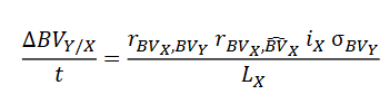
A measure of the strength of the relationship between breeding values for one trait and breeding values for another trait (rBVx,BVy)
What is phenotypic correlation?
A measure of the strength in the relationship between performance in one trait and performance in another trait
What is true of genotypic and phenotypic correlation + difference?
Genotypic and phenotypic are often similar in size, and the difference is due to environmental sources of variation
What is environmental correlation?
A measure of the strength in the relationship between environmental effects on one trait and environmental effects on another trait
What is true of choosing whether to select an indirect or direct trait?
Sometimes it is more feasible to select for a correlated trait rather than select directly for the trait you want to change (e.g. traits that are difficult or expensive to measure)
What is true of unwanted or unexpected consequences occurring due to direct selection?
If unfavorable genetic correlations are ignored, selection for one trait may lead to an unwanted change in another trait (e.g., selection for growth rate in cattle leading to increased birth weights & dystocia problems—these can be addressed with multiple trait selection—indexes)
What does the key equation become in response to DIRECT selection (i.e., direct response)?
(The same factors affecting direction response to selection also affect the correlated response)

What is the equation for correlated response in trait Y resulting from selection on trait X (i.e., correlated response)?