ASTR 1 Midterm 2 Fall 2026
 Call Kai
 Learn
 Practice Test
 Spaced Repetition
 Match
 Flashcards
 Knowt Play
1/62

There's no tags or description
Looks like no tags are added yet.
63 Terms

What is the name of layer 1?
Core, 10^7K center where fusion happens
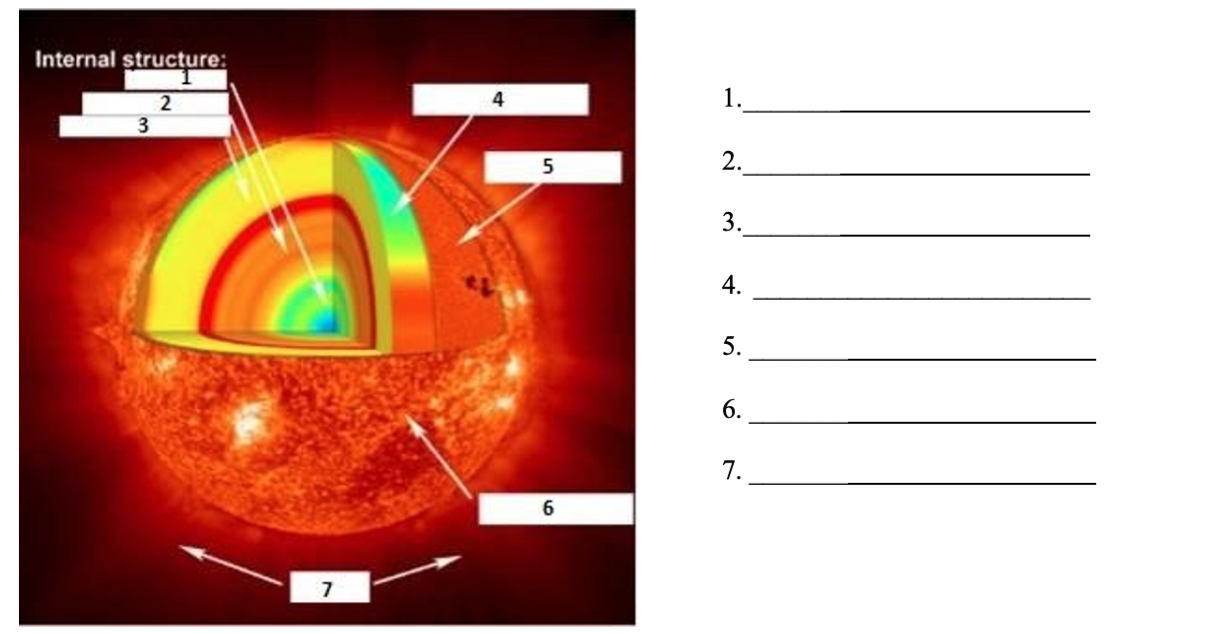
What is the name of layer 2?
Radiation Zone, energy is transported upward by photons from the core

What is the name of layer 3?
Convection Zone, boiling plasma as everything rises

What is the name of layer 4?
subsurface flows (not studied in lecture), currents of plasma just under the surface that transports the magnetic field and affects the solar cycle
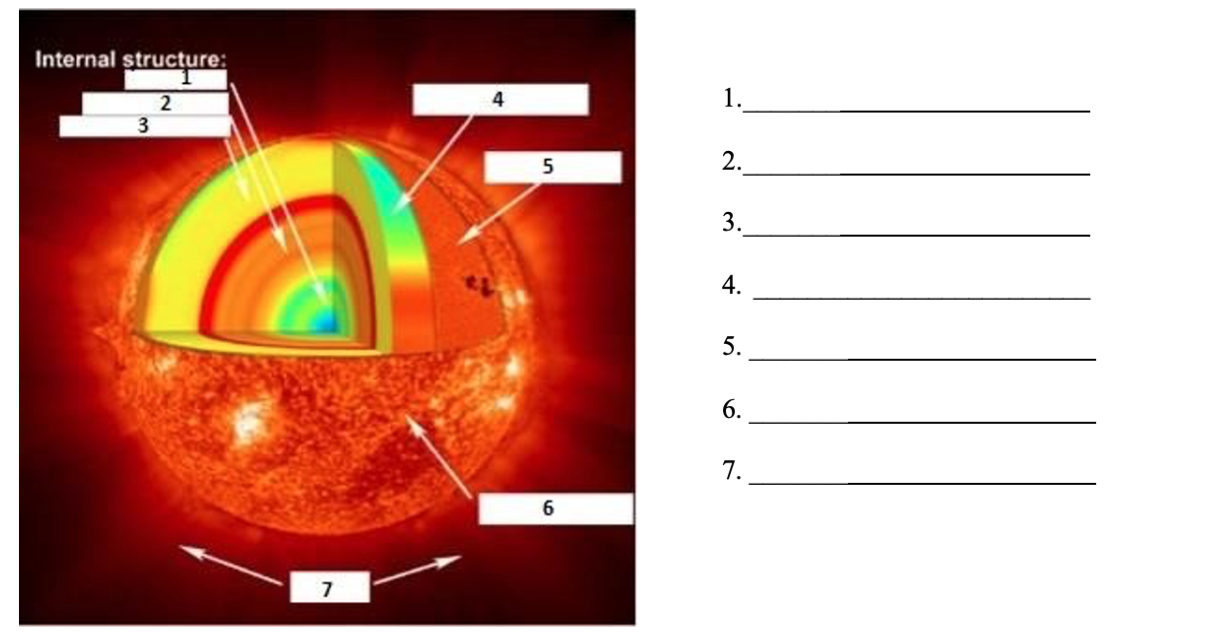
What is the name of layer 5?
Photosphere, 6000k and top of boiling water, most of our interactions with the sun

What is the name of layer 6?
chromosphere, hotter than the photosphere at 10^4-10^5k, middle layer of solar atmosphere

What is the name of layer 7?
Corona, 10^k and outermost layer of the solar atmosphere
Sun’s luminosity and size
3.8×10²6 watts and 10x diameter of Earth
luminosity
energy radiated / time
fusion
combines 2 nuclei to make bigger nuclei, only happens in the core of a star
How does the sun maintain its structure?
fight between gravity and pressure from nuclear fusion
Solar Thermostat
decline in core temp = fusion rate drops and core contracts and heats
rise in core temp = fusion rate rises and core expands and cools
helioseismology
measuring of patterns of vibration on surface of the sun
neutrinos
antimatter created during fusion that interacts very little with matter so it can fly straight through the sun
sun spots
cooler areas (4000k) on the surface of the sun that are formed because of a strong magnetic field
solar flares
loops connecting sun spots break because of the sun’s movement, bursts of x-rays
corona mass ejection
10^13-10^14kg material is released out into the solar system
Carrington Event
massive coronal mass ejection
solar cycle
every 11 years number of sun spots rises and falls
differential rotation
different parts of a rotating object move a different angular velocities based on different latitudes, depths, or times
4H to 1 He
fusion of Helium, .7% less energy than 4H, released energy stops the sun from collapsing
parallax
for nearby stars, the measurement of the separation between 2 points to solve for distance
parsecs (d)
d=1/p(in arcseconds)
the 3 observational categories
imaging, spectroscopy, time monitoring
apparent magnitude
magnitude of a star as we see it
What 2 factors are most important in determining the current appearance of a star?
mass and stage of life
which units are appropriate for measurement of apparent brightness?
watts per square meter
how did astronomers discover the relationship between spectral type and mass for main sequence stars?
they measured masses and spectral types of main sequence stars in binary systems
apparent brightness
how bright a star is to an observer, dependent on luminosity and distance
spectroscopic binary
determining a pair of stars orbit eachother through Doppler Shifts
interstellar medium
the gas and dust that lies between the stars in the Milky Way
what must we measure to infer a star’s surface temperature?
spectral type
what do we need to calculate luminosity?
apparent brightness, distance, and the assumption that there is no interstellar gas absorbing or scattering light between us and the star
How do we determine a star’s mass directly?
by a binary star
visual binary
a pair of stars that we see directly orbiting eachother
eclipsing binary
pair of stars that orbit each other in the plane of our line of sight

where do stars spend most of their time?
main sequence

the higher the mass…
the higher the luminosity and the shorter the life

the lower the mass…
the lower the luminosity and the longer the life
open cluster
newly formed stars loosely packed together (pleiades)
globular cluster
millions of stars held in a dense ball and some of the oldest structures in the universe
main sequence turnoff
marks where starts stop fusing Hydrogen and starts its evolution into the Giant phase
pulsating variable stars
changes in brightness of stars over a period of time
Cepheid variables
most luminous pulsating stars, 1000 times brightness of sun
molecular clouds
cold and dense interstellar clouds where stars are born
interstellar reddening
change in color of starlight as it passes through dusty gas
gravitational equilibrium
outward push of gas pressure balances inward pull of gravity
thermal pressure
increase of pressure as temperature rises, happens in interstellar clouds after collapsing
oldest stars in the universe
born of just Hydrogen and Helium, more massive stars because clouds could not cool as much as today’s
how does a cloud become a star?
as cloud becomes smaller and denser, thermal energy is created via friction and cannot escape as easily
protostar
forming star that cannot yet fuse Hydrogen
what would happen to the surface temperature if a star’s radius increased by 7 times but there was no change in luminosity?
the star’s surface temperature would decrease
population 3 stars
first stars to form, born only about 150 million years after Big Bang
circumstellar disk
material collapses on protostar, jets push material out but angular momentum forms this as it heats up and speeds up
what would happen to a protostar that formed without any rotation?
there would be no planets. the rotation that creates the circumstellar disk is what forms planets
development of a protostar
luminosity and temp grows as matter collects
surface temp remains near 3000k while convection is main energy transport
luminosity remains nearly constant during late stages of contraction while radiation transports energy
core temp continues to rise until star begins fusion
what would happen to a contracting cloud fragment if it were not able to radiate away its thermal energy?
internal pressure would increase
Pauli Exclusion Principle
electrons in gas or plasma sort themselves into different energy states
example: students finding seats in a lecture (students electrons and seats energy level)
what happens in a low-mass star when core temp rises enough for helium fusion to begin?
Helium fusion rises quickly
what happens when the star’s core runs out of helium?
Helium fuses in a shell around the core
what happens when a star runs out of hydrogen to fuse?
the core of the star contracts under gravity’s pressure, which rises temperatures and starts Helium fusion where then it expands into the red giant phse
life of a low-mass star
star formation
protostar
main-sequence (90% of life)
red giant
He burning star
2nd red giant
planetary nebula
white dwarf
planetary nebula
envelop lifts and core is revealed