Astronomy: Notable Concepts (Combined)
 Call Kai
 Learn
 Practice Test
 Spaced Repetition
 Match
 Flashcards
 Knowt Play
1/222

There's no tags or description
Looks like no tags are added yet.
223 Terms
Moon Phase (Fact 1)
Shape of the Moon that appears to us on Earth, being how much we see it from Earth being illuminated by the Sun, there are 9 of them total
New Moon (Fact 5)
Phase of the Moon in which the distance between it and the sun starts to increase, as it once decreased in the Waning Phases, it will now increase, into the Waxing phases, and will now begin heading back to the East and be lightened again
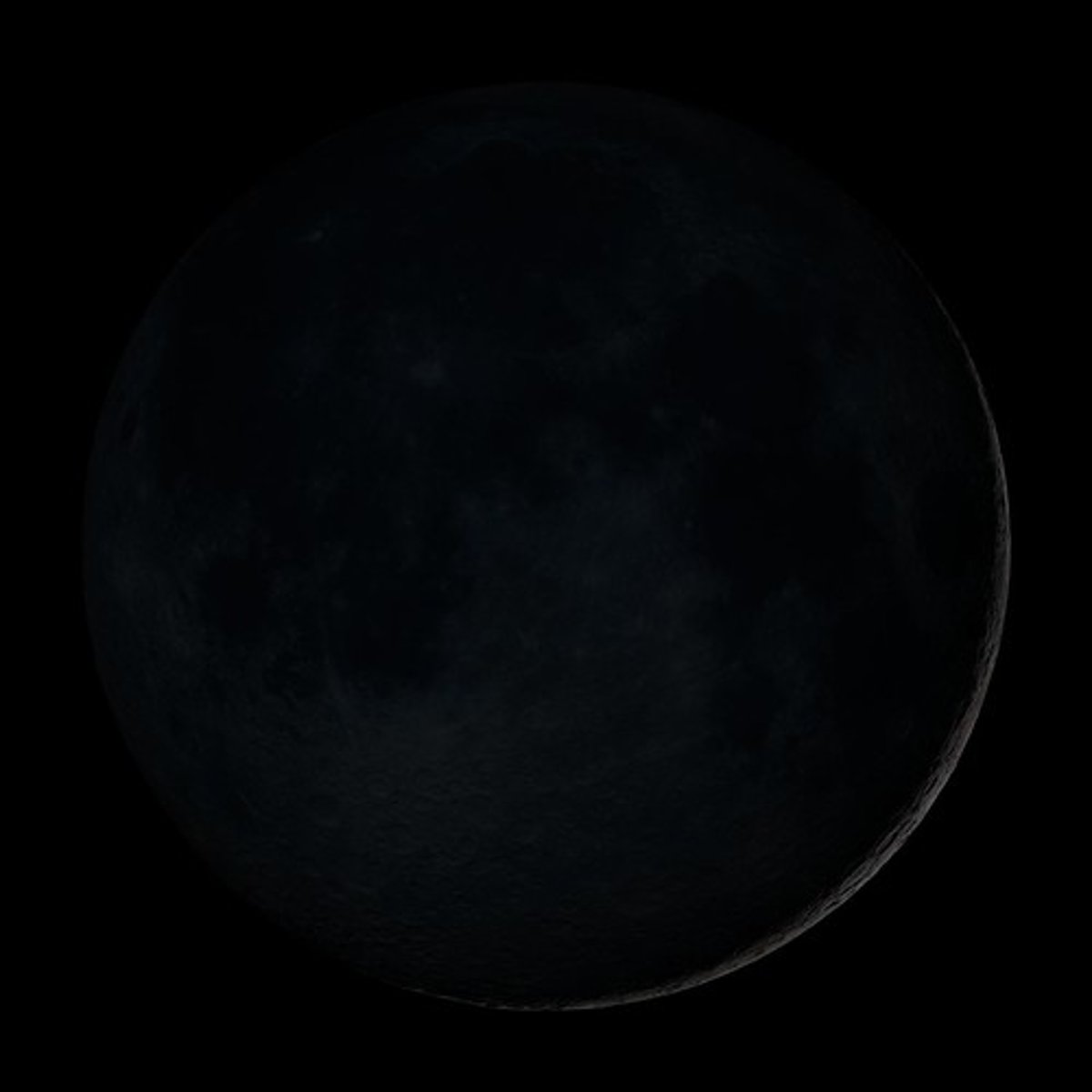
New Moon (Fact 7)
Phase of the Moon that occurs when the moon is directly between the Earth and Sun, but may be a little bit above or below the sun since it has its own tilt and orbit different from Earth's and because it is rotating while the Earth rotates just slightly differently in front of the Earth and in line with the sun
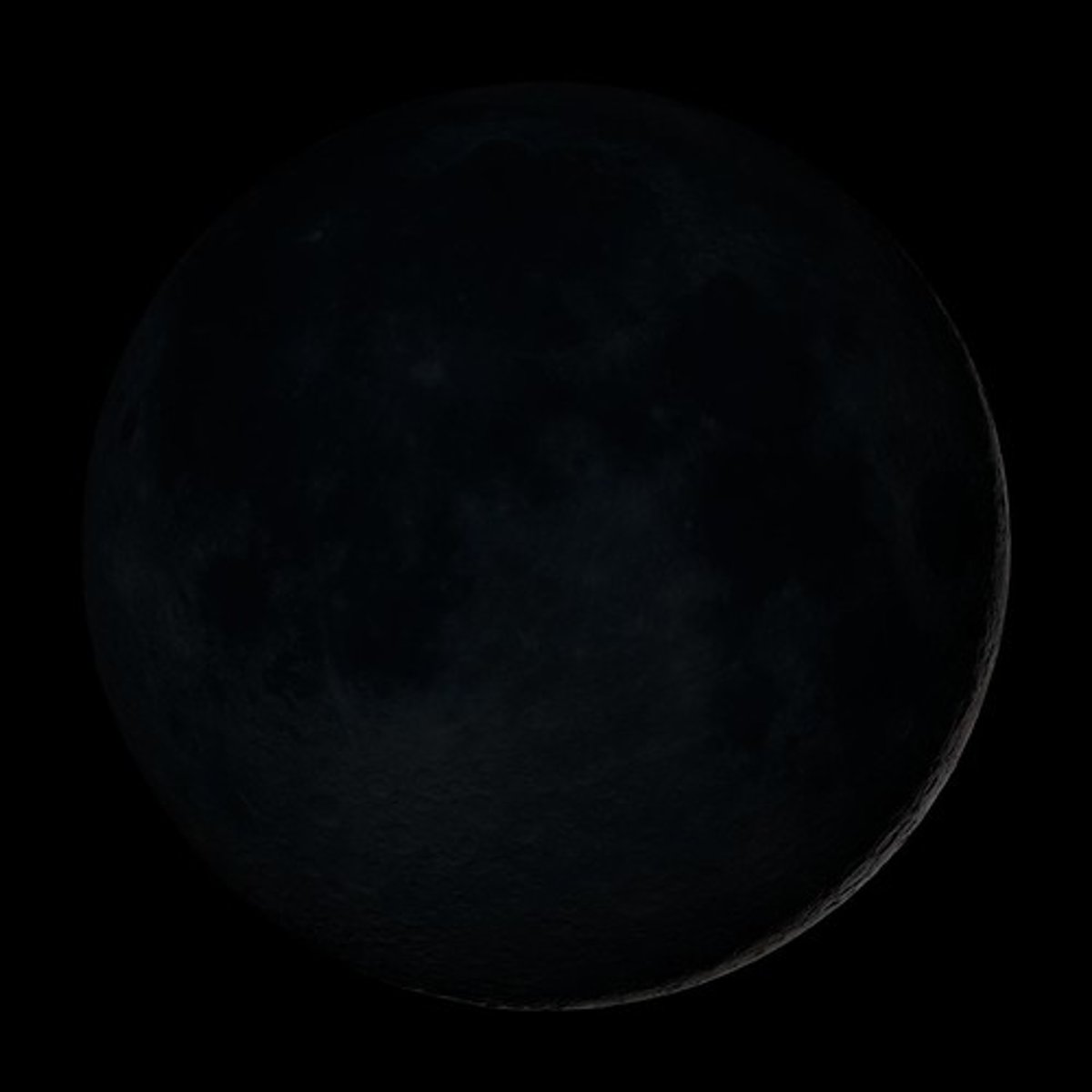
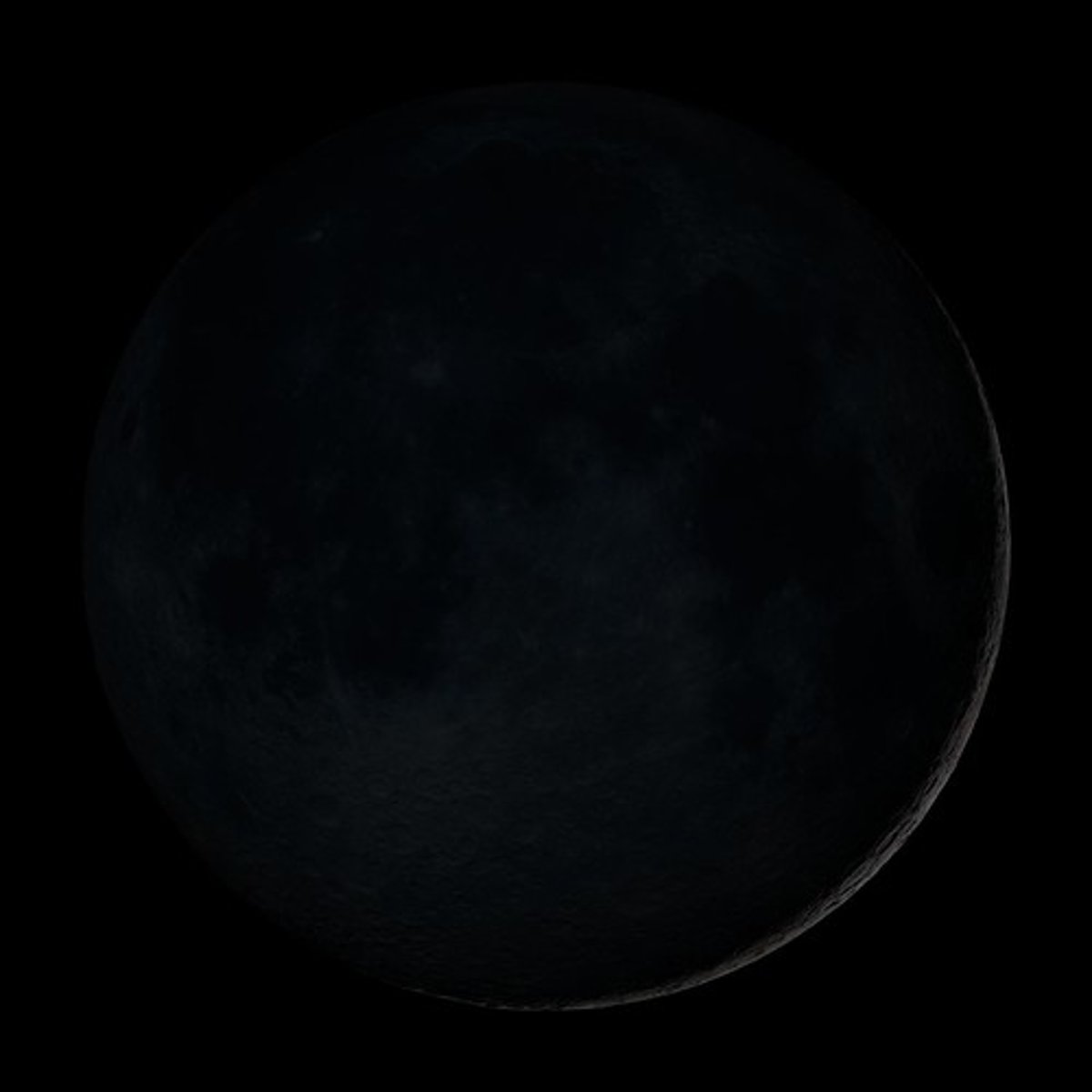
New Moon (Fact 8)
Phase of the Moon that occurs when one sees the shadow or part where the light waves aren't hitting since light waves don't bend or curl, so there is no light
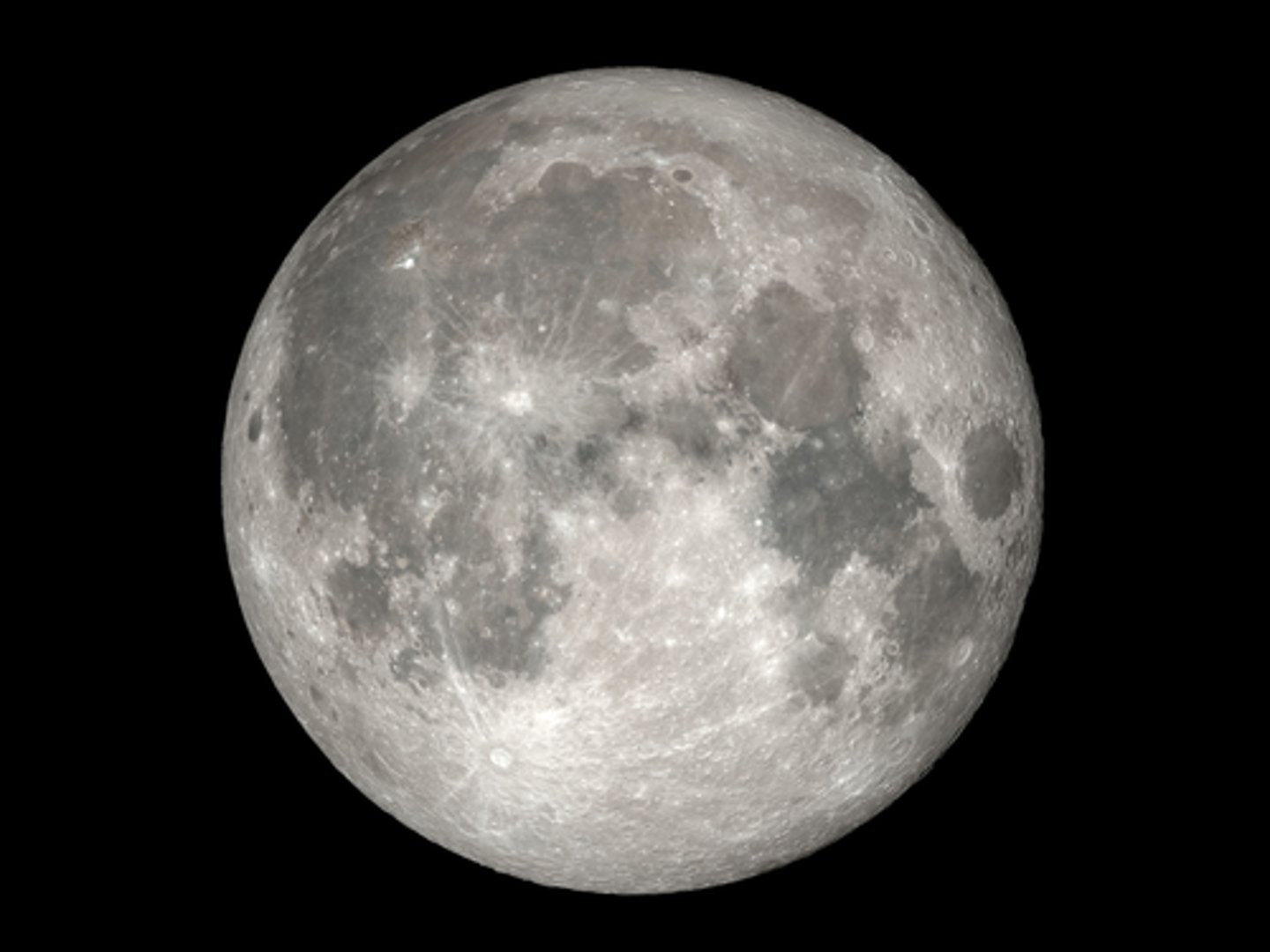
Full Moon (Fact 2)
Phase of the Moon in which all of the sun's light reflects off of the surface of the Moon on its tilt and onto Earth and is up all night shining that light down onto Earth
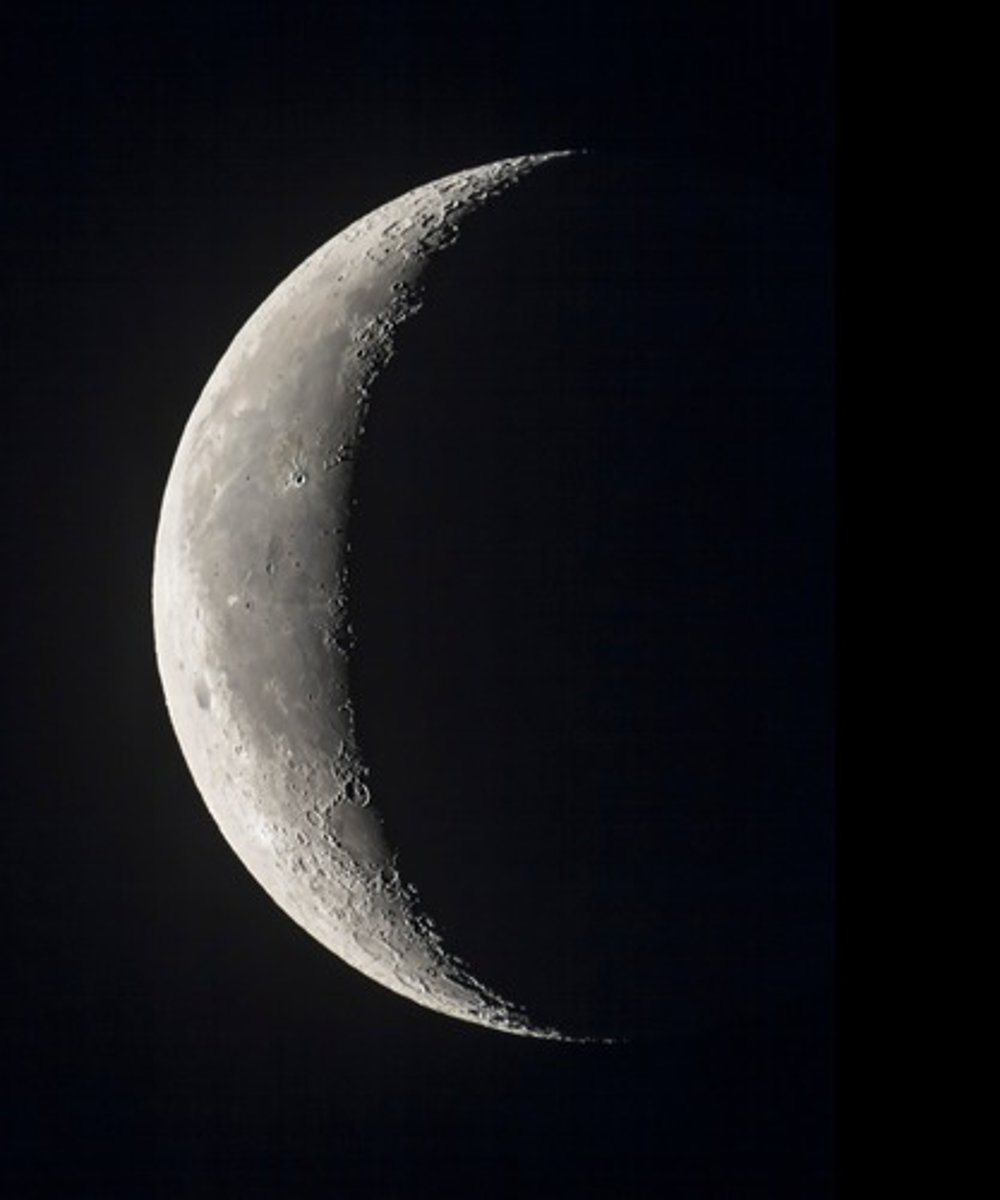
Waning Crescent (Fact 3)
it is near the sun when looked at in the sky
Planet (Etymology)
Comes from the Greek for "wanderer"
Solar System Formation - Collision Theory (Fact 1)
Heliocentric Model (Fact 1)
Proved by Galileo Galilei using his telescope, he observed that the moons of Jupiter were originating around Jupiter instead of Earth, questioning the Geocentric Model considering there were already planets with moons of their own that revolved around them apart from Earth
Heliocentric Model (Fact 2)
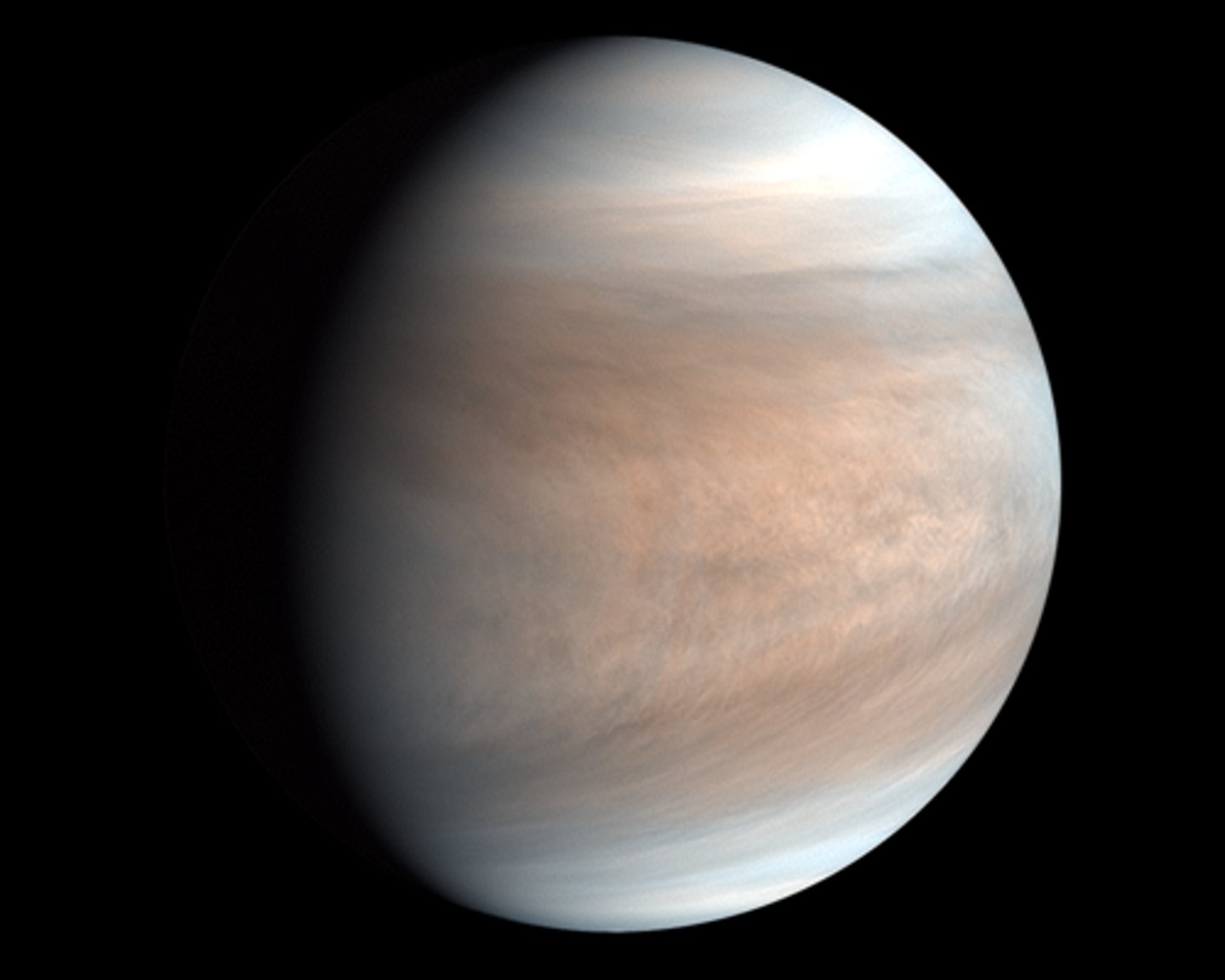
Proved by Galileo Galilei using his telescope, he observed that Venus was going through phases like those of our own moon, distinguished by Venus's location in the sky (like our own moon) and that it reflected more or less light at certain angles (like our own moon), which couldn't happen if it revolved around Earth because it was known that the Earth didn't generate its own light
Venus (Fact 1)
2nd Planet from the Sun
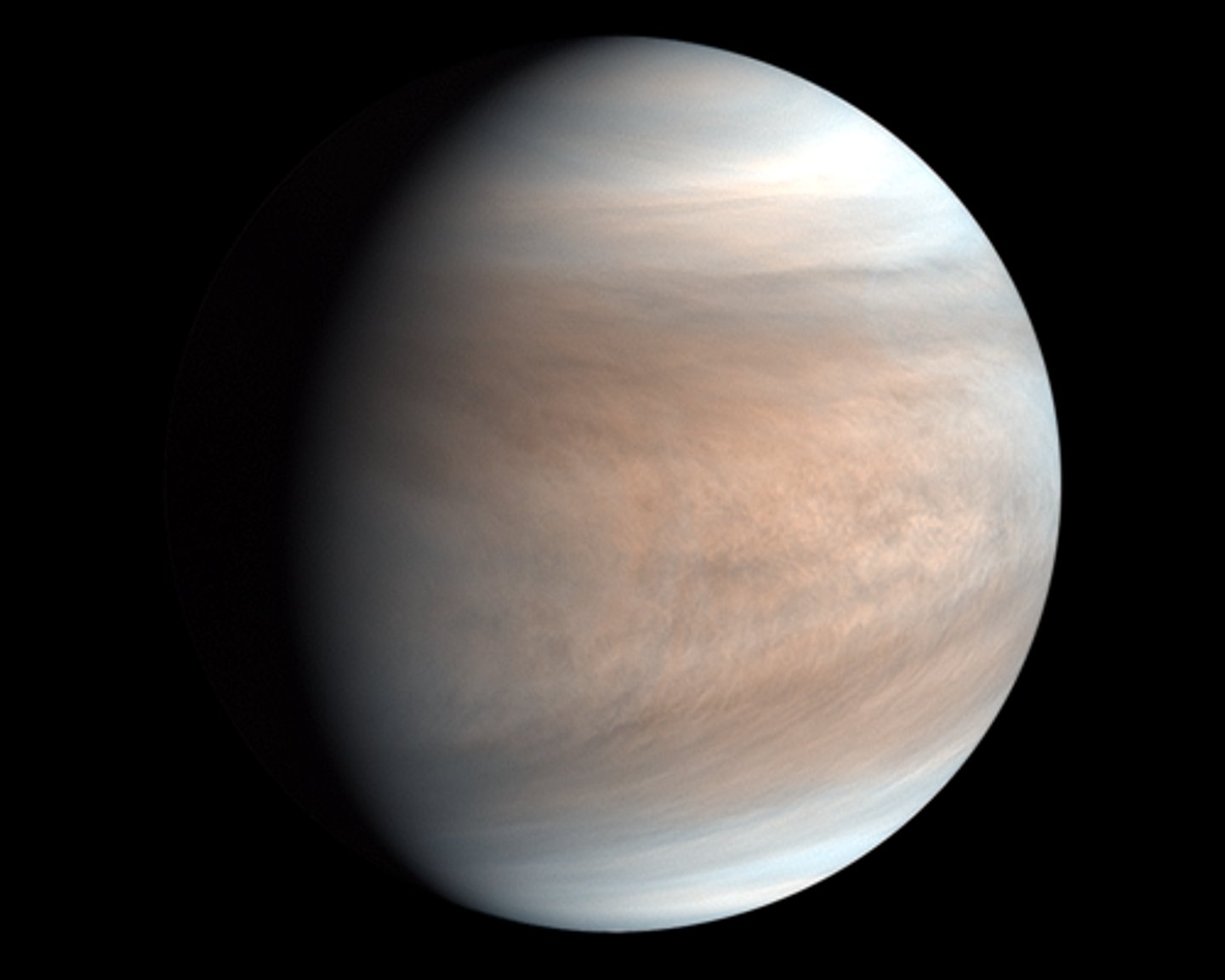
Venus (Fact 2)
Has billowing lakes of Sulfuric Acid and clouds of Carbon Dioxide, of which it helps best demonstrate the Greenhouse Effect among the planets
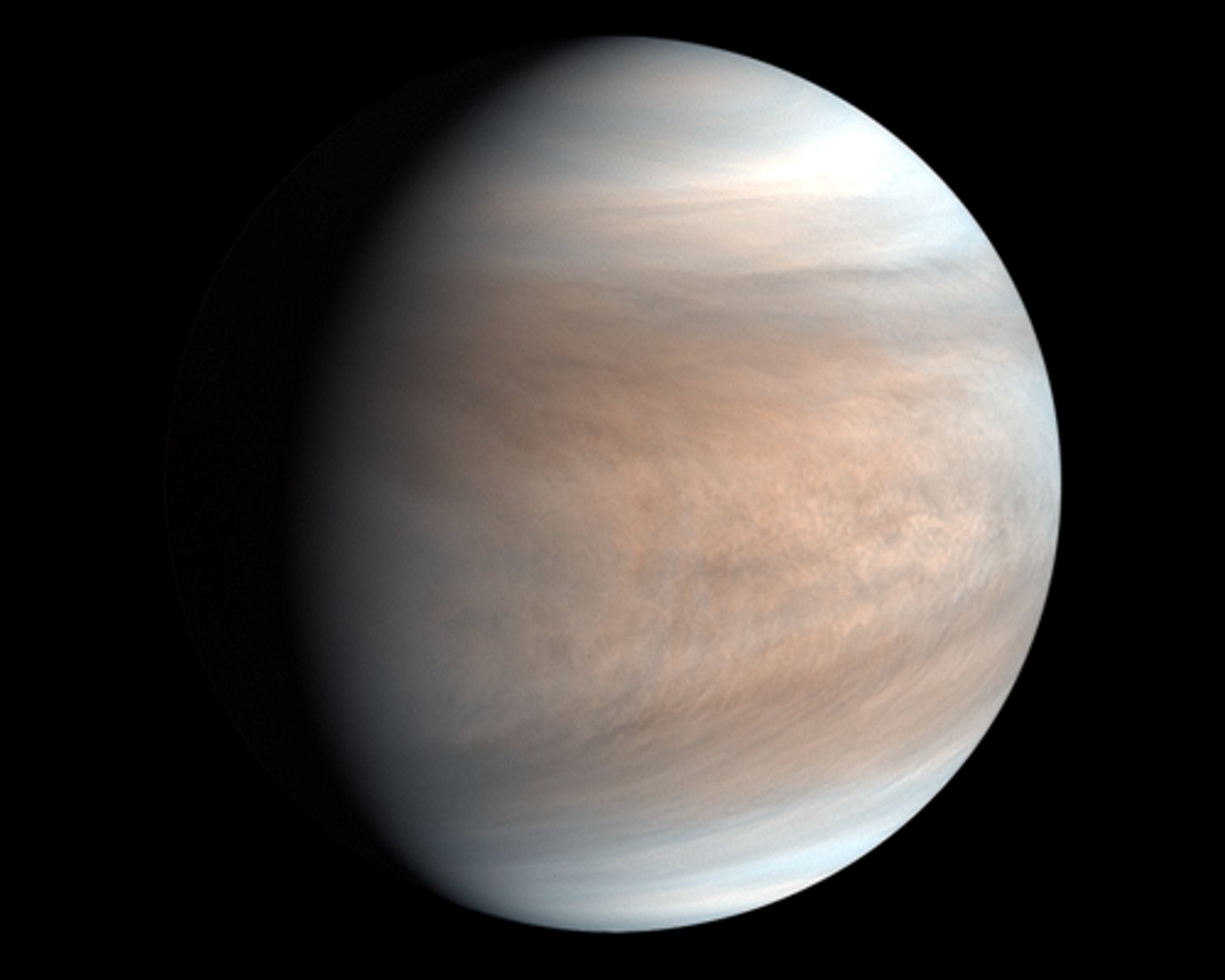
Venus (Fact 3)
Has Retrograde Rotation or "reverse" rotation in which scientists theorize was caused by a large object colliding with it during the formation of the solar system at a speed great enough to "reverse" its normal rotation
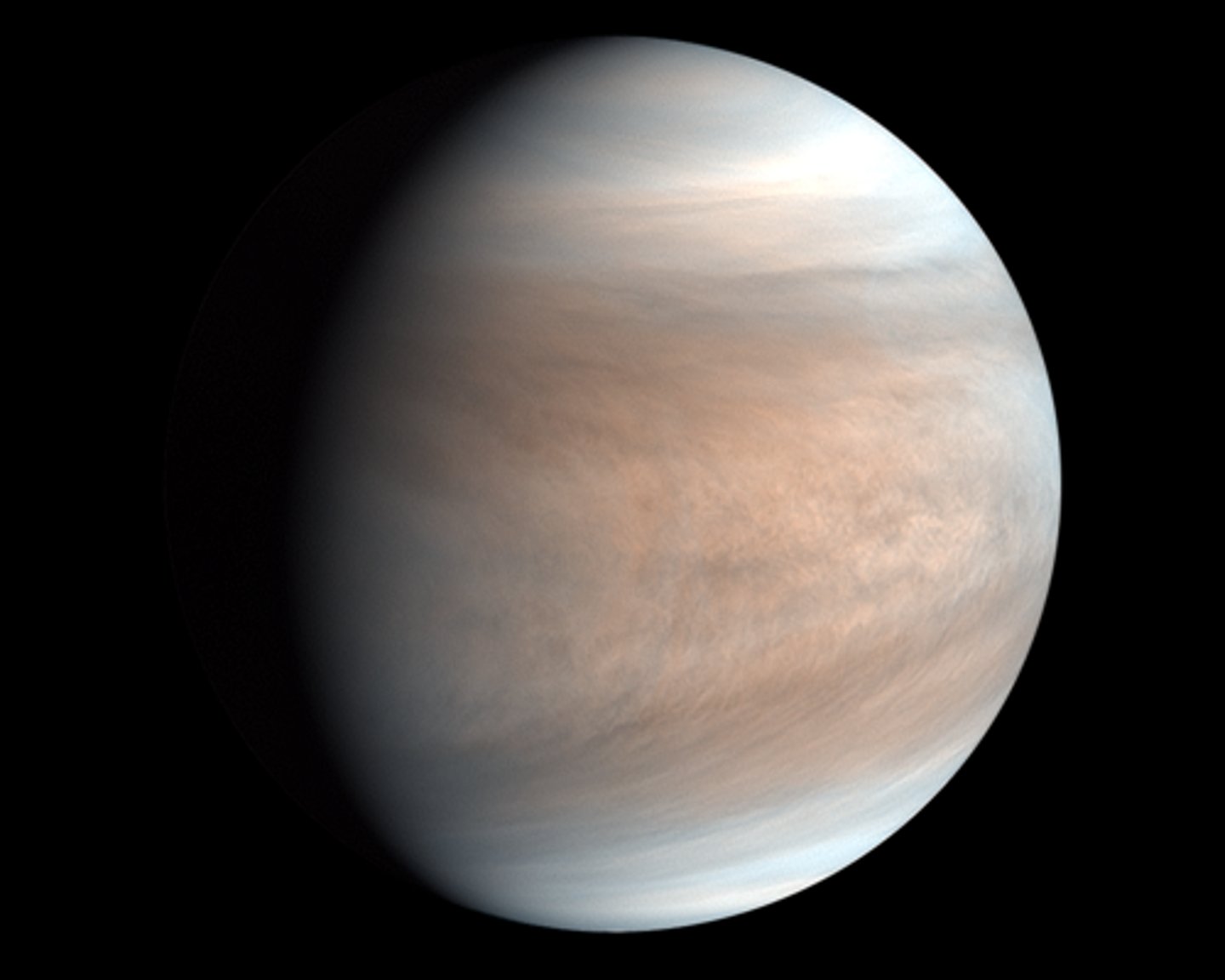
Venus (Fact 4)
Its Period of Revolution is shorter than its Period of Rotation, thus it completes one orbit around the sun before it finishes one complete rotation about its axis, thus its day is longer than its year
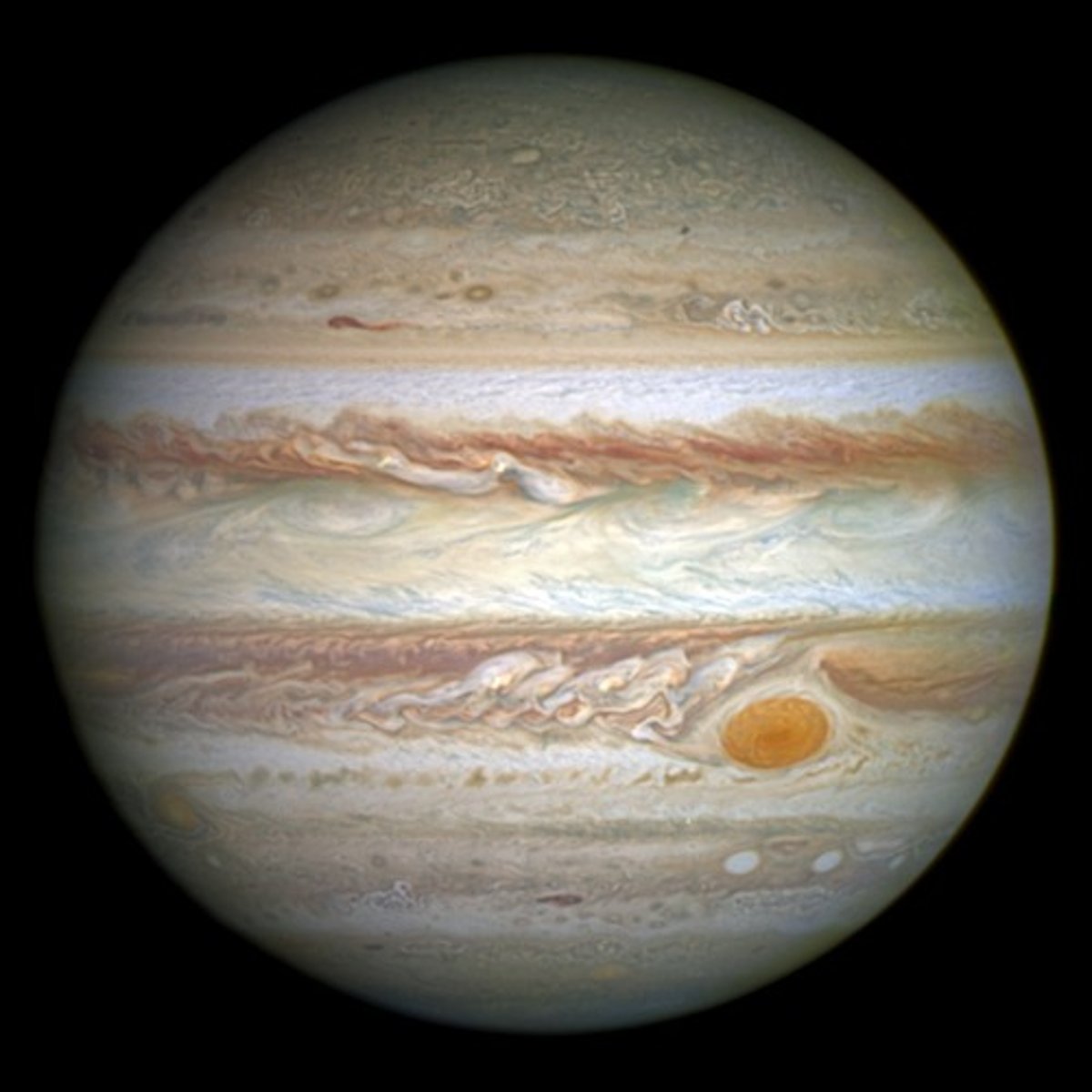
Jupiter (Fact 2)
Has a giant "red Spot", a swirling storm that has been there for thousands of years
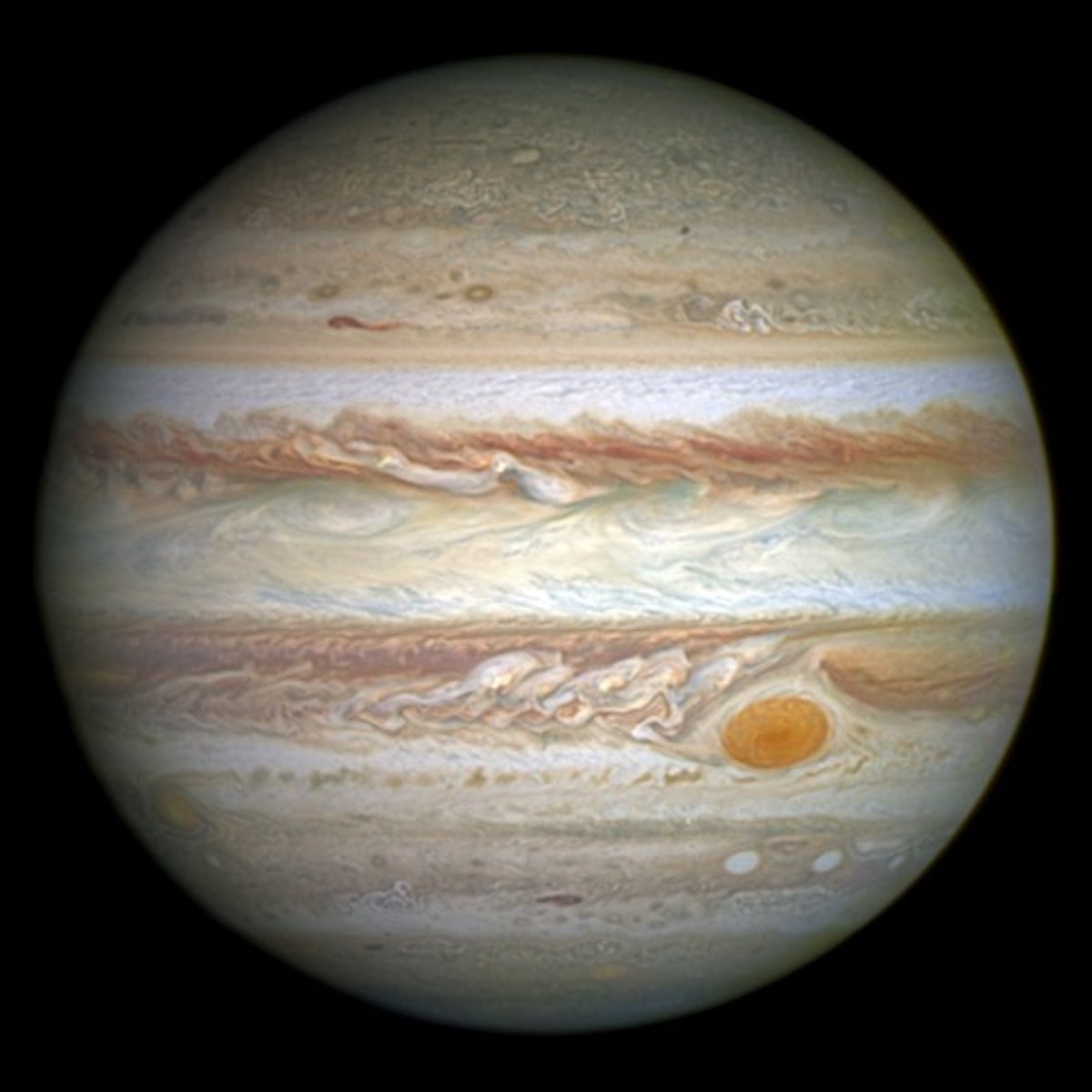
Jupiter (Fact 1)
5th Planet from the Sun
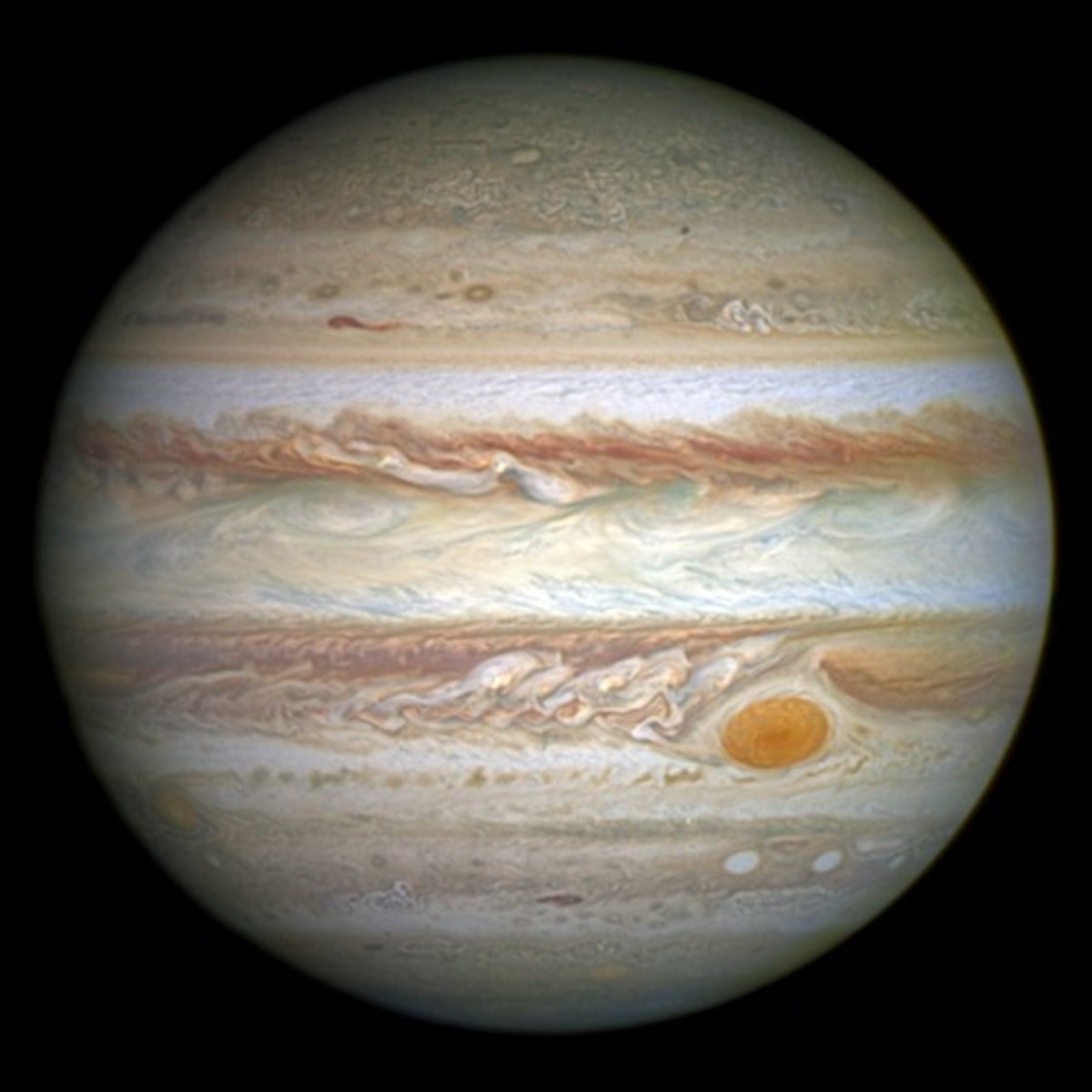
Jupiter (Fact 3)
Has over 60 moons, which include the popular, ice-containing "Europa"
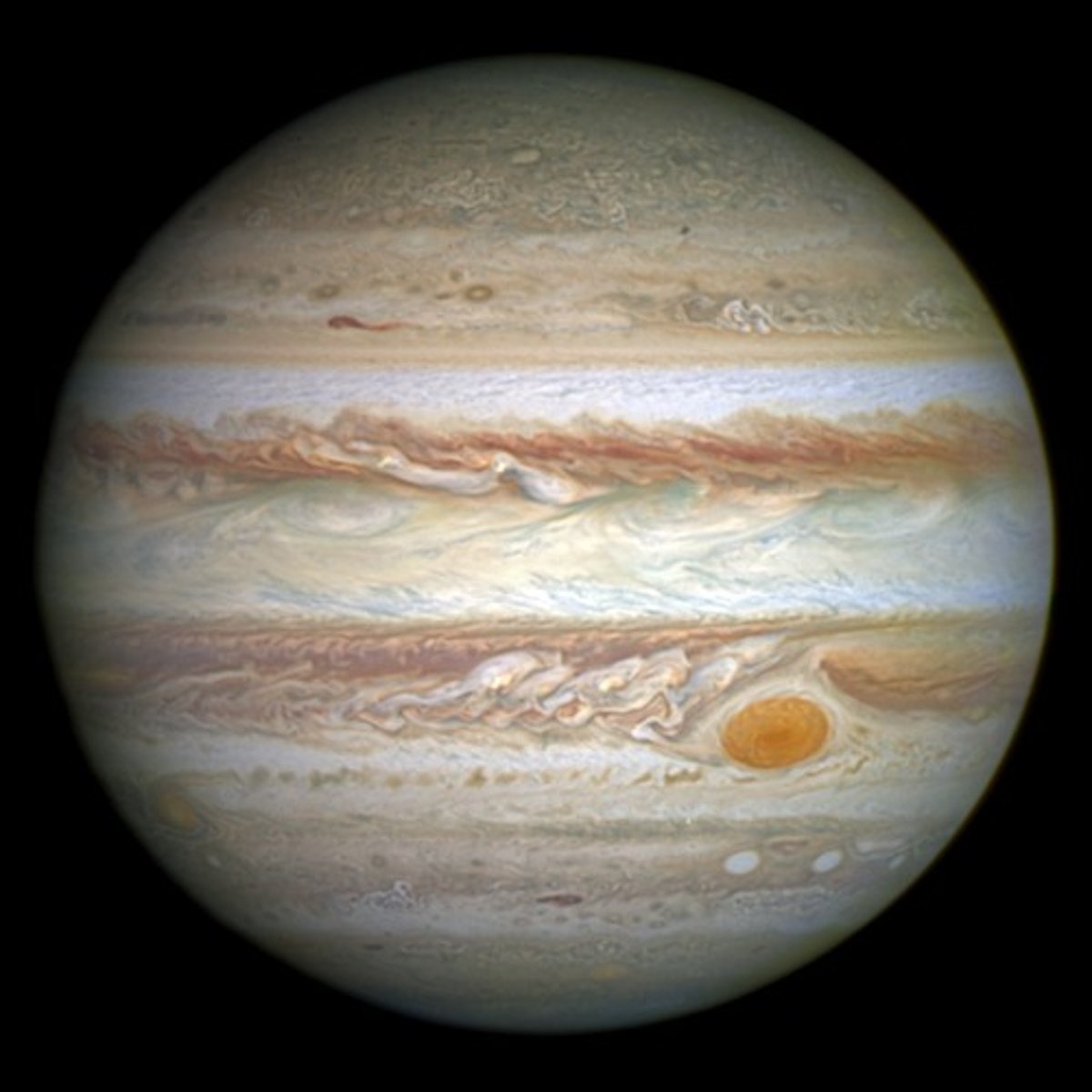
Jupiter (Fact 4)
Largest Planet in the Solar System
Comet (Fact 1)
Ball of rock and dust with ice formed at its "coma" (tail) that follows an elliptical orbit around the sun for a very long period of time until it gets close enough to sun to where its ice tail turns to water and then vaporizes as "solar wind" pushes the particles away to form the tail
Meteor (Fact 1)
Ball of rock and dust sometimes called a "shooting star" that enters from outer space and burns up in Earth's atmosphere due to friction
Solar Weather (Fact 1)
Ejection from the Sun of the products of Nuclear Fusion including subatomic particles and radiation, in which most of the particles and/or radiation is absorbed by the gases in our atmosphere or deflected off our magnetosphere
Solar Weather (Fact 2)
Ejection from the Sun of the products of Nuclear Fusion including subatomic particles and radiation, in which some of the particles and/or radiation passes through in our atmosphere and magnetosphere specifically, producing aurora borealis but also sometimes disrupting electric power grids, causing blackouts
Solar Weather (Fact 3)
Ejection from the Sun of the products of Nuclear Fusion including subatomic particles and radiation, in which some of the particles and/or radiation disrupts NASA satellites in space and can harm NASA astronauts operating ships and/or satellites in space
Spectroscopes (Fact 1)
Tool which measures the exact frequencies or types of light/radiation given off by planets and stars, which in turn are used by Astronomers to study and to understand the physical properties and chemical composition of the planets and stars
Seeing the Past (Fact 1)
Because light takes time to travel (186,000 mi/s), the farther away an object is, the longer it will take for it to reach one's eye, since the sun is 93 million miles away, one who looks at the sun looks at it 8 minutes into the past since 93 million miles/186,000 miles/second roughly equates to 8 minutes (480 seconds)
Binary Stars (All Concepts and Facts)
Optical Double Stars are stars that appear very close together even though they are very far away from each other in space
Binary Stars are stars that appear very close together because they are very close together, and they are orbiting each other, and form near each other in the gas cloud nebula together, two such dense clumps collect material together until they become true stars
Almost half of all stars in the sky are part of a Binary or Multiple Star System
Mizar and Alcor are a good example of a Binary Star type of system, located in the Big Dipper, and were used as an eye test in ancient times since it is hard to distinguish between the two looking with the naked eye
Visual Binary Stars are Binary stars that can be seen separately using a telescope
Sirius is a good example of a Visual Binary Star, as it is composed of Sirius A- a Blue Giant, and Sirius B- a White Dwarf, orbiting each other
Visual Binary Stars are important because you observe them long enough over time by telescope or other complex methods or tools, you may be able to see their orbital motion with each other over time
If we can measure Visual Binary Stars' distance from Earth, then we can determine the size and shapes of their orbits, and applying mathematical and physical concepts of gravity to these orbits, we can find the mass of these stars, and is one of the only ways we know how to find stellar masses, which is when they are in Binary Stellar Systems, and then finally when we know the mass of the star, we can know a lot of other things like their Volume, Density, Magnitude, Luminosity, and Age, so you can thank Binary Stars for the creation of Astrophysics
Spectroscopic Binary Stars are Binary stars that can be seen separately applying concepts of spectroscopy, meaning we know one of the stars is heading towards us and the other away based on the wavelengths being emitted from the light of these stars, and based on the Doppler Shift, one with a Red Shift is moving away because this is a longer wavelength, and one with a Purple or Blue Shift is moving closer because this is a shorter wavelength, and when these shifts appear in a pattern between two very close stars based on the data collection of spectra of these stars, they are considered Binary Stars orbiting so close you cannot even separate them by looking through a telescope
Mizar and Alcor are a Sextuple Star System, or a Multiple Star System since they are a Binary System from a Visual Binary standpoint, but from a Spectroscopic Binary standpoint by observing the spectra and thus the shifts of these two stars, they make a much larger, multiple star system
Astrophysicists today think that stars close by our sun that got ejected from the creation of the star system in the first place, if there were any, must have similar chemical compositions compared to the sun
4U-1820-30
Eclipsing Binary Stars are Binary Stars in which orbit each other by passing in front of each other blocking the other star from our view, we record or observe the total amount of brightness, light, or magnitude being emitted from one star, or the larger star, and how on a graph this brightness dips, when there is a smaller dip in brightness, we assume that the star in front of the other closest to us with a possible blue shift is larger than the other star, and thus when the smaller star comes around in front of the larger star with a possible blue shift, it is smaller because the dip in brightness is much less than the previous dip, and this data is used to measure and record results about these types of Binary Systems, also of which cannot be thoroughly seen with a telescope or another similar tool because it would look like one star despite the fact that one star is orbiting the other and coming in front of it at our point of view, dropping brightness considerably because its overall luminosity is lesser, it is smaller and dimmer as a star, passing in front of a larger, brighter star, the dips are similar if they are relatively the same size like the size of our sun, but completely different if one is brighter or sometimes bigger than the other
As such, a lot of information can be gathered from the graphs and observations of drops or dips in brightness due to the size and shape of the binary stars in relation to each other
This includes finding out about the stars' Sizes, Masses, Rotation Rates, Temperatures, Orbits, and Distances from us or from the viewing point
Contact Binary Stars are Binary Stars that are pretty much touching each other
Two stars that are tightly and constantly orbiting each other, one being a hot blue star and the other being a Red Dwarf, and when the Blue star becomes a Red Supergiant and the Red Dwarf stays the same, since the star's gravity depend on their masses, as the larger star loses mass, the orbits get a little stranger or irregular, and when the star finally swells into the largest star or Red Supergiant possible, it GIVES OFF matter and energy to the other star being a Red Dwarf or much smaller star, touching it as a Contact Binary
However, the process proceeds with the Red Dwarf sucking in the matter and energy from the larger Red Supergiant star, which starts to grow, and over time the star which was once small become more massive than the star which was once more massive than it, and thus the stars sort of trade sizes, the Red Dwarf gets bigger and bigger, and eventually turns into a Red Supergiant going through the life of a star as usual, shedding mass onto the White Dwarf,
Then the Red Supergiant gets smaller and smaller, and eventually turns into a White, and then Black Dwarf (kind of like socialism- giving to the poor until you become poor, making them rich when you were once rich, which solves nothing over time, or Robin Hood- the puppet of Socialism), and Algol of the constellation Perseus is a good example of this Contact Binary Star system, small and large star, and this process is thus known as the Algol Paradox
Stellar Novae are the result of stars becoming visible after being invisible for a long time based on the after effects of the Algol Paradox in star systems like the Contact Binary System Algol, because as the newer, larger red supergiant sheds its mass, Hydrogen Gas and whatnot out into space, some of this is pulled in by the strong gravitational forces exhibited by the White Dwarf, and this can cause massive eruptions of matter and energy to burst out, and the result is the stellar novae or new star, despite the fact it isn't really new but actually old because it has been around so long, they give this name because they are now visible to the naked eye or aid with telescope
Recurrent Novae are the result of these Contact Binary Star Systems transferring or exchanging matter back and forth by the Algol Paradox process and the Stellar Novae Production process, and can go back and forth between the two stars in the system forever, one being large the other small and then vice versa and then back again, all while creating new stars at the same time as stellar novae, and creating booming explosions every now and then
If the matter stream is slower, the material can fuse steadily, never piling up, so it never explodes, however the mass of the White Dwarf still increases and is compressed so much when increasing in size that temperatures get super-hot to the point where Carbon plasma fusion (the element needed to be fused further that exists on all white-hot white dwarves) starts, but because White Dwarves cannot expand due to the strong forces of electron degeneracy pressure, the extra energy goes to fuse all the Carbon all at once and the star explodes as a Supernova, releasing the same amount of energy as Supernova produced from the deaths of High-Mass stars undergoing Silicon Fusion
Star Clusters and their Features (All Concepts and Facts)
Open Star Clusters are loosely bound collections of dozens or thousands of stars usually an irregular shape
Open Star Clusters are formed from gigantic clouds of gas and dust and dependent on local conditions such as how massive the clumps forming in these nebulae surrounded by the interstellar medium can be, and are bound pretty much by their mutual gravity forming an open cluster, all the stars contribute to the overall gravity of the star cluster, and their orbits are not planar but more trigonal or octahedral, like how comets scatter around the sun and celestial objects exist in the halo of our solar system rather than just the orbits
Open Star Clusters range in size but are usually a couple lightyears across, with some closer together than others, and that you would find in normal, interstellar space
Open Star Clusters are astronomically young, a couple million years in age and this is easy to realize because some clusters have a bunch of blue stars, which are younger stars that are bigger mass stars that use up their fuel more quickly because they are compressed more because they are bigger and live shorter lives, so blue star clusters are young clusters, and most of these clusters are young since most of them contain a whole bunch of blue stars or we detect blue or high-energy light and energy from them, and we can also use spectra to determine the mass and/or later on the age of stars in such clusters for more accurate information anyway
Open Star Clusters however are mostly young because the stars within the cluster interact within such a way that they are constantly tugging on one another and changing each other's orbits, and that the kind of orbit an object has depends on the amount of energy it has, the more energy it has, the larger the orbit until it reaches escape velocity and flies out of range of the original orbit and in Star Clusters because of their gravity, stars are always exchanging energy with each other, and these interactions tend to flick smaller, lower mass stars out of the cluster, and then higher mass stars once those are kicked out, and then unstable massive stars and dense stars like Giants and Pulsars and Black Holes, and these collisions are also aided by the tidal forces of the remaining stars in the cluster, especially those of Black Holes, leading to a sort of Evaporation effect of such Open Clusters
The Pleaides Cluster (M45- The Seven Sisters, despite the stars include Asterope, Taygeta, Maia, Celaeno, Electra, Merope, Alcyone, Pleione, and Atlas being more than 7) is a popular example of an Open Cluster undergoing this evaporation effect
Globular Star Clusters are more compact, dense, spherical shaped clusters (hence their name) that contain tens of thousands and hundreds of thousands of stars
Globular Star Clusters are formed like Open Star Clusters, but their difference is that Globular Clusters have a definite core and their orbits are more erratic
Globular Star Clusters are much larger in size, over 100 lightyears across
Globular Star Clusters are different from Open Star Clusters because they are larger, denser, have a definitive core, have more erratic orbits, but also because most of them container redder stars, and that most of these clusters have stars not much bigger than our own sun, and perhaps the biggest difference is that they are much older stellar objects, compared to the much younger open clusters
Globular Star Clusters also contain less heavier elements because since they are old and have been around such a long time, they do not contain the heavier elements that have nucleosynthetically been produced throughout the universe over time, so they are so old that elements like Phosphorus and Sulfur didn't even exist back then, and that they do not have these elements in the stars of these clusters, and that since they are old they have had time to shed their mass of the heavy elements they have created, like Nitrogen or Carbon, and that is gone now because they are so old, some close to reaching the end of their lives
They also live longer than Open Clusters because they are denser and contain more stars, which contradicts the orbital evaporation effect exhibited by the open clusters but makes sense on overall simple terms
Globular Clusters contain stars all born at the same time and thus are all close to or are of the same age, and since they are old they contain a ton of low-mass red stars and white dwarves
Blue Stragglers (like those in M4) are oddly existing blue stars found within Globular Clusters that are created from star collisions in Globular Clusters, which makes sense since there are much stars and there is much more density in globular cluster than open clusters, and thus they collide often and two lower mass stars combine to form one higher mass, blue star
There are around 150 Globular Clusters in the Milky Way Galaxy
And with the help of DeepSkyVideos, we can learn so much more about these Star Clusters thoroughly as deep space objects, NGC, and Messier Objects
Stars (All Concepts & Facts)
A spectrum is the result when you divide the incoming light into individual colors or wavelengths revealing a lot of data about the object. The spectrum we study and measure from a star consists of two different kinds of spectra, stars being hot, dense balls of gas give off a continuous spectrum, emitting light at all wavelengths, but stars have atmospheres as well, thinner gaseous layers above the denser solid and liquid layers, and absorb light at specific wavelengths from the light below depending on the elements in them, the result is that the continuous spectra of a star have dark gaps in them, where different elements absorb different wavelengths, absorptions spectra as they were called.
So, stars were first classified by the strength or quantity of their Hydrogen lines, the most having Hydrogen lines being A stars, the second most being B stars, and so on. Spectroscopist Annie Jump Cannon merged and rearranged certain classifications that classified or organized stars by the strengths and appearances of many different absorption lines in their spectra. Later, physicist Max Planck jumped in and organized stars and their colors based on their temperature as well, hotter being blue and cooler being red. Meghnad Saha later worked on Max Planck's work on how atoms give off light at different temperatures. Then, Cecelia Payne-Gaposchkin showed that the spectra of stars were dependent on both the temperatures of and the elements in their atmosphere, and first proved stars were not made of earth elements, but Hydrogen and Helium based on her work and system she made. Her system is still used today although not as popular, organizing stars by temperature and assigning each a letter, but are not alphabetical for historical reasons systematically, and they go O, B, A, F, G, K, M, pneumonic made: Oh, be a fine girl, kiss me. Our sun is 5500 degrees Celsius and is a G2 star, slightly hotter stars would be a G1 and slightly cooler stars would be a G3. Betelgeuse (beetle juice), being red and cool is an M2, while Sirius A, being blue and hot is a A0. There are no green stars because as much green light as these stars are giving off, our eyes do not detect them for a certain reason, and much of it and purple light bounces or reflects or refracts off of Nitrogen Gas in our atmosphere, one of the reasons our sky is mainly blue, since that is one of the only wavelengths that gets through rather than purple and green, and why it is hard to see green or purple stars in the first place because of our particular atmosphere. Energy measured at a distance is measured as Luminosity, while light given off overall is measured as magnitude or brightness, the higher the number the dimmer the star.
Luminosity depends on size and temperature (and distance), so if two stars are the same size but one is hotter than the other, it has more of a luminosity, however if two stars are the same temperature, but one is bigger than the other, it has more of a luminosity. Knowing the temperature and distance (size), means knowing the stars themselves. Finally, in the 10's, Ejnar Hertsprung and Henry Norris Russell looked for trends comparing and contrasting physical characteristics from temperature to distance (size), to color and so on using millions of spectra and in finding trends, made a table or diagram now known as the HR or Hertsprung-Russell diagram, which is perhaps the most important diagram in Astronomy except for Spectra and their relative spots on the EMS. They plotted a stars' temperature- in which hotter, whiter stars were on the left, and colder, redder stars were on the right, compared to luminosity- in which the more of a luminosity (the energy produced based on distance of the star or size of the star, smaller being farther away and bigger being closer, all as one color however, and not different colors displaying different sizes) is the upper part of the diagram, and the less of a luminosity or energy produced or emitted of the star is the lower part of the diagram. So the trends included a whole bunch of stars in the lower left hand corner of the diagram, extremely hot and small White Dwarves, and a whole bunch of another category of stars in the upper left hand corner, extremely hot and extremely big, most likely because they were (and still are) closer in distance, despite having higher luminosities these were Blue Giants and stars, in the Upper Middle part are Blue Supergiants, a whole bunch of planets in another classification or group being the Red Supergiants, super cold but giving off a ton of energy, and then the Red Dwarves, super cold but not giving out as much energy being in the lower right hand corner, showing us how pretty much all of the stars live their lives, as Main Sequence Stars, then as Giants, and finally as Dwarves, lower mass stars being red and higher mass stars being blue, also known as a result of the knowledge of the lives of stars, and so this diagram helped astronomers classify and understand the lives of the stars. The following paragraphs explain the lives of low and high-mass stars and their products and impact in space after their death, and the features of these star products, such as High-mass stars dying producing black holes, a feature of them being that they have so much gravitational force that light cannot escape from it.
You can think of outerspace just like on Earth, only it is a little weirder than that, and our basis for our understanding of stars, planets, and the interaction between these two celestial objects, comes from a theoretical and mathematical probability designed by the infamous and ingenious Albert Einstein, in that space is warped. Just like the more massive an object is on Earth, the more massive a star is, the more it will be weighed down by gravity, and the more massive a planet is, the more it will be weighed inwards towards the sun. The fact that all stars are formed from nebulae and other types of interstellar explosions and reformations also supports the idea and sense that all stars sooner or later collapse under their own weight due to the gravity not pulling them down, but surrounding them, since there is no "ground" in space. The details here can be a little more complex, but you can accept the rule that gravity is the that force helps the collapse of stars under their own weight occur in space.
For very low-mass stars, convection is the process that heats the star from the inside out because they are much smaller, and thus Hydrogen Fuel would take forever to run out since it is constantly being reused and only a small amount of it is being taken away, and it is known these stars can last up to a trillion years.
However, when a star is created, it is extremely hot, so the high temperatures naturally occur. This is because when gas from nebulae collect into a protostar and later into a disc dependent on the correct sequence and variables of temperatures, pressures, and densities in space, as a gas compresses, it gets hotter to the point where it can make its surroundings hotter, to the point where it isn't a gas, but a plasma due to it being ionized because of how hot it is in the core, and in the mantle soon enough, but thin, dense layers surrounding it such as in our own corona and surface layers. When a star is created, it is extremely compressed, so the high pressures naturally occur also. This is because there is no ground to space and gravity being the most powerful force in the universe makes all celestial objects like stars weigh down on themselves, inside themselves, since there is no ground in space in other words. Therefore, since there is greater pressure when there is more mass in stars, more fuel is squeezed together and used up in higher-mass than in lower-mass stars, so the smaller a star, the less pressure and thus the less fuel it must use, so the longer it lives. Low-mass stars live longer than high-mass stars. Low-mass stars can live up to trillions of years, and sun-like stars can live up to billions of years.
Because of the naturally high temperatures and pressures, the Hydrogen Gas found all throughout the star is becoming very hot, hotter on the insides of stars near their cores. The temperatures and pressures inside the core are so hot that they fuse Hydrogen Plasma into Helium Plasma, which also produces lots of electromagnetic energy or radiation in the form of Infrared, Visible, Ultraviolet, Gamma, and X-Ray Energy, some of which is naturally blocked away by Earth's gaseous atmosphere, so we are unaffected because of the specific chemistries and absorption spectra outside the Visible Light range of Nitrogen and Oxygen. It also produces radiation from the breakdown of heavier elements' nuclei created in complex nucleosynthetic processes. In any star, low or high mass, protons are changed into neutrons through the process of positron decay, in which a deuterium nucleus is made and another leftover proton joins with this nucleus to produce a Helium-3 nuclei, given that the nucleus already has a neutron from the positron decay and a proton that it started out with, while producing a positron and electron neutrino (which may theoretically combine to form an election) with 2 protons and a neutron, whereas the second proton doesn't convert into a neutron and electron neutrino along with the positron or positively-charged anti-matter like electron. The electron from the first proton joining and converting meets up with another electron produced somewhere in the sun, and they join to release a ton of energy in the form of Gamma Rays. Just so you know, protons are just ionized Hydrogen of course inside the core, they only exist inside the core, the core of the star is just protons and a few neutrons. However, this number of neutrons can grow inside higher mass stars until all that is left are neutrons and the protons in higher-mass stars decay so when the star explodes it releases a ton of energy in the form of a supernova explosion, and thus a neutron star is leftover. However, this is not the case with Low-Mass stars.
Once the Helium-3 nuclei is created, it joins with another Helium-3 nuclei also just created recently, and they join to produce Beryllium-6, giving a Helium-4 nucleus, and releasing 2 protons, being an isotope of Beryllium-8, and naturally being an ion. Through this decay, the production of the Helium-3 nuclei, and the smaller 2 protons being released to restart the process, tons of electromagnetic energy and radiation is given off. And the electrons which are stripped from their atoms because of how hot the star is are still attracted to their fellow protons at a long distance because of the electromagnetic force laws, and thus these electrons can flow like electrons in metal wires because they do not return to their atoms because it is so hot, but this is only in the core and sooner or later in the mantel. Therefore, the sun and other low-mass and sun-like stars also have naturally occurring magnetic fields which may repel random electrons, and leftover protons from nucleosynthetic processes back into space, along with all that radiation, all in the formation of solar wind and in extreme cases, solar windstorms. As complex as this process is, there are even more complex nucleosynthetic processes low-mass stars undergo which we will not go into because they follow this same concept but take forever to explain. It takes billions of years just for the entire core of a star like our sun to fuse all the Hydrogen into Helium where there is none left in the core to fuse. Also, the cores of high-mass stars like Betelgeuse and VY Canis Major are so hot that as fusing elements occurs at far higher rates, the fuel is used up quickly as well, and is why they live shorter lives as larger stars. Although this process gives only a little bit of energy, it happens constantly everywhere always within a sun like ours for over 5 billion years, and that adds up to a lot of energy naturally being produced by stars like our sun.
When this happens, the temperatures are not high enough to fuse Helium into Carbon, and either are the pressures, but the pressures are high enough to compress Helium more and more in the core. According to Joseph Gay-Lussac's stoichiometrically-based proportional mathematical gas law that Pressures increase as Temperatures increase and vice versa and decrease at the same time, if Helium is compressed and the pressure of it is raised, it should raise the temperature overall, but although it raises the temperature inside the core a little, it also raises the temperature on the mantle and on near, yet farther parts of the sun then the core, the Helium on the outside of the core is compressed, and thus heats the Hydrogen Gas in the mantle until it ionizes to become plasma. Then it heats it up even more and soon the temperatures and pressures in the mantle due to the compressed Helium core rise so much that the Hydrogen in the mantle can fuse into Helium, in the same nucleosynthetic process as described before. Eventually, all the Hydrogen Plasma in the mantle will be used up, it will all form Helium, and then it will be compressed, thus heating its surroundings to the point where the temperatures and pressures are high enough for Hydrogen fusion.
As this occurs, the sun is getting brighter, having a higher luminosity or lower magnitude, and thus because it is heating up, it is not only getting brighter, but bigger. As this occurs throughout a star from the inside out, and according to Jacques Charles' stoichiometrically-based proportional mathematical gas law that Volumes increase as Temperatures increase and vice versa and decrease at the same time, if the compressed Helium in the core heats up, then it will expand as well. Now the temperatures are high enough to increase the size of the star and are second to the development of the star after Pressures, taking their toll, and then Volume takes its toll after temperature. While the core is expanding, and the high temperatures and pressures are spreading throughout the star from the inside of the core, to the mantle, to the surface layers, the entire star is getting larger and larger because the gas (and plasma) is expanding. Soon, it will expand so much that the Low-Mass star is renamed a Red Giant. As it expands, the temperatures and pressures increase, the volume increases, and the energy produced from the nucleosynthetic processes of hydrogen fusion also increases, however the star becomes so large that the energy produced isn't always released from everywhere out of the star because it is getting so large. Therefore, parts of the star aren't as hot as they were before because it is so large that although more energy is being produced, it isn't enough to escape and/or radiate from the entire star, so as it gets cooler, it gets redder, showing the energy being produced is of less and less energy in the red wavelengths, until it becomes one large, cool, red giant. Surface Area is an important property in determining certain things in science, especially on cool, red giant stars which do not emit as much energy per square unit, most likely per square meter surface area, then they used to, because they are not growing larger proportionally to how much energy they are producing.
In every star, there is a competition between the gravity holding, surrounding, and forcing all of the star together and the nuclear and electromagnetic forces working together to compensate for and cancel out the gravity. As a star survives, there is a balance between these two forces. However, when low-mass stars turn into red giants, the core's combined nuclear and electromagnetic forces are producing enough energy not to make the entire star hot, but in enlarging the star to such grand volumes, it overcomes the gravitational forces holding down on it, so with no gravity holding the star in place, the star starts to disintegrate since there is no gravity holding it down and only expanding plasmas and gases originating from the power of the core. Therefore, when low-mass stars become red giants, they lose about 33% of their mass. As they do so, they shrink because as the mass leaves and the core is all worked up, gravity begins to take its toll again and makes its way toward the balance between electromagnetic and gravitational forces. So, as they shrink, the pressures become great enough again to begin fusing Helium into Carbon since the temperatures from the core are extremely hot and the pressures are building up again from the 33% of the star being disintegrated. Gravitational forces soon win over the electromagnetic and nuclear forces from the core, and the star returns to normal low-mass stars.
The entire process is repeated once again when Helium fuses into Carbon in the core. The Carbon is compressed and it heats up, thus not only expanding but heating its surroundings to temperatures great enough for Helium fusion into Carbon. This overall process produces a ton more energy and the temperature, pressure, and volume of the star increase, thus making it too large for all the radiative energy to be effective and not as much is emitted per square unit probably per square meter, so the energy decreases measured via Surface Area, not as much energy is particularly distributed evenly per square meter because the star is growing in size more times than it is producing energy, and thus making it a cold, red giant. The core's combined nuclear and electromagnetic forces overpower the gravitational forces for a short time in the production of this cold, red giant making the red giant disintegrate more and more of its mass, at around 50% of its mass, because the star isn't as giant as it was before because it didn't grow out because now much more massive Carbon has been created. This same process happens again when the star gets smaller and the gravitational forces win and the pressure increases again and the gases compress and heat and ionize themselves and heat their surroundings in the star just enough to fuse a whole series of heavier elements' nuclei including Oxygen and some Neon. At this point when the star becomes a Red Giant, over the course of another few hundred million years, it loses almost all of its mass, until the star's core forces overpower the gravitational forces so much because there is so little mass and the core is doing so much work to produce so much energy, even though the star is still ironically cold and red, that it explodes and all the plasma returns to its gaseous form in different elemental states producing certain gases which give certain gases found at certain concentrations and densities throughout space from certain stellar orbits or planetary orbits, giving a Planetary Nebula, and the Carbon plasma core soon converts back into Carbon Gas, and then into a large lump of coal in outerspace or a Black Dwarf, but while in the phase of Carbon plasma and neutron and proton-rich mass, it is known as a White Dwarf. The features of a White Dwarf will be explained after a discussion of High-Mass stars.
Because they are so big and all the energy from their core is percolating outwards, it is very bright, so bright in fact it swells up the sun, and so big the core's work can overpower gravity, another reason nuclear forces- strong or weak, are stronger than gravity, because they have the potential to be stronger than gravity, and EMF is stronger than gravity because it if weren't, you would fall right through the ground
THE EMF OVERPOWEING THE GRAVITATIONAL FORCE DOES NOT JUST OVERPOWER IT BECAUSE OF THE EMISSIONS AND ENERGY PRODUCED FROM THE CORE, BUT ALSO FROM ALL THE LIGHT ENERGY FROM THE HEAT ENERGY MAKING THE SUN A BIG RED GIANT AND THE FACT THAT AS IT GETS HOTTER IT GETS BIGGER, AND THUS FROM BOTH EFFECTS IT GETS BRIGHTER IS WHY IT OVERCOMES GRAVITY, NOT JUST BECAUSE OF HEAT AND VOLUME, BUT BECAUSE OF LIGHT ENERGY AS WELL
ALSO A NOTE I MISSED WAS THAT IT IS WORTH KNOWING THAT THE EPIC ERUPTIONS AND CONTRACTIONS OR COMPRESSIONS IN SIZE, DRASTIC CHANGES BASED ON HELIUM INSTABILITY IN THE SUN OCCURING BECAUSE OF HELIUM FUSION HAPPEN MORE OFTEN, HAPPEN MORE THAN JUST A THIRD ROUND OF MASS SHEDDING, THERE ARE PROBABLY 3 OR 4 MORE SPASMODIC AND SPONTANEOUS ROUNDS OF THIS AFTER THE STAR LOSES 50% OF ITS MASS, AND THEN AFTER 3 OR 4 ROUNDS OF THIS, THE SUN JUST ENDS UP LOSING ALL OF ITS MASS altogether LIKE THAT, AND PRODUCES A WHITE DWARF
ALSO NOTE THAT NOT ALL SUN-LIKE STARS OR SMALLER STARS THAT ARENT AS OLD AS RED DWARFS OR BLACK DWARFS PRODUCE PLANETARY NEBULAE, ONLY SOME OF THE LARGER ONES, OUR SUN MAY FIT INTO THAT CATEGORY, WE OBVIOUSLY DO NOT KNOW WHETHER OR NOT THAT WILL HAPPEN, HOWEVER SCIENTISTS THINK IT WILL BASED ON STARS SIMILAIR TO THE MASS OF OUR SUN AND THE RESULTS AND AFTER EFFECTS OR CELESTIAL PRODUCTS OF THEIR DEATH
Therefore, we have covered the production and basic descriptions of many celestial objects in this document including Sun-like Stars, Red Giants; Red, Brown, White, and Black Dwarfs; and Planetary Nebulae. Before we will ahead to discovering the production and basic descriptions of another handful of celestial objects based on the lives of High-Mass stars, let us go more in depth with Planetary Nebula, since they are not the only type of nebulae, and let us talk about nebulae, because they are where all these stars are born.
For High-Mass Stars, the same concept occurs except nucleosynthetic processes continue and there are more than the 6 or 7 rounds in the Low-Mass stars; when Carbon fusion begins to create heavier elements like Neon (Carbon and Helium), Sodium (Carbon, Helium, and Hydrogen), and Magnesium (Carbon to Carbon). As plasmas in the cores of stars, they are compressed, heating their surroundings and increasing the overall volume of the star until all the layers follow this same pattern and the star enlarges and cools to a red supergiant, not a red giant, since it results from a high-mass star, it turns into a red supergiant (like Betelgeuse) or red hypergiants (like YV Canis Majoris, the largest known star in our own galaxy with a circumference of 2 billion kilometers, which come into existence after a couple rounds of expansion and contraction. The process continues with Neon, Sodium, and Magnesium fusion into Sulfur and Silicon, and then into Iron. However, once Iron is created, it stops fusing, and the red supergiant that is created loses all of it mass here and dies out. However, a series of steps and concepts follow different from ordinary low-mass stars. Due to the complex and astronomically-based physics of universal Iron plasma (which do give such stars very strong magnetic or electromagnetic fields), the stage taking place in such high-mass stars is through the absorption of the energy of the core instead of emission of the energy of the core. Also, high-mass stars shrink to become much hotter than low-mass stars, giving off a lot more energy (of course, wavelength-wise), so they become blue supergiants from the start, and get smaller (like Rigel). They may also become blue supergiants because the energy produced from the Silicon and other heavy element fusion is great enough not to cool, but heat the star, determined by its density or mass and volume measurements, making the energy rate more proportional to the surface area per square meter or centimeter of the star. When the star sheds all this mass while absorbing all this energy into one small, compact, dense ball, the fate of a high-mass star ends similarly to low-mass stars, in which case it dies and a supernova explosion occurs, equivalent to a planetary nebula, and a dense ball of neutrons is formed, since the electrons are absorbed by the Iron Plasma, and since protons decay, these small, compact balls of neutrons in space are known as neutron stars, composed entirely of neutrons. These happen to high-mass stars with masses 8 times than that of the sun. Any bigger a star, the high high-mass stars die and a black hole is created, which is so dense and compact in which case gravity pulls it down so much that near light of the star cannot escape and is sucked in, and that is why it is black and not lit because it is gravitationally distorted, which makes the core so strong that a black hole can start to form... or just a neutron star. Whether a neutron star or black hole is created, a supernova occurs and Silicon fusion stops. Because the Iron absorbs the energy, the entire star collapses, and in forming the neutron star or black hole and supernova, it releases a ton of energy and makes heavy enough elements to be considered contributors to your own stuff, as well as electromagnetic radiation in the form of neutrinos, which hate matter, they could be anti-matter, they pass through lead as if nothing was there. This vast waves of neutrinos hits the material going inwards, and thus it blasts outwards forming a supernova explosion, and the expanding material is called the supernova remnant, nebulae and interstellar medium.
High-Mass stars 20 times the mass of the sun go through many different stages of fusion, Helium fusion will take around 1,000,000 years, Carbon Fusion will take around 1,000 years, Neon Fusion will take around 1 year, Oxygen Fusion will take several months, and Silicon Fusion will take only about a DAY!
AND NOT TO MENTION, SUPERNOVA DESPITE DESTROYING US ALL IF THEY WERE CLOSER THAN 100 MILLION LIGHTYEARS AWAY FROM US, NONE OF THESE STARS EXIST EXCEPT FOR ONE WHICH IS LOW IN MASS IT PROBABLY WILL NOT EXPLODE, SO NO NEED TO WORRY SOMETHING ELSE WILL KILL US, ALSO THESE ARE ESSENTIAL BECAUSE EXPLOSIVE NUCLEOSYNTHESIS, THE CREATION OF HEAVY ELEMENTS, METALS, AND MATERIALS DRIFT OUTWARD ALL THE WAY TO EARTH BILLIONS OF YEARS LATER AND THE CALCIUM IN YOUR BONES AND PHOSHPROUS IN YOUR DNA COMES FROM ANCIENT EXPLOSIVE NUCLEOSYNTHESIS, ALONG WITH COSMIC RAYS BEING ABSORBED BY YOUR BODY, SO YOU ARE MADE OF STAR STUFF AND YOU ELECTROMAGNETICALLY REACT WITH STAR STUFF, THUS DEVELOPING A STRONGER RELATIONSHIP WITH YOU AND THE STARS
Stars substantial compositions are found using spectroscopes and telescopes of stars to see what radiation their giving off in the process of producing energy, both chemically and in a nuclear sense, and producing Helium, while giving off leftover solar particles like repelled electrons from a stars magnetic field, as well as lots of electromagnetic energy, stars like our own sun give off infrared, visible, and ultraviolet light, but some other stars more distant from us can also give off X-Rays, Gamma Rays, very weak Radio Waves, and Cosmic Rays, so their compositions are found using emission and absorption spectra
Remember though that all the thicker, denser cores of stars are giving off all this radiation, the thinner, less dense gaseous atmospheres of stars, apart from the plasma, can absorb some of this electromagnetic radiation, therefore not all light gets through, and there are black lines rather than a continuous spectrum in all emission spectra
Two scientists by the name of Ejnar Hertsprung and Henry Russell found trends in their work of studying the physical properties of stars after determining their chemical compositions with the help of other famous scientists, and they were the ones to come up with the official system for classifying stars based on their physical properties, rather than their chemical ones, and they found a trend in a relationship between three different physical properties of stars and thus compiled it into a chart they called the Hertsprung-Russell Diagram, they named it after themselves, and it is considered what the periodic table is considered iconic to chemistry or what the electromagnetic spectrum is considered iconic to physics
It shows that the hotter and larger a star, the more luminous and vice versa proportionally, however since it compares 3 properties, there are more comparisons to be made than this
If two stars are of the same temperature, but one is larger than the other, it is more luminous, and if two stars are of the same size, but one is hotter than the other, it is also more luminous
Thus, really large, cool stars are very luminous, and smaller, hotter stars are just as luminous, and thus small, hot stars are more luminous than small, cool stars
Therefore, stars that are very luminous but are cool must be very huge, and stars that are very luminous but are small must be extremely hot
So, some of the properties of stars in classifying and understanding them include pointing out their chemical composition, rate of fusion (which force is acting against gravity to keep the star alive or in other words rate of energy production vs collapsing under its own gravity), temperature, mass (size), pressure, luminosity (brightness), and most importantly, magnitude
Also another variable is the rate of fusion, which considered mathematically explains why larger stars live shorter lives than smaller stars, the more massive star, the more room there is for more pressure, thus energy is produced and fuel is used up, and the entire process happens very quickly, with smaller stars, the pressure isn't as great because there isn't so much room (mass) for it to collapse under its own gravity or put pressure on it, therefore it takes much longer for it to use up its fuel, you can think of high-mass stars as unstable and low-mass stars as stable chemical compounds
Because of this, the lower the mass is of a star, the longer it lives, and the higher the mass is of a star, the shorter it lives
Stars increase in luminosity throughout their lives not just in comparison to size and temperature, but also from the fact that the core of stars like our sun contain Helium, and that Helium is compressed, and so whenever gases are compressed they heat up, because Joseph Gay-Lussac's Law states that an increase in pressure results in an increase in temperature, therefore the core of a star like our sun slowly produced more and more Helium, it gets hotter, and the resulting light gets brighter, so stars like our sun get brighter as they move on with their lives
Certain types of stars are grouped based on all matching certain characteristics together at the same time, there are also different types of stars, and different types of the same type of star based on the age of the star, since stars can be characterized and called different names based on the stage of their life that they are in, the types of stars include sun-like stars, low-mass & high-mass stars, brown dwarfs, red dwarfs, black dwarfs, white dwarfs, red & blue giants and supergiants, neutron stars, and black holes
Low-mass Stars live the longest of all stars, and there isn't much mass, thus not much pressure, thus more time for fuel usage, and convection of Hydrogen occurs on such stars, thus making the fuel more available, these stars can last up to a trillion years, and our sun will only last up to 10 billion years, so that means it is much bigger than low-mass stars
Low-mass stars' energy production in the form of helium gas as well as hydrogen gas ingredients leftover convect throughout low-mass stars, in other words the hot gas rises to the top of the star and when it cools it falls back down, just like certain parts of the Earth contain certain amounts of lava and other gases and they convect in just the same way
Therefore, since there isn't much pressure because of its low mass, it can convect hydrogen and helium rather than have anything push down on it, and then this will make the falling hydrogen reusable, so it can refuel the star from its core to its outer layers over and over again, thus making the star last a lot longer
Our own sun also has convection occurring, just not as efficiently as low-mass stars
The most common of low-mass stars are called red dwarfs, and sun-like stars like our own sun are also considered low-mass stars, they are just named differently based on the age of their life and the type of death they have, that is because Red Dwarfs die by exploding and in the end producing Black Dwarfs, but Sun-like Stars die by exploding and in the end producing White Dwarfs, and a Planetary Nebula
Scientists believe low-mass red dwarf stars die to be a Black Dwarf, a large lump of a mixture of heavy elements created in the star throughout its life or from the start of its life, but no one really knows how it explodes or what products it comes up with because as they can last up to a trillion years as proved mathematically by comparison of larger stars and their lifespans', the age of the universe is only around 14-15 billion years, as proved physically by very complex electromagnetic radiation tracing measurements, so they are probably just starting their lives now
While smaller Low-mass stars convect leftover Hydrogen and produced Helium from the core to the surface of the star, Sun-like stars do convect, but only after it has been produced, rather than carrying it straight from the core to the surface
When you compress a gas, it heats up, and when you heat a gas it expands, which seems contradictory, but their laws of two different contexts, the expanding and compressing is happening at the same time in stars, it's just a matter of which is happening more, if more compressing is happening than expanding for example, than the star is near the end of its life, until compression under its own gravity due to all the fuel being used up is all that happens
As a star (like our sun) continues its life, less and less fuel is available and the pressure continues to compress the gases, and at one point in a star like our sun's life, more expanding is happening than compressing, because the outer layers from the core like the convection layers, radiative layers, and corona are also heating up like the core, so the star gets bigger
In other words, when more and more Hydrogen is converted to Helium, soon the fuel runs out, but the star doesn't explode there, because only the core is Helium, the rest of the star is still Hydrogen-filled
Instead, the Helium core doesn't fuse into heavier elements like Beryllium or Oxygen, but is still compressed, so although the temperatures are not hot enough in such stars like our sun to make Helium fuse into heavier elements, the pressures are high enough to compress, and thus heat the core of the sun (according to Gay-Lussac's Law), so it gets so hot that the Hydrogen outside of the core begins to fuse into Helium, thus making the overall star hotter, more luminous, and also in result of producing and releasing energy, makes the star bigger, and as this pattern continues, the energy produced is of greater amount, but the star is too large for that energy to compensate the surface area of the entire star, so since the stars are bigger, there is less heat to contain itself in because it is so large, the heat won't spread as quickly, so the star gets cooler, and thus redder, until it becomes a red giant, or red supergiant
Such stars also increase not only in size, but in luminosity, for the bigger they get, and thus the cooler they get, that trend matches an increase in luminosity, usually
Remember not to get confused with Red Dwarfs and Red Giants
So, although the core has now been completely fused to Helium, the temperature isn't hot enough to fuse Helium into heavier elements, but the pressures are great enough to compress the gas and heat the outer layers from the core of the sun to temperatures hot enough to fuse Hydrogen into Helium, producing and releasing energy throughout the star as this process continues, and thus making the star bigger because as the gas is compressed, it heats up to other layers, and when those fully convert to Helium and heat up to the next outer layers, they compress and expand, and this continued expansion is what makes stars like our sun turn from their normal size to much larger subgiants, red giants, and red supergiants
As this process continues, such a star will shed mass, approximately 33% of it, because the core's nuclear forces are strongly overpowering the gravitational forces trying to make the star collapse on itself, so material on the surface is blown off like a large solar wind, because the energy from the core already makes the star shed itself, since it is overpowering gravity, the star overall expands rather than contracts, but loses mass at the same time in the form of large solar winds because there is no gravity to push it down, and this process continues and enlargens the star, making it lose mass, until finally the core is hot enough to fuse Helium into Beryllium, and Carbon, in which case in releasing tons of energy from this type of nucleosynthetic process and as result of complex physics concepts demonstrated inside stars, the core begins to expand and absorb the energy created, thus making the star smaller and smaller again
The whole process starts all over again when all the Helium fuel to make the Carbon is used up, and the Carbon (as a gas, in a scary way) is compressed to temperatures hot enough to fuse the rest of the Helium in the star into Carbon, thus making the star bigger and brighter again, cooler and redder, until it becomes a red giant again, and as the core and other layers close to it overpower the force of gravity because of their strong nuclear force and large energy production, more of the surface of the star sheds because there is no gravity to compress, and it loses up to more than 55% of its mass
This process or pattern continues whereas Carbon fuses into heavier elements, the star contracts and expands again into a red giant, and loses a larger percentage of its mass, until it loses all of its mass, that is when the explosion occurs, in the form of a nebula, and there is only a small, dense leftover in the form of a White Dwarf, cooling and fading over millions of years
Low-Mass Stars: White Dwarfs (All Concepts and Facts)
So when a sun-like star or low-mass star with 1 or more solar masses, that being 1-2 or 3 solar masses goes through about half of the rounds of nuclear or stellar fusion and nucleosynthesis in order to provide fuel and energy for the star to live, constantly expanding and contracting in size due to astrochemical and astrophysical phenomenon, the core of the star at about half of the rounds, when 50% of the star's mass is disintegrated due to the power of the core and the EMF overcoming the original gravitational power of the star, what remains of the star are carbon nuclei, electrons, and a small, random amounts of a few other elements
Like charges repel, and two electrons both having the same charge of negative repel each other, the tighter you squeeze them, the stronger the pressure
Another force being a result of complicated Quantum Mechanical principles and concepts known as the Electron Degeneracy Pressure applies the Pauli Exclusion Principle in that no two electrons with the same [half-integer] spin (also known as Fermions) can occupy the same orbital (quantum state) at any given time (simultaneously), and that it implies that electrons hate being squeezed together beyond simple electrical repulsion, and as a strong repulsive force, a phenomenally strong resistance, so it becomes the dominating force in supporting the core of a star when Helium fusion stops, this electron degeneracy outward pressurizing force balances out with the gravity of the soon to be white dwarf star's core, and when it sheds all of its remaining mass becomes a White Dwarf, and its features become more and more clear as its size shrinks
One of the most prominent features is its extreme density, 1 square centimeter of it weighs a ton, or 2,000 pounds, so an ice cream scoop of White Dwarf material outweighs 60 cars
Its extreme gravitational force on the core after overcoming the electron degeneracy pressure and forces means that if you weigh 75 kilograms, you would weigh 7,500 tons on this kind of celestial object
It can vaporize and ionize pretty much anything around it at 100,000 degrees Celsius
Their intense heat and small size is why they are called White Dwarfs
It can also glow in the X-Ray and Ultraviolet Radiation
Because they are so small, they are very faint and hard to see unless you have a telescope
William Herschel who is famous for discovering Uranus among cataloguing celestial objects and refining many of Messier's catalogues, as well as discovering Infrared Light, gave these nebulae that kind of name because through his telescopes they looked like planetary discs of matter
Charles Messier made a catalogue of avoidable objects he so-called them in order to look for planets, small fuzzy blobs in space examined through eyepieces at the time which eventually were made into a catalogue, and among them are many planetary nebulae like M27
Some Planetary Nebulae are plain round discs, but some are elongated, some have spiral patterns, some have jets shooting out on either side, some have tendrils blowing out, and while they all appear symmetrical, there are only about 100 disc-like planetary nebulae or circular bubble shapes
A red giant shedding its mass will normally blow a solar wind outwards in all directions spherically, however as they begin to blow away they expose the deeper, hotter parts of the star blowing a less dense, but much faster wind, which eventually catches up with and ties or bangs into the slower solar wind, and then you get the solar spherical or circular bubble shaped planetary nebula
However, Binary Stars give off the more elongated polar side shapes due to centrifugal force and other physical phenomenon and concepts
The other shapes and structures are produced in other ways still only based on theories
The glow in a planetary nebula is due to the white dwarf ionizing the gas around it, Hydrogen glows red, Oxygen glows Green, at certain oxidation states up in space of course, Nitrogen and Sulfur glow red and orange, and oxygen can not only glow green but also blue
The structure, shape, and color of a Planetary Nebula tells us about the life of the star that formed it and learn more about stellar evolution
After a few hundred thousand years, the white dwarf will become a black dwarf, and the gas glow will go away because there is nothing to ionize it, so we do not see many Planetary nebulae in the universe, much less see any in our own galaxy because the planetary nebulae you see is only a short, brief stage in the life cycle of a star, so the millions of other stars are undergoing other stages with the exception of a few, so enjoy looking at them while you can
High-Mass Stars: Neutron Stars (All Concepts and Facts)
By electron degeneracy pressure fails to stop the collapse of a core collapsing 4 solar masses or larger, and while this happens via positron decay and electron capture, the core squeezes the protons, electrons, and neutrons all into an extremely heavy, dense ball of neutrons known as a neutron star, also white because of the tremendous amount of heat and light being produced but named after its composition rather than its description
Its mass being 1.5 times that of the sun and 12 miles in diameter, the solid crust, normal matter squeezed to an everlasting rate is only a mile thick, and the heavy neutron interior is a liquid
Like electron degeneracy pressure occurring to resist the gravitational forces in White Dwarves, Neutron degeneracy pressure is occurring to resist the gravitational forces in Neutron Stars
Like electrons, neutrons resist being squeezed two tightly together (strong nuclear force pressure at work here rather than EMF pressure, so the strength of the pressure is extremely, or much farther and stronger than for electrons), so if the remnant or core is less than 2.8 solar masses is basically forms a large wall of neutrons, with a few surviving protons and electrons scattered in between and as everything stops a shockwave occurs and neutrinos are produced and blast outwards, a neutron star is found in the middle of M1- the Crab Nebula
Its mass is packed up, all the mass of the sun packed into a ball around 20 kilometers across
So imagine an atom enlarged to a baseball field, and then a marble on the middle of the baseball field would be a neutron, and there would be electrons whizzing about on the high tops of the stadium, now imagine a zillion marble rows and columns as walls forming between the marble and top corners of the stadium, that is one atom of a neutron star
Neutronium (Neutron star stuff), one single cubic centimeter of it has a mass of around 400 million tons, or the total mass of every single car and truck in the united states alone crushed down to the size of a six-sided dice (Mass)
A typical neutron star has a surface gravity 100 billion times stronger than Earth's, so if you weigh 130 pounds on Earth, you would weigh 13 trillion pounds, more than 20 Empire State buildings in weight
When you take a spinning object, and shrink it, the spinning will increase, such as when an ice skater brings his arms in and spins faster, but as it turns into a neutron star this spin, the orbit of the actual star, like a planet, will increase much more, and not only does the spin increase but the magnetic field increases as well, having a magnetic field several trillion times stronger than our own sun
The first Neutron Star was detected in 1965, another one correctly identified and found in 1966, and in 1967 Jocelyn Bell discovered a Pulsar in 1967 (neutron stars and their rapid rotation and strong magnetic fields launch twin beams of energy on opposite sides away from the star outwards sending out an EMP (electromagnetic pulse, like a lighthouse pattern), and from Earth we see and detect this as a Pulse, specifically an EMP, and is detected in radio waves, visible light, and x-rays, and the spin was discovered to be and always is very stable despite being a natural object, catalogued LGM-1 (Little Green Men, for acting this way)
Some of these pulsars are in Binary Systems, and exchange and trade matter in space between other stars, centrifugal force would rip them apart over time despite their strong gravity towards each other
There is a Pulsar in the middle of the Crab Nebula, which powers the Nebula all by itself causing it to glow brightly even after 1,000 years
The extremely thin, squeezed, highly-compressed, highly-stiffened and crystallized-state normal matter that makes up the solid crust or wall of these neutron stars, and the magnetic field being stronger than most can rip through the solid crusts, acting like the breaks on a car, slowing the spin of the star, because in a neutron star, the crust and magnetic field are so intertwined and locked together, so a change one affects or changes the other, so the crust of the star is under incredible strain due to the intense gravity of the magnetar and the rapid rotation of the magnetar, and if it cracks or slips it can cause an extremely strong Starquake, and the energy released from these solid crust cracks is huge in amount, released as a tremendous explosion or burst of energy, shaking the crust, and shaking the magnetic field, and the magnetic fields react
Magnetars react extremely and strongly from these bursts or solid crust cracks and the Magnetar can release a solar flare, and in a second, a magnetar can release as much energy as the sun gives off in 500,000 years, and is over a billion times as strong of a solar flare as the Sun
Magnetars are uber-powerfully quadrillion times stronger than Pulsars, and their magnetic fields slow down the spin of the star, most magnetic objects in the universe
One Magnetar called SGR 1806-20, located 50,000 (500 quadrillion kilometers) lightyears away from us, had one of these slips or cracks in the solid crust and it erupted or exploded, releasing X-Rays which hit a satellite out in space in 2004 called Swift that was blinded by these powerful X-Rays that it was supposed to detect in the first place, and the Earth's upper atmosphere became partially ionized, this shows how powerful these Magnetar Eruptions can be, but we are safe because there are very few magnetars in the Milky Way Galaxy and in the Universe, a good percentage of Neutron Stars are Pulsars, like the one in the Crab Nebula, but only 10% of Pulsars are Magnetars in the known, observable universe
High-Mass Stars: Black Holes (All Concepts and Facts)
By electron degeneracy pressure fails to stop the collapse of a core collapsing 4 solar masses or larger, and while this happens via positron decay and electron capture, the core squeezes the protons, electrons, and neutrons all into an extremely heavy, dense ball of neutrons known as a neutron star, also white because of the tremendous amount of heat and light being produced but named after its composition rather than its description
Its mass being 1.5 times that of the sun and 12 miles in diameter, the solid crust, normal matter squeezed to an everlasting rate is only a mile thick, and the heavy neutron interior is a liquid
Like electron degeneracy pressure occurring to resist the gravitational forces in White Dwarves, Neutron degeneracy pressure is occurring to resist the gravitational forces in Neutron Stars
Like electrons, neutrons resist being squeezed two tightly together (strong nuclear force pressure at work here rather than EMF pressure, so the strength of the pressure is extremely, or much farther and stronger than for electrons), so if the remnant or core is less than 2.8 solar masses is basically forms a large wall of neutrons, with a few surviving protons and electrons scattered in between and as everything stops a shockwave occurs and neutrinos are produced and blast outwards, a neutron star is found in the middle of M1- the Crab Nebula
Its mass is packed up, all the mass of the sun packed into a ball around 20 kilometers across
So imagine an atom enlarged to a baseball field, and then a marble on the middle of the baseball field would be a neutron, and there would be electrons whizzing about on the high tops of the stadium, now imagine a zillion marble rows and columns as walls forming between the marble and top corners of the stadium, that is one atom of a neutron star
Neutronium (Neutron star stuff), one single cubic centimeter of it has a mass of around 400 million tons, or the total mass of every single car and truck in the united states alone crushed down to the size of a six-sided dice (Mass)
A typical neutron star has a surface gravity 100 billion times stronger than Earth's, so if you weigh 130 pounds on Earth, you would weigh 13 trillion pounds, more than 20 Empire State buildings in weight
When you take a spinning object, and shrink it, the spinning will increase, such as when an ice skater brings his arms in and spins faster, but as it turns into a neutron star this spin, the orbit of the actual star, like a planet, will increase much more, and not only does the spin increase but the magnetic field increases as well, having a magnetic field several trillion times stronger than our own sun
The first Neutron Star was detected in 1965, another one correctly identified and found in 1966, and in 1967 Jocelyn Bell discovered a Pulsar in 1967 (neutron stars and their rapid rotation and strong magnetic fields launch twin beams of energy on opposite sides away from the star outwards sending out an EMP (electromagnetic pulse, like a lighthouse pattern), and from Earth we see and detect this as a Pulse, specifically an EMP, and is detected in radio waves, visible light, and x-rays, and the spin was discovered to be and always is very stable despite being a natural object, catalogued LGM-1 (Little Green Men, for acting this way)
Some of these pulsars are in Binary Systems, and exchange and trade matter in space between other stars, centrifugal force would rip them apart over time despite their strong gravity towards each other
There is a Pulsar in the middle of the Crab Nebula, which powers the Nebula all by itself causing it to glow brightly even after 1,000 years
The extremely thin, squeezed, highly-compressed, highly-stiffened and crystallized-state normal matter that makes up the solid crust or wall of these neutron stars, and the magnetic field being stronger than most can rip through the solid crusts, acting like the breaks on a car, slowing the spin of the star, because in a neutron star, the crust and magnetic field are so intertwined and locked together, so a change one affects or changes the other, so the crust of the star is under incredible strain due to the intense gravity of the magnetar and the rapid rotation of the magnetar, and if it cracks or slips it can cause an extremely strong Starquake, and the energy released from these solid crust cracks is huge in amount, released as a tremendous explosion or burst of energy, shaking the crust, and shaking the magnetic field, and the magnetic fields react
Magnetars react extremely and strongly from these bursts or solid crust cracks and the Magnetar can release a solar flare, and in a second, a magnetar can release as much energy as the sun gives off in 500,000 years, and is over a billion times as strong of a solar flare as the Sun
Magnetars are uber-powerfully quadrillion times stronger than Pulsars, and their magnetic fields slow down the spin of the star, most magnetic objects in the universe
One Magnetar called SGR 1806-20, located 50,000 (500 quadrillion kilometers) lightyears away from us, had one of these slips or cracks in the solid crust and it erupted or exploded, releasing X-Rays which hit a satellite out in space in 2004 called Swift that was blinded by these powerful X-Rays that it was supposed to detect in the first place, and the Earth's upper atmosphere became partially ionized, this shows how powerful these Magnetar Eruptions can be, but we are safe because there are very few magnetars in the Milky Way Galaxy and in the Universe, a good percentage of Neutron Stars are Pulsars, like the one in the Crab Nebula, but only 10% of Pulsars are Magnetars in the known, observable universe
Nebulas (All Concepts and Facts)
Nebula in Latin means cloud
Part of the interstellar medium and have sharp edges with Planetary Nebula and Shockwave- gas cloud expanding equally in all directions, whereas the gas slams into the much thinner gas intertwined between the stars
Nebula are classified or categorized by their interactions with stars around them, refracting light from nearby stars by gas- emission nebula, reflecting light from nearby stars by dust- reflection nebula, molecular clouds cold enough for atoms to stick together to form molecules and Barnard 68 scattering blue light where light from stars is redder closer to the black cloud by gas- color, and dust- scattering- Absorption Nebula
Orion Nebula- Trapezium stars allow for interactions to categorize the entire nebula as emission, and part of a large, cold, dark, and extremely giant molecular cloud, emitting UV light
but the second effect brings about a dark nebula, reddening starlight, or also creates what is known as a "molecular cloud" whereas it is cold enough for atoms to stick enough to form larger molecules because there is more dust than gas, so the temperature is colder rather than hotter
In the Eagle Nebula, there are some stars produced so massive and luminous that they can give off UV light so much more than our sun, and thus erodes away at the surrounding nebula, through a process called photoevaporation, in which case the gas or gases present in the "Pillars of Creation" absorb the light of the nebula around them so you can't see it
Earth's Seasons/Sky Cycles (All Concepts and Facts)
Seasons are explained because of the way the sunlight hits Earth,
The Earth revolves around the sun, changing our viewpoint on the sky
Planet means "Wanderer" in Greek
The Earth is tilted by 23.5 degrees
If the Earth were perpendicular to its orbit, straight up and down, the sun wouldn't move up or down, taking the same path across the sky
If you were on the equator, the sun would rise, go overhead, and set, every morning
If you were on the poles, the sun would appear to go around the horizon everyday neither rising nor setting, it would always be tilted
Since Earth moves in an elliptical orbit, it is closer to the sun one season, and farther away from it the next, and also receives sunlight one season and less sunlight the next
Since the second scenario is the correct case and the first scenario isn't the case, Earth must be tilted, on a particular axis
As Earth orbits, it's North Pole is tipped toward the sun on its tilt, and 6 months later (Summer), so many rotations later, it's North Pole is tipped away from the sun on its tilt (Winter) for Americans
As Earth orbits, in the North, in Summer when tipped toward the sun, the sun takes a higher path in the sky, taking advantage of the tilt, which gives more room for the sun to shine upon compared to the rotation, and thus creates summer, more sunlight, longer path, longer days
As Earth orbits, and in 6 months, so many rotations later, it's North Pole is tipped away from the sun on its tilt (Winter), so the sun takes a lower path in the sky, so the path is shorter, and days are shorter
Since in Winter in the North, when it does rotate to see the sun still on the tilt, it is less distance since it is farther North to get the sunlight, and because of the tilt and Earth's revolution in rotation, it only appears for a short time
That's why we have seasons
When the sun shines high in the sky for a long period of time, and shines straight on the ground, it heats it better (Infrared Radiation caused by Radioactive Transfer of Heat), days are longer, more time to heat up, hotter
Sun is lower, less Surface Area to warm everything up (like a chain reaction and its relationship to Surface Area which I discuss in General Chemistry), less efficient, less time to do so, colder
Mythbusted, Earth is closer to the Sun in January or Winter than it is in Summer, following its elliptical orbit, it isn't the distance from the Sun which makes Earth cold or hot, but the angle of the sun's rays received by the Earth as it rotates and revolves on its tilt or axis, and revolves or changes itself by seasons
When summer in the Northern Hemisphere, it is winter in the Southern Hemisphere, this is because when the North Pole is tipped towards the Sun, the South Pole is away from the Sun, and its tipped because of the Earth rotating and revolving on its axis or tilt
When winter in the Northern Hemisphere, it is summer in the Southern Hemisphere, this is because when the North Pole is away from the Sun, the South Pole is tipped towards the Sun, and its tipped because of the Earth rotating and revolving on its axis or tilt
Our planet's axis is also moving, so it June will never always be June and January will never always be January, this is because the Earth precedes or is undergoing precession, just like when spinning a dreidel or top, the axis or point of the top also spins in rotational motion or in its rotation and revolution as the entire top or dreidel is moving, and this slow circle or precession of Earth's Axis takes 26,000 years to complete
Earth's Days/Moon Phases (All Concepts and Facts)
Days and nights are explained because of the way the sunlight hits the Moon
The Terminator is the Line which divides the Dark Side from the Light, and it is not Luke Skywalker, however it is what it is
Anyway, the Phase of the Moon we see depends on from what direction the sunlight's hitting it, and angle that we see that from Earth, and as also reflecting off of it onto our retinas
The moon orbits the Earth once per month, going through all of it's phases, 29.5 days
There are officially 9 phases the Moon goes through
The first is the New Moon, when the moon is directly in front of the sun, and the part the sun if reflecting on reflects back to the sun, so we see the shadow or part where the light waves aren't hitting since light waves don't bend or curl, so there is no light, and thus is a New Moon, primarily a Waxing Crescent, since it will then soon form a small crescent of sliver of light, waxing or "forming" into that crescent, the moon may be a little bit above or below the sun since it has its own tilt and orbit different from Earth's and is tipped a bit, so we see the dark side, and the lit side is on the other side, separated from the terminator (terminator of light, choker of light, Vader of light, hey it is a Jaradox!)
o Since the moon is always in the sky, it is up during the day as well and during the night and can only see it at the part of the Earth lit during daytime
o Since the New Moon is directly in front of the sun, it rises at sunrise and sets at sunset, rotating while the Earth rotates just slightly differently in front of the Earth and in line with the sun
o 180 degrees from sun in sky
o It rises at sunrise and sets at sunset, because it is directly in front of Earth, so at night you can't see it since the Earth not being shined by the Sun doesn't have a moon to look up to since it is between the lit side of the Earth and the Sun, and since both the Sun and Moon are visible during this time, it sets at sunset
The second phase is Waxing Crescent Moon
o Now we are seeing it along a slight angle as it moves to the east, and it continues to rotate first, then revolve, rotate, then revolve, etc. like the Earth, and a little bit of the illuminated portion of the moon we can now see
o Horns of Crescent point away from the Sun
o Stays up all day, going up early in the morning and setting after the sun does, and before it sets, it will be low over the Western Horizon
o Well away from the sun, easier to spot
o 120 degrees from sun in sky
The third phase is Quarter Moon (Waxing)
o One quarter its orbit, 1/4 through its cycle, but 1/3 through its phases
o 90 degrees from sun in sky
o It is half lit, however is still on a tilt so the lower right hand area will be lit, and upper left hand area will still be dark
o It is half full, but is 1/4 the cycle, and 1/3 the phases, wow!
o Continuing on its gravitational party with Earth
The fourth phase is Waxing Gibbous Moon
o More than half full, no where like a crescent, dark side is now crescent
o 120 degrees from sun in sky
o It is the same 120 degrees as in the Waxing Crescent, but that is because most of it's back was to the sun, and only a little portion, on the right side of the moon since it orbits and travels east, was visible, but now it is facing the sun, so most of the light is reflected off the Moon to Earth, and there's a small portion left over
The fifth phase is Half Moon
o Exactly 180 degrees from the sun in the sky
o It is the same 180 degrees as New Moon except it is on the other side now and all the Sun rays bouncing off of it from its tilt are hitting it, giving the impression or image that all of it is lit
o Rises at sunset, and falls at sunrise, shining the night all night when the Earth rotates away from the Sun, since the side of the Earth that sees it, it being behind the Earth, they can't see the sun anymore, but now they can see the moon, light generated from the sun reflecting it onto us, but since it is reflection of waves and not conduction or radiation of waves, it isn't as powerful
o 180 degrees from the sun in the sky, so continuing to move around Earth in a circle, the distance between it and the sun starts to decrease, as it increases in the Waxing Phases, it will now decrease, into the Waning phases
o Rising after Sunset and Falling or Setting after Sunrise as it gets closer to the sun
o If you wake up early morning in the East as the Sun Rises, you will see the near full moon setting in the West, and full once you can't see it
The sixth phase is Waning Gibbous
o Same exact thing backwards, and instead of East to West in being lightened, it goes from East to West in being darkened
The seventh phase is Third Quarter
o Same 90 degrees, but different side, West side instead of East Side because it is on the East side of the Earth or Orbit, and the West Side of the Moon is covered in Light
The eighth phase is Waning Crescent
o Same 45 degrees as before, opposite side
o Rises a couple of hours before sunrise, and Falls or Sets a couple of hours before sunset
And then there is a New Moon! 8 Steps, 1 Recycle Step
Opposites with Earth, Full Moon, New Earth, Half Moon, Half Earth, New Moon, Full Earth, because Moon moves in orbit just like Earth's, and Earth acts as Moon when really the moon is still orbiting the Earth
The unlit side of the moon you see when it is at 45 degree angles in its Crescent Phases from the Sun, or when it is at its 180 degree angle in its New Moon phase from the sun is actually not unlit, because the nearly Full Earth is reflecting sunlight it gets on the moon, lighting up the otherwise dark parts, the Earth is bigger and more reflective of light than the moon, so it is 50 times brighter than a Full Moon, this glowing phenomenon is known as "Earthshine" or the "Old Moon in the New Moon's Arms"
Collision Theory (All Concepts and Facts)
4.5 billion years ago, clouds were floating all around in the universe which had much heat and gravity couldn't hold it all in because it was fighting the outstretch of particles at increased volumes due to the heat or thermal energy, and the main production of planets came from the products of exploding stars, in other words stars run on Hydrogen fuel, and once all of it is fused into Helium, for example our sun would do this in 4 billion years, then it explodes, and from that, all the particles and energy can move other dust particles and energy in "space clouds" away, and compressed the cloud, and gravity was stronger than the electromagnetic forces of thermal heat at this time as it compressed from the exploding star, and thus began to collapse
An important measure of this collapse is concerned with Angular Momentum (Inverse Variation), like normal Momentum- mass times velocity, only with a spin, the values are of mass and rate of rotation, so the more mass, the slower it will rotate, however the less mass, the faster it will rotate
As all the compressed clouds finished spinning, it would form one large disc, spinning like to galaxies weaving together or raw pizza dough, and as it collapsed more dense material was present in the hot center, while less dense materials was present in the cold farther out, where such materials began running into each other at tremendous velocities, but small masses, such as dust, rock, and other bits not because of heat energy since it was cold, but from being a part of the clouds the explosion came in contact with, or maybe they were debris from the denser materials and as these clumps grew from buildup, their gravity increased, drawing more and more material in
They did this until they officially formed large clumps of rock called Planetismals, and as they formed into planets, the object forming near the hot dense center region was a Protostar, note that the "Nebula" was of an exploding star or collapsing of an interstellar gas, and thus the Protostar is the next location or position of a star's life, also being formed with the planets
In the Protostar, it became so hot in the center that Nuclear Fusion took place and released large amounts of energy, radiation, and protons, electrons, and neutrons of course, and all of that blew out all the leftover material from the disc that didn't form the star or the planets out of the system, and thus the Solar System was created
The closer planets that formed gave off all their Hydrogen and produced Helium because they were light gases not compressed at all by Earth or any other terrestrial planet's gravity because they were very light and did not have enough gravity, however the colder planets had more gravity and thus could hold these gases in, and the Jovian planets outmassed the solid material in the cores with atmospheric mass or gas
Scientists still do not know why material in the Asteroid Belt could come together to form a planet, and they think that Jupiter's gravity aggravated them, being too large for them to escape, however they weren't large enough either to clump together and form another planet
Mercury (All Concepts and Facts)
1st Planet from the Sun, Closest to the Sun
Not the hottest planet!
No Atmosphere
Has many impact craters because it has no atmosphere
Period of Rotation is 59 days and Period of Revolution is 88 days
Named after Mercury, the Roman God as an equivalent to Hermes, the messenger God
Perihelion- The closest point in a planets orbit to the sun, however Aphelion is the farthest point in a planets orbit with the sun
It has the most elliptical orbit compared to any other planet, and although the distance between it and the sun when it is closer is a little more than half the distance when it is away from the sun, it receives twice as much light and heat for when it is closer
Just like the tides from the Earth lock the Moon's spin, the tides from the Sun lock Mercury's spin, or as so scientists assumed until 1965, and concluded under this statement that a 1:1 ratio, rotation to revolution confirmed Mercury's orbit, so by the time it finished spinning, it already went around the sun once
Then, in 1965, used radar concerned with the Doppler Effect, used to measure Mercury's spin, and found its day was 59 earth days, and not 88
Mercury's Year known today is 88 days, and it's day is 176 days, sunrise to sunrise, however from sunrise to sunset, it is 59 days
The tides on Mercury are stronger when it is at Perihelion compared to when it is at Aphelion, and the tides slowed down the rotation of the moon, for more on this see how Tides Work section
It's day is twice as long as its year, and this is because one side is facing the Perihelion one year, and the other will face the next year, so 1 complete rotation, or one day is 176 days, sunrise to sunset
Since Mercury's spin is constant, however it moves faster at perihelion then aphelion
The largest impact crater on Mercury is Caloris Basin
Venus (All Concepts and Facts)
2nd Planet from the Sun
Same size and mass as Earth
Very thick, high pressure atmosphere 90 times that of Earth of Carbon Dioxide and Sulfuric Acid
Hottest planet instead of Mercury simply because it has an atmosphere which can absorb Sun's radiation, and has a larger surface area than Mercury and thus can take in more light
What causes the Heat in the Atmosphere of Venus, like that of Earth's has to do with the Greenhouse Effect, and that from the Absorption Spectrum of Carbon Dioxide, we know it absorbs heat really well
Mountains all over surface formed by ancient volcanoes, probably the source of the thick atmosphere which covers the planet
Experiences Retrograde Rotation, where it's period of revolution takes longer than period of rotation, thus its year is longer than its day technically, as explained in the above sections
Earth (All Concepts and Facts)
Although the core of the earth is hotter than the mantle and normally would be considered a liquid or gas rather than a solid, it has much higher pressures compared to that of the rest of the planets, and thus remains solid, then liquid, then solid again for it is cooler above, with lighter, less dense materials also coming up and out of the inside of the Earth from the decomposing Iron and Nickel, since the lighter the element, the less gravitational pull there is for it, and thus the electromagnetic force and field of those elements repels the gravitational force and if light enough like Hydrogen or Helium, can move right out of the atmosphere
Explanations for the Heat of the Core, and other Science Concepts, see Inorganic Chemistry Journal: Earth
In the core, the liquid Iron and Nickel convects, then generates magnetic or electromagnetic fields we see that protect us
The line which separates out atmosphere from space is known as the Karman Line
Water Vapor is in our atmosphere too, in the form of clouds! This part of the atmosphere is warmest at the bottom, and as convection occurs throughout the air, creating currents of rising air, which carry water with them, in which we have clouds, and weather
Water supposedly comes from the Earth being formed itself, and trillions of comet and ice impacts billions of years ago during the so called collision, and melted when the Earth heated forming water, the exact proportion of the two sources is still unknown
Earth's Moon (All Concepts and Facts)
5th largest moon in the Solar System
With a small solid iron inner core, very small liquid iron outer core, an extremely thick mantle, and a crust of lighter material on top, upper mantle is solid, not liquid like Earth's
Highlands- Lighter gray parts that are heavily cratered, countless impacts of comets and asteroids colliding throughout history with moon
Maria- Darker gray parts that are smoother surfaces, formed from basaltic material, basalt, cooled igneous rock, or cooled lava from core
No Maria, All Highlands on far side of the moon
Giant Impact Hypothesis explains how moon was formed, explains differences of the properties of the moon compared to that of Earth
The moon is theorized to be formed from the collision of one of Mars's 4 billion year old moons named Thea, which collided into Earth during the formation of the Solar System, and released a large amount of material which coalesced into the moon, and the moon contains isotopes of Oxygen found using spectrographs of the Oxygen isotopes on Mars most likely
There are
o Crater chains (streams of rock which accelerate like rocks over water),
o Crater mountains formed (material blasted back out into space after impact and stayed there)
o Double Craters (from binary asteroid or multiple comet impacts)
o Crater Rays (like the Tycho Crater, formed from ejections of pluming material like a volcano and lava radially shaped and landing in various spots), these are 5 different types of craters the moon has, and since Crater Ray material is a bit more reflective than the surrounding terrain, they appear bright in contrast, however all crater impacts make up the Highlands of the Moon on both sides, especially the Far side, and thus a lighter grey, or brighter contrast of grey can be seen from the highlands, why they are highlands and not lowlands I do not know
o Lava Flow Craters to add a 5th type, which looks like long dry moon rivers where lava most likely used to flow from the radial positions of the Ray Craters most likely from ancient volcanoes to mention again
The Maria are the darker, smoother parts
Lava Tubes formed by collapsing heated tunnels are still dried up and there was well
There are no tectonic plates, however there are still mountains formed from cooled volcanoes, probably there due to the giant impacts with huge forces that pushed up the rocks at the rim
Water is on the moon! From comet impacts, collecting in dark craters and hide from the sun vaporizing the rest of the ice on the comet, using the moon as its protection
Mars (All Concepts and Facts)
4th Planet from the Sun
At the North Pole, there is frozen Water or (Wet) Ice on Mars
At the South Pole, there is frozen Carbon Dioxide of Dry Ice On Mars
Red Color due to Iron Oxide as explained in the above sections
Period of Revolution is 1.9 years, and Period of Rotation is a little over a Year of Earth's thus, Mars will have rotated once as Earth revolved around the sun and orbited around it for one straight revolution or Earth year
Mars has seasons as well because of the way it takes in the light, see above sections, because it has a 25 degree tilt, axis
Mostly made up of Carbon Dioxide
Very thin atmosphere, opposite to that of Venus
Mars is a third the size of Earth
Olympus Mons- Tallest Mountain in the Solar System, over three times as tall as Mount Everest
Vallis Marinaris- Longest, Deepest Valley in the Solar System, as long as the United States from the Pacific in the West to the Atlantic in the East
Mars has 2 moons, Phobos & Deimos, which are gravitationally attracted asteroids a little smaller than most asteroids
Last of the 4 terrestrial (rocky) Inner Jovian Planets in the Solar System
Jupiter (All Concepts and Facts)
5th planet from the Sun, after Asteroid Belt
Largest Planet, surprisingly rotates on its axis quite quickly, period of rotation is 10 hours
Jupiter could have been a star if its core was somewhat hotter
Jupiter has a thin ring, however Saturn has a thick ring of ice and dust particles (by ice we mean frozen solid cold gases and dust)
The first of the Gas Giants, it generates much energy in the form of heat, but not light energy because nuclear fusion cannot take place because there isn't a high enough temperature because there isn't a high enough pressure, because there isn't enough gravity pulling itself in, because it is not massive enough, because it did not turn out that way when it was forming
Has 63 moons which it is most prominent for, the 4 Galilean Moons are the most prominent, which include Io (most studied by Galileo, most popular by short name), Europa (which has liquid water), Ganymede (largest moon in solar system and larger than Mercury), and Calisto (most cratered mass in our solar system)
Its giant red spot is a storm that has been brewing for over 300 years
Saturn (All Concepts and Facts)
6th planet from the Sun, 2nd largest planet
Galileo first observed its rings, and Christian Huygens discovered its most famous moon with a thick Nitrogen atmosphere and green color, Titan, as Saturn has over 62 moons, many of which are already in its rings which are also made up of dust and ice (frozen cold solids like meteoroids) particles
Has very strong winds, powerful enough to cause windstorms like that of Jupiter's giant red spot
Spins rapidly on Axis like Jupiter, surprisingly, but both spin fast because of their low density, being less dense than water per cubic centimeter
Neptune (All Concepts and Facts)
30 Astronomical Units (AU) from the Sun, 8th Planet from the Sun, 4th largest planet
Discovered by mathematical calculations, not actually observed until much later
Period of Revolution is 164 years, Period of Rotation is 16 hours
Same composition as Uranus, its twin planet
Had a Great Dark Spot as a storm like that of Jupiter's until it went away in 1994
Uranus (All Concepts and Facts)
7th planet from the, 3rd largest planet
Rotates on its side at about 98 degrees
Greenish blue because of Methane, see above sections
Discovered by William Herschel as comet, then had no elliptical orbit, so it was a planet
Is not a part of you body
Has thin ring like that of Jupiter and Neptune
Period of Revolution is 84 Earth Years, and Period of Rotation is 17 hours
Sun/Nuclear Fusion & Convection/Plasma and Magnetism and their Reciprocal Relationship (All Concepts and Facts)
The sun produces all its energy, light and heat and electrical energy from Nuclear Fusion processes similar to those explained below
The layers of the sun start with the core, and then with the Radiative Zone, the Convective Zone, the Photosphere, Chromosphere, Transition Region, and Corona
Now, the Radiative and Convective Zones are explained below
The photosphere is a thin, cool layer near the surface of the sun, in which when the density of the material inside the core gets thin enough, it becomes transparent or colorless and light can shine right through it, so the heat and light energy generated near the core travels right through it, and thus the light we see is from it
The corona is a lot less dense than the rest of the sun and is very thin, however is very hot
The corona has no end, and ends up meeting with the stream of subatomic particles in the form of Solar Wind or Solar Weather
When Helium is produced, it not only generates heat energy and Gamma, UV, and Infrared radiation, as well as protons, neutrons, electrons, and positrons, but also tremendous amounts of light energy which is transported through the photosphere for us to see
The light energy produced from Nuclear Fusion can immediately interact with a subatomic particle as a part of the wind from the heated plasma already fused and converted into light energy, and no matter the particle, absorbs it, converts it into kinetic energy or motion, and reemits or refracts the light with a little less energy, be it red, orange, or yellow, and the light works its way out of the sun this way, losing energy each and every time
Therefore, the light which is transported to the surface and the energy produced converts into what makes up most of the energy of the Solar Wind, and the loss of energy of the light, the little energy it has remains, and since this photon of visible light is at such low energy since all that energy was converted into the motion of the particles which make up Solar Wind, emissions of high energy, moving or motion particles from the plasma heating and the light from the fusion process being produced and immediately interacting with the other particles which make up the plasma of the sun, moving the particles out of the sun to make solar wind, losing energy, and moving out of the sun, out of the corona, into the universe as low energy photons, responsible for the red, orange, and yellow color of the sun, and thus the radiation flies with the solar wind, starting in the core for the fusion, then the Radiative zone is where the light interactions take place, and through the Photosphere the low energy light is emitted, and through the very top surface, the corona, the Solar Wind is emitted
It takes around 100 to 200,000 years for the light energy to be emitted low energy wave to us through the Photosphere, so in connections of Spacetime, the light you see being emitted from the Photosphere of the sun right now was first generated in the core 200,000 years ago, when the Homo Sapiens Crazy Peoples lived in Africa
2 Hydrogen (Protium) atoms join together because of the high temperature and pressures of the sun and form Deuterium, in which a neutrino and positron is released along with tremendous amounts of heat energy, and the neutrino is converted into a neutron and makes the Deuterium, and then joins with another Hydrogen (Protium) atom to produce Helium-3 and Gamma Waves, and when 2 Helium-3 atoms are available, they fuse into Helium-4, and release 2 more Hydrogen atoms, or protons, since the sun is so hot it is a plasma, and Gamma Waves, and the 2 Hydrogen atoms can be recycled
However, there are other similar ways of explaining the process as well, simply being explained as a Deuterium atom produced from the above process of 2 Hydrogen atoms combing together to produce the neutrino and positron, and the neutrino being converted into a neutron with the other hydrogen atom to form Deuterium, and Tritium may also be produced from the natural radioactive decay of Helium-3, also producing a Hydrogen atom
The heat is also produced or "carried" and transferred through the heat transfer form of convection
Hydrogen fusion occurs in the core of the sun and the energy released heats the gas above the core but isn't enough to undergo Nuclear Fusion at the surface of the sun, and as the gases are leaving the center as well as some of the heat produced from their fusion, the gases are becoming less dense, and eventually the heat emanating from below makes the gas buoyant on the fusion factory core, and rises, and this is convection
In other words, rising hot gas stretch very high outwards from the core, and bringing the sun's interior heat to the surface, but then the gas cools and sinks back down into the core
Plasma is the 4th known state of matter, the 5th and final being Bose-Einstein Condensates
Plasma comes from the Greek word "Plasma" meaning "Anything formed"
Plasma occurs if you heat a gas or subject a gas to a strong electromagnetic field
Plasma applies to Lamps and Lasers, specifically Gas Discharge Tubes filled with inert gases like Neon or Argon, in which when you heat the gas, or you pass electromagnetic energy through it, the electrons of the gas atoms move out of their shells because of the electromagnetic field, heat energy moving electrons out of their shells caused by the Photoelectric Effect, and they as move back down, they refract certain color distinct of the difference in energy levels of a certain atom, emitting a certain wavelength dependent on how many shells they move down, so for Neon, it refracts or reflects red light, and Argon refracts blue light
Plasma applies to Lamps and Lasers like these because as the electrons move out of the shells of otherwise octavalent elements, they become ions as well, and thus all the gases become cations (not anions) or positively charged ions, as well as electrons, so a material environment in which ions and electrons coexist together but do not electrically react because of repelling strong electromagnetic fields, extremely high energies of heat and or light, and other forms of energy, they can coexist without reacting as plasma, lightning is another form of plasma since electricity is being passed through gases in the form of high energy, exciting the electrons of gases, making its electrons refract purple light we see as lightning, and also making both the ions and electrons coexist together without reacting, this is known as Plasma
This makes Plasma extremely electrically conductive, and sort of acts like a metal in metallic bonding where all electrons float around with the metals, however this is because the metals are in their natural state of formal charge, and are not actually ionic, no electrons are actually coming out of the shells, thus Plasma occurs due to the dissociation of molecular, chemical bonds, and overcomes the chemical energy (and sometimes the Binding Energy of nucleons), and thus Plasma occurs in stars since Hydrogen and Helium, primary gases of stars like our sun, Hydrogen is fusing by nuclear fusion, generating lots of heat, and their nuclei are fusing, so it is a nuclear reaction, not a chemical one
Thus, all the electrons are left over, and the nuclei about to fuse are considered ions, and all the electrons are excited and come out of the Hydrogen atoms and refract red, orange, and yellow light as well as some invisible forms of light in the form of Solar Wind, or Radiation, so all the Hydrogen ions, as well as its electrons, make up Solar Wind, and thus the products of the sun at work at high pressures and temperatures exciting electrons out of Hydrogen atoms, thus making them Hydrogen ions or protons, the Hydrogen atoms being common isotopes, Deuterium and Deuterium, or Deuterium or Tritium fuse together, however not all fuse, and thus after Nuclear Fusion, large amounts of energy are released withholding the production of Helium, in the form of radiation including UV Rays (absorbed by the Ozone in our atmosphere), Infrared Rays (which go right through our atmosphere that we feel as heat on our skin, but is absorbed by our skin), and Gamma Rays (as a result of the nuclear fusion process and the energy released), so as a result the sun produce protons (Hydrogen ions), electrons (excited by the heat and taken out of the atoms), and neutrons (from Deuterium and Tritium fusing and leaving a neutron left over)
However, the neutrons are recycled to begin the process, and the leftover protons, electrons, and radiation in the form of Infrared, UV, and Gamma Ray electromagnetic energy, or electromagnetic particles is carried throughout space, accelerating at enormous speeds because of the massive amounts of energy produced after nuclear fusion was carried out, as well as radiation, makes up Solar Wind and thus demonstrates Solar Weather
These high energy protons and electrons, as well as Radiation accelerates at such high speeds, they make the coma of comets, or tail of ice and dust face away from the sun, so the burning cold comet of Carbon faces the sun, and the coma away from it, thus always following its elliptical orbit
Also apply to Plasma TV's, the Northern Lights (Aurora Borealis), and is different than Neon Gas, where the electrons are bound to the nucleus, the energy breaking them apart, be it thermal of electromagnetic, is higher than the ionization energy, thus exciting it, and converting it from Neon Gas into Neon Plasma
Thus, any object of Plasma, be it a TV or Star, has ionized atoms, and in stars like our sun, protons, as well as neutrons produced from nuclear fusion in our star, but not in plasma
Most importantly, plasma acts like metals through metallic bonding, they are electrically conductive for the electrons are flowing through the plasma due to the high energies separating them from the otherwise effective nuclear charge, and thus each electron carries with it its own electromagnetic, electric and magnetic fields, each electron having its own pole
Thus, all Plasma is electrically conductive, and also magnetically conductive
Due to the Convection of heat and Rotation of the Sun, the immense and extreme temperatures ionize the Hydrogen and Helium, and the electrons go free, forming areas of gas, and other areas of plasma with attracting and repulsing magnetic fields, twisting and turning in other words
As the plasma reaches the Sun's Surface (corona), so do the Magnetic Fields or Electromagnetic Fields
All these magnetic fields are visible on the surface of the sun, and always interact and intertwine with each other
As plasma reaches the surface it cools, but if magnetic fields tangle up they prevent the plasma from sinking back down and continuing the convection process inside the sun closer to its core
Plasma shines because it is hot, but as it cools, it dims, so as the fields tangle up, it dims, thus producing what we know as "sun spots" or dark spots on the sun of tangled magnetic fields produced from the plasma flowing out to eh surface from the inner layers of the sun and from the free electrons naturally occurring with the protons fusing to make Helium, and thus this Plasma rises just like Light energy rises, getting less dense
Faculae (means little torch in Latin) is a phenomenon in which bright rims around sunspots form because of concentrated, heated electromagnetic and magnetic fields around the plasma, creating the bright rim faculae
Faculae produce more light than the sun normally does on their own, thus sunspots which are normally dim generate more energy that the sun gives off than normal ironically
Plasma can flow along magnetic loops also, creating large filaments of plasma burning and its concentrated electromagnetic field creating a variation of faculae called prominences
Magnetic fields have huge amounts of energy stored in them and if they tangle, they may form together and break together, and all that stored vast energy explodes outwards, and this is a Solar Flare, much more explosive than Faculae and Prominences
The fourth Solar Eruption is called Coronal Mass Ejections (CME) that are much more powerful and explosive than Solar Flares, and occur when twisting and tangling magnetic fields interfere with each other and break or open up, releasing that energy at tremendous powers and creating it, although it happens at the edge of the sun, at the corona, at the thin, least dense plasmas of electromagnetic energy or magnetic fields twisting
Earth is uniquely protected from the Solar Wind caused by the ejection or eruption, be it a faculae, prominence, flare, or CME of electrons, protons, radiation in the form of Infrared, UV, and Gamma Rays, and more, all constitutes solar wind, a byproduct of the lower energy light forming after being produced by nuclear fusion and interacting with these subatomic particles and giving them energy
Other than most of the particles being deflected, or repelled if their electrons with their own electromagnetic field compared to the electromagnetic fields based on the electron based fields of atoms in the atmosphere since all gases naturally contain their own electromagnetic field as does all matter on Earth, than it repels or repulses it as it goes away, however some of it interferes or interacts strongly at the poles of the Earth, and most radiation is absorbed
Aurora Borealis is from interaction at poles with magnetic fields of Earth due to Iron and Nickel in core, and Solar Wind
When the Borealis is formed, however, the interactions can generate large amounts of energy in the Earth's crust overloading Power Grids and causing blackouts due to the Solar Storms, so that is why NASA and other organizations are concerned and feel the need to study Solar Wind
Once stars run out of Hydrogen Fuel to burn and fuse into Helium, the core of Helium contracts at extreme pressures to fuse two to three Helium nuclei into Carbon, and then Carbon Nuclei fuse with Helium nuclei into Oxygen nuclei which fuse with Carbon into Silicon nuclei, whose nuclei fuse with Helium or in which two Oxygen nuclei fuse into Sulfur nuclei, and Silicon nuclei fuse together into Nickel, and Sulfur and Silicon nuclei fuse into Iron, and so on, and when the star runs out of fuel and turns into a supernova, it releases all these elements created back into space, and the heavier ones compose most of what is left, like all the meteorites and rocks and globes left of the planet
Since the universe isn't that old, Hydrogen is currently the most abundant element since trillions of stars are still fusing it to create new elements, but as zillions of years pass, Hydrogen will be all used up, and Helium may be the next most abundant element, and then that will all be used up, and Carbon will be the most abundant element, and then Oxygen, and then Sulfur, and then Silicon, and then Iron and Nickel, and gazillions of years later, trillions of light years later, Tellurium may the most abundant element, and the universe will keep on getting heavier and heavier, bigger and bigger
Earth's involvement goes to say that large chunks of rock 4-5 billion years ago came together to form a globular structure which quickly cooled in outerspace and meteorites containing ice soon fell into Earth and it evolved to be life-giving today, all the heavy and dense elements still apart of its 4 billion year old characteristics tucked beneath in its core, and all the lighter elements arising from that core, in which elements like Sodium, Magnesium, Phosphorus, and Sulfur lay in the Mantle and Soil, whereas Nitrogen and Oxygen are present in the atmosphere, and whereas Helium and Lithium are in the least dense portions of the Lithosphere and Atmosphere, and whereas Hydrogen Gas being the lightest of all drifts off into space, along with some Helium here and there, and may one day be apart of a glowing ball of Hydrogen Gas which fuses into Helium and continues nucleosynthesis processes of the universe
With understanding the Photoelectric Effect, certain light has energies too high or low for us to see or pick up that energy with our retina, so in order to see that light of higher or lower energy, in which something of matter can contain that light, the matter must absorb the highest energy forms of visible light or lowest energy forms, meaning bright purple or dark red light must be shined in a room, therefore the substance can absorb that light, transmit, and then reflect out the light it naturally emits as radiation
So if substances with UV light are slightly radioactive, or Ultraviolet Radiation, which basically means it is a little higher form of purple we cannot see unless we shine visible light's purple at it, therefore it can absorb the purple and when doing so, transmit and reflect a higher form of energy, UV light energy
UV Light and understanding how substances absorb high purple light, transmit, and reflect UV light are applicable to many different science fields
Various Celestial Objects and their Basic Definitions (All Basic Objects)
Star- Ball of Hot Gases, primarily Hydrogen and Helium in our star, the Sun, upon which may get so hot they turn into plasma, as many stars are also made of this, a luminous ball of plasma held by its own gravity, like many massive space objects including large planets
Planet- Large spherical objects which orbit stars and make up solar systems because of the gravity of the star and because they are less massive and thus gravitationally attracted to the star, a planet is not large enough to undergo nuclear fusion however is large enough to be rounded and held within its own gravity, and is not a plasma but a gas and sometimes liquid near the core because of the high pressures, and also if metals are in the core of planets, such as Earth, a resulting magnetosphere would block out most of the solar wind or deflect it since it is an electromagnetic field, and thus repelling magnetic fields of depth of the situation would cause them to go elsewhere
Other than the Earth and all Stars, other planets do not have magnetospheres and thus absorb the solar wind and also reflect the sun's light but are different colors because of the way the radiation they absorb and reflect, based on the substances in their atmosphere, gives off light, why Venus gives off a tan is because of the Carbon Dioxide and Sulfuric Acid, why Mars gives off a red is because of rust or Iron Oxide, why Jupiter and Saturn give off their colors is because of Helium, Uranus and Neptune contain Methane and thus give off a blue color, just like the abundant natural gas used in ovens to cook, natural Methane Gas which is blue in both forms
Comet- Asteroid of Carbon and Cold, Ice, and Dust which begins to accelerate at an elliptical orbit near the sun, heating up, causing the liquid to vaporize, and also the solar wind caused by the sun's natural plasma (radiation, protons, and electrons) causes the coma to drive off from the sun, so it just looks like a burning asteroid to us
Asteroid- Too large to be a moon, to small to be a planet, these are large chunks of rocks and dust in space as well, and do not contain an atmosphere of gases, Mercury being a planet would thus be considered the largest asteroid in our solar system, and because they are attracted by both Jupiter's large gravity, as well as the Sun's gravity, and thus exist primarily in the Asteroid Belt between Mars (of the terrestrial planets near the sun) and Jupiter
Meteoroid- Any chunk of rock or dust in space, they come off or decompose off of comets and asteroids and float through space
Meteor- Any object from space which enters an atmosphere, like Earth's at high speeds as its elliptical orbit changes and aligns with the planets rather than the sun, and thus burns up because of the fluid friction and electromagnetic tensions solid object and gases in Earth's atmosphere, and thus since there are bumps between the two states of matter, lots at high speeds, friction is created, and the object burns up, like rockets coming back to Earth, although a Rocket is not technically a "space object", however if a meteoroid acting as a meteor is large enough, it may not burn, or may only burn a little, also known as "shooting stars" because this is how they act when we see them in the atmosphere, since stars cannot move that fast
Meteorite- A meteor which hits the surface of a planet like Earth, thus forming a crater, and whatever is left of the Meteor (Meteoroid burning up in Atmosphere, if it burned up at all)
Comets and Meteors (All Concepts and Facts)
A comet is a ball of rock, probably composed of Carbon or some other mineral, and is floating out in space at temperatures so cold that it forms a tail of ice, and as it orbits elliptically and gets closer to the sun, the tail heats up and the ice turns to water vapor, and the mass stream of particles ejected from the plasma makeup of the sun push the tail of the comet away from the sun, and the Carbon or mineral rock begins to burn up. If it continues burning by fluid friction in the atmosphere of a planet, it is a meteor. However, comets and even asteroids are only meteors if they are already in the atmosphere of a planet, rather than in space. "Shooting Stars" are actually meteors visible in our own atmosphere.
Solar Weather (All Concepts and Facts)
Solar Weather is a mass stream of subatomic particle emissions from the plasma makeup of the sun, as Hydrogen fuses into Helium, much of the light energy produced interacts with the separated subatomic particles, the Hydrogen ions, which are really just protons, the electrons, which are stripped from their atoms because of the high temperatures and pressures of the sun due to its mass and gravitational pull. As the light energy is produced from Nuclear Fusion, it interacts with the protons, and electrons, and also produces lots of other energy, including thermal energy, and light energy in the form we cannot see, or Radiative forms such as UV Rays and Gamma Rays. Earth's flowing Iron and Nickel core gives all of Earth an electromagnetic field (magnetic field) protecting it from the stream of protons and electrons absorbing light energy and converting it into kinetic energy and thus being ejected out of the sun, along with the radiation produced all from Nuclear Fusion. Most of the Solar Wind, protons and electrons, are either absorbed by the gases and Ozone in our atmosphere, or deflected off Earth's magnetosphere
Doppler Effect (All Concepts and Facts)
The Doppler Shift applies knowledge of light or sound waves, in which when an object is stationary and emits a sound, the wave travels in all direction equally, so the same sound is heard all around. However, if the object moves from one place to another emitting the same sound, it pushes on the waves it is emitting to one side, compressing them, making them shorter wavelengths, and thus shorter or "higher" frequencies with higher energies, and the ones they are leaving behind are longer in length, thus lower in energy, and lower in frequency or pitch with lower energies, and thus make a low pitched sound. So when a train passes by and the horn honks, the honking sound waves in front are pushed as the train moves towards them, and the others are left behind and thus are longer and a lower pitch
Looking up into the Past (Explained)
The reason you are looking into the past when you look at the stars really depends on how far the star is from Earth. No matter what star you are looking at though, you are looking into the past. One interesting property of light is that it can travel in a vacuum, unlike sound, which needs a medium such as air to travel through. However, like sound waves, light waves "travel" and it takes time for anything to travel from one place to another. Light can "travel" at 186,000 miles a second, which is 300,000 kilometers per second. Multiply that by 31,536,000 seconds, the number of seconds in a year, and you have the distance light can travel in a year, also known as a light year. So, the farther away a star is distance wise, the longer it takes for that light to travel to our eyes. That enormous distance light can travel however, is shorter than the distance between Earth and the nearest star, other than our sun, which is 4 light years away, Proxima Centauri. Our Sun is 1.5 light years away. It takes 8 minutes for the light from our sun to travel to Earth, therefore, every time we look at our own star, the Sun, we are looking 8 minutes in the past. Therefore, 4 billion years from now when the sun explodes and the end of the world comes, you will have an 8-minute warning!
M1 aka Crab Nebula (All Facts)
First object catalogued by Charles Messier, hence its name M1
After effect of a thousand-year-old stellar explosion, a supernova remnant as astronomers call it
Exploded in 1054, Chinese Astronomers kept accurate records was so bright it was visible during the day, a very well documented event
Lord Ross made some sketches of the Crab Nebula, and the name goes back to him after he named it that because that is what he thought it looked like, in which it was because there were filaments sticking out the sides like legs like a crab
Outer layers of the star have been blown out at incredibly high speeds and that kinetic energy is converted into heat energy, and that gas gets heated up to millions of degrees and it takes millions of years to cool down, and it is currently in that phase
2 or 3 solar mases worth of stuff around the nebula, remnant left in the middle adds up to 5 or 6 solar masses, or 5 times the mass of the sun, and beforehand it probably had 10 or 11 solar masses worth of stuff and this is evidence and astronomers have already proven that because they know stars shed mass through the complex processes of a star's life, and that mass is what makes the difference in masses and we will not see this leftover mass that left the star before it exploded until its gas is ionized when the Crab Nebula expands more and heats up this gas, so it may even get bigger than it is right now
There is a pulsar rotating at 33 times a second, and is as dense as a neutron star, squishing the sun down to the size of a city, weighing over a trillion pounds, and this pulsar with extremely strong magnetic fields is in the center of the Crab Nebula, the lower right of 2 large stars in the center remnants of the nebula, and this pulse shockwave from the pulsar has changed the structure of the nebula
Comets are dirty snowballs or collections of ice and dust or dirt, which are very dim until they reach the sun, so an object like the Crab Nebula could have been mistaken as a comet, and is a reason Messier catalogued it, since he made a catalogue of comet-looking objects
ALMA and M1 significance, M1 is a nearby, reliable resource of Gamma Rays, ALMA picks up Gamma Rays every second or every hour
M2 (All Facts)
One of many globular clusters, also known as NGC 7089
Contains a lot of Carbon, Nitrogen, Strontium, and Barium ionized and studied by astronomers through emission spectra and the photoelectric effect application of this
Color-Magnitude (Age-Luminosity, Hertsprung-Russell Diagrams), and it takes a whole bunch of stars from a star cluster or local group and the x axis measures how blue or red the star is, so Ultraviolet Light to the far left and Infrared Light to the far right, and the luminosity of the star as a logarithmic function, Fainter stars below and Brighter stars above and increase in size diagonally upwards (from left to right), so there are White Dwarfs in the bottom left hand corner, and there are Red Supergiants in the upper right hand corner of these diagrams
Astronomers have found that most Globular Clusters have a second sequence of stars on the diagram which defy the fact that because all the stars have the same masses they have the same properties and it is overall much easier to study globular clusters, so they took spectra of many of these stars, examining the absorption lines present due to the presence of different chemical elements and Strontium and Barium are S-Process elements which is named after certain nuclear processes, and after a few hundred million years, Strontium and Barium begins to get generated in the cluster and spewed out and may explain the complexity of globular clusters as to why they have multiple generations of families of stars in their cluster and that they did not just all spew out at once
All Globular Clusters, Messier discovered it second! William Herschel 20 years later confirmed it as a Stellar Cluster
The Earth's Seasons (Fact 1)
Phenomenon caused by Earth (like Mars) being tilted on its axis of 23.5 degrees upon which it rotates as it revolves around the sun, so when it rotates and revolves about the axis, it reflects a certain amount of sunlight and takes in direct rays so the hemispheres experience different amounts of light, each of which receive a certain amount of sunlight dependent on the angle of the sun's rays received by Earth
The Earth's Seasons (Fact 2)
The hemisphere tilted towards the sun receives more light and thus experiences that light for a longer period of time, thus having a warm season with longer days and shorter nights
The Earth's Seasons (Fact 3)
The hemisphere tilted away from the sun receives less light and thus experiences having less light for a longer period of time, thus having a cold season with shorter days and longer nights
The Earth's Seasons (Fact 4)
Phenomenon caused by the fact that when it is summer in the Northern Hemisphere, it is winter in the Southern Hemisphere, this is because when the North Pole is tipped towards the Sun, the South Pole is away from the Sun, and its tipped because of the Earth rotating and revolving on its axis or tilt
The Earth's Seasons (Fact 5)
Phenomenon caused by the fact that when it is winter in the Northern Hemisphere, it is summer in the Southern Hemisphere, this is because when the North Pole is away from the Sun, the South Pole is tipped towards the Sun, and its tipped because of the Earth rotating and revolving on its axis or tilt
Summer Solstice (Fact 1)
Phenomenon caused by the fact that as Earth orbits, its South Pole is tipped toward the sun at one point allowing the Southern Hemisphere to receive more direct sunlight than the Northern Hemisphere and thus as the Earth rotates, it creates a path for the sun to travel along and since there is more direct sunlight hitting the Southern Hemisphere, the path is longer therefore days are longer and hotter, this occurs around December 21st
The Earth's Seasons (Fact 7)
Phenomenon NOT caused by the distance the Earth is from the sun (since during the Northern Hemisphere's winter the Earth is actually closer to the sun than further away due to its elliptical orbit) but rather the angle at which the sun's rays are received by Earth
The Earth's Seasons (Fact 6)
Phenomenon caused by the fact that when the sun shines high in the sky for a long period of time, and shines straight on the ground, it heats it better (Infrared Radiation caused by Radioactive Transfer of Heat) and thus days are longer because there is more time for the ground to heat up, likewise when the sun shines low in the sky for a long period of time, there is less Surface Area for it to warm everything, so it gets colder
Summer Solstice (Fact 2)
Phenomenon caused by the fact that as Earth orbits, its North Pole is tipped toward the sun at one point allowing the Northern Hemisphere to receive more direct sunlight than the Southern Hemisphere and thus as the Earth rotates, it creates a path for the sun to travel along and since there is more direct sunlight hitting the Northern Hemisphere, the path is longer therefore days are longer and hotter, thus creating Summer in the Northern Hemisphere, this occurs around June 21st
Winter Solstice (Fact 1)
Phenomenon caused by the fact that as Earth orbits, its South Pole is tipped away from the sun at one point making it so that the Southern Hemisphere receives less direct sunlight than the Northern Hemisphere, thus the path it creates for the sun is not as long as the Northern Hemisphere's because it doesn't receive as much sunlight, so the path is shorter therefore days are shorter and colder, this occurs around June 21st
Winter Solstice (Fact 2)
Phenomenon caused by the fact that as Earth orbits, its North Pole is tipped away from the sun at one point making it so that the Northern Hemisphere receives less direct sunlight than the Southern Hemisphere, thus the path it creates for the sun is not as long as the Southern Hemisphere's because it doesn't receive as much sunlight, so the path is shorter therefore days are shorter and colder, this occurs around December 21st
Precession (Fact 1)
Phenomenon caused by the fact that anything that spins on its axis is slowly widening the area of the circle it makes as it spins, tracing out a cone and necessarily its axis wobbles or moves and similarly to any spinning object such as a top, the motion of Earth's axis that traces out a cone does so but because of its large mass, it take a period of over 26,000 years to complete
Precession (Fact 2)
Phenomenon that affects the behavior of the solstices, which are shifting ever so slightly but make a full cycle around the calendar every 26,000 years, so over the course of that time January will feel like June and June like January
Tropic of Cancer (Fact 1)
Line on Earth marked by the location by which the Sun is overhead at midday on the Summer Solstice
Tropic of Capricorn (Fact 1)
Line on Earth marked by the location by which the Sun is overhead at midday on the Winter Solstice
North Pole (Fact 1)
Northernmost point of the Earth's axis, if one observed the path of the sun from it, the sun would appear to go around the horizon everyday neither rising nor setting, which is because this point on the Earth is always in a position of being tilted
South Pole (Fact 1)
Southernmost point of the Earth's axis, if one observed the path of the sun from it, the sun would appear to go around the horizon everyday neither rising nor setting, which is because this point on the Earth is always in a position of being tilted
Equator (Fact 1)
Line on Earth marked by the location by which the Sun is overhead at midday on the Spring and Fall Equinoxes
Equator (Fact 2)
Line on Earth marked by the location by which the Sun would rise, go overhead, and set, every morning since no matter which way the Earth is tilted, it doesn't affect this location since it is the middlemost point of the Earth latitudinally
Terminator (Fact 1)
Line separating the Daylight/Bright Side from the Night/Dark Side of the Moon
Crescent of the Moon (Fact 1)
Formed by the fact that the Terminator of the Moon, from our perspective, appears curved around the Moon