ART HISTORY 188 ESSAY
 Call Kai
 Learn
Learn Practice Test
 Spaced Repetition
 Match
Match Flashcards
 Knowt Play
1/30

There's no tags or description
Looks like no tags are added yet.
Name | Mastery | Learn | Test | Matching | Spaced | Call with Kai | Chat |
|---|
No analytics yet
Send a link to your students to track their progress
31 Terms

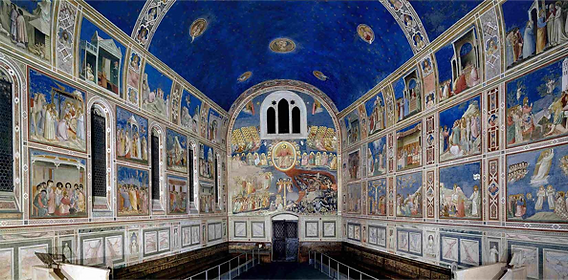
Giotto, Arena Chapel (Scrovegni Chapel)
Basics: Giotto, 1305 to 1306, fresco, Padua, Italy
Style: Proto Renaissance / Late Gothic, Italy
Look for: blue ceiling w stars, walls in three registers (Mary and family, Christ's life and ministry, Christ's passion and death), Annunciation near the altar, Last Judgment near the entrance, figures in earthly architectural settings instead of flat gold
Patron: Enrico Scrovegni, banker family that charged interest (usury, a sin), chapel partly to make up for that sin, in the Last Judgment Enrico is shown presenting the chapel to Mary
Meaning: works like a picture book so people who couldn't read learn the Bible stories, divine events set in human spaces
Vocab: Fresco = paint on wet plaster; Register = a horizontal band or level of images stacked on a wall; Narrative cycle = a series of scenes that tell a story in order; Patron = person who pays for the art; Last Judgment = Christ judging souls at the end of time, saved rise to heaven and damned fall to hell; Usury = charging interest on loans, the church called it a sin

Jean Pucelle, Hours of Jeanne d'Evreux
Basics: Jean Pucelle, c.1325 to 1328, grisaille and color on vellum, 3.5 x 2.5 in, Paris, France
Style: Gothic / late medieval, Northern Europe (France)
Look for: grisaille (gray tones look like sculpture), shading makes figures 3d, Annunciation scene w Mary inside a house and the angel telling her she'll bear God, Pucelle put the scene into a modern building, image is big on the page
Patron: made for Jeanne d'Evreux, Queen of France / Meaning: book of hours = personal prayer book you reread to get into a prayer mindset, private devotion instead of public church art
Vocab: Book of hours = personal prayer book for private devotion; Illuminated manuscript = handwritten book decorated w detailed painted pictures; Grisaille = painting in grays that looks like sculpture; Vellum = animal skin page; Annunciation = Gabriel tells Mary she'll bear Christ; Private devotion = prayer done alone at home w a personal object instead of in church

Vesperbild (Pieta)
Basics: unknown artist, c.1330, painted wood, 34.5 in, Middle Rhine region, Germany
Style: Gothic / late medieval, Northern Europe (Germany)
Look for: emaciated malnourished Christ, holes and wounds in hands, graphic blood, Mary's face full of complex sadness and longing, stiff awkward body
Meaning: Vesperbild = image for evening (vespers) prayer, pieta = Italian for pity, goal is for the viewer to feel Christ's suffering and Mary's unnamable grief for her son
Vocab: Vesperbild = German image for evening prayer showing Mary holding dead Christ; Pieta = image of Mary holding dead Christ, pieta = pity; Private devotion = prayer done alone at home w a personal object instead of in church

Workshop of Robert Campin, Annunciation Triptych (Merode Altarpiece)
Basics: Workshop of Robert Campin, c.1427 to 1432, oil on oak panel, central panel 25.25 x 24.875 in, Netherlands / Flanders (now the Met Cloisters)
Style: Early Netherlandish, Northern Renaissance
Look for: triptych, center Gabriel visits Mary as she reads, tiny baby Christ w a cross flies in on rays of light thru the window, right panel Joseph in his carpenter shop w mousetraps, left panel donors kneeling outside, tilted table and weird perspective, bright oil color, tons of detail and nice lighting
Symbols: mousetraps = Christ trapping the devil, lilies = Mary's purity, everyday objects carry sacred meaning (disguised symbolism)
Patron: donors pray to be blessed, likely for a safe childbirth, Annunciation images were often for luck w childbirth, too small for a church so made for a home
Vocab: Triptych = three panel painting that opens and closes; Annunciation = Gabriel tells Mary she'll bear Christ; Oil paint = dries slow, layered glazes, glowing detail and texture; Iconography = study of symbols in art to find deeper meaning; Disguised symbolism = everyday objects that secretly carry religious meaning; Private devotion = prayer done alone at home w a personal object instead of in church; Donor = person who paid for the work and is often painted into it praying; Hieratic scale = most important figures shown biggest

Jan van Eyck, Double Portrait (Giovanni Arnolfini and His Wife)
Basics: Jan van Eyck, 1434, oil on wood panel, 33 x 22.5 in, Bruges, Flanders (now National Gallery London)
Style: Early Netherlandish, Northern Renaissance
Look for: joined hands and blessing gesture, dog, shoes off, single candle in chandelier, oranges/ripening fruit, St Margaret carving on the bed, convex mirror showing two more people entering, fur, rugs, red bed = wealth
Symbols: dog = fidelity/loyalty, shoes off = sacred ground, single candle = devotional candle from medieval marriage ceremonies, fruit and St Margaret = wish for fertility and safe childbirth, woman is prob not pregnant (taboo to show), just holding up her dress
Context: Arnolfini = wealthy merchant, commerce boom gives middle class money for art, low life expectancy, signature 'Jan van Eyck was here 1434' above mirror like a witness or notary Readings: Panofsky's iconographic analysis, ordinary objects hold religious meaning, 'transfigured reality'
Vocab: Iconography = study of symbols in art to find deeper meaning; Disguised symbolism = everyday objects that secretly carry religious meaning; Oil glazes = thin see through layers of oil paint that make color glow; Convex mirror = round bulging mirror that reflects a wide view of the room; Patron = person who pays for the art; Portraiture = art showing a specific real person; Transfigured reality = everyday realism charged w symbolic and religious meaning

Jan van Eyck, Ghent Altarpiece
Basics: Jan van Eyck, possibly begun by Hubert van Eyck, completed 1432, oil on wood panels, St Bavo's Cathedral, Ghent, Flanders
Style: Early Netherlandish, Northern Renaissance
Look for: huge polyptych, closed panels = Annunciation and patrons, open panels = intense color, God, crowds and armies, lamb on the altar, crazy fine detail
Meaning: lamb = Christ's sacrifice, detail makes heaven feel believable and physical, connects heaven and earth
Context: stayed closed most of the year, opened on feast days so opening felt like a religious revelation, shows how invested van Eyck was in capturing reality
Heads up: your class notes say triptych but it has way more than three panels, call it a polyptych
Vocab: Polyptych = many panel altarpiece; Altarpiece = painting or sculpture made to stand on or behind a church altar; Oil paint = dries slow, layered glazes, glowing detail and texture; Donor = person who paid for the work and is often painted into it praying; Feast day = special church holiday

Jan van Eyck, Man in a Red Turban (Portrait of a Man)
Basics: Jan van Eyck, 1433, oil on wood panel, 13 x 10 in, Flanders (prob self portrait)
Style: Early Netherlandish, Northern Renaissance
Look for: three quarter view (between frontal and profile), wrinkles, veins, stubble, bright red turban, light and shadow make the face super real
Inscriptions: top: 'As I can' (his motto), bottom: 'Jan van Eyck made me in 1433 on the 21st of October'
Meaning: lifelike, more conversational way to capture personality, shows off his skill so people hire him, portraiture takes off w the rising middle class
Heads up: your reading notes labeled this one as the Arnolfini Portrait by mistake, it's this card
Vocab: Three quarter view = face turned between frontal and profile; Portraiture = art showing a specific real person; Self portrait = artist's image of themself; Oil paint = dries slow, layered glazes, glowing detail and texture; Naturalism = showing things the way they really look

Rogier van der Weyden, Deposition
Basics: Rogier van der Weyden, c.1435 to 1438, oil on panel, Flanders (now Prado, Madrid)
Style: Early Netherlandish, Northern Renaissance
Look for: Christ taken down from the cross, Mary fainting w her body mirroring Christ's, many crying figures, visible wounds, pale Mary, very real details inside an unrealistic compressed gold setting like a shallow box
Meaning: make viewers feel Christ's suffering personally and strengthen devotion, Mary's pose = she suffers w him / Extra: made for the crossbowmen's guild in Leuven, tiny crossbows in the corners (not in your notes, add if you want) / Heads up: your reading notes labeled this as Ghent Altarpiece by mistake
Vocab: Deposition = scene of Christ's body being taken down from the cross; Emotional devotion = art meant to make viewers feel grief and connect personally to the story; Compressed space = shallow squished setting w little room for the figures; Oil paint = dries slow, layered glazes, glowing detail and texture

Filippo Brunelleschi, Dome of Florence Cathedral
Basics: Filippo Brunelleschi, dome 1420 to 1436, lantern 1471, cathedral (Santa Maria del Fiore) begun 1296, Florence, Italy
Style: Early Italian Renaissance architecture / Look for: double shell (one dome inside another, idea from the Pantheon), octagonal drum, sandstone rings like a barrel, herringbone brickwork, 37,000 tons, 4 million+ bricks
Engineering: no scaffolding possible (not enough timber in Tuscany), invented a reversible hoist bc oxen can't walk backwards, dome holds itself up while being built / Context: cathedral sat unfinished 100+ yrs which hurt the city's identity, Florence wanted the biggest dome in Europe, competition idea emerges in the Ren, civic pride, Medici backed him, Brunelleschi also invented linear perspective
Vocab: Double shell = a dome built as two domes, one inside the other, lighter and stronger; Drum = the round or octagonal wall a dome sits on; Lantern = small open tower on top of a dome that lets in light; Herringbone brickwork = bricks laid in a zigzag pattern so they lock in place and don't fall inward; Civic pride = art that celebrates the city and its people; Patronage = paying for and supporting artists, often to gain prestige and power; Classical revival = bringing back the styles and ideas of ancient Greece and Rome; Linear perspective = math system where lines recede to a vanishing point to fake 3d space

Donatello, David
Basics: Donatello, 1446 to 1460?, bronze, 5 ft 2 in, Florence, Italy
Style: Early Italian Renaissance sculpture
Look for: nude w only a helmet/hat and boots, contrapposto, sword, Goliath's head at his feet, feather caressing his thigh, shown after the fight, relaxed
Significance: first freestanding bronze nude male since ancient Rome, classical celebration of humanity
Meaning: underdog story = Florence beating bigger enemies, civic pride, feather maybe erotic coded meaning (real risk, 14,000 tried for sodomy in 15th c Florence)
Patron: reading says Cosimo de Medici, class said patron not totally known, kept in the Medici garden, republic took it when Medici fled
Vocab: Contrapposto = weight on one leg so the body twists naturally, from antiquity; Humanism = rebirth of classical learning, humans at the center, dignity and potential in this life; Bronze = metal cast from a mold, used for sculpture; Freestanding sculpture = sculpture you can walk all the way around, not attached to a wall; Classical revival = bringing back the styles and ideas of ancient Greece and Rome; Civic pride = art that celebrates the city and its people
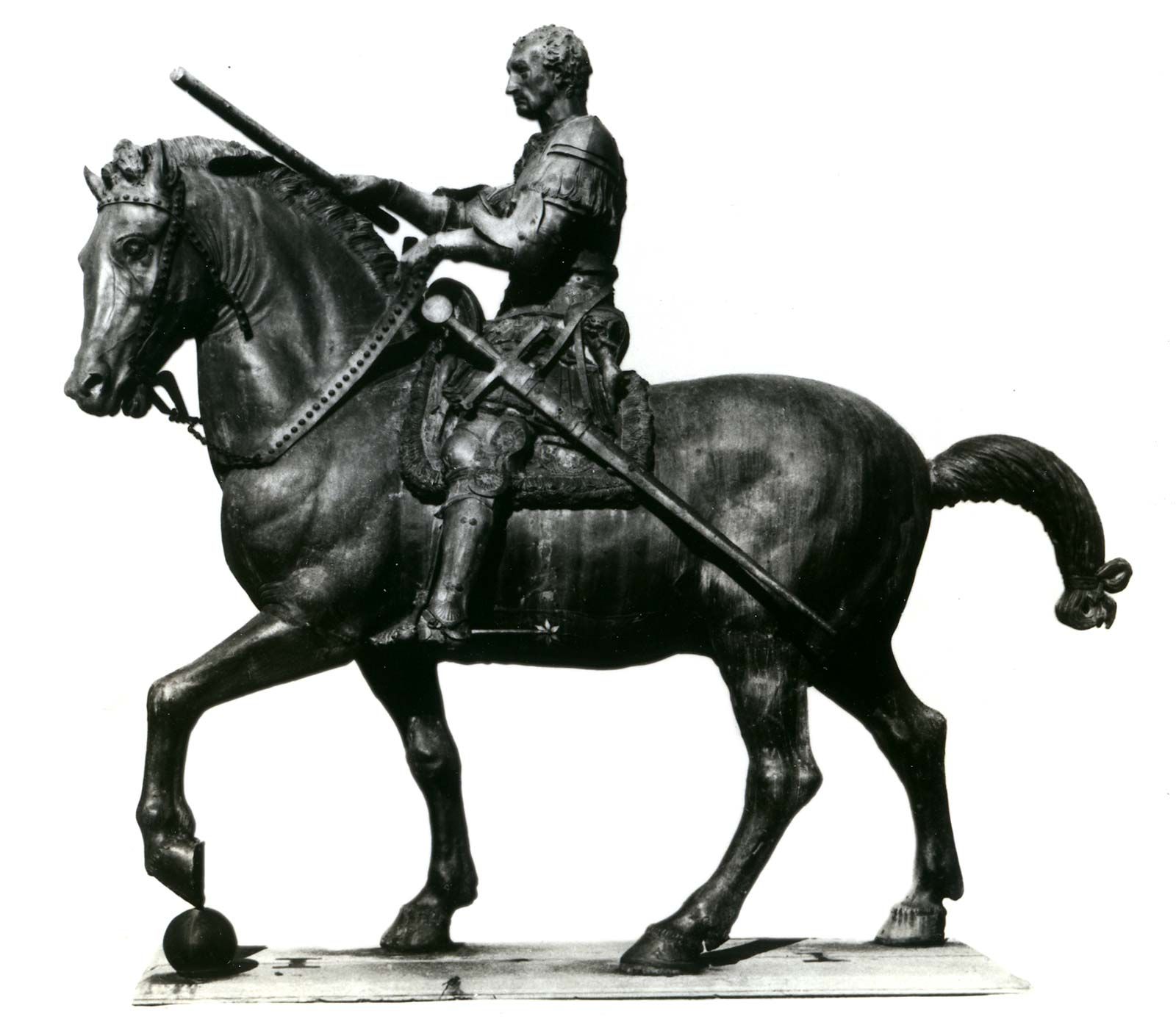
Donatello, Equestrian Monument of Erasmo da Narni (Gattamelata)
Basics: Donatello, 1443 to 1453, bronze, Padua, Italy
Style: Early Italian Renaissance sculpture
Look for: commander on a horse, armor, calm commanding pose, horse's hoof on a ball, high base in a public space / Meaning: honors a condottiere, linked to bravery and nobility, uses Roman ideas of the public equestrian monument (like ancient emperor statues) to present a real person convincingly
Significance: first large bronze equestrian statue since antiquity
Vocab: Condottiere = mercenary commander hired by Italian city states; Equestrian monument = statue of a rider on a horse; Bronze = metal cast from a mold, used for sculpture; Classical revival = bringing back the styles and ideas of ancient Greece and Rome

Masaccio, Trinity with the Virgin, St John the Evangelist, and donors
Basics: Masaccio, c.1425 to 1428, fresco, 21 ft x 10 ft 5 in, Santa Maria Novella, Florence, Italy
Style: Early Italian Renaissance
Look for: God the Father, dove, Christ crucified, Mary gestures to Christ, St John, donors kneeling outside the chapel space, skeleton on a tomb at the bottom, coffered barrel vault, Corinthian capitals, round classical arch, pyramid composition / Perspective: one of the earliest uses of linear perspective, vanishing point at viewer's eye level near Christ's feet, orthogonals, lines made w string on the wall, flat wall reads as a real chapel
Meaning: memento mori: 'I was once what you are and what I am you also will be' in Italian so regular people could read it, Mary = intercessor, God and humans share one measurable space
Body: chiaroscuro gives volume, ribs and muscles, weight of Christ's body, painted by Masaccio in his 20s
Readings: Alberti's On Painting (vanishing point at eye level), Brunelleschi's mirror experiment, Pico's humanism
Vocab: Linear perspective = math system where lines recede to a vanishing point to fake 3d space; Vanishing point = spot where receding lines meet, Masaccio puts it at viewer's eye level; Orthogonals = diagonal lines pointing back to the vanishing point; Horizon line = line at the viewer's eye level where the vanishing point sits; Memento mori = reminder of death; Fresco = paint on wet plaster; Humanism = rebirth of classical learning, humans at the center, dignity and potential in this life; Chiaroscuro = strong light vs dark to model 3d form; Pyramidal composition = figures arranged in a triangle for balance and stability; Donor = person who paid for the work and is often painted into it praying; Intercession = saints or Mary pleading for souls; Coffered barrel vault = half tube ceiling decorated w sunken square panels, a Roman form

Botticelli, Primavera
Basics: Sandro Botticelli, c.1482, tempera on wood, 6 ft 8 in x 10 ft 4 in, Florence, Italy
Style: Early Italian Renaissance
Look for: Venus center, blindfolded Cupid aiming at a Grace, Three Graces dancing, Mercury pushing clouds, Zephyrus grabbing Chloris who turns into Flora strewing flowers, trees behind Venus like a halo, flat and frieze like, weightless figures, not about perspective
Meaning: celebrates nature, light and love, Venus placed where the Virgin would normally go, Neoplatonism mixes Plato w Christianity, classical past + Christian present
Context: Medici era Florence, humanism, later Savonarola's Bonfire of the Vanities 1497 and Botticelli turned more conservative / Vocab: Mythology = stories of ancient Greek and Roman gods; Neoplatonism = mixes Plato w Christianity; Humanism = rebirth of classical learning, humans at the center, dignity and potential in this life; Tempera = egg based paint, dries fast, flatter look; Allegory = abstract idea shown thru symbolic figures; Frieze = figures lined up across a flat band, like a strip of relief sculpture

Leonardo da Vinci, The Last Supper
Basics: Leonardo da Vinci, 1495 to 1498, experimental oil and tempera on dry plaster (a fresco attempt), 15 ft 1 in x 29 ft, refectory of Santa Maria delle Grazie, Milan, Italy
Style: High Renaissance
Look for: one point perspective, all lines converge on Christ's head, window behind him works like a halo, no halos, Christ = triangle, apostles in four groups of three, Judas on the same side of the table clutching silver w his face in shadow, sfumato faces
Meaning: moment of 'one of you will betray me' plus the Eucharist, divinity shown thru geometry, anatomy and psychology instead of gold, 3 = important number (Trinity)
Context: in situ in the monks' dining hall, paint didn't stick so it crumbled even in his lifetime, perspective set above the floor so viewer is lifted up
Vocab: Linear perspective = math system where lines recede to a vanishing point to fake 3d space; Vanishing point = spot where receding lines meet, Masaccio puts it at viewer's eye level; Sfumato = smoky soft blur over faces and edges; In situ = still in its original place; Refectory = dining hall in a monastery; High Renaissance = c.1490 to 1527, ideal balance and bodies; Pyramidal composition = figures arranged in a triangle for balance and stability; Humanism = rebirth of classical learning, humans at the center, dignity and potential in this life

Michelangelo, Pieta
Basics: Michelangelo, c.1498 to 1500, marble, 68.5 x 76.8 in, St Peter's Basilica, Rome, Italy
Style: High Renaissance
Look for: pyramid composition, marble polished to look like flesh, Mary's hand pressing into his side, Christ's foot muscles, huge drapery to hide the size difference, Mary looks too young, his only signed work (on her sash)
Meaning: humanist sorrow, less suffering and violence, more human beauty and calm, Mary mourns and also presents Christ as salvation, Michelangelo said she looks young bc she's pure and w out sin
Patron: French cardinal in Rome, Michelangelo was in his early 20s / Readings: Vasari: Michelangelo surpasses every artist and nature w ease
Vocab: Pieta = image of Mary holding dead Christ, pieta = pity; Pyramidal composition = figures arranged in a triangle for balance and stability; Idealized = made more perfect and beautiful than real life; Humanism = rebirth of classical learning, humans at the center, dignity and potential in this life; High Renaissance = c.1490 to 1527, ideal balance and bodies; Sprezzatura = studied effortlessness, hide the work

Michelangelo, David
Basics: Michelangelo, 1501 to 1504, marble, 17 ft, Florence, Italy (now Accademia) / Style: High Renaissance
Look for: contrapposto, head and eyes turned, tense brow, huge hands, carved from an abandoned block, shown BEFORE the fight (the pregnant moment)
Context: meant to go high on the cathedral but too beautiful so placed in front of city hall (Palazzo Vecchio), Medici kicked out, Savonarola executed, republic restored, religious hero becomes political symbol of Florence the underdog, Medici supporters threw stones at it
Readings: Michelangelo's sonnet: sculpture is best bc it's based on the perfect human body, paragone, Vasari
Vocab: Contrapposto = weight on one leg so the body twists naturally, from antiquity; Pregnant moment = the tense instant right before the action happens; Paragone = debate over painting vs sculpture; Humanism = rebirth of classical learning, humans at the center, dignity and potential in this life; High Renaissance = c.1490 to 1527, ideal balance and bodies

Michelangelo, Sistine Chapel (ceiling and Last Judgment)
Basics: Michelangelo, chapel built 1475 to 1481, ceiling 1508 to 1512, Last Judgment 1536 to 1541, fresco, Vatican, Rome, Italy
Style: ceiling = High Renaissance, Last Judgment = Counter Reformation
Mannerism / Ceiling: Pope Julius II, 9 Genesis scenes (Creation of Adam, Eve, the Fall, Noah), no Christ but shows why he's needed, prophets and sibyls, ignudi, fictive architecture, he moves from detailed to clearer bigger figures as he goes, optimism / Last Judgment: Pope Paul III, after Sack of Rome 1527 and Reformation, 300+ bodies, Christ like Apollo Belvedere, Mary accepting, blessed rise left, damned sink right, rosary pulling souls up (good works matter), St Bartholomew holds skin w Michelangelo's face, Charon and Minos from Dante, pessimism, distorted bodies / Context: Michelangelo saw himself as a sculptor forced to paint (paragone), where cardinals elect the pope, nudity later covered by Daniele da Volterra / Readings: Dante's Inferno, Vasari, paragone
Vocab: Fresco = paint on wet plaster; Ignudi = nude male figures on the Sistine ceiling; Sibyl = pagan prophetess who foretold Christ; Fictive architecture = painted fake architecture; Paragone = debate over painting vs sculpture; Counter Reformation = Catholic response, Council of Trent, saints and good works; Mannerism = after 1527, elongated, tense, artificial; High Renaissance = c.1490 to 1527, ideal balance and bodies

Bronzino, Portrait of a Young Man
Basics: Bronzino, 1530s, oil on wood, 37.6 x 29.5 in, Florence, Italy (now the Met)
Style: Mannerism
Look for: cool composed arrogant face, hand on hip, finger holding a poetry book, fancy clothes, grotesque faces carved on table and chair, hidden mask face in his clothing folds, rich interior w high ceilings, elongated body / Meaning: perfect courtier: noble and educated, effortless look = sprezzatura, the masks hint his image is a crafted mask = self fashioning
Readings: Castiglione, Book of the Courtier (sprezzatura, well rounded, hide effort), Pico (you shape what you become)
Vocab: Sprezzatura = studied effortlessness, hide the work; Self fashioning = shaping your own identity and image; Courtier = noble who serves at a royal or noble court; Mannerism = after 1527, elongated, tense, artificial; Grotesques = fantastical ancient Roman style decoration w monster faces and odd creatures
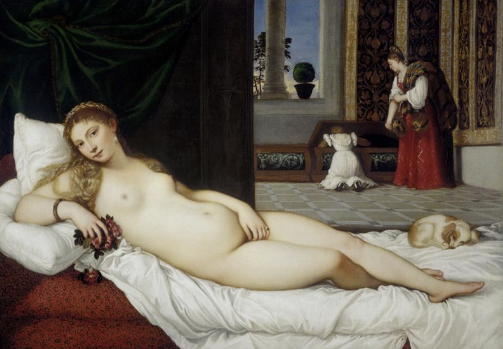
Titian, Venus of Urbino
Basics: Titian, c.1538, oil on canvas, Venice, Italy (now Uffizi)
Style: Venetian High Renaissance / Look for: reclining nude looking out, glowing layered skin, curves against a grid of walls, sleeping dog, roses in her hand, myrtle, maids at dowry chests (cassoni), green curtain, focal point at her hand/groin (Venus pudica pose)
Symbols: dog = fidelity, roses and myrtle = Venus and constancy, chests = marriage, so often read as a marriage painting
Patron: Guidobaldo II della Rovere called her 'the nude woman', Vasari later called her Venus, hung privately
Context: colorito (Venice, color first) vs disegno (Florence, drawing first), oil glazes, canvas, sets the model for the reclining nude (later Manet's Olympia)
Vocab: Colorito = Venetian idea that color and layered paint come first; Disegno = Florentine idea that drawing and design come first; Reclining nude = nude figure lying down, a pose Titian makes into a standard type; Venus pudica = modest pose w hand covering; Oil glazes = thin see through layers of oil paint that make color glow; Cassone = decorated wedding or dowry chest; Patron = person who pays for the art; Male gaze = art made from and for a male viewer's point of view, looking at women as objects
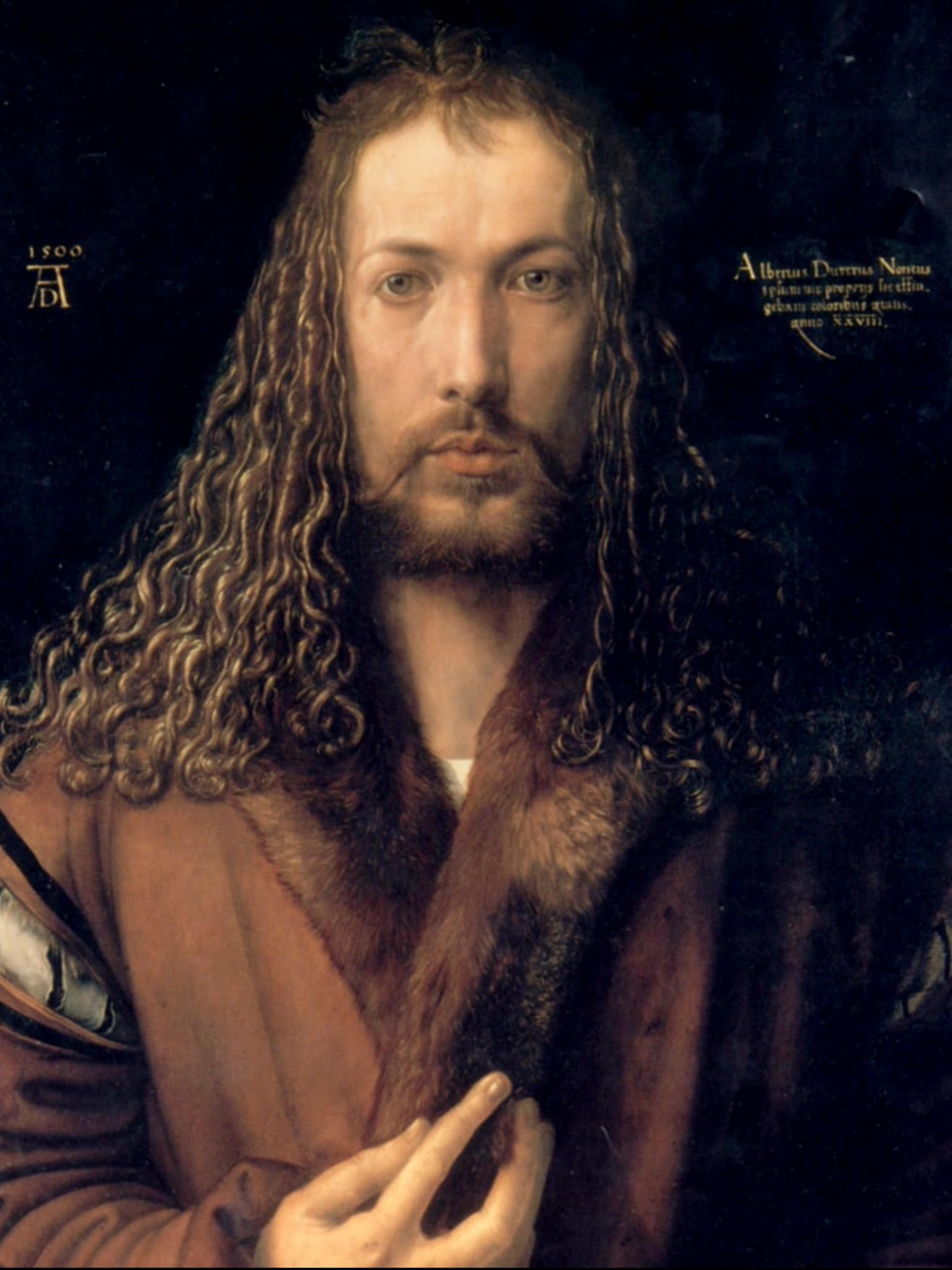
Albrecht Durer, Self Portrait
Basics: Albrecht Durer, 1500, oil on wood panel, 26.25 x 19.25 in, Nuremberg, Germany (now Munich)
Style: Northern Renaissance (German)
Look for: full frontal pose usually saved for Christ, calm face, super real skin and hair, fur collar = wealth, 1500 and AD monogram at eye level, inscription says he painted himself at 28, body fills the frame
Meaning: artist as gifted intellect and scholar not a craftsman, maybe his talent comes from God / Context: brings Italian ideas over the Alps plus Northern detail, humanist who wrote theory books, later joined Luther
Vocab: Frontal portrait = sitter faces straight out at the viewer, a pose usually saved for Christ; Monogram = artist's initials used as a signature (Durer's AD); Self fashioning = shaping your own identity and image; Humanism = rebirth of classical learning, humans at the center, dignity and potential in this life; Northern Renaissance = Ren art north of the Alps, known for oil paint, fine detail, print and symbols

Albrecht Durer, Four Apostles
Basics: Albrecht Durer, 1526, oil on wood, two panels, 7 ft 1 in x 2 ft 6 in each, Nuremberg, Germany
Style: Northern Renaissance, Protestant Reformation
Look for: left: John in red in front, old bald Peter w gold key behind, right: Paul w sword and book in front, Mark w scroll behind, open Bible 'In the beginning was the Word', Luther's German Bible text below warning about false prophets
Meaning: John and Paul (Luther's favorites) pushed forward, Peter (the pope) pushed back, faith alone and scripture over church authority
Patron: no commission, Durer gave it to Nuremberg's town council himself
Readings: Luther's German Bible / Vocab: Protestant Reformation = Luther, faith alone and scripture; Faith alone = Luther's idea that belief, not good works, gets you saved; Iconography = study of symbols in art to find deeper meaning; Monumental figures = large solid figures that feel grand and important
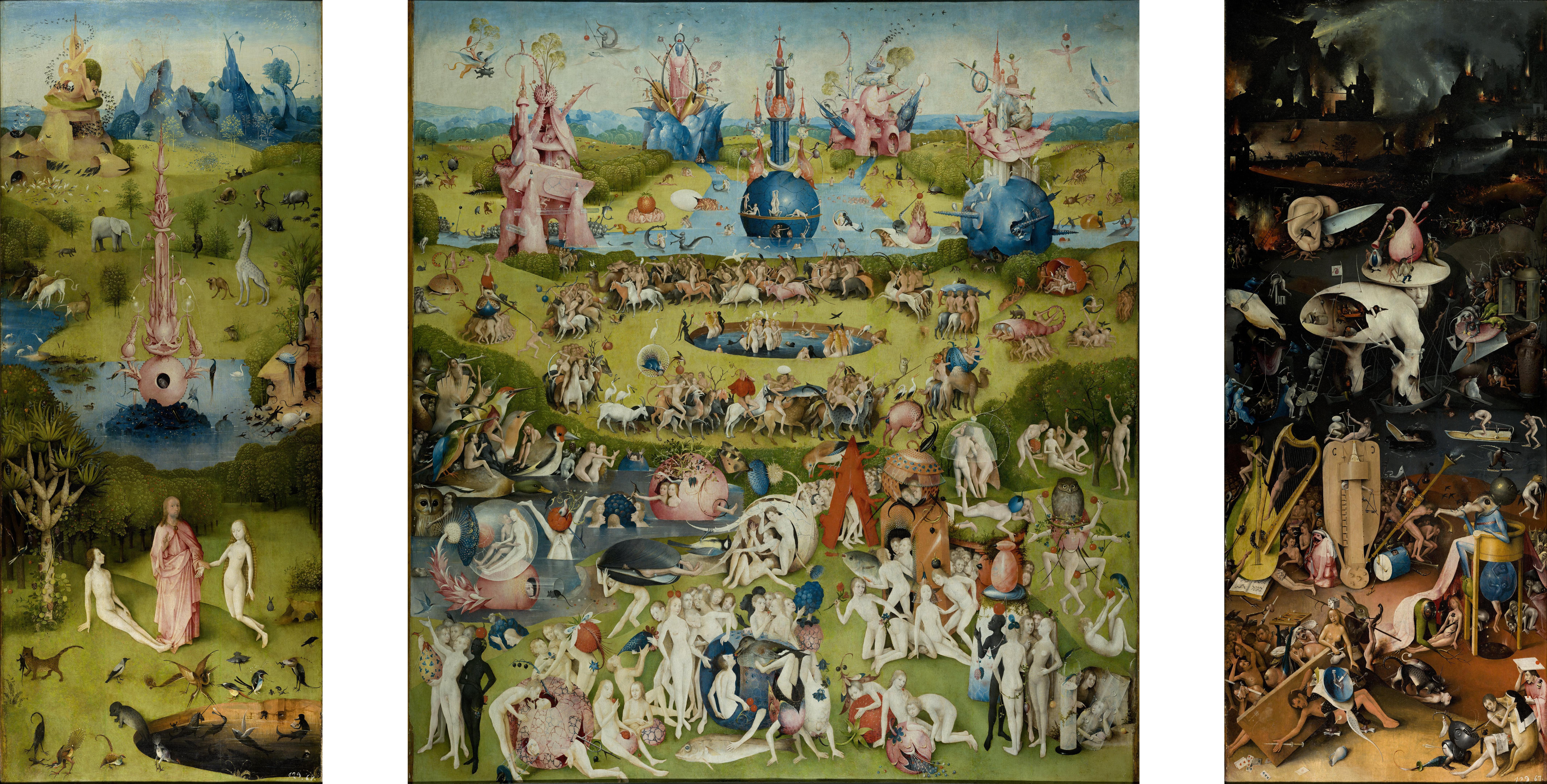
Hieronymus Bosch, The Garden of Earthly Delights
Basics: Hieronymus Bosch, c.1490 to 1515, oil and grisaille on oak, Netherlands (now Prado)
Style: Early Netherlandish / Northern Renaissance
Look for: triptych, outer wings in grisaille = Third Day of Creation w God top left, inside left = Eden, center = crowds of nude people w giant fruit and animals, right = hell w devilish creatures, tons of tiny detail
Meaning: fate of humanity, sin and earthly pleasure lead to hell, a liturgical altarpiece format pushed into strange orgy and devil imagery
Context: private not church viewing, owned by Nassau nobility, later Philip II sent it to El Escorial, lots of copyists / Vocab: Triptych = three panel painting that opens and closes; Grisaille = painting in grays that looks like sculpture; Moralizing = art that teaches a lesson about sin and right behavior; Northern Renaissance = Ren art north of the Alps, known for oil paint, fine detail, print and symbols
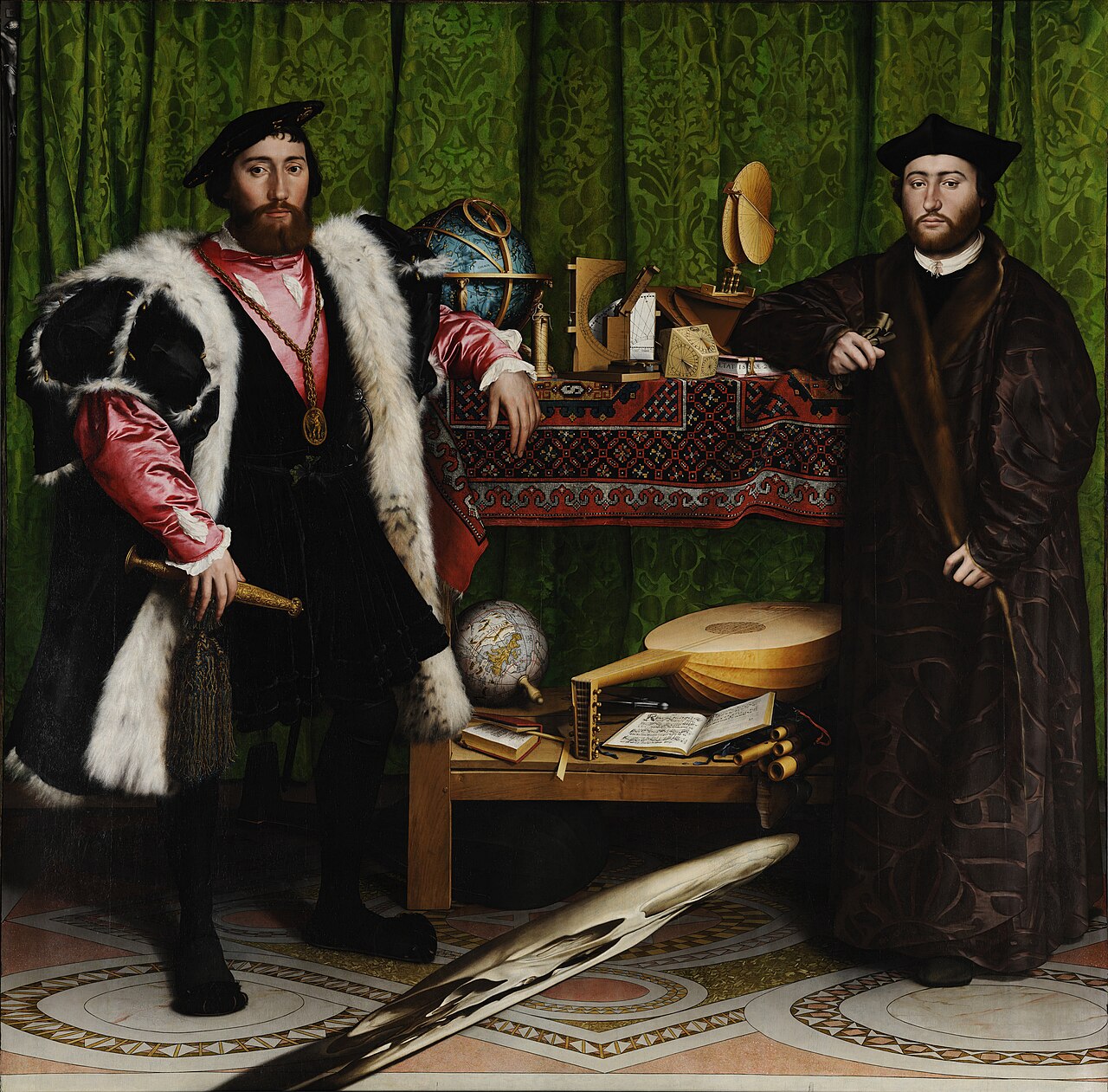
Hans Holbein the Younger, The Ambassadors ***
LIKELY ON ESSAY.
Basics: Hans Holbein the Younger, 1533, oil on oak panel, 81 x 82 in, London, England
Style: Northern Renaissance (German artist at the English court)
Look for: left Jean de Dinteville (French ambassador to England), right Georges de Selve (bishop of Lavaur), Turkish rug, celestial globe and navigation tools, globe, lute w broken string, music book, math book open to division, compass, anamorphic skull on the floor, half hidden crucifix top left
Meaning: broken lute and division page = religious discord, skull = memento mori, crucifix = hope of redemption, tension between worldly knowledge/wealth and death/faith
Context: 1533 Henry VIII marries Anne Boleyn after the pope refuses his annulment, England breaks from Rome, Reformation conflict, global trade, liberal arts
Vocab: Anamorphosis = distorted image readable only from an angle; Memento mori = reminder of death; Iconography = study of symbols in art to find deeper meaning; Liberal arts = Ren subjects of learning like math, music, astronomy; Humanism = rebirth of classical learning, humans at the center, dignity and potential in this life; Protestant Reformation = Luther, faith alone and scripture; Patron = person who pays for the art

El Greco, Burial of the Count of Orgaz
Basics: El Greco (Domenikos Theotokopoulos), 1586 to 1588, oil on canvas, Santo Tome, Toledo, Spain
Style: Mannerism, Spanish Counter Reformation
Look for: bottom = earthly, dark, real 16th c Toledo men, self portrait looking at us, his son pointing, Saints Augustine and Stephen lower the count; top = heaven w loose brushwork, stretched figures, Christ, Mary, John the Baptist, Peter w keys, angel carrying the count's soul as a baby
Meaning: legend says the count was so good the saints buried him, good works get you to heaven and saints intercede (Catholic ideas Protestants rejected), heaven sits right above earth
Context: Council of Trent (1545 to 1563), El Greco trained as an icon painter in Crete, then Venice and Rome, the contract required the portraits
Vocab: Counter Reformation = Catholic response, Council of Trent, saints and good works; Intercession = saints or Mary pleading for souls; Mannerism = after 1527, elongated, tense, artificial; Elongation = stretching bodies longer than real life, typical of Mannerism; Two realms = heaven and earth shown in separate zones of one picture
Diego Velázquez, Las Meninas
Basics: Diego Rodríguez de Silva y Velázquez, 1656, oil on canvas, 320.5 x 281.5 cm, painted in the Cuarto del Príncipe of the Alcázar in Madrid (Prado)
Style: Spanish Baroque
Look for: the Infanta Margarita with her maids of honor (las meninas), a dwarf and a dog, Velázquez himself at a huge canvas with palette and brush, King Philip IV and Queen Mariana reflected in the mirror on the back wall, a figure in the lit doorway behind, huge dark room with light from the right
Meaning: complicates artist, sitter and viewer, we may be standing where the king and queen stand, so we get pulled into the space, a seemingly ordinary royal portrait becomes mysterious
Context: Velázquez was born in Seville, started with bodegones (genre scenes), became court painter to Philip IV in 1623 after painting his portrait, he was not born noble and spent his life seeking noble rank, receiving the Knighthood of Santiago in 1659, painters were usually denied noble rank because they worked with their hands, Antonio Palomino gave it its own section in his 1724 history of Spanish painters
Vocab: Genre painting = scenes of everyday life; Bodegón = Spanish genre scene with food or tavern objects; Court painter = artist employed by royalty; Baroque drama = light, mirrors and viewer involvement
Related readings: The Waterseller of Seville (1618 to 1622, a bodegón showing three ages of man, Caravaggio style lighting and earthy palette, watersellers were usually painted as cheats but Velázquez gives him dignity) and Juan de Pareja (1650, portrait of the man of African descent enslaved in his studio, painted in Rome, shown as a real person looking directly out at us, Velázquez signed papers freeing him soon after)
Artemisia Gentileschi, Judith Slaying Holofernes
Basics: Artemisia Gentileschi, 1620 to 1621 (your list says c.1620), oil on canvas, 162.5 x 199 cm, painted in Florence (Uffizi)
Style: Italian Baroque, Caravaggisti
Look for: two strong young women working together, sleeves rolled up, focused gazes and firm grips, Judith bracing on the bed and pressing the head down while pulling the sword through, Abra holding Holofernes down, blood arcing in jets and spattering her arms and dress, red velvet and golden damask, strong chiaroscuro, bloody sheets pushed right up to the viewer, signed in the lower right
Meaning: Judith, a widow from Bethulia, saves her people by beheading the Assyrian general, the sword marks the central axis and her fist sits at the very center, her hand becomes the hand of God protecting the Israelites
Context: her father Orazio trained her and was Caravaggio's friend and follower, she pushes past Caravaggio's version where Judith recoils and the servant just watches, scholars link her Judith to her own experience of being assaulted at 17 by Agostino Tassi and the trial that followed, Abra is young and helpful unlike the chaperone who abandoned her, the blood pattern may reflect her friend Galileo's work on parabolic trajectories, probably commissioned by or gifted to the Medici, a Medici duchess later banished it to a dark corner of the Uffizi
Symbolism: Judith read as victory of virtue over vice and as a symbol of the Church militant fighting Protestants and the Ottoman Turks, a cameo on her bracelet seems to show Artemis
Vocab: Caravaggisti = followers of Caravaggio; Tenebrism; Chiaroscuro; Picture plane = the front surface of the painting, Baroque artists push action right up against it
Caravaggio, The Calling of Saint Matthew
Basics: Michelangelo Merisi da Caravaggio, c.1599 to 1600, oil on canvas, Contarelli Chapel, San Luigi dei Francesi, Rome
Style: Italian Baroque
Look for: tenebrism, light streaming in from an unseen source above Christ's head down a diagonal to Matthew, tavern setting, contemporary 17th century clothing, Christ mostly hidden behind Peter with only his head and pointing arm visible, Matthew pointing at himself in disbelief while his other hand still reaches for the coins, the men on the left never look up, only a hairline halo over Christ
Meaning: the instant of spiritual awakening and conversion, Christ's hand copies Adam's hand from Michelangelo's Creation of Adam because Christ is the second Adam, an empty spot at the table seems to wait for us
Context: Caravaggio's gritty naturalism uses common people off the streets of Rome instead of High Renaissance ideal beauty, one of three Caravaggio paintings in the chapel, in situ
Readings: Caravaggio and the Caravaggisti, followers copied his tenebrism, half length figures and subdued palette, he had no real workshop but the Caravaggisti spread his style across Europe
Vocab: Tenebrism = deep darkness with a harsh spotlight, like a lit stage; Chiaroscuro = strong light and dark contrast that models form; Naturalism = real, unidealized bodies and faces; Caravaggisti = his many followers; In situ = still in its original place
Bernini, Saint Peter's Square (context for the exam, not on the image list)
Basics: Bernini, 1656 to 1667, travertine colonnade, Vatican City, Rome
Look for: two curving arms of four rows of massive unfluted Tuscan columns, oval piazza, ancient Egyptian obelisk in the center, two fountains, colonnades end in simple temple fronts
Meaning: Bernini called the colonnades the motherly arms of the church reaching out to embrace the faithful and reunite heretics (Protestants) with the church
Context: built over St. Peter's grave, Old St. Peter's built by Constantine, rebuilt by Bramante, Michelangelo and Maderno, Bernini activates the church so it moves out into the city, geometry is now ovals and trapezoids instead of High Renaissance squares and circles
Vocab: Colonnade = a row of columns carrying a roof or entablature; Counter Reformation architecture = space designed to gather and move the faithful
Bernini, Ecstasy of Saint Teresa
Basics: Gian Lorenzo Bernini, 1647 to 1652 (your list says 1645 to 1652), marble, gilded bronze rays, stained glass and fresco, Cornaro Chapel, Santa Maria della Vittoria, Rome
Style: Italian Baroque
Look for: Teresa collapsing on a cloud, body writhing under heavy rough cloth, angel smiling with a golden spear, his gauzy fabric whipping around him, gilded rays behind, hidden window above the broken pediment pours real light down, Cornaro family carved in what look like theater boxes on both sides, the whole group seems to float because it is supported from a deep recess
Meaning: Teresa's transverberation, an angel piercing her heart with the arrow of divine love, her account describes intense pain that is sweet and spiritual though the body shares in it, Bernini uses the body and near sexual language to express a spiritual union
Context: Teresa canonized in 1622, Counter Reformation mysticism, Bernini was deeply religious and also a theater designer, patron Cardinal Federico Cornaro, marble carved into totally different textures (cloud, skin, gauze, feathers, heavy wool)
Readings: Life of Saint Teresa, the primary source excerpt, angel with a golden spear tipped with fire, she moans, the pain is spiritual but the body has a considerable share
Vocab: Bel composto = Bernini's beautiful whole, uniting sculpture, architecture, painting and light into one experience; Mysticism = direct personal union with the divine, promoted by the Catholic Church in the Counter Reformation; Theatricality = art staged like theater to pull the viewer in
Bernini, David
Basics: Gian Lorenzo Bernini, 1623 to 1624, marble, 170 cm high, Rome (Galleria Borghese)
Style: Italian Baroque
Look for: David twisting mid motion, body crossing itself in a strong diagonal, about to release the slingshot, knit brow, lips pressed together, armor and harp on the ground, activates the space around him so viewers feel like they might get hit
Meaning: catches the moment of action itself, not before or after, Baroque wants you to feel it in your body not just contemplate it, empathy is the point
Context: made for Cardinal Scipione Borghese while Bernini was in his 20s, Counter Reformation art as a teaching tool (Council of Trent), David fighting a giant may mirror the Church battling Luther
Three Davids: Donatello (Early Ren, bronze, after the fight, relaxed), Michelangelo (High Ren, marble, before the fight, ideal and superhuman, stable pyramid), Bernini (Baroque, marble, during the fight, natural looking man, diagonal)
Vocab: Baroque = 17th century style built on drama, movement, and the momentary; Diagonal composition = energetic slanted lines replacing the stable Renaissance pyramid; Naturalism = showing a real looking body rather than an idealized one; Counter Reformation = Catholic response to Luther, art used to inspire faith