CPAR (Final Term) Quiz 2
 Call Kai
 Learn
 Practice Test
 Spaced Repetition
 Match
 Flashcards
 Knowt Play
1/33

There's no tags or description
Looks like no tags are added yet.
34 Terms
Fernando Amorsolo
First National Artist of the Philippines
Master of light, realism, romanticism
Celebration of Filipino identity
Grand Old Man of the Philippine Art
The well-known title of Fernando Amorsolo
El Ciego (by Fernando Amorsolo)

Realism
Shows real Filipino life
Romanticism
Makes that life look more beautiful, peaceful, and ideal than ordinary reality
El Ciego
Reflects Filipino identity because it shows compassion for an ordinary person, values human dignity, and presents everyday life as something worthy of art
Carlos “Botong” V. Francisco
National Artist-1973
Filipino Struggles through History
One of the pioneers of modernism
Angono Petroglyphs
Modernism
Means presenting Filipino history, culture, and everyday life in a newer, more expressive style rather than copying traditional realistic painting exactly
Filipino struggles through history (by Carlos “Botong” V. Francisco)

Victorio C. Edades
Father of modern Philippine Painting
His style is described as raw and rough using bold impasto strokes
modernist style
He introduced liberal arts program
Impasto strokes
The artist applies paint thickly and heavily, so the brushstrokes remain visible and the surface looks textured
The Builders (by Victorio C. Edades)

Vincente S. Manansala
Pioneer of cubism in the Philippines
His works are combined concepts from rural and urban settings
Cubism
Breaking images to form geometric shapes
Manansala’s transparent cubism
Overlapping those shapes in a softer, see-through way
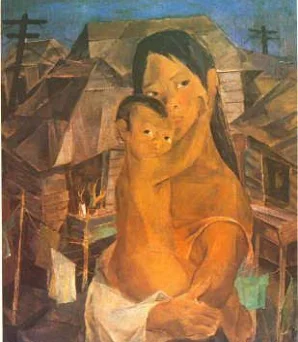
Madonna of the slums (by Vincente S. Manansala)
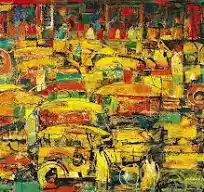
Jeepneys (by Vincente S. Manansala)
Cesar T. Legaspi
A neorealist whose style showed geometric distortions that express social commentaries
He promoted modern art
Neorealism
Showing real social life and human experiences using a modern, expressive style
Gadgets (by Cesar T. Legaspi)

Hernando R. Ocampo
The themes of his work told of the destruction and the harshness of life after World War II.
Abstract works
Genesis (by Hernando R. Ocampo)

J. Elizalde Navarro
A visual artist
His paintings are made of abstract figures
Known for incision painting technique
Incision painting technique
This technique is to scratch, cut, or carve lines into the painted surface to create texture, patterns, and stronger visual effect
The Seasons (by J. Elizalde Navarro)

Jose Joya
He created an authentic Filipino abstract
He was recognized as National Artist for Painting in 2003
Makiling Interlude
An abstract interpretation of Mount Makiling
It can also connect to Filipino identity because Mount Makiling is strongly associated with Philippine landscape, folklore, and the story of Maria Makiling
Makiling interlude (by Jose Joya)

Benedicto R. Cabrera
One of the most successful Filipino contemporary artists
Also called BenCab
He is most popular with his work that feature a solitary figure of a scavenger whom he named Sabel
Studies of Sabel
Shows an ordinary woman transformed into a powerful symbol of Filipino life
It also connects to Filipino identity because it focuses on an ordinary Filipino and reminds viewers of resilience, dignity, and the experiences of people who are often overlooked in society
Madonna with objects
The women can suggest motherhood, care, or the important role of women.
The objects around them may represent everyday life, work, or domestic responsibilities.
Studies of Sabel (by Benendicto R. Cabrera)

Madonna with objects (by Benendicto R. Cabrera)
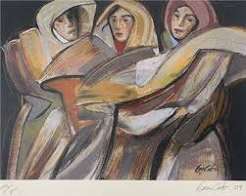
Woman with fan (by Benendicto R. Cabrera)
