NREMT
 Call Kai
 Learn
 Practice Test
 Spaced Repetition
 Match
 Flashcards
 Knowt Play
1/83

There's no tags or description
Looks like no tags are added yet.
84 Terms
What is the normal vital sign range for Blood Pressure?
90-120 mmHg (systolic), 60-80 mmHg (diastolic)
Overall: 120/80
What are normal skin signs?
Pink, dry, warm
What is the normal vital sign range for Pulse Rate?
60-100 BPM
What is the normal vital sign range for Respiratory Rate?
12-20 breaths per min
What is the normal vital sign range for O2?
95-100% saturation
What is the normal vital sign range for Blood Glucose?
70-120 units
What is the normal vital sign range for Temperature?
96.8-98.9
What does DCAP BTLS stand for
Deformity
Crepitus
Abrasions
Punctures/Penetrations
Burns
Tenderness
Lacerations
Swelling
What does OPQRST stand for?
Onset
Provocations
Quality
Region/Radiation/Reoccurrence
Severity
Time
What does SAMPLE stand for?
Signs/Symptoms
Allergies
Medication
Pertinent medical history
Last oral Intake
Events leading up to
What does Primary Assessment consist of?
Penman, GI, consent, AVPU, (X)ABCDEF
What does Secondary Assessment consist of?
Sample, opqrst, vitals, body exam+
What are the 4 types of shock?
Hypovolemic, Distributive, Obstructive, and Cardiogenic
What is shock?
Hypo perfusion (insuffienect blood flow)
What is Hypovolemic shock?
Bodily shock due to sever blood and fluid loss.
How does shock present?
Cool pale clammy/ or diaphoretic
Tachycardia
Hypotension
Disorientation
What is Cardiogenic shock?
Shock due to the pump failure failing to meet the bodies need of blood volume
What is Obstructive shock?
Shock due to a physical blockage against blood flow
Examples of Cardiogenic Shock?
MI or CHF
MI vs CHF
MI~ Heart attack, surprise blockage
CHF~ The heart gets tired and fails to work as effectively as before
MI is a common cause of CHF
Examples of Obstructive Shock?
Tension Pneumothorax, Cardiac Tamponade, and Pulmonary Embolism
What is Distributive Shock?
Shock due to a full body domino effect
Examples of Distributive Shock?
Anaphylactic, Septic shock and Neurogenic Shock
What is the Heart Blood flow pathway
RA, Tri(high)cuspid valve, RV, Pulmonary Artery
Lungs
Pulmonary Vein, LA, Bicuspid Value/ Mitral, LV, Aorta
What is Bronchitis?
Inflammation of the bronchi
S/S of Bronchitis?
Excess mucus, difficulty exhales
What is Emphysema?
Damage to the alveoli
What is Cushings Triad
Signs of Increased ICP
Cushing'‘s Triad:
Hypertension
Bradycardia
Irregular Respirations
What is Becks Triad?
Signs of Cardiac Tamponade
Becks Triad:
Hypotension
JVD
Muffled Heart Sounds
3 Neurological Types:
Ischemic, Hemorrhagic, TIA
Differentiate: Ischemic, TIA, & Hemorrhagic
Ischemic Stroke: A permanent blockage in the brain
TIA: A temporary blockage in the brain (stroke-like symptoms)
Hemorrhagic Stroke: A ruptured blood vessel inside or around the brain
What is Graves Disease
IS attacks Thyroid gland, makes body produce excess hormones
Hyperthyroidism
Bulging eyes
Tachycardia
Altered Mental Status
What organs live in the RUQ?
Liver and Gallbladder
What organs live in the LUQ?
Stomach, Spleen and Pancreas
What organs live in the RLQ?
Appendix, Cecum, Small Intestine and Ascending colon
What organs live in the LLQ?
Sigmoid Colon, Descending Colon and Small Intestine
S/S of AAA
Tearing pain that radiates straight to the back
S/S of Appendicitis
Worsening umbilicus pain that radiates and worsens at the RLQ
S/S of Cholecystitis(Gallbladder)
Sharp RUQ pain that radiates to the right shoulder
S/S of Pancreatitis
(LUQ) pain at the belt band radiating through the back
S/S of Diverticulitis
Cramping pain in the LLQ
S/S of a GI bleed
Hematemesis or Melena
S/S of Ectopic Pregnancy
Pain in any of the lower quadrants (childbearing age and missed periods)
Visceral, Parietal (Somatic) vs Referred Pain
Visceral: Hollow Organs cause cramping (poor localization)
Parietal (Somatic): Peritonial Lining irritation causing sharp/ severe pain (easily localized)
vs Referred Pain: Gallblader radiation to right shoulder or Spleen radiation to left shoulder
S/S of Peritonitis
rigid like abdomen due to inflammation of the abdominal cavity lining
We can help administer: Oxygen, Aspirin, Oral Glucose, Epi, Narcan and Charcoal (indications and contracindications)
O: ALLAT Contra: nun
Asp: Chest Pain Contra: Allergy, GI bleed
Oral Gluc: Hypoglycemia Contra: Unconscious (can’t swallow or protect airway)
Epi: Anaphylaxis Contra: nun
Narcan: Opioid Overdose Contra: nun
Charcoal: Poisoning and overdoses Contra: ALOC
We can help assist: Nitro, Albuterol and Epi (indication and contraindication)
Nitro: non traumatic Chest pain Contra: 53 bash
Albuterol: Respiratory Distress Contra: nun
Epi: Anaphylaxis Contra: nun
How long can you suction a adult vs ped for
Adult: 15 seconds max
Peds: 10 seconds max
Order the O2 devices from least to most effective
Nasal Cannula(2-6 L/min)
Non-Breather mask (10-15 L/min)
Bag Valve mask (15 L/min)
Indications for Nasal Cannula:
Mild Hypoxia in patients that are stable and spontaneous
Indications for Non-Breather mask:
Severe acute hypoxemia in patients that are spontaneously breathing
ex: carbon monoxide poisoning, acute trauma, severe respiratory distress
Indications for Bag Valve Mask:
Patients where spontaneous breathing cannot sustain life.
ex; Respiratory arrest, apnea, agonal breathing, or severe hypoventilation/failure
When are traction splints used?
For closed femur fractures
Coup vs contrecoup impacts
Coup are anterior brain injuries
Contrecoup are posterior brain injuries
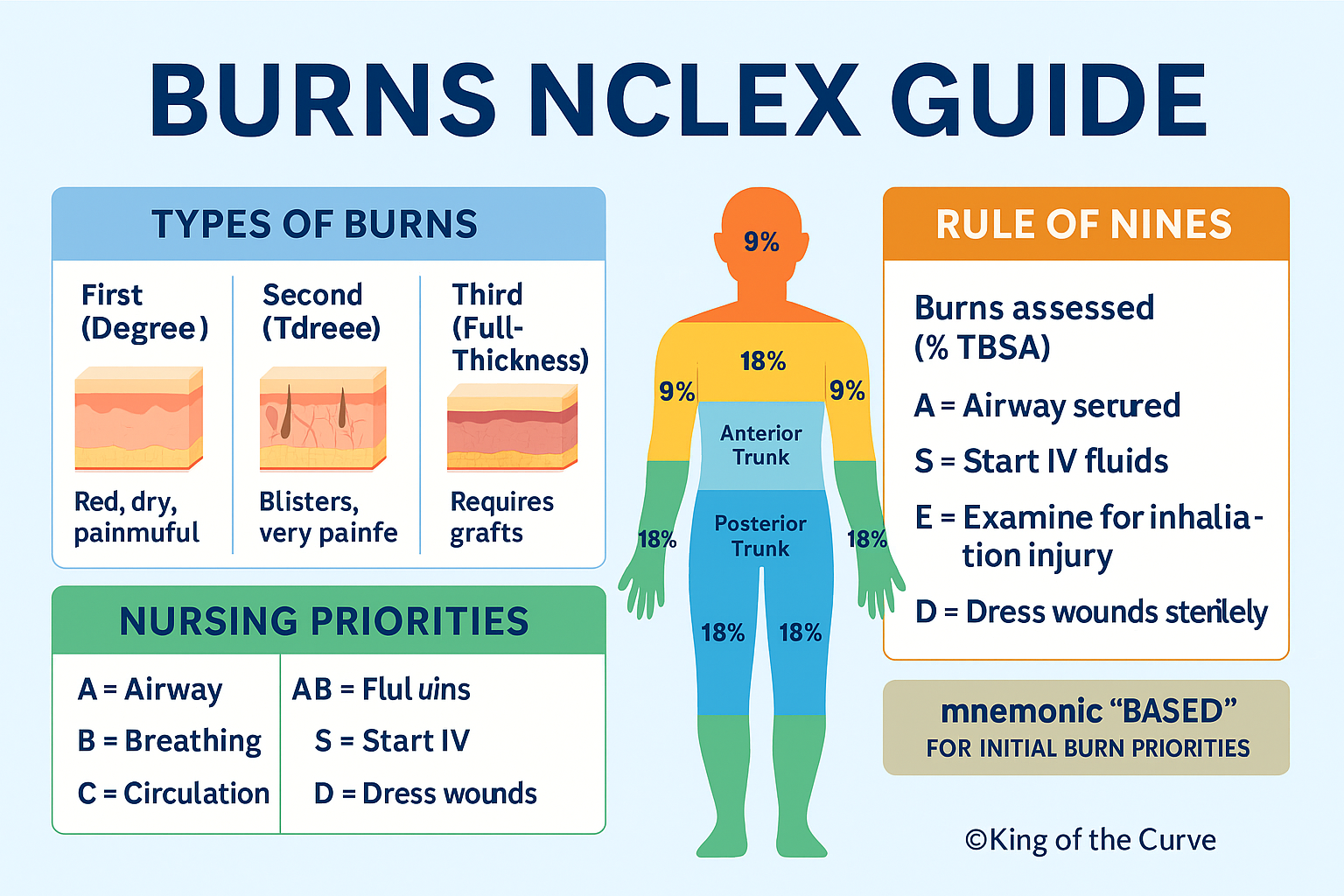
First Degree vs Second Degree vs Third Degree Burns
First Degree: Superficial
Second Degrees: Partial Thickness
Third Degree: Full Thickness
Rule of Nines
Head & Neck: 9%
Each Upper Extremity: 9%
Anterior Trunk: 18%
Posterior Trunk: 18%
Each Lower Extremity: 18%
Genitalia: 1%
What is Placentia Previa (S/S)
The placentia develops lower, covering the uterine opening
S/S: Painless, bright red vaginal bleeding
What is Placentia Abruptio (S/S)
The placenta prematurely detaches from the uterine wall before delivery
S/S: Painful, dark red vaginal bleeding
What is Preeclampsia?
Gestational Hypertension
CPR ratios
2 rescuer or infant 1 rescuer- 30:2
Neonates- 3:1
Which rythyms are shockable for an AED
V-fib and pulseless V-tach
What is Eclampsia?
Preeclampsia with tonic-clonic seizures (left lateral recumbent)
Prolapsed Umbilical Cord vs Breech/Limb Presentation actions
UC: lift fetus off chord, trendelenburg then moist dressing
Breech/Limb: elevate limbs
For the stroke scale, what does FAST stand for?
F: Facial Droop
A: Arm Drift
S: Slurred speech
T: Time 0 (last known normal)
What are the seizure phases?
Aura, tonic (stiffening), clonic (jerking), post-ictal (recovery/ lethargy)
Hypogylcemia vs Hyperglycemia
Hypo: Rapid Onset, cool/clammy, aloc.
Hyper: Gradual Onset, warm/dry, kussmaul resp (deep,rapid), fruity breath
START (simple triage & rapid treatment) categories
Red(immediate): airway, bleed, shock, aloc
Yellow (delayed): fractures+
Green (minor/ walking wounded): Minor cuts, abrasions
Black (expectant/ deceased): apneic, dead
Differentiate S/S of Opioids, Stimulants and Anticholinergics

Ex of Opioids, Stimulants and Anticholinergics
Opioids: Heroin, Fentanyl, and Oxycodone
Stimulants: Cocaine, Meth and MDMA
Anticholinergics: Benzos, Alcohol, Barbiturates
What is PAT testing for
Pediatric Appearance, work of breathing and circulation to skin
What is the cause of pediatric cardiac arrest
Respiratory failure/ hypoxia
What is croup vs epiglotittis
Croup: Seal, bark like cough with stridor and low grade fever
Epiglottitis: Drooling and tripod position fever with no cough
When are OPA and NPA contradicted
OPA: Gag reflex
NPA: Facial trauma
BVM rate with advanced airway
1 breath every 6 seconds
Signs of Basillar Skull Fracture?
Battle signs, raccoon eyes, and CSF
Tension Pnuemo vs Cardiac Tamponade
TP: tracheal deviation + absent lung sounds on one side
CT: Bilateral clear breath, muffled heart
What is a flail chest?
2 or more ribs broken in 2 or more places causing paradoxical chest motion
(BVM and CPAP)
APGAR testing is…
appearance, pulse, grimace, activity, and respiration 1-5 mins post delievery
What is Supine Hypotensive Syndrome
When the heavy gravid uterus compresses the inferior vena cava (patient must then be transported left lateral recumbent)
The 3 stages of labor are:
1: Onset of contractions to dilation
2: Full dilation to delivery
3: Delivery of baby to delivery of placenta
Expressed vs Implied consent
Expressed: Informed consent where an adult agrees
Implied: Emergency decision making
Involuntary: court ordered consent
Which 4 elements prove negligence
Duty to act
Breach of Duty
Damges
Causation