Venous Insufficiency & Wound Dressings
 Call Kai
 Learn
 Practice Test
 Spaced Repetition
 Match
 Flashcards
 Knowt Play
1/99

There's no tags or description
Looks like no tags are added yet.
100 Terms
Venous stasis ulcers result from _______.
Chronic venous insufficiency (CVI)
Explain the pathophysiology behind dysfunctional venous valves --> venous stasis ulcers.
Dysfunctional valves --> blood pooling and increased venous pressure --> capillary leakage, tissue edema, and reduced oxygenation --> inflammatory mediators and fibrin deposition contribute to skin and tissue damage --> breakdown of skin and development of ulcers
Venous ulcers: location
Above or on the malleoli, in the distal 1/3 of the lower leg or "Gaiter" region
**NOTE: if outside this area, may be mixed etiology OR other underlying etiology**

Venous ulcers: surrounding skin
Hyperpigmentation (hemosiderin staining), stasis dermatitis, varicose veins, lipodermatosclerosis (scarring of the skin and fat --> thickened, hard, immobile skin)

Venous ulcers: wound characteristics
Uneven edges, shallow wound bed, HIGHLY exudative (primarily serous)

Venous ulcers: periwound tissue
Maceration, diffuse edges, irritation

List exercise options for patients with venous insufficiency.
- Gastroc stretches
- Ankle pumps, circumduction, ABCs, rocker board
- Heel & toe raises
- Step overs
- Exaggerated heel-toe sequence during walking
- Walking
- Biking
- Aquatics (if no wound)
What is the GOLD STANDARD for the treatment of venous insufficiency?
Compression (chronic situation -- unless surgically intervened)
What should we educate our patients w/ venous insufficiency on?
Compression, consequences of extended standing or sitting or crossing legs, importance of elevation, care and replacement of compression stockings, need for a healthy lifestyle (weight, smoking, diet, sleep, etc.)
PT intervention goals: prevention
DETECT S/S EARLY!! = vascular screening for venous reflux, plan for long-term compression use, surgical consult
PT intervention goals: treatment
Edema mgmt (PRIMARY) = leg elevation, compression therapy; wound care = manage drainage, protect periwound skin
PT intervention goals: education for long-term management
Education on condition, expectation for other wounds if not intervened; long-term compression needs
List compression methods for venous insufficiency.
- Tubigrip: light, easy, reusable
- Long-stretch and short-stretch
- Inelastic: Unna boot
- Multilayer: 2-4 layers, high compression
- Stocking: maintenance, custom vs. OTC
- Garments: farrow wrap, Circ-Aid
List the purpose of dressing.
1. Protect the wound from contamination
2. Maintain a moist healing environment
3. Manage exudate
4. Promote autolytic debridement
5. Support tissue regeneration
List KEY considerations in wound dressing selection.
1. Wound type & depth: is it superficial, partial, or full thickness?
2. Exudate level: dry, moderate, or heavy?
3. Infection status: is antimicrobial action needed?
4. Periwound condition: fragile, macerated, or intact?
5. Patient factors: allergies, mobility, cost, ease of use
_______: type of dressing used for low to moderate exudate, promotes autolysis
Hydrocolloids
_______: type of dressing that can absorb moderate to heavy exudate, cushions
Foams
_______: type of dressing for heavy exudate, promotes hemostasis
Alginates
_______: type of dressing that can rehydrate dry wounds and support autolysis
Hydrogels
_______: type of dressing that can stimulate tissue growth and support wound matrix; suitable for minimally exudative, non-infected wounds
Collagen
_______: type of dressing that provides a barrier for superficial wounds, low exudate
Films
_______: type of dressing that incorporates silver, iodine, or honey for infections
Antimicrobial
_______: flexible dressings made of silicone adhesive that is gentle on
skin and wound areas to absorb wound drainage. May be used in areas w/o wounds to prevent friction.
Foam (silicone foam borders -- Optifoam/Mepilex)

Contraindications: foam
Allergy or sensitivity to silicone
Directions for use: foam
NOTE: we're always going to assume that you washed your hands (or used hand sanitizer) before & after and applied clean gloves.
▪ Gently peel off the Foam Border.
▪ Cleanse the wound and around the wound with sterile saline.
▪ Gently blot dry around the wound and the wound bed using clean or sterile gauze.
▪ Peel backing film(s) off of the FoamBorder
▪ Apply Foam Border over wound bed
_______: thin, transparent adhesive dressing that acts as a barrier to external contaminants while allowing oxygen exchange. It is ideal for superficial wounds with minimal exudate and can also be used to secure IV sites or cover healing wounds.
Film (transparent film -- Tegaderm)

Contraindications: film
Allergy or sensitivity to adhesive materials, moderate to heavy exudate, fragile or compromised skin that may tear upon removal
Change as ordered by your provider!!
Direction for use: film
NOTE: we're always going to assume that you washed your hands (or used hand sanitizer) before & after and applied clean gloves.
▪ Gently remove the old dressing
▪ Cleanse the wound and surrounding skin with sterile saline
▪ Gently blot dry using clean or sterile gauze
▪ Peel backing from the film
▪ Apply the dressing smoothly over the wound, avoiding wrinkles
▪ Press edges to ensure full adhesion
Change as ordered by your provider OR if it becomes loose or soiled!!
_______: sterile, non-adherent dressing made of fine mesh gauze impregnated with petrolatum and 3% bismuth tribromophenate. It provides a moist wound environment and has mild antimicrobial properties. Commonly used for superficial wounds, donor sites, surgical incisions, and skin grafts.
Non-adherent contact layer/ impregnated gauze (Xeroform)

Contraindications: impregnated gauze
Allergy or sensitivity to bismuth or petrolatum, deep or heavily exudative wounds w/o secondary dressing
Direction for use:
NOTE: we're always going to assume that you washed your hands (or used hand sanitizer) before & after and applied clean gloves.
▪ Gently remove the old dressing
▪ Cleanse the wound and surrounding skin with sterile saline
▪ Gently blot dry using clean or sterile gauze
▪ Apply a new piece of Xeroform directly over the wound bed
▪ Cover with a secondary dressing if needed (e.g., gauze pad, foam)
Change as ordered by your provider!!
_______: flexible dressing that works together with wound moisture and drainage to help wound healing and to help remove dead tissue through autolytic debridement. Autolytic debridement uses your body's own enzymes and moisture to re-hydrate, soften and finally liquefy dead tissue. It is also used as a protective covering to prevent certain types of skin breakdown, such as friction.
Hydrocolloid - thin

Contraindications: hydrocolloid - thin
Allergy or sensitivity to hydrocolloid, moderately or heavily draining wounds, 3rd degree burns
Direction for use: hydrocolloid - thin
NOTE: we're always going to assume that you washed your hands (or used hand sanitizer) before & after and applied clean gloves.
▪ Begin to remove dressing by slowly and lightly peeling up the edges. If dressing is difficult to remove, adhesive remover wipes may be used to assist in dressing removal.
▪ Cleanse the wound and around the wound with sterile saline, making sure to remove all old dressing materials.
▪ Gently blot dry around the wound and the wound bed using clean or sterile gauze.
▪ Optional: Apply Skin Prep around the wound. This will protect the skin when removing the dressing and provide a sticky surface to adhere to.
▪ If necessary, cut piece to fit over the entire wound bed and extending approx 1 inch, if space allows, onto the skin around the wound.
▪ Remove the backing from the Hydrocolloid Thin.
▪ Apply piece of Hydrocolloid Thin over the wound.
Change as ordered by your provider!!
What is important to consider when analyzing a wound that has had a hydrocolloid dressing on it?
Hydrocolloid thin can develop a slight odor; if this odor is present, it should resolve w/ cleansing the wound
What is the difference b/w hydrocolloid thin and regular?
Regular dressings are thicker and more absorbent, making them suitable for low to moderate exudate (while thin dressings are suitable for dry to light exudate)
_______: highly absorptive material that creates a soft gel when wound drainage is absorbed. May also come with Silver Impregnated (Ag).
Hydrofiber
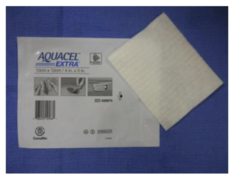
Direction for use: hydrofiber
NOTE: we're always going to assume that you washed your hands (or used hand sanitizer) before & after and applied clean gloves.
▪ Clean the wound and around the wound with sterile saline, making sure to
remove all old dressing material. If you can't easily remove the dressing from the wound, apply sterile saline to the dressing until it is able to be removed. ▪ Gently blot dry around the wound and the wound bed using clean or sterile
gauze.
▪ If necessary, cut a piece slightly larger than the size of the
wound bed, overlapping approx 1 cm (0.5in), on to the skin, if possible.
▪ Apply piece over the wound bed
▪ Cover with dry dressing recommended by your provider
Change as ordered by your provider!!
_______: cooling, soothing
dressings made primarily of water and polymer. They help maintain a moist wound environment, support autolytic debridement, and provide pain relief. Ideal for dry or minimally exuding wounds. Some may contain
antimicrobial agents like silver.
Hydrogel sheet (also comes in a gel variation)

Direction for use: hydrogel sheet
NOTE: we're always going to assume that you washed your hands (or used hand sanitizer) before & after and applied clean gloves.
▪ Clean the wound and surrounding skin with sterile saline. Remove any old dressing gently. If stuck, moisten with saline until it loosens.
▪ Gently blot dry around the wound using clean or
sterile gauze.
▪ If needed, cut to fit the wound size,
allowing a slight overlap onto healthy skin (about 1 cm
or 0.5 in).
▪ Apply directly over the wound bed.
▪ Cover w/ a secondary dressing as recommended by
your healthcare provider (e.g., foam or gauze).
Change as directed by your provider OR when it becomes dry or soiled!!
_______: made from seaweed-derived fibers that form a soft gel when in contact with wound exudate. They are highly absorbent and ideal for moderate to heavily draining wounds. When impregnated with silver (Ag), they provide antimicrobial protection to help reduce bacterial load in the wound.
Alginate

Direction for use: alginate
NOTE: we're always going to assume that you washed your hands (or used hand sanitizer) before & after and applied clean gloves.
▪ Clean the wound and surrounding skin with sterile saline. Remove any old dressing gently.
If stuck, moisten with saline until it loosens. ▪ Gently blot dry around the wound using clean or sterile gauze.
▪ If needed, cut to fit the wound size, allowing a slight overlap onto
healthy skin (about 1 cm or 0.5 in).
▪ Apply directly into or over the wound bed.
▪ Cover with a recommended secondary dressing (e.g., foam or gauze pad) to secure and
manage drainage.
Change as directed by your provider OR when the dressing becomes saturated or soiled!!
_______: sheet dressings contain medical-grade Manuka honey infused into a sterile, absorbent gauze. The honey provides natural antimicrobial action, supports autolytic debridement, and helps maintain a moist wound environment. The sheet format allows for easy application and removal.
Honey sheet (note: there is also a gel version and alginate version that provides absorption)

Contraindications: honey sheet
Allergy or sensitivity to honey or honey-derived products, 3rd degree burns, heavily bleeding wounds
Direction for use: honey sheet
NOTE: we're always going to assume that you washed your hands (or used hand sanitizer) before & after and applied clean gloves.
▪ Cleanse the wound and surrounding skin with sterile saline. Remove any old dressing gently. If stuck, moisten with saline until it loosens. ▪ Gently blot dry around the wound and wound bed using clean or sterile gauze.
▪ If needed, cut to fit the wound bed.
▪ Apply directly over the wound. If the wound has depth, lightly pack the
dressing as directed by your provider.
▪ Cover with a dry secondary dressing as recommended by your healthcare provider.
Change as ordered by your provider!!
_______: Iodine based gel, used to reduce dead tissue and bacteria on the surface of wounds.
Cadexomer Iodine gel (there is also a pad variation)

Contraindications: Cadexomer Iodine - Gel
Iodine allergy or sensitivity, pregnant or breastfeeding, thyroid metabolism issues (if used long-term)
Direction for use: Cadexomer Iodine - Gel
NOTE: we're always going to assume that you washed your hands (or used hand sanitizer) before & after and applied clean gloves.
▪ Clean the wound and skin around wound with sterile saline, making sure to remove all old dressing materials. If you can't easily remove the dressing from the wound, apply sterile saline to the dressing
until it is able to be removed.
▪ Gently blot dry around the wound and wound bed using clean or sterile gauze ▪ Apply enough Iodosorb to cover wound bed using either a cotton tip applicator (Q-Tip) or by squeezing
the gel onto the secondary dressing such as a gauze and applying it over the wound
▪ Cover with dry dressing recommended by your provider
Change as ordered by your provider!!
When wound drainage is absorbed by Cadexomer Iodine - Gel, the Iodosorb changes color from what to what? (note: also, take extra care to ensure all old Iodosorb material is removed before placing new Iodosorb)
Brown --> cream/grey color
_______: what our bodies need to produce new cells; this synthetic version dissolves into the wound bed to act as scaffolding for tissue in wounds to grow. Comes in a silver impregnated version as well.
Collagen

Contraindications: collagen
3rd degree burns, allergy or sensitivity to collagen
Direction for use: collagen
NOTE: we're always going to assume that you washed your hands (or used hand sanitizer) before & after and applied clean gloves.
▪ Cleanse the wound and around the wound with sterile saline, making sure to remove all old dressing materials. If you can't easily remove the dressing from the wound, apply sterile saline to the dressing
until it is able to be removed.
▪ Gently blot dry around the wound and the wound bed using clean or sterile gauze.
▪ Cut a piece to fit the size of the wound bed.
▪ Apply cut piece to the wound bed
▪ Moisten with sterile saline until entire piece of collagen dressing turns translucent/gray.
▪ Cover with dry dressing recommended by your provider
Change dressing as ordered by your provider!!
Is it necessary to remove residual collagen dressing from the wound bed during dressing changes?
NO!! -- collagen will naturally absorb into the body over time
_______: foam dressing that helps stop the growth of bacteria (bacteriostatic). The foam is made up of polyvinyl alcohol sponge, Methylene Blue, and Crystal Violet, which are the bacteriostatic ingredients.
Hydrofera Blue
Contraindications: Hydrofera Blue
Allergy or sensitivity to polyvinyl alcohol, Methylene Blue, or Crystal Violet; 3rd degree burns; heavily bleeding wounds
Direction for use: Hydrofera Blue
NOTE: we're always going to assume that you washed your hands (or used hand sanitizer) before & after and applied clean gloves.
▪ Cleanse the wound and around the wound with sterile saline, making sure to remove all old dressing materials. If you can't easily remove the dressing from the wound, apply sterile saline to the dressing until it is able to be removed. ▪ Gently blot dry around the wound and the wound bed using clean or sterile gauze.
▪ If necessary, cut piece to fit into/over the entire wound bed.
▪ If ordered, moisten piece with ordered liquid (example: sterile saline, acetic acid, etc). Squeeze out excess liquid once moistened.
▪ If ordered, fenestrate the dressing by cutting slits in the body of the piece of dressing you will use.
▪ Apply to cover wound bed, if wound has depth lightly pack wound
▪ Cover with dry dressing recommended by your provider
Change as ordered by your provider!!
Advantages vs. contraindications: hydrogel
Advantages: cooling effect, promotes autolysis, hydrates wound bed
Contraindications: heavy exudate
Indications: hydrogel
Minimally draining, dry wounds, eschar
Advantages vs. contraindications: antimicrobials
Advantages: controls bacteria, reduces or prevents infection
Contraindications: known sensitivity, silver may cause staining in wound/skin
Indications: antimicrobials
Infected wounds, wounds at risk for infection
Advantages vs. contraindications: impregnated gauze
Advantages: highly comfortable, non-adherent, promotes autolysis, maintains moisture
Contraindications: heavy exudate, indications may vary based on impregnated dressing
Indications: impregnated gauze
Painful wounds, burns, dry wounds, minimal drainage
Advantages vs. contraindications: alginates
Advantages: highly absorbent, easy to use, slows bleeding, layered for more absorption
Contraindications: dry eschar, 3rd degree burns, heavy bleeding
Indications: alginates
Moderate to heavy drainage, infections, slough or granulation
Advantages vs. contraindications: foams
Advantages: non-adhesive options for friable skin
Contraindications: 3rd degree burns, dry or non-draining wounds
Indications: foams
Minimal to heavy exudate, infected wounds
Advantages vs. contraindications: hydrofiber
Advantages: highly absorbent, packing agent
Contraindications: dry wounds, dry eschar
Indications: hydrofiber
Infection, moderate to heavy exudate
Advantages vs. contraindications: hydrocolloids
Advantages: maintains a moist wound bed, adhesive and absorptive, promotes autolysis
Contraindications: burns or dry wounds, heavy exudate, tunneling or sinus tracts, infection
Indications: hydrocolloids
Dry, necrotic wounds; minimal exudate; clean, granulating wounds
Advantages vs. contraindications: transparent film
Advantages: promotes autolysis, reduces surface tension, various sizes and shapes
Contraindications: moderate to heavy exudate
Indications: transparent film
Dry or minimal drainage, partial thickness, secondary dressing
Guiding question: Can you describe the basic anatomy of the venous system? Do veins have significant smooth muscle within their walls, similar to arteries?
Basic anatomy: network of blood vessels that return deoxygenated blood from the body back to the heart. Low-pressure system with valves to prevent backflow.
NO!! Veins do NOT have significant smooth muscle in their walls. Veins are often referred to as "capacitance vessels" because of their thin walls and large lumens allow them to hold large volumes of blood w/ relatively low pressure.
Guiding question: What is venous hypertension?
Abnormally high pressure within the veins, most commonly in the veins of the legs. This occurs when blood flow back to the heart is impaired (vein valves are not working properly, vein walls are damaged, blood is obstructed, muscle pump failure)
Guiding question: What system is used to classify venous wounds?
CEAP Classification
- Clinical = what can be seen or measured on physical exam
- Etiologic = cause
- Anatomic = which veins are affected
- Pathophysiologic = how the veins are malfunctioning
Provides a universal language, guides treatment decisions, allows tracking of disease progression and healing
Guiding question: Describe the typical location and characteristics of venous insufficiency ulcers (wounds).
Location: medial lower leg, esp. just above the medial malleolus (i.e., the "gaiter" area)
Appearance & characteristics: irregular, shallow, moderate to heavy exudate, pain relieved by leg elevation, hemosiderin staining, stasis dermatitis, pulses present, lipodermatosclerosis, atrophie blanche
Guiding question: What is lipodermatosclerosis?
Chronic inflammatory and fibrotic condition of the skin and subQ tissue of the lower legs caused by long-standing venous HTN.
- skin feels like leather
- shape is an "inverted champagne bottle"
- often tender and discolored
Guiding question: What is hemosiderin staining?
Brownish skin discoloration caused by the leakage and breakdown of RBCs --> releases hemoglobin --> iron from the hemoglobin is stored in tissues as hemosiderin
Guiding question: What is the primary underlying treatment, most important for treating venous insufficiency ulcers?
Compression therapy!! (removes venous pressure, improves venous return, decreases edema, enhances oxygen and nutrient delivery, promotes ulcer healing, and prevents recurrence)
Guiding question: What are the goals of appropriate wound dressings?
1. Protect the wound from contamination
2. Maintain a moist healing environment
3. Manage exudate
4. Promote autolytic debridement
5. Support tissue regeneration
Guiding question: What considerations are there in choosing an appropriate dressing?
1. Wound type & depth
2. Exudate level
3. Infection status
4. Periwound condition
5. Patient factors (allergies, mobility, cost, ease of use)
Guiding question: What is a primary dressing?
Primary: first layer of dressing that comes directly in contact w/ the wound bed
- maintains a moist environment
- protects
- absorbs exudate (if needed)
- delivers medication (if medicated dressing)
- minimizes trauma when removed
Ex: hydrocolloids, alginates, hydrofibers dressings, foams, non-adherent contact layers, antimicrobial dressings
Guiding question: What is a secondary dressing?
Secondary: additional dressing applied over the primary dressing to provide supportive functions
- secures the primary dressing in place
- provides addition absorption
- protects
- adds compression or insulation
Ex: gauze pads or rolls, elastic or cohesive bandages, foam pads or ABD pads, compression wraps
Guiding question: What is a composite dressing?
Composite: combines multiple layers or functions -- including both primary and secondary dressing roles -- into one single product
- usually has 3 layers
- ex: Tegaderm Plus Pad, Allevyn Adhesive, Covaderm, Opsite Post-Op dressing
Guiding question: When should we change the dressing? How do we know when it's best to change?
Depends on the type of wound, type of dressing, and amount of exudate. General rule is dressings should be changed often enough to keep the wound clean and the surrounding skin intact -- but not so often that you disturb healing. "Change as needed, not by habit."
When in doubt, change dressing as ordered by your provider!!
Guiding question: List the dressing classifications.
Hydrocolloids, foams, alginates, hydrogels, collagen dressings, films, antimicrobial dressings
Guiding question: What does it mean for a dressing to be occlusive?
Occlusive: impermeable to air and water
- completely seals the wound from the external environment
- retains moisture and heat
- typically used for shallow, clean wounds or minor abrasions
Ex: hydrocolloid dressings, some transparent films
Guiding question: What does it mean for a dressing to be semi-occlusive?
Semi-occlusive: allows gas exchange (O2, CO2) BUT blocks water and bacteria
- maintains a moist environment w/ some airflow
- moderate exudate wounds, venous ulcers
Ex: foam dressings, hydrogel sheets, transparent films
Guiding question: What does it mean for a dressing to be nonocclusive?
Nonocclusive: permeable to air, water, AND bacteria
- does not retain moisture
- allows wound to dry out
- infected or heavily draining wounds (often combined with another dressing)
Ex: gauze, tulle dressings
Guiding question: How is gauze best used and what cautions are there with gauze used?
Uses: as a secondary dressing to secure it and absorb excess drainage, for short-term wound packing, for heavily exudative or infected wounds
Cautions: adherence to wound bed (dry gauze sticks), desiccation, fibers left behind, frequent changes needed, non-selective debridement (NO LONGER RECOMMENDED IN MODERN WOUND CARE), poor barrier protection (nonocclusive)
Guiding question: What are the indications and risks with use of impregnated gauze?
Indications: primary dressing; partial-thickness wounds, skin grafts and donor sites, surgical incision, minor burns or radiation injuries, chronic and/or painful wounds
- keeps wound moist, prevents adherence
- best for superficial, clean, or granulating wounds
Risks: limited absorption, potential for maceration, occlusion of air flow, sensitivity reactions, frequent changes needed, not ideal for debridement
Guiding question: What are the indications and risks with using a film dressing?
Indications: barrier for superficial wounds, low exudate
- allows visualization of the wound bed and wound exudate
- waterproof and bacterial barrier w/ oxygen and vapor exchange
- reduces friction and shear
- facilitates autolytic debridement
- conforms to body contours
- serves as a secondary dressing
- is cost-effective
Risks: NOT for infected wounds or wounds w/ excess moisture buildup; NOT suitable for deep, cavity, or tunneling wounds
- may tear fragile skin upon removal
- does not absorb exudate
- may not adhere well to dry, flaky skin
- may macerate skin if fluid collects underneath
**Best for superficial, minimally exudative wounds and for protection vs. absorption**
Guiding question: When should a film dressing not be used?
1. Moderate to heavily exudating wounds (fluid is trapped beneath the surface --> maceration and wound enlargement)
2. Infected wounds (seal traps bacteria and exudate)
3. Deep, cavity, or tunneling wounds
4. Fragile or compromised periwound skin
5. Wounds w/ thick eschar or heavy slough (film blocks oxygen and moisture)
Guiding question: What are the indications and risks with using a hydrogel? When should a hydrogel not be used?
Indications: hydrates dry wounds, support autolysis
- rinse or clean easily
- conforms
- soothe "hot" wounds and reduce pain
- delivery system
Risks: macerate the periwound skin if wound become too wet, do not absorb drainage, dry out if not covered adequately, require a secondary dressing, usually require daily dressing changes
Contraindications: wounds w/ visible exudate
Guiding question: Which dressing class is most appropriate for use over an exposed structure, such as bone or tendon?
Exposed bone or tendon must stay moist and protected. The goal is to prevent desiccation, avoid trauma, and encourage granulation tissue. So, we need a moisture-donating, non-adherent dressing.
Best choice = hydrogel (hydrates exposed structures, promotes autolytic debridement, non-adherent and soothing)
Guiding question: What are the indications and risks with foam dressings?
Indications: absorb moderate to heavy exudate, cushion
- create and maintain a moist environment
- easy to apply
- effective under compression
- absorb light to heavy exudate
- conform well
- do not adhere to a moist wound surface
- available w/ antimicrobials
- protective
Risks:
- require a secondary dressing if non-bordered
- not effective for dry eschar
- may macerate periwound skin if saturated
- costly
Guiding question: What are the indications and risks with hydrocolloids? When should a hydrocolloid not be used?
Indications: low to moderate exudate, promote autolysis
- maintain moist wound
- keep bacteria, moisture, and contamination out of wound
- absorb min to mod exudate
- facilitate autolytic debridement
- thermal insulation
- effective under compression
- self-adhering
- conform well
Risks:
- prevent visualization of wound bed (not recommended for DTPI)
- difficult to remove from fragile skin
- may leak
- require a different primary dressing to fill spaces
Should NOT be used: covering exposed structures (tendon, bone), infections, heavy exudate
Guiding question: What are the differences and similarities between calcium alginates and hydrofiber dressings?
Similarities: highly absorbent (used for moderate to heavily exudating wounds), form a soft, cohesive gel that maintains a moist wound environment and traps bacteria and exudate
**Both are used for venous ulcers, pressure injuries, diabetic ulcers, surgical or traumatic wounds, infected wounds (antimicrobial)**
Differences: base material (alginates = seaweed, hydrofiber = cellulose), fluid retention (hydrofiber retains fluid better), cohesiveness (hydrofiber is more cohesive), hemostatic capabilities (alginates have, hydrofibers do not), wicking (alginates = horizontal, hydrofibers = vertical), cost (alginates are cheaper)
Guiding question: What are the three types of antimicrobials? When are they indicated for use and how long should they be used for?
Types: Silver, Iodine, Honey
Uses: infected wounds, wounds with high bioburden, wounds w/ early infection signs (increased exudate, odor, friable) granulation tissue, or delayed healing), post-debridement wounds or graft sites
How long: standard initial course is 2 weeks. continue beyond 2 weeks only if infection signs persist or bacterial load remains high. discontinue when wound shows progression (less exudate, healthy granulation, no odor, no redness).
Guiding question: When should silver not be used? When should cadexomer iodine not be used?
When NOT to use: clean, healing wounds; dry or minimally exudative wounds; long-term use
Silver: allergy or sensitivity, pediatric population (risk of toxicity), patients w/ electrical implants (can interfere w/ electrical conduction -- rare but noted in precautions), during MRI imaging (may distort MRI images or heat up), in combination w/ oil-based or petroleum products (deactivate the silver), where enzymatic debridement is used (silver inactivates these agents)
Iodine: allergy or sensitivity to iodine, dyes, or shellfish; pregnant or breastfeeding (may affect the baby's thyroid); thyroid metabolism issues; renal impairment