M3 Coulson- Evolutionary Ecology I + Species interactions I: Evolution + sepcies interactions in stage-structured models
 Call Kai
 Learn
 Practice Test
 Spaced Repetition
 Match
 Flashcards
 Knowt Play
1/3

There's no tags or description
Looks like no tags are added yet.
4 Terms
what are integral projection models?
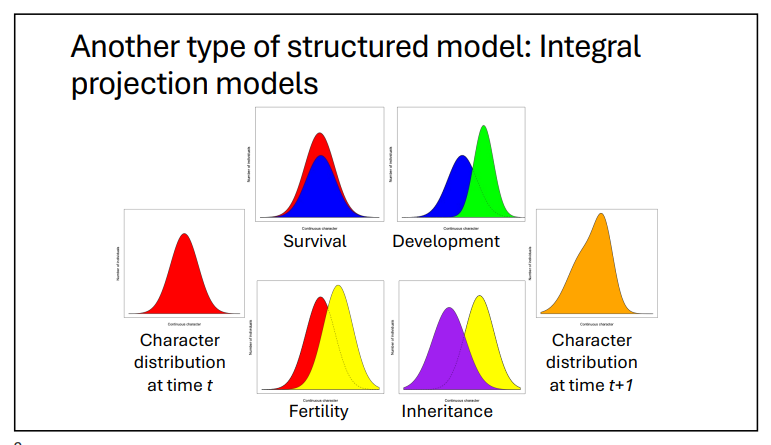
integral projection models (IPMs):
plot a character distribution for a given trait for a population at time t
modulate this distribution by multiplying by functions for survival + development (where the trait changes with growth) and fertility + inheritance
combining these distributions will give us a character distribution of the new population, adding one generation on
mortality (+ emigration) removes from the distribution, reproduction (+ immigration) adds to it, and ontogenic development moves data within the distribution
eg. IPMs of wolves in yellowstone
what have integral projection models told us about wolves in yellowstone?
wolves can be classified into coat colour:
AA and AB wolves are black (A is dominant)- AA is the least fit phenotype
BB wolves are grey
the strongest factor influencing wolf populations is density dependence due to limited food availability
however, coat colour is not under direct selection
the heterozygotes are those with the greatest fitness → they have the highest survival in years of canine distemper virus (CDV) outbreaks because the A allele protects against lung infections
the model predicted disassortative mating (black x grey) to increase the amount of heterozygotes, which was observed under CDV pressure
(while assortative mating of grey wolves is most successful in the absence of CDV)
survival, development, fertility and inheritance are the four factors affecting the character distribution over time
what are structured models not good at capturing?
they do not capture change in environments over very long timescales due to evolution and innovation rewiring ecosystems
yes, convergent evolution leads to similarity in traits due to selection for specific traits leading to similar conclusions, but we cannot predict evolution due to historical contingency
eg. the evolution of lignin produced trees in the early carboniferous that couldn’t be broken down by detritivores
eg. the human brain was also a major evolutionary innovation that changed the course of history
how can we model species interactions in yellowstone?
starting with grass, elk and wolves:
as wolves become better at hunting, the elk population goes down, but so does the wolf population because the food source decreases (evolutionary suicide), and the grass improves
when wolves are present they tend to stabilise the population (less cyclic dynamics between elk and grass)
it is difficult to parameterise these models
this can be built up to a much larger model capturing a greater selection of species interactions
we can remove one factor, eg wolves, and examine how other populations change → increase in elk due to lack of predation, but a decrease in bison, since elk outcompete them for vegetation, and they weren’t really predated by wolves in the first place