Biochemistry Unit 3
 Call Kai
 Learn
 Practice Test
 Spaced Repetition
 Match
 Flashcards
 Knowt Play
1/200

There's no tags or description
Looks like no tags are added yet.
201 Terms
Metabolism
Overall process through which living organisms aquire and use free energy to carry out various properties
Catabolism
Degredation; nutrients and cell constituents are broken down to salvage their components and/or make energy avaliable

Anabolism
Biosynthesis; biomolecules are synthesized from simpler components

Metabolic pathways
Series of connected enzymatic reactions that produce specific products
Metabolites
The reactants, intermediates, and products in a metabolic pathway
How is free energy obtained in metabolic pathways
Complex metabolites exergonically broken down into simpler products
Free energt released in the degradative process is conserved through teh creation of different molecules ATP from ADP and Pi, or
Free energy storage
Stored through synthesis of ATP from ADP + Pi or by the reduction of a coenzyme such as NADP+ to NADPH.
Major energy sources for anabolic reactions
Generalizations about metabolism
Metabolic pathways are interconnected and converge into common hubs
All pathways occur simultaneously
Facilitated by enzymes
Regulated
Main source of fuel for many metabolic pathways
Glucose
Transportation of metabolites in tissues
Only glucose is transported through blood
There are other specialized ways/functions to transport
Where specifically does metabolism occur?
Primarily in cellular compartments, primarily the cytosol and mitochondrion
Lysosome has other related processes that occur, but not necessarily metabolic pathways
Why are enzymes important in metabolism
They are biological catalysts, that allow greater reaction specificity, higher reaction rates, milder reaction conditions(don’t need/cause intense conditions that may kill cell to occur), and capacity for regulation
What do enzymes sometimes need?
Cofactors
What is a cofactor
a non-protein chemical compound or metallic ion required for an enzyme to function as a catalyst in a biochemical reaction
Cofactors are the vitamins and minerals from your diet.
How are enzymes highly specific
through binding of active site of enzyme by lock and key model
Have geometric complementarity and electronic complementarity for substrate/active site
This means substrate physically fits into active site, while having favorable electronic charges/residues that bring them together
What are the electronic components of enzyme
The residues of the active site;
1) hydrophobic effect- allows substrate to bind to active site and displace water, increasing entropy, which is favorable(don’t compete with H2O for reaction)
2)Hydrogen bonding
3)Ion-dipole
How do enzymes change reaction kinetics
Enzymes DO NOT change thermodynamics(delta G remains the same), but rather lowers the activation energy (X double cross/ delta delta G) to make reaction more attainable energetically
Example of how enzymes change the rate of reaction
in proteases, they contain an oxyanion whole which lowers the transition state energy
What type of environment to the top and bottom histidines have in common?
Hydrophobic environment(promotes initial status of unprotonated/uncharged)
Hydrophilic envirnment (promotes charges, polar initial status)
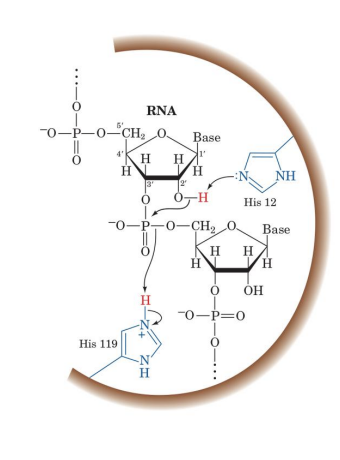
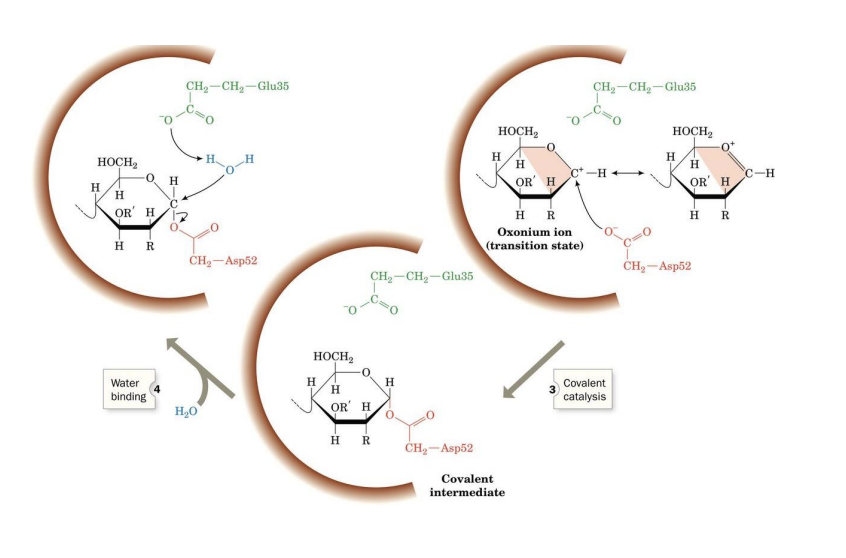
Covalent catalysis
Substrate is temporarily covalently bonded to active site of enzyme
Nucleophilic groups can catalyze reactions through transient formation of covalent bonds with the substrate
Oxonium ion covalent catalysis
Cofactor subcatagories
Metal ion: may play a role in stabilizing enzyme structure, or directly in catalysis
Coenzymes: organic molecules
• Cosubstrate: associated transiently
• Prosthetic group: permanently associated with enzyme, often through covalent bond

Oxidoreductase
Enzyme for oxidation-reduction reaction
Transferase
enzyme that aids in transfering of functional group
Hydrolase
Enzyme that helps in hydrolysis reactions
Isomerase
Enzyme that helps in isomerization reactions
Ligase
Enzyme that helps in bond formation reactions
Kinase
Enzyme that uses ATP to add a phosphate group to molecule
Dehydrogenase
Any enzyme in a oxidation/reduction reaction that consumes NAD-/NADH
Overview of thermodynamics of reaction

deltaG>0
Non-spontaneous/endergonic
deltaG=0
Reversable and at equilibrium
deltaG<0
Spontaneous/exergonic
How can direction of chemcial reactions be determined?
Le Chatelier’s principle; tells us how equilibrium shifts
Most metabolic pathways are in equilibrium
What is the consequence of reactiions functioning far from equilibrium
These irreversible reactions confer directionality on that pathway(push pathway in equilibrium in one direction)
Commit metabolites to pathway(thin Le chatleier’s)
These are the rate limiting reaction and serve as potential control points for the pathway(allows enzyme regulation)
Reaction far from equilibrium impacting metabolic pathway example
Exergonic/spontaneous reaction essentially converts all reactants into products
These products are reactants for the second step of pathway; high concentration of step 1 product/step 2 reactant pushes step 2 towards products, confering directionality of the pathway

How do we calculate free energy of pathway?
We can calculate the changes in free energy of an entire pathway by adding the changes in free energy of each reaction within that pathway.

How is enzyme activity controlled (short term;seconds to minutes)
Allosteric Activation/inhibition
Covalent modification-Phosphorylation and hormones
Substrate cycle-two metabolic pathways run simultaneously in opposite directions
How is enzyme activity controlled (long term; hours to days)
Genetic control- regulation of enzyme availability
Allosteric control
Binding of moleucle to non-active site that conformationally changes enzyme
Converts enzyme between T state and R state
Binding of desired substrate makes enzyme more active
How can metabolic pathway products serve as effectors and why can this be beneficial?
High concentration of product indicates there is a plentiful amount, and more production would waste energy; if product serves as an inhiitor upstream of pathway, it can self regulate itself, and stop the metabolic pathway from reducing more/at the rate it is doing so
Vice versa for activators, except high concentration of reactants serve as activators downstream

Gluconeogenesis(what is it and delta G)
Synthesis of glucose
reverse reaction
deltaG«0
glycolysis(what is it and delta G)
Degradation of glucose
Forward reaction
deltaG«0
How can gluconeogenesis and Glycolysis both have a -delta g if they are opposite reactions?
Do this by having two different sets of enzymes to control either direction, and take control by activating/inactivating any given enzyme
**equilibrium steps only use one enzymes, leaving them in equilibrium
Why is metabolism stepwise?
so energy can be stored for other processes , and not be used all at once/lost to heat
How is energy generated in metabolism stored?
In energy packets that readily release/generate energy for various processes
ATP, Ac-CoA, NADH, FADH2
What are different bonds in ATP?

Most common/accesible reaction with ATP
Breaks one phosphoanhydride bond

Phosphoanhydride vs phosphoester free energy
Phosphoanhydride bond is less stable, leading to its hydrolysis releasing more free energy
ATP hydrolysis reactions and standard free energy

Why is phosphoryl-transfer so favorable?
1. Resonance stabilization is greater in the products.
2. Electrostatic repulsion is reduced after hydrolysis.
3. Hydrolysis products are better solvated.
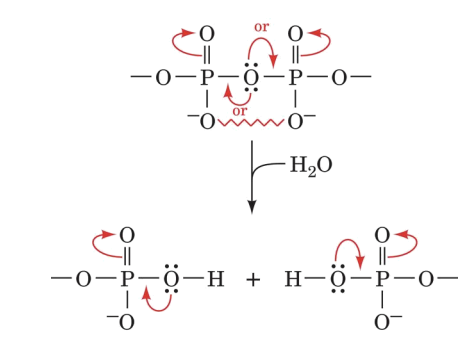
Why is phosphoryl transfer so useful?
The free energy change associated with phosphoryl group transfer from ATP is negative enough to be coupled with other metabolic reactions and power these reactions
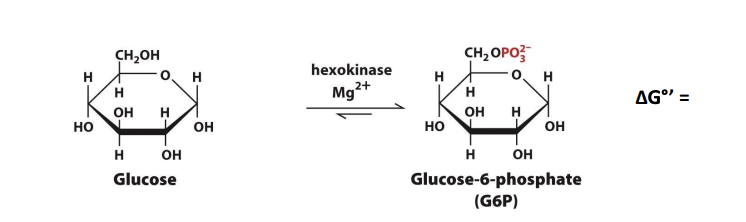
How do we make this endergonic reaction proceed?
Couple reaction with ATP/ATP hydrolysis


What is the delta g of this reaction (deltaG reaction 1=+13.8, deltaG reaction 2= -30.5)
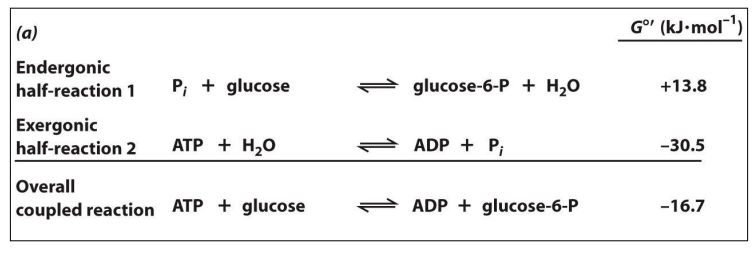
thioesters use in energy storage
Thioesters can conserved/act like ATP, in that it saves energy rather than it being lost as heat
Has a similar -deltaG to ATP
NADH
Electron acceptor; can accept two electrons in the form of H —

NADH functions
NAD+ (derived from niacin) is a cosubstrate for many dehydrogenases. NAD+ accepts electrons and transfer them to other compounds.
NADH can shuttle electrons to the Electron Transport Chain (ETC).
FADH2
Can accept two electrons but one at a time (in the form of radical H)
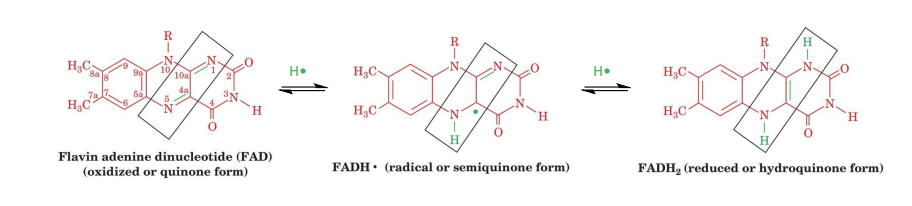
FADH2 functions
FAD(derived from vitamin B2 ) is a cosubstrate for some dehydrogenases.
FAD accepts electrons and transfer them to other compounds.
FADH2 can shuttle electrons to the ETC
Substrate-level phosphorylation
The transfer of a phosphoryl group from a phosphorylated substrate to ADP to regenerate ATP.

Oxidative phosphorylation
Process by which energy released by electrons is used to generate ATP.

Digestion of carbohydrates
1)Salivary amylase begins digestion in mouth
2) salivary amylase is denatured by stomach acids
3)Pancreatic emylase continues digestion in small intestine
4) Enzymes in microvilli break down carbohydrates to monosaccharides
5)Resistant starches and fibers are digested and fermented in the large intestine and colon
What is the basic mechanism of polysaccharide breakdown in low pH envirnment

Where do energy generating processes occur?
Within the cell; specifically, the cytosol and mitochondria
How is glucose brought into the cell and what is done to it innitialy?
Via GLUT’s (Glucose transporters) which bring it in from across the plasma membrane
Once inside, it is phosphorylated
Phosphorylation locks glucose inside the cell
Why does phosphorylation lock glucose inside the cell
The large and polar phosphate group prevents the glucose from crossing the membrane barrier
Rate limiting steps
Steps that are far from equilibirum and have a very negative delta g
General overview of glycolysis
hasd two stages stage 1 and stage 2
10 enzymatic reactions, and converts glucose into two pyruvates
net gain of 2 ATP and 2 NADH
Stage 1 general overview
5 steps
requires in investment of 2 ATP’s
Stage 2 general overview
Energy recovery phase
5 steps
Produces 4 ATP and 2 NADH
Step 1 of glycolysis
Hexokinase phosphorylates glucose at C6
Coupling with ATP hydrolysis makes reaction favorable
Substrate: Glucose
Cofactors: Mg2+, ATP
Enzyme: hexokinase
Very negative delta G! (-27kJ/mol—> Favorable)
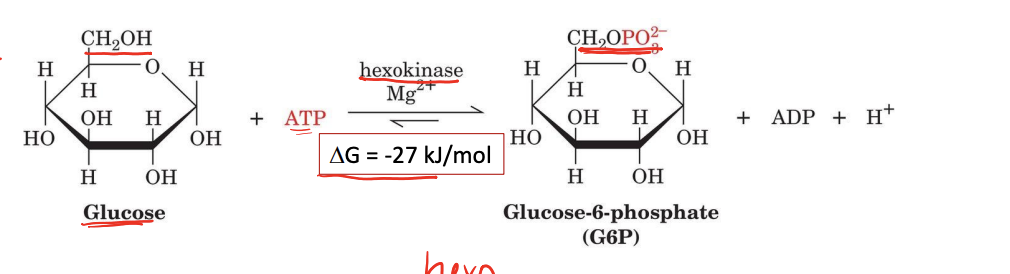
Half reactions of step 1
Glu+ Pi—> Glu-P
ATP—> ADP + Pi
Adds up to
Glu+ATP —> Glu-P +ADP
Hexokinase enzyme
Preforms step 1 of glycolysis
Relatively nonspecific and will phosphorylate many different sugar molecules
This step is what locks glucose inside of cell
What is function of Mg2+
Cofactor; stabilizes negative charge of ATP, shielding these negative charges
Also makes the y-phosphorous atom(third one) more accessible to nucleophilic attack by C6-OH of glucose
Why is C6-OH attacked?
It is the only primary alcohol in glucose, making it the most reactive
Step 1 mechanism
Water is a nucleophile that attacks one of the phosphate groups in ATP
Example of hydrophobic effect at active site with H2O being replaced to prevent h2o from interrupting the reaction
enzyme works by excluding water and prevents water from acting as a nucleophile and competing with glucose/ATP reaction
Glucose binding to hexokinase
Substrate binding induces conformational change of enzyme.
Enzyme closes on substrate (like a baseball glove).
Excludes H2O from active site.
Brings substrate and cofactors into close proximity.
Step 2 of glycolysis
G6P converted into F6P; catalyzed by phosphoglucose isomerase
Enzyme: phosphoglucose isomerase (PGI)

Phosphoglucose isomerase mechanism
Works by using general acid–base catalysis. It first opens the glucose ring, then shifts the carbonyl from C1 to C2 through a cis-enediolate intermediate, with active-site acids and bases moving protons back and forth. Finally, it closes the ring into the five-membered fructose form and releases F6P.

Step 3 of glycolysis
F6P phosphorylated into FBP
Cofactors: ATP, Mg2+
Enzyme: phosphofructokinase(PFK); similar traits to that of hexokinase
Very negative delta g(ATP hydrolysis coupled reaction)

What are the two forms of F16BP that exist and which is the product of a reaction and which is the reactant in a reaction
These forms are in equilibrium with eachother and regularly interconvert.
Step 3 product is FBP cyclic form and step 4 reactant is linear/non-cyclic form
Why does step 4 use FBP isomer?
Aldolase needs a free C2 ketone, which only the open-chain form has. An active-site lysine attacks that carbonyl to form a Schiff base, and that iminium pulls electrons so the C3–C4 bond can break, splitting FBP into DHAP and G3P. In the ring form, C2 is tied up in the ring and isn’t a carbonyl, so this mechanism can’t happen.
Step 4 of glycolysis
Aldolase cleaves FBP
FBP—> DHAP + GAP
6 C sugar converted into two 3 C molecules
Substrate: Open chain form of FBP
Enzyme: Aldolase
Product: GAP + DHAP

Step 4 mechanism details
Aldolase catalyzes the aldol cleavage between C3 and C4.
Requires a carbonyl at C2 and hydroxyl at C4.
Using step 4 reaction, why is isomerization of G6P necessary?
If glucose is not isomerized, it would form a 4 C and 2 C molecule, which is not ideal for creating the same 3 C molecule, which is eventually done in glycolysis
Isomerization allows for aldolase to effectively split the substrate in half into two 3 C molecules

Aldolase mechanism
Lysine attacks carbonyl forming a schiff base making it more electrophilic, and Asp attacks C4-OH as a basewhich effectively leads to C3-C4 bond cleavage
This schiff base must be hydrolyzed to remove enzyme(attached via covalent catalysis)
Why is lysine the only residue that can be used in aldolase
Aldolase’s mechanism requires a Schiff base, which can only form from a primary amine attacking the carbonyl, and lysine is the only amino acid with a primary amine side chain. Other nitrogen-containing residues like arginine, histidine, asparagine, and glutamine aren’t nucleophilic enough to do this. The active site also lowers lysine’s pKa so it stays neutral and able to attack.
Step 5 of glyvolysis
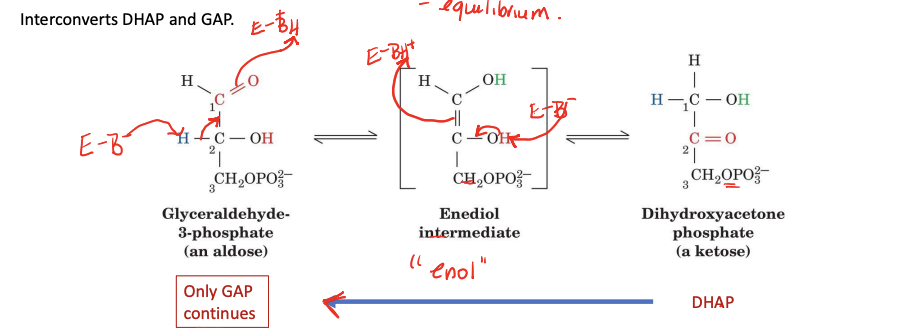
Triose phosphate isomerase converts DHAP into GAP
DHAP—> GAP
substrate: DHAP
enzyme: triose phosphate isomerase
Product: GAP

triose phosphate isomerase mechanism notes
Acid-base catalyzed isomerization.
Maintained at equilibrium.
Triose phosphate isomerase helps make enediol intermediate
GAP continues down path, DHAP converted to GAP as GAP is consumed.
First stage of glycolysis overview
1 Glucose converted to 2 GAP and 2 ATP used

What are high energy compounds
Compounds whose delta G has a large magnitude, negative delta G
They are used to help form ATP via ADP and Pi
Step 6 of glycolysis
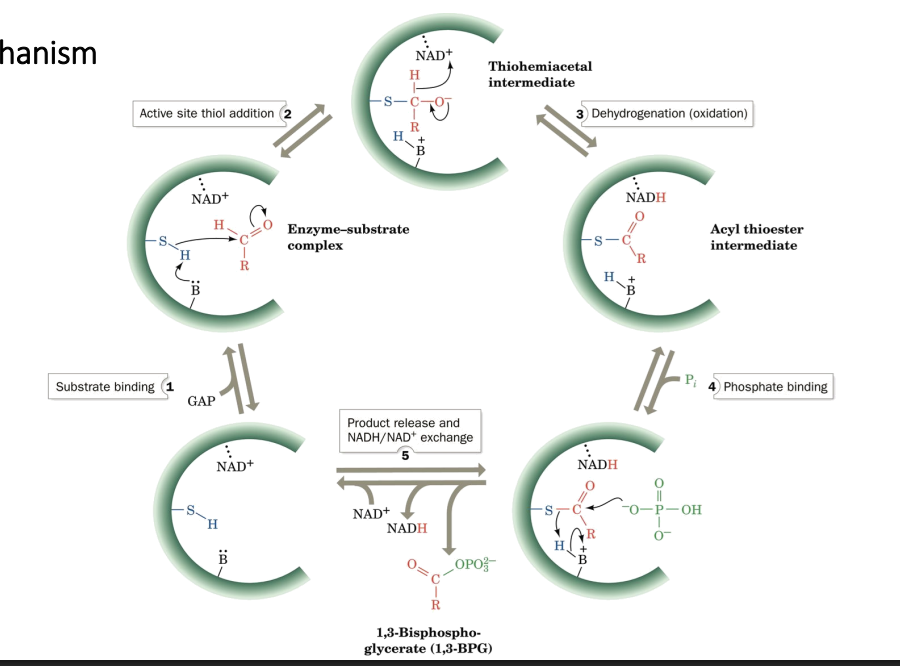
GAP, NAD+, and Pi converted into 1,BPG (high energy intermediate), NADH, and H+
Catalyzed by glyceraldehyde-3-phosphate dehydrogenase (GAPDH)
Redox reaction with dehydrogenase enzyme; aldehyde is oxdized and NAD+ is reduced
Enzyme: Glyceraldehyde-3-phosphate dehydrogenase (GAPDH)
Substrate: Glyceraldehyde-3-phosphate (G3P)
Cosubstrates: NAD⁺ (oxidizing agent) and inorganic phosphate (Pi). No ATP is used.

GADPH mechanism
Pi is a cosubstrate
Keep note that Cys is catalytic residue and needs a base to deprotonate it in order to attack aldehyde; Represents a transient covalent bond, and will serve as a good LG(TS energy).
Role NAD+ has as a oxidizing agent and pulling off aldehyde H, and allowing for Pi to attack
Step 7 of glycolysis
1,3BPG+ADP converted into 3PG + ATP; catalyzed via PGK
Enzyme: Phosphoglycerate kinase (PGK). It’s named for the reverse reaction, where ATP phosphorylates 3-phosphoglycerate.
Substrate: 1,3-bisphosphoglycerate (1,3-BPG)
Cosubstrate: ADP, bound as a Mg²⁺–ADP complex (Mg²⁺ is the required metal cofactor)
Products: 3-phosphoglycerate (3PG) and ATP

Why does step 7 reaciton work
Look at the delta G’s of the reaction; releasing a Pi group from 1,3BPG is highly favorable, and can be coupled with formation of ATP which isn’t favorable
1,3-BPG + H₂O → 3PG + Pi ΔG°′ = −49.3 kJ/mol
ADP + Pi → ATP + H₂O ΔG°′ = +30.5 kJ/mol
──────────────────────────────────────────────
1,3-BPG + ADP → 3PG + ATP ΔG°′ = −18.8 kJ/mol
Step 7 mechanism

Step 8 of glycolysis
3PG converted to 2PG via PGM (phosphoglycerate mutase)
Substrate: 3PG
Product: 2PG
Enzyme: phosphoglycerate mutase (PGM)

Mutase
An enzyme that catalyzes the transfer of a functional group from one position to another on a molecule.
Step 8 Simple Mechanism

PGM mechanism
His acts as intermediator for Pi transfer
Acidic amino acid is also needed for transfer of original Pi onto the His
