Neuron Function
 Call Kai
 Learn
Learn Practice Test
 Spaced Repetition
 Match
Match Flashcards
 Knowt Play
1/17

There's no tags or description
Looks like no tags are added yet.
Name | Mastery | Learn | Test | Matching | Spaced | Call with Kai | Chat |
|---|
No analytics yet
Send a link to your students to track their progress
18 Terms
communication and processing of information is encoded in _____ ___________ of _________ and _____________ ____________
communication and processing of information is encoded in ELECTRICAL ACTIVITY of NEURONS and CHEMICAL SIGNALING
Central nervous system consists of:
Peripheral nervous system consists of:
CNS:
components: brain and spinal cord
type of cells it has: neurons and glia
PNS:
components: all nervous tissue located outside CNS
type of cells: both neurons and glia (insulate neurons)
Neurons: 10 to the 11 neurons
Synapses: 10 to the 14-15 synapses

Neurons vary in ____ and ____
structures and properties

explain this slide on neural zones
Signal Reception: The dendrites and cell body receive incoming signals, converting them into a change in membrane potential.
Signal Integration: The axon hillock evaluates these electrical changes and initiates an action potential if the threshold is met.
Signal Conduction: The axon, insulated by myelinated Schwann cells, rapidly conducts the electrical impulse along its length.
Signal Transmission: The axon terminals release neurotransmitters across the synapse to communicate the message to the target cell.


explain the changes in membrane potential

what is membrane potential?
its the electrical potential difference between inside and outside cell
Resting membrane potentials: no net movement of ions across membrane


explain this
Panels A and B: Establishing a Potassium (K+) equilibrium
The cell starts with equal [K+, Cl-] inside and outside of cell, no net movement
K+ channels open, and the extracellular fluid [KCl] is reduced, creating a strong chemical force, driving K+ out of cell
K+ leaves, Cl- is inside cell, making it negative. This negative charge creates an electrical force that pulls K+ in
When C and E balance out, a stable negative membrane potential is negative
Panel C: Adding Sodium Na+ to the mix
A large [NaCl] is added to the outside and smaller amount to the inside
Event though there are a lot of gradient for Na+, there are no open channels for it, so it cannot cross the membrane
Panel D: flipping the charge via Na+ channels
switching the K+ channels with Na+ channels, the rules reverse
this causes Na+to rush into the cell, carrying postitive charge inside, making the cell positive
Panel E: The real cell scenario: both channels open
the membrane is much more permeable to K+ than to Na+ at rest
Because K+ leaks out faster than Na+ leaks in, the resting membrane potential stays negative, resting very close to the ideal eq. potential for K+
whats the Nernst ewuation or Eq. potential

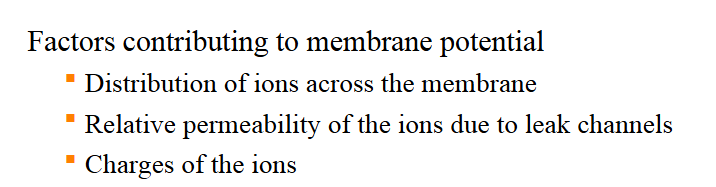
what are 3 factors contributing to membrane potential
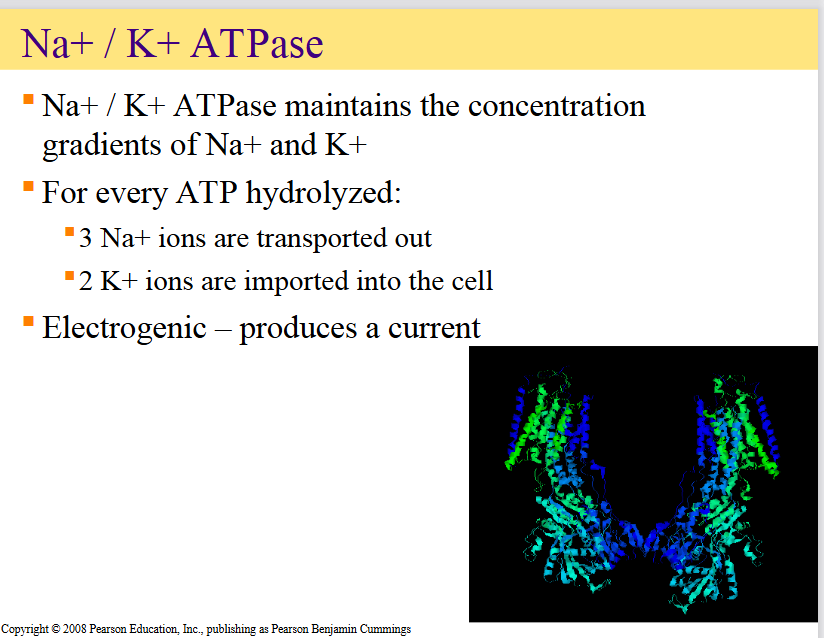
talk about the slide of Na+/K+ ATPase

explains these 2 graphs about changes in membrane potential
depolarization and hyperpolarization
Depolarization:
cell starts with -70mV
sodium channels open up
inside of cell is less negative and climbs to positive values
the Na+ equilibrium potential is the point where the positive internal change becomes strong enough to electrically repel any more incoming sodium
Hyperpolarization:
cell starts with -70mV
additional K+ channels open up
K+ leave the cell and go outside
Inside of cell becomes more negative
Eventually, the negative internal charge becomes so strong that its inward electrical pull exactly matches the outward chemical push.
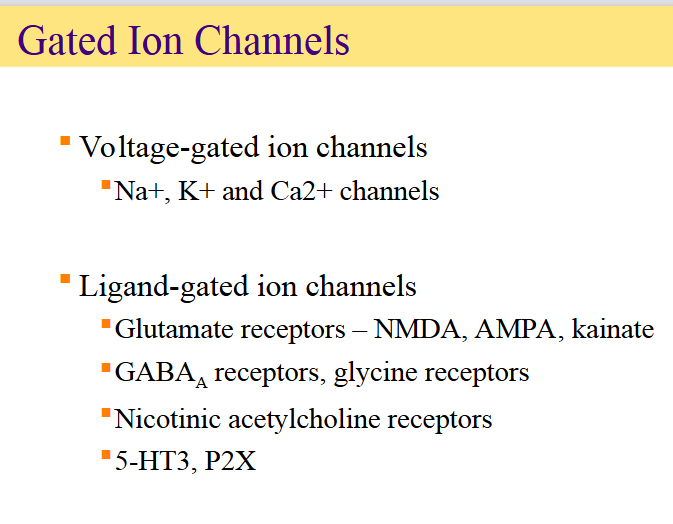
talk about Gated ion channels
they open and close according to neurotransmitter or voltage
they only allow specific ions to pass through

gated ion channels: 2 types
talk about the 2 formulas of conductance and electrochemical driving force

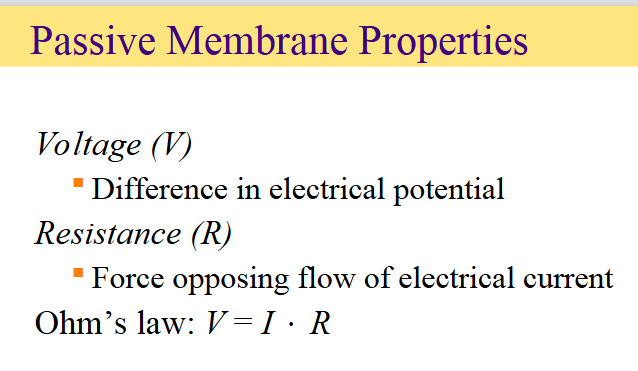
whats voltage and resistance?
whats axon membrane capacitance?

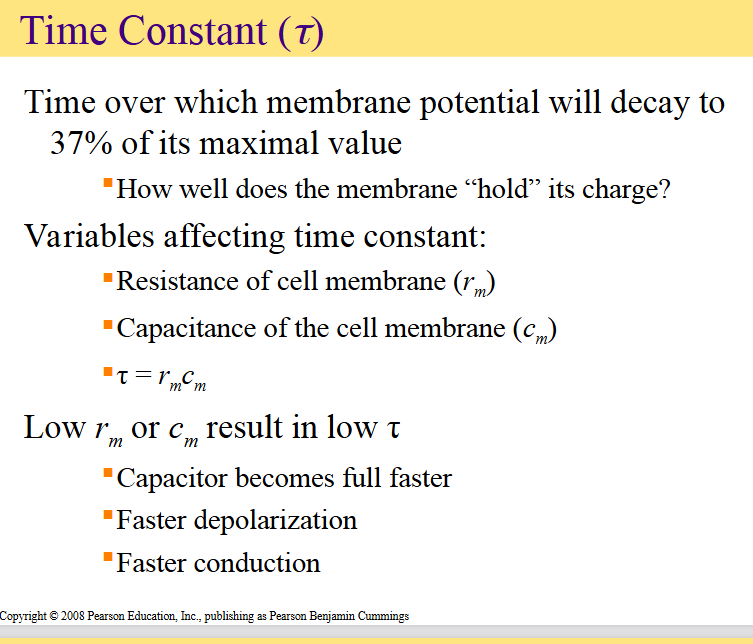
what is the time constant:
explain the voltage decreases with distance slide
