Honors Biology Chapter 05B Metabolism Energy and Enzymes
 Call Kai
 Learn
 Practice Test
 Spaced Repetition
 Match
 Flashcards
 Knowt Play
1/89

Earn XP
Description and Tags
Comprehensive review organized by topic: energy and thermodynamics, free energy, ATP and coupling, enzymes and activity graphs, inhibition, redox, and electron transport chains. Includes diagram-reading prompts.
90 Terms

[DIAGRAM 1] Match each graph to enzyme behavior: no enzyme, enzyme present, temperature change, or pH change.
Identify the curves by shape: a lower activation-energy peak shows an enzyme present; temperature usually rises to an optimum then drops sharply from denaturation; pH activity forms an optimum-centered bell curve.
[Energy and Thermodynamics] What is the ultimate source of energy for most life on Earth?
The Sun. Autotrophs capture solar energy and convert it into chemical energy that can move through ecosystems.
[Energy and Thermodynamics] What is kinetic energy?
Energy of motion; anything moving has kinetic energy.
[Energy and Thermodynamics] What is potential energy?
Stored energy based on an object's position or structure.
[Energy and Thermodynamics] What is chemical energy?
Potential energy stored in the bonds of molecules.
[Energy and Thermodynamics] State the first law of thermodynamics.
Energy cannot be created or destroyed; it can only be transferred or transformed. This is the law of conservation of energy.
[Energy and Thermodynamics] Give a biological example of the first law of thermodynamics.
During photosynthesis, autotrophs transform solar energy into chemical energy stored in carbohydrates.
[Energy and Thermodynamics] State the second law of thermodynamics.
Every energy transfer or transformation increases the entropy of the universe, and some usable energy is dispersed as heat; no transfer is 100% efficient.
[Energy and Thermodynamics] Give a biological example of the second law of thermodynamics.
Muscle activity transforms chemical energy into movement, but some energy is released as heat.
[Energy and Thermodynamics] What is entropy?
A measure of disorder or energy dispersal in a system.
[Energy and Thermodynamics] Why do organisms require a continual input of energy?
Cells need energy to maintain organization and homeostasis against the natural tendency toward increasing entropy.
[Energy and Thermodynamics] How does glucose breakdown illustrate increasing entropy?
One organized glucose molecule is converted into smaller, more dispersed molecules such as carbon dioxide and water, while energy is released.
[Metabolism and Free Energy] What is metabolism?
The sum of all enzyme-mediated chemical reactions in a cell or organism.
[Metabolism and Free Energy] What is an anabolic pathway?
A pathway that builds larger, more complex molecules from smaller ones and generally requires energy; photosynthesis and polymer synthesis are examples.
[Metabolism and Free Energy] What is a catabolic pathway?
A pathway that breaks larger molecules into smaller ones and generally releases energy; cellular respiration is an example.
[Metabolism and Free Energy] What are reactants?
The starting molecules that enter a chemical reaction.
[Metabolism and Free Energy] What are products?
The molecules formed by a chemical reaction.
[Metabolism and Free Energy] What is free energy, G?
The portion of a system's energy available to perform work.
[Metabolism and Free Energy] What does delta G measure?
The change in free energy between products and reactants: delta G = G(products) - G(reactants).
[Metabolism and Free Energy] What characterizes an exergonic reaction?
It releases free energy, has a negative delta G, and leaves products with less free energy than reactants. It is thermodynamically spontaneous, though it may still require activation energy.
[Metabolism and Free Energy] What characterizes an endergonic reaction?
It requires an input of free energy, has a positive delta G, and leaves products with more free energy than reactants.
[Metabolism and Free Energy] Does spontaneous mean instantaneous?
No. A spontaneous reaction has a negative delta G, but it may occur very slowly unless activation energy is overcome or an enzyme is present.
[Metabolism and Free Energy] How do anabolic and catabolic pathways differ energetically?
Anabolic pathways are usually endergonic and consume energy; catabolic pathways are usually exergonic and release energy.
[ATP and Energy Coupling] Why is ATP called the energy currency of the cell?
ATP stores transferable chemical energy and couples energy-releasing reactions to energy-requiring cellular work.
[ATP and Energy Coupling] What are the components of ATP?
Adenine, the five-carbon sugar ribose, and three phosphate groups.
[ATP and Energy Coupling] What reaction releases usable energy from ATP?
ATP hydrolysis: ATP + H2O -> ADP + inorganic phosphate (Pi) + energy.
[ATP and Energy Coupling] What is dephosphorylation?
Removal of a phosphate group; ATP dephosphorylation produces ADP and Pi and is exergonic.
[ATP and Energy Coupling] What is phosphorylation?
Transfer or addition of a phosphate group to a molecule, often making that molecule more reactive or changing its shape.
[ATP and Energy Coupling] What is energy coupling?
Using energy released by an exergonic reaction, such as ATP hydrolysis, to drive an endergonic reaction.
[ATP and Energy Coupling] How can ATP hydrolysis drive polymer synthesis?
The exergonic hydrolysis of ATP provides energy and/or transfers a phosphate to reactants, allowing endergonic joining of monomers into a polymer.
[ATP and Energy Coupling] What is chemical work performed by ATP?
Driving endergonic synthesis of molecules, such as building macromolecules from monomers.
[ATP and Energy Coupling] What is transport work performed by ATP?
Powering the movement of substances across membranes against their concentration or electrochemical gradients.
[ATP and Energy Coupling] What is mechanical work performed by ATP?
Powering movement, such as muscle contraction, chromosome movement, cilia, or flagella.
[ATP and Energy Coupling] How is ATP regenerated?
Energy from catabolic reactions or light is used to add Pi to ADP: ADP + Pi + energy -> ATP.
[Enzymes and Pathways] What is a metabolic pathway?
An ordered sequence of linked reactions in which the product of one step becomes a reactant for the next and each step is catalyzed by a specific enzyme.
[Enzymes and Pathways] What is a catalyst?
A substance that increases reaction rate without being consumed or permanently changed by the reaction.
[Enzymes and Pathways] What is an enzyme?
A biological catalyst, usually a protein, that speeds a reaction by lowering activation energy.
[Enzymes and Pathways] What is a substrate?
A reactant that binds to an enzyme and is acted upon by it.
[Enzymes and Pathways] What is an active site?
The specific region of an enzyme where the substrate binds and catalysis occurs.
[Enzymes and Pathways] What is the enzyme-substrate complex?
The temporary complex formed when a substrate is bound in an enzyme's active site.

[Enzymes and Pathways] Describe the basic enzyme reaction cycle shown in diagrams.
Substrate enters the active site -> an enzyme-substrate complex forms -> the enzyme lowers activation energy and converts substrate to product(s) -> products leave -> the unchanged enzyme can be reused.
[Enzymes and Pathways] What is enzyme specificity?
An enzyme's active site has a particular three-dimensional shape and chemical environment that allow it to bind only certain substrate(s).
[Enzymes and Pathways] What is the induced-fit model?
Substrate binding causes the enzyme's active site to change shape slightly, improving the fit and positioning chemical groups for catalysis.
[Enzymes and Pathways] Why are enzymes often named with the suffix -ase?
Many enzyme names identify their substrate or reaction and end in -ase; for example, lactase catalyzes the breakdown of lactose.
[Enzymes and Pathways] Are enzymes consumed in reactions?
No. They emerge unchanged, so a small amount can catalyze many reaction cycles.
[Activation Energy] What is activation energy, Ea?
The initial energy that reactant molecules must absorb to reach the transition state and begin a reaction.
[Activation Energy] Why is activation energy biologically useful?
It prevents energy-rich molecules from reacting or degrading spontaneously and gives cells control over when reactions occur.
[Activation Energy] How do enzymes speed reactions?
They provide an alternative reaction pathway with lower activation energy, increasing the number of successful molecular collisions per unit time.
[Activation Energy] Do enzymes change delta G or the energy of reactants and products?
No. Enzymes lower activation energy but do not change delta G, the reaction's equilibrium, or the starting and ending free-energy levels.
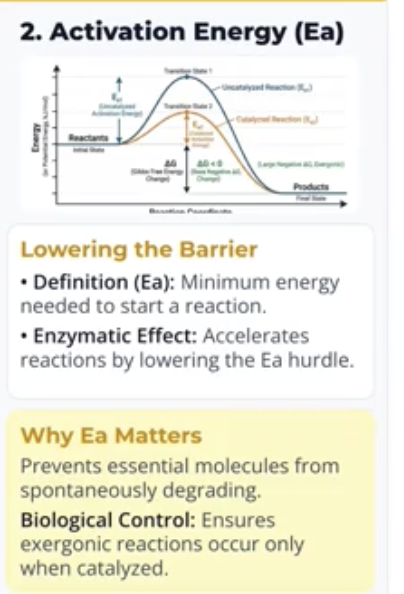
[Activation Energy] How should an energy diagram with and without an enzyme be read?
Both curves begin and end at the same energy levels, but the enzyme-catalyzed curve has a lower peak. The peak difference is the reduction in activation energy.
[Enzyme Activity] How does temperature affect enzyme activity?
Increasing temperature raises kinetic energy and collision frequency up to an optimum; above the optimum, heat disrupts enzyme structure and activity drops sharply because of denaturation.

[Enzyme Activity] What does a typical enzyme activity vs. temperature graph look like?
Activity rises as temperature approaches the optimum, reaches a peak, then falls steeply at higher temperatures as the enzyme denatures.
[Enzyme Activity] How does low temperature affect an enzyme?
It slows molecular motion and collision rate, reducing activity, but usually does not permanently denature the enzyme.
[Enzyme Activity] How does pH affect enzyme activity?
pH changes charges and hydrogen bonding within the enzyme, which can alter the active site's shape. Each enzyme has an optimal pH; extreme pH can denature it.
[Enzyme Activity] What does a typical enzyme activity vs. pH graph look like?
A bell-shaped curve centered on the enzyme's optimal pH; activity decreases on either side as active-site interactions are disrupted.
[Enzyme Activity] How does substrate concentration affect reaction rate?
Rate rises as substrate concentration increases because collisions become more frequent, then levels off when all active sites are occupied and enzymes are saturated.
[Enzyme Activity] What does the plateau on a reaction rate vs. substrate concentration graph mean?
The enzymes are saturated; nearly all active sites are occupied, so adding more substrate cannot increase rate unless more enzyme is added.
[Enzyme Activity] How does enzyme concentration affect reaction rate?
If enough substrate is available, increasing enzyme concentration increases reaction rate because more active sites are available.
[Enzyme Activity] What is denaturation?
Loss of an enzyme's functional three-dimensional shape, especially the active site, due to conditions such as high temperature or extreme pH.
[Enzyme Activity] What factors can influence enzyme activity?
Temperature, pH, substrate concentration, enzyme concentration, cofactors and coenzymes, and inhibitors.
[Enzyme Activity] What is a cofactor?
A nonprotein helper required by some enzymes, often an inorganic ion such as Mg2+, Zn2+, or Fe2+.
[Enzyme Activity] What is a coenzyme?
An organic nonprotein helper, often vitamin-derived, that assists an enzyme by carrying electrons or chemical groups.
[Enzyme Inhibition] What is enzyme inhibition?
A decrease in enzyme activity caused by an inhibitor binding to the enzyme.
[Enzyme Inhibition] What is competitive inhibition?
An inhibitor resembles or competes with the substrate for the active site, reducing substrate binding.
[Enzyme Inhibition] How can competitive inhibition often be reduced?
Increase substrate concentration so substrate molecules are more likely than inhibitor molecules to occupy the active site.
[Enzyme Inhibition] What is noncompetitive inhibition?
An inhibitor binds at a site other than the active site, changes enzyme shape or function, and lowers catalytic activity even if substrate can still bind.
[Enzyme Inhibition] Why does increasing substrate usually not overcome noncompetitive inhibition?
The inhibitor does not compete for the active site; it alters the enzyme's functional shape or catalytic ability from another site.
[Enzyme Inhibition] What is an allosteric site?
A regulatory binding site separate from the active site; binding there changes the enzyme's shape and activity.
[Enzyme Inhibition] What is feedback inhibition?
The end product of a metabolic pathway inhibits an enzyme early in the pathway, preventing unnecessary product accumulation and conserving resources.

[Enzyme Inhibition] In an inhibition diagram, how can competitive and noncompetitive inhibition be distinguished?
A competitive inhibitor occupies the active site. A noncompetitive or allosteric inhibitor binds elsewhere and changes the active site's shape or enzyme activity.
[Redox Reactions] What is an oxidation-reduction reaction?
A reaction involving transfer of electrons from one reactant to another; oxidation and reduction always occur together.

[Redox Reactions] What is oxidation?
Loss of electrons. In biological reactions it often also means loss of hydrogen, gain of oxygen, and loss of potential energy.
[Redox Reactions] What is reduction?
Gain of electrons. In biological reactions it often also means gain of hydrogen, loss of oxygen, and gain of potential energy.
[Redox Reactions] What mnemonic distinguishes oxidation from reduction?
OIL RIG: Oxidation Is Loss of electrons; Reduction Is Gain of electrons.
[Redox Reactions] What is the reducing agent?
The electron donor. It reduces another substance and is itself oxidized.
[Redox Reactions] What is the oxidizing agent?
The electron acceptor. It oxidizes another substance and is itself reduced.
[Redox Reactions] In photosynthesis, what happens to carbon dioxide and water?
Carbon dioxide is reduced to carbohydrate, while water is oxidized to oxygen; light supplies the required energy.
[Redox Reactions] In cellular respiration, what happens to glucose and oxygen?
Glucose is oxidized to carbon dioxide, while oxygen is reduced to water; released energy is captured in ATP and electron carriers.

[Electron Transport Chain] What is an electron transport chain, ETC?
A series of membrane-associated electron carriers that pass electrons through sequential redox reactions and use released energy to pump H+ across a membrane.
[Electron Transport Chain] What happens to electron energy as electrons move through an ETC?
High-energy electrons enter, then lose free energy in controlled steps as they pass to carriers with greater electron affinity; low-energy electrons leave or reach a final acceptor.
[Electron Transport Chain] How does an ETC create an electrochemical gradient?
Energy released by electron transfers powers H+ pumping to one side of a membrane, creating differences in H+ concentration and electrical charge.
[Electron Transport Chain] What three differences are associated with a proton electrochemical gradient?
A difference in proton concentration, charge, and pH across the membrane.
[Electron Transport Chain] What is chemiosmosis?
The use of energy stored in an H+ electrochemical gradient as protons flow through ATP synthase to drive ATP production.

[Electron Transport Chain] What is ATP synthase?
A membrane enzyme complex that uses the flow of H+ down its electrochemical gradient to phosphorylate ADP and form ATP.
[Electron Transport Chain] In what major processes are ETCs used?
Cellular respiration and photosynthesis.
[Electron Transport Chain] Where is the respiratory ETC located in eukaryotic cells?
In the inner mitochondrial membrane; H+ is pumped from the matrix into the intermembrane space.
[Electron Transport Chain] Where is the photosynthetic ETC located?
In the thylakoid membrane of chloroplasts; H+ accumulates in the thylakoid space.
[Electron Transport Chain] What is the final electron acceptor in aerobic cellular respiration?
Oxygen, which combines with electrons and H+ to form water.
[Electron Transport Chain] Trace the energy conversions in oxidative phosphorylation.
Chemical energy in high-energy electrons -> energy in the H+ electrochemical gradient -> rotational/mechanical energy in ATP synthase -> chemical energy in ATP.
[Electron Transport Chain] In an ETC diagram, what should you identify first?
The membrane, direction of electron flow, direction of H+ pumping, side with high H+ concentration, ATP synthase, direction of H+ diffusion, and where ADP + Pi becomes ATP.