BIS 103 Exam Review
 Call Kai
 Learn
 Practice Test
 Spaced Repetition
 Match
 Flashcards
 Knowt Play
1/104

There's no tags or description
Looks like no tags are added yet.
Name | Mastery | Learn | Test | Matching | Spaced | Call with Kai | Chat |
|---|
No analytics yet
Send a link to your students to track their progress
105 Terms

What is this structure
ATP
What does ATP hydrolysis result in
Large negative delta G which means high energy release when the phosphate group is removed from ATP, driving exergonic reactions in cells.

What is this compound
Adenosine Diphosphate - ADP

What is this compound
Adenosine monophosphate - AMP
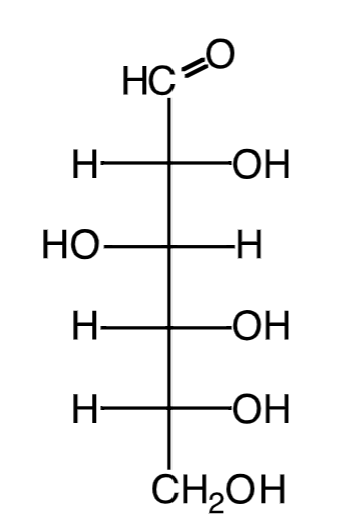
What kind of compound is this and what’s its name
This is an aldose compound. More specifically it is D-Glucose = GLC

What compound is this and what is its name
This is a ketose compound and it is D-Fructose = F
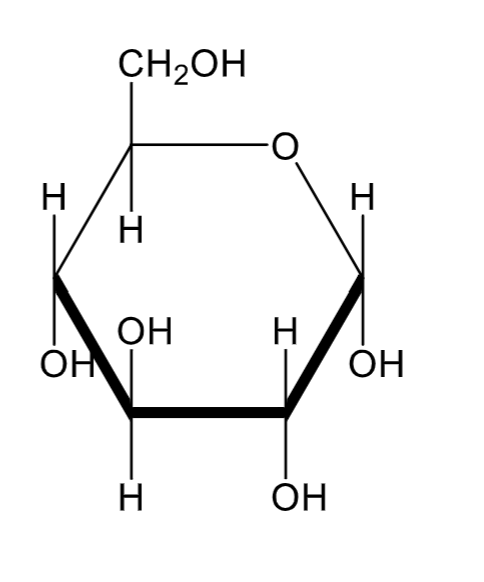
What is this
a-D-GLC

What is this
D-Fructose
Why is it important to convert GLC to G-6-P
G-6-P is more polar which makes it harder for it to leave the cell and it helps with the concentration gradient of GLC. The cell will not detect a major influx of GLC if it is converted to G-6-P.

What is this
Glucose-6-Phosphate - G-6-P
What happens during the first step of glycolysis
GLC - glucose, is phosphorylated using hexokinase and ATP to make GL6P. ADP is a product of this phosphorylation
What enzyme is used during the first reaction of glycolysis
Hexokinase
What happens during the second rxn of glycolysis
GLC6P is isomerized into F6P using a ketolisomerase. You go from an aldose to a ketose.

What is this structure
GLC-6-P

What is this structure
F-6-P
What happens during the 3rd rxn of glycolysis
F6P is phosphorylated into F-1,6-BisP using Phosphofructokinase - PFK1. This process uses 1 ATP and results in ADP as a side product as well

What is this
F-1,6-BisP
What happens during the 4th rxn of glycolysis
F-1,6-bisP is split by undergoing aldol cleavage via the Fructosebisphosphate aldolase enzyme and turns into DHAP and G-3-P

What is this
DHAP

What is this
G-3-P
What happens during the 5th rxn of glycolysis
DHAP is isomerized using another ketolisomerase into G-3-P. This now means in total there are 2 G-3-P molecules present.
What happens during the 6th rxn of glycolysis
Now that there are two molecules of G-3-P present each has to undergo the next steps. So each step happens twice to account for both molecules. First the aldehyde on G-3-P is oxidized, then it is converted to an acyl phosphate with Pi. The resulting products are 2 molecules of NAD and 2 molecules 1,3-bisPGA.
What is important is step 6 of glycolysis
Co - factor balance is important in this step because if there is no balance of NADH and H then the rxn cannot continue.
Why is 1,3-bisPGA important
It is a high energy compound

What is this
1,3-bisPGA
What are some high energy compounds
acyl phosphates, enolic phosphates, creatine phosphates, Thioester phosphates, phosphate anhydride

What is this and why is it relevant
Acyl phosphate - High energy compound

What is this and why is it relevant
Enolic phosphate - high energy compound
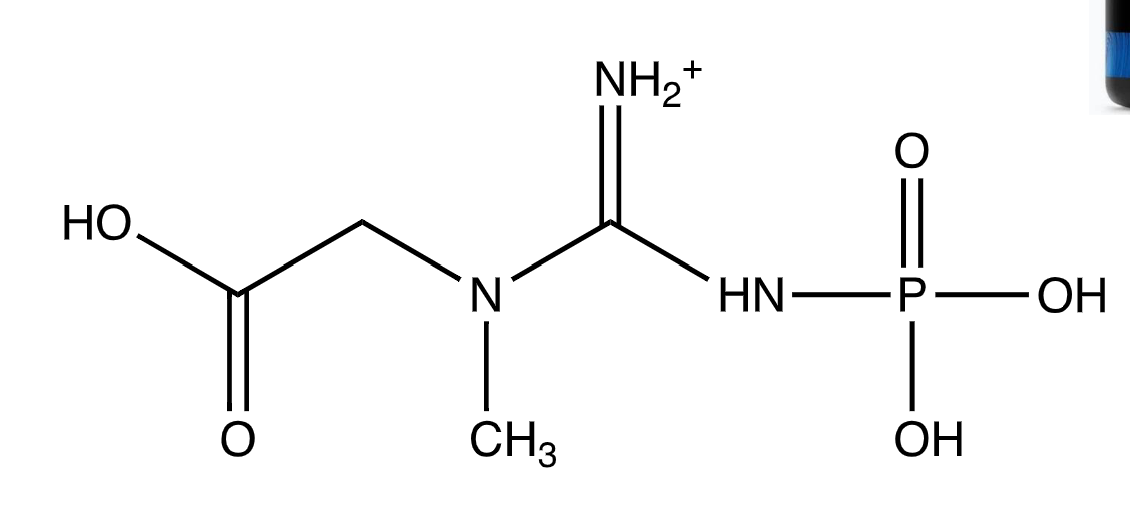
What is this and why is it relevant
Creatine phosphate - High energy compound

What is this and why is it relevant
Thiol ester - high energy compound

What is this and why is it relevant
Phosphate anhydride - high energy compound
What happens during step 7 of glycolysis
1,3-bisPGA is converted into 3-PGA via a substrate level phosphorylation mechanism. The phosphoryl group is hydrolyzed off and transferred to ADP. 1 ATP is produced in this process.

What is this
3-PGA
What happens during rxn 8 of glycolysis
An isomerase/mutase rxn occurs changing 3-PGA to 2-PGA

What is this
2-PGA
What happens during the 9th rxn of glycolysis
2-PGA undergoes a hydration/dehydration enolase rxn and is converted to PEP. H2O is a product of this step

What is this
PEP
What happens during the 10th step of glycolysis
PEP undergoes substrate level phosphorylation and in the process ADP is converted to ATP and this results in Pyruvate

What is this
PYR or pyruvate
Why do we need 10 reactions for glycolysis
The reaction steps provide other entry points to bring in other sugars. Results in 2x G3P which in turn results in a net yield of 2 ATP. Also these reactions allow for dynamic regulation of glycolysis
What happens during Fructose metabolism. How many pathways are there in Fructose metabolism
In all cells fructose can be converted to F-6-P via a kinase enzyme rxn. However, an alternate major pathway is in the liver. In the liver Fructose is turned into F-1-P using 1 ATP in a enzymatic ketose reaction. The F-1-P is then turned into DHAP and Glyceraldehyde using an aldolase to cleave the compound. DHAP is then used in glycolysis while glyceraldehyde is turned into G-3-P using a kinase and 1 ATP

What is this
Glyceraldehyde

What is this
Lactose
Why is packing helpful
Reduces osmolarity, storing more GLC molecules, simultaneous breakdown at many non reducing ends
How is breakdown of extracellular and intracellular starches/glycogen/CHO’s accomplished
Dietary - glycogen/starch → free GLC
liver/muscle glycogen → GLC-1-P→ GLC-6-P
What is the process of extracellular starch/glycogen breakdown
Have your starch/glucose and want to break glycosidic bonds within the structure. One way to do that is through hydrolysis. You use water in the form of your saliva to break the glycosidic bond. The enzyme used is a-amylase. This enzyme hydrolizes the a-1,4 glycosidic bond. Starch/glycogen broken down into maltose
How do you breakdown maltose
Maltose is obtained after the hydrolysis of starch/glycogen. Then using water it is again broken down into two molecules of glucose and these are used in glycolysis.
Where does intracellular glycogen phosphorolysis happen
liver and muscle
What is the process of intracellular glycogen phosphorolysis
Starting at non reducing ends using the glycogen phosphorylase enzyme, inorganic phosphate is used to cleave off a-1,4 glycosidic bond and a phosphoryl group is in place of that bond. This results in GLC-1-P which can then be converted into GLC-6-P which uses one less ATP than in glycolysis.
What are the limitations of glycogen phosphorylase
The phosphorylase stops when there are four residues left because of the shape of the active site. It will no longer work.
What does the debranching enzyme do
A combined enzyme with two active sites. One is a transferase where it takes three residues and reattaches them to the terminal end which allows the phosphorylase to continue. The second activity is the glucosidase and this cleaves off one molecule of glucose. This molecule goes into glycolysis and allows the phosphorylase to continue the process. At the end the structure is converted into GLC-1-P. Lastly GLC-1-P is isomerized into GLC-6-P
What does a Kinase do
Catalyzes transfer of phosphoryl group from donor to acceptor molecules using ATP and phosphate donor
What does a phosphorylase do
Catalyzes transfer of Pi to acceptor molecule
What does phosphatase do
Catalyzes removal of phosphoryl group from substrate
What does dehydrogenase do
Some can couple oxidation with transfer of Pi to substrate. e.g. G-3-P dehydrogenase in glycolysis

What is this
Sucrose
What is important to remember about co factors
Co Factor Balance
What happens during Lactic Acid fermentation
An additional step to glycolysis using lactate dehydrogenase to make L-Lactate. NADH + H+ are used to reduce the carbonyl group to an alcohol. NAD+ is also a product of this rxn
What happens during ethanol fermentation
Pyruvate is turned into Acetaldehyde using pyruvate decarboxylate. During this process the CO2 group is cleaved off and becomes a side product of the reaction. This reaction continues using a NADH + H+. NAD+ is made as a side product of this reaction and used in glycolysis. Alcohol dehydrogenase is used to then turn Acetaldehyde into Ethanol.

What is this
Ethanol

What is this
Acetaldehyde
What is NOT found in mammals
PDC
What happens during Ethanol metabolism
Ethanol is first converted into Acetaldehyde via an Alcohol dehydrogenase enzyme (ADH), this is an oxidation rxn. The Acetaldehyde is then oxidized using an Acetaldehyde dehydrogenase (ALDH) enzyme and turns into Acetic Acid. During these two rxn’s NAD+ is converted into NADH + H+. This leads to co factor INBALANCE (COFACTOR BALANCE OUT OF WHACK). The Acetic acid is then turned into Acetyl-CoA using a Adenylate Kinase. This rxn converts the carboxyl group of acetic acid into a Thioester with CoA.
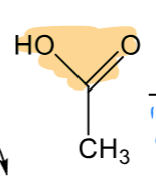
What is this
Acetic Acid

What is this
Acetyl-CoA
What can PYR be decarboxylated to form?
Acetyl-CoA
How does the decarboxylation of PYR work?
CoASH is introduced and used to oxidize PYR into ACETYL-COA. This process uses NAD+ and leads to PYR being decarboxylated into Acetyl-CoA. This is a oxidative decarboxylation rxn and 5 co-factors are used: CoASH, NAD+, TPP, Lipoic Acid, and FAD

What is this
Thiamin pyrophosphate (TPP)
Where does TPP function in
Decarboxylation of alpha keto acida
Cleavage of a-hydroxy ketones

What is this
Lipoic acid/ lipoamide
What is the key intermediate of metabolism
Acetyl-CoA
What facilitates the decarboxylation of PYR
PDH - Pyruvate dehydrogenase
What happens during the PDH rxn
PYR is decarboxylated. The carboxyl group is removed in the form of CO2
TPP is then brought into the rxn and binds to the acetaldehyde intermediate. This stabilizes the intermediate structure.
TPP is released and the new intermediate is bound to lipoic acid/lipo amide. During this step lipoic acid is reduced and the disulfide bond opens to accept the intermediate.
CoASH is brought in to take the intermediate from lipoic acid and form Acetyl-CoA. However, the enzyme gets stuck because the lipoic acid/lipoamide is in its reduced form which leaves it inactive.
We need to reoxidize the lipoic acid. The electrons are transferred to FAD and makes FADH2.
Another co factor is brought in to reoxidize FAD. NAD+ is brought in to take the electrons from FADH2 to make NADH which can leave the enzyme. NAD+ can be taken up by the enzyme.
What molecules can be decarboxylated?
a-keto acids, b-keto acids, b-hydroxy acids
What step needs to be done in order to decarboxylate a b-hydroxy acid
Oxidize the hydroxy group. NAD+ is used in this process and tuned into NADH as a result the b-hydroxy acid is turned into a b-keto acid. a-keto acids and b-keto acids can be decarboxylated outright
What does the TCA cycle do in Aerobic organisms?
generates chemical energy via the oxidation of acetyl-CoA derived from CHOs, lipids and proteins into CO2 and reduced electron carriers (NADH, FADH2)
What does the TCA cycle do in Anaerobic and Aerobic organisms?
provide precursors of certain amino acids and other biomolecules that are used in other biochemical pathways
What is the TCA cycle considered to be?
Amphibolic pathway - “Central Wheel of Metabolism”
What does the TCA cycle accomplish?
using 1 Acetyl CoA the TCA cycle results in 2 CO2, 1 GTP, 3 NADH, and 1 FADH2
What is the first step of the TCA cycle?
Due to cellular PH (cellular conditions) Acetyl Co-A can act as a nucleophile and becomes more reactive. Acetyl Co-A reacts with OAA via a carbon-carbon condensation rxn. These two molecules fuse together to make OAA Oxaloacetate. Then CoASH is hydrolyzed off to make citrate.
What enzyme is used during the first rxn of the TCA cycle?
Citrate synthase

What is this
Citrate
What happens during the second rxn of the TCA cycle?
Citrate is isomerized into Isocitrate via a iconitase enzyme

What is this
Isocitrate
What happens during the 3rd rxn of the TCA cycle?
B-OH isocitrate is oxidized into a B-keto acid which is then decarboxylated to form a-KG. NAD(P)+ is needed as a co factor during this process. An isocitrate dehydrogenase enzyme is also used during this rxn. An NADH is made during this process as well.

What is this
a-ketoglutarate (a-KG)
What happens during the 4th rxn of the TCA cycle
a-ketoglutarate is decarboxylated into succinyl-CoA.
What co-factors are needed during the 4th rxn of the TCA cycle
TPP, Lipoic acid, FAD, NAD, and CoASH
What is the 4th rxn of the TCA cycle similar to
The PDH rxn
What is succinyl-CoA considered to be
A thioester- High Energy Compound
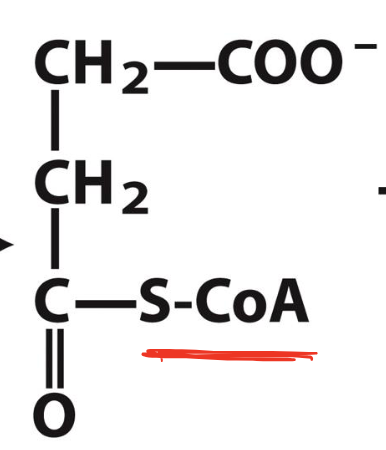
What is this
Succinyl-CoA
what is used during the 5th step of the TCA cycle
Substrate level Phosphorylation using GDP

What is this
Succinate
What happens during the 6th rxn of the TCA cycle
Succinate is oxidized into Fumarate using a succinate dehydrogenase enzyme and FAD, which then leaves as FADH2.
What happens during the 7th rxn of the TCA cycle
Fumarate is turned into Malate by bringing in a OH group.
What happens during the 8th rxn of the TCA cycle
Malate is oxidized into OAA - oxalacetate using malate dehydrogenase and NAD+.

What is this
Fumarate

What is this
L-Malate
Where does glycolysis happen in Eukaryotes
Cytosol
Where do the PDH, TCA, and ETC cycles happen in Eukaryotes
The Mitochondria