ARCH 210 Latin American Pre-Columbian Architecture

0.0(0)
Studied by 0 people
call kaiCall Kai
learnLearn
examPractice Test
spaced repetitionSpaced Repetition
heart puzzleMatch
flashcardsFlashcards
GameKnowt Play
Card Sorting

1/9

encourage image

There's no tags or description

Looks like no tags are added yet.

10 Terms

1
New cards

The Serpent Mound

·       Adams County, Ohio, USA, 1070 CE, Fort Ancient Culture

·       Many mounds built in burial contexts (not this one)

·       People became wealthy through trading

·       Head on one end, ending in a coiled tail

·       1000ft long

·       Largest serpentine image

·       Zoomorphic: taking an animal form

·       Natural ridge that sits, overlooking bend of river—the snake corresponds to the natural formation of the geography

·       Head of serpent aligns with solstices, placement of monument in its landscape has reason

·       Native peoples of this area mostly created snake shapes

·       Body of snake rises 3ft high, constructed by putting down layers of earth

<p><span>·</span><span style="font-family: &quot;Times New Roman&quot;; line-height: normal; font-size: 7pt;">&nbsp;&nbsp;&nbsp;&nbsp;&nbsp;&nbsp; </span>Adams County, Ohio, USA, 1070 CE, Fort Ancient Culture</p><p class="MsoListBulletCxSpMiddle"><span>·</span><span style="font-family: &quot;Times New Roman&quot;; line-height: normal; font-size: 7pt;">&nbsp;&nbsp;&nbsp;&nbsp;&nbsp;&nbsp; </span>Many mounds built in burial contexts (not this one)</p><p class="MsoListBulletCxSpMiddle"><span>·</span><span style="font-family: &quot;Times New Roman&quot;; line-height: normal; font-size: 7pt;">&nbsp;&nbsp;&nbsp;&nbsp;&nbsp;&nbsp; </span>People became wealthy through trading</p><p class="MsoListBulletCxSpMiddle"><span>·</span><span style="font-family: &quot;Times New Roman&quot;; line-height: normal; font-size: 7pt;">&nbsp;&nbsp;&nbsp;&nbsp;&nbsp;&nbsp; </span>Head on one end, ending in a coiled tail</p><p class="MsoListBulletCxSpMiddle"><span>·</span><span style="font-family: &quot;Times New Roman&quot;; line-height: normal; font-size: 7pt;">&nbsp;&nbsp;&nbsp;&nbsp;&nbsp;&nbsp; </span>1000ft long</p><p class="MsoListBulletCxSpMiddle"><span>·</span><span style="font-family: &quot;Times New Roman&quot;; line-height: normal; font-size: 7pt;">&nbsp;&nbsp;&nbsp;&nbsp;&nbsp;&nbsp; </span>Largest serpentine image</p><p class="MsoListBulletCxSpMiddle"><span>·</span><span style="font-family: &quot;Times New Roman&quot;; line-height: normal; font-size: 7pt;">&nbsp;&nbsp;&nbsp;&nbsp;&nbsp;&nbsp; </span>Zoomorphic: taking an animal form</p><p class="MsoListBulletCxSpMiddle"><span>·</span><span style="font-family: &quot;Times New Roman&quot;; line-height: normal; font-size: 7pt;">&nbsp;&nbsp;&nbsp;&nbsp;&nbsp;&nbsp; </span>Natural ridge that sits, overlooking bend of river—the snake corresponds to the natural formation of the geography</p><p class="MsoListBulletCxSpMiddle"><span>·</span><span style="font-family: &quot;Times New Roman&quot;; line-height: normal; font-size: 7pt;">&nbsp;&nbsp;&nbsp;&nbsp;&nbsp;&nbsp; </span>Head of serpent aligns with solstices, placement of monument in its landscape has reason</p><p class="MsoListBulletCxSpMiddle"><span>·</span><span style="font-family: &quot;Times New Roman&quot;; line-height: normal; font-size: 7pt;">&nbsp;&nbsp;&nbsp;&nbsp;&nbsp;&nbsp; </span>Native peoples of this area mostly created snake shapes</p><p class="MsoListBulletCxSpLast"><span>·</span><span style="font-family: &quot;Times New Roman&quot;; line-height: normal; font-size: 7pt;">&nbsp;&nbsp;&nbsp;&nbsp;&nbsp;&nbsp; </span>Body of snake rises 3ft high, constructed by putting down layers of earth</p>
2
New cards

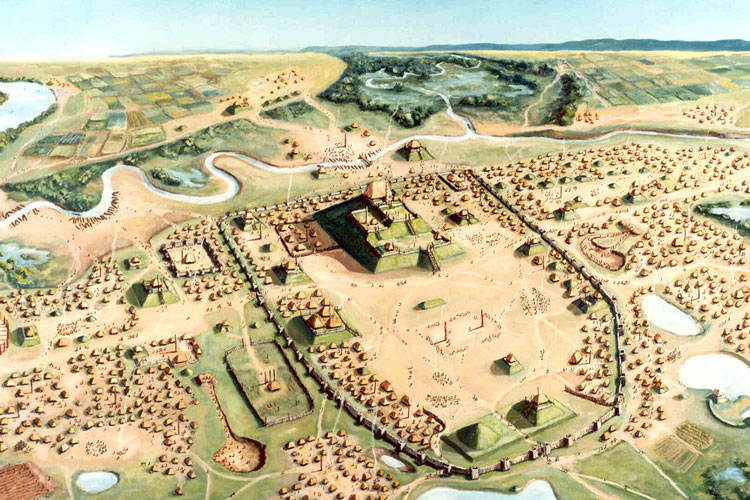
Cahokia

·       Collinsville IL, USA, 1050-1200 CE, Mississippian Culture

·       Extremely large city, peak population of 15k-20k in city

·       Greater Cahokia area probably had 40k-50k people

·       Populated with smaller pyramidal forms

·       Hundreds of houses

·       Large woodhenge enclosure to one side of Monk’s Mound (circular formation with wooden posts driven into the ground)—helped mark the passing of seasons and was a solar calendar, making both spiritual observations and the agricultural schedule

·       Sun rose at one post each for the Winter and Summer solstices and a third marked the halfway point between (equinoxes)

·       Sunrise on equinoxes appeared due east of the circle, as if the sun was rising from the front of Monk’s Mound

·       At solstices, the sunrise aligned with other particular mounds in the Cahokia constellation, such as a with Fox Mound, just south of Monk’s Mound

·       Landscape was in a flood zone, good for agriculture

·       Uses a north-south orientation, as at other pre-Columbian sites of North America

·       Monk’s Mound, Cahokia, Collinsville, IL, USA, 1050-1200 CE, Mississippian Culture

·       Largest central feature

·       Raised temenos that carried a number of different buildings on it, like a temple at the top

·       Platform ascended by 2 staircases by large enclosed open plaza that formed heart of city of Cahokia and heart of vast ceremonial center

·       15 acres, approximately 100ft high

·       Seat of governance for region of Cahokia

·       Probably housed building 100x50x50ft

·       Things found around the site have come from as far away as the Gulf of Mexico, Great Lakes, Rocky Mountains, and Appalachia—means that Cahokia sits at the center of trade

·       Rebuild a number of times—core of prior structure that was built over

·       Mound was strengthened by placement of timbers in central portion

·       Ramp with stairs constructed at outer face

·       There was likely a large festival that drew people to Cahokia biannually—allowed Cahokia to become a trade site
<p><span>·</span><span style="font-family: &quot;Times New Roman&quot;; line-height: normal; font-size: 7pt;">&nbsp;&nbsp;&nbsp;&nbsp;&nbsp;&nbsp; </span>Collinsville IL, USA, 1050-1200 CE, Mississippian Culture</p><p class="MsoListBulletCxSpMiddle"><span>·</span><span style="font-family: &quot;Times New Roman&quot;; line-height: normal; font-size: 7pt;">&nbsp;&nbsp;&nbsp;&nbsp;&nbsp;&nbsp; </span>Extremely large city, peak population of 15k-20k in city</p><p class="MsoListBulletCxSpMiddle"><span>·</span><span style="font-family: &quot;Times New Roman&quot;; line-height: normal; font-size: 7pt;">&nbsp;&nbsp;&nbsp;&nbsp;&nbsp;&nbsp; </span>Greater Cahokia area probably had 40k-50k people</p><p class="MsoListBulletCxSpMiddle"><span>·</span><span style="font-family: &quot;Times New Roman&quot;; line-height: normal; font-size: 7pt;">&nbsp;&nbsp;&nbsp;&nbsp;&nbsp;&nbsp; </span>Populated with smaller pyramidal forms</p><p class="MsoListBulletCxSpMiddle"><span>·</span><span style="font-family: &quot;Times New Roman&quot;; line-height: normal; font-size: 7pt;">&nbsp;&nbsp;&nbsp;&nbsp;&nbsp;&nbsp; </span>Hundreds of houses</p><p class="MsoListBulletCxSpMiddle"><span>·</span><span style="font-family: &quot;Times New Roman&quot;; line-height: normal; font-size: 7pt;">&nbsp;&nbsp;&nbsp;&nbsp;&nbsp;&nbsp; </span>Large woodhenge enclosure to one side of Monk’s Mound (circular formation with wooden posts driven into the ground)—helped mark the passing of seasons and was a solar calendar, making both spiritual observations and the agricultural schedule</p><p class="MsoListBulletCxSpMiddle"><span>·</span><span style="font-family: &quot;Times New Roman&quot;; line-height: normal; font-size: 7pt;">&nbsp;&nbsp;&nbsp;&nbsp;&nbsp;&nbsp; </span>Sun rose at one post each for the Winter and Summer solstices and a third marked the halfway point between (equinoxes)</p><p class="MsoListBulletCxSpMiddle"><span>·</span><span style="font-family: &quot;Times New Roman&quot;; line-height: normal; font-size: 7pt;">&nbsp;&nbsp;&nbsp;&nbsp;&nbsp;&nbsp; </span>Sunrise on equinoxes appeared due east of the circle, as if the sun was rising from the front of Monk’s Mound</p><p class="MsoListBulletCxSpMiddle"><span>·</span><span style="font-family: &quot;Times New Roman&quot;; line-height: normal; font-size: 7pt;">&nbsp;&nbsp;&nbsp;&nbsp;&nbsp;&nbsp; </span>At solstices, the sunrise aligned with other particular mounds in the Cahokia constellation, such as a with Fox Mound, just south of Monk’s Mound</p><p class="MsoListBulletCxSpMiddle"><span>·</span><span style="font-family: &quot;Times New Roman&quot;; line-height: normal; font-size: 7pt;">&nbsp;&nbsp;&nbsp;&nbsp;&nbsp;&nbsp; </span>Landscape was in a flood zone, good for agriculture</p><p class="MsoListBulletCxSpMiddle"><span>·</span><span style="font-family: &quot;Times New Roman&quot;; line-height: normal; font-size: 7pt;">&nbsp;&nbsp;&nbsp;&nbsp;&nbsp;&nbsp; </span>Uses a north-south orientation, as at other pre-Columbian sites of North America</p><p class="MsoListBulletCxSpMiddle"><span>·</span><span style="font-family: &quot;Times New Roman&quot;; line-height: normal; font-size: 7pt;">&nbsp;&nbsp;&nbsp;&nbsp;&nbsp;&nbsp; </span>Monk’s Mound, Cahokia, Collinsville, IL, USA, 1050-1200 CE, Mississippian Culture</p><p class="MsoListBulletCxSpMiddle"><span>·</span><span style="font-family: &quot;Times New Roman&quot;; line-height: normal; font-size: 7pt;">&nbsp;&nbsp;&nbsp;&nbsp;&nbsp;&nbsp; </span>Largest central feature</p><p class="MsoListBulletCxSpMiddle"><span>·</span><span style="font-family: &quot;Times New Roman&quot;; line-height: normal; font-size: 7pt;">&nbsp;&nbsp;&nbsp;&nbsp;&nbsp;&nbsp; </span>Raised temenos that carried a number of different buildings on it, like a temple at the top</p><p class="MsoListBulletCxSpMiddle"><span>·</span><span style="font-family: &quot;Times New Roman&quot;; line-height: normal; font-size: 7pt;">&nbsp;&nbsp;&nbsp;&nbsp;&nbsp;&nbsp; </span>Platform ascended by 2 staircases by large enclosed open plaza that formed heart of city of Cahokia and heart of vast ceremonial center</p><p class="MsoListBulletCxSpMiddle"><span>·</span><span style="font-family: &quot;Times New Roman&quot;; line-height: normal; font-size: 7pt;">&nbsp;&nbsp;&nbsp;&nbsp;&nbsp;&nbsp; </span>15 acres, approximately 100ft high</p><p class="MsoListBulletCxSpMiddle"><span>·</span><span style="font-family: &quot;Times New Roman&quot;; line-height: normal; font-size: 7pt;">&nbsp;&nbsp;&nbsp;&nbsp;&nbsp;&nbsp; </span>Seat of governance for region of Cahokia</p><p class="MsoListBulletCxSpMiddle"><span>·</span><span style="font-family: &quot;Times New Roman&quot;; line-height: normal; font-size: 7pt;">&nbsp;&nbsp;&nbsp;&nbsp;&nbsp;&nbsp; </span>Probably housed building 100x50x50ft</p><p class="MsoListBulletCxSpMiddle"><span>·</span><span style="font-family: &quot;Times New Roman&quot;; line-height: normal; font-size: 7pt;">&nbsp;&nbsp;&nbsp;&nbsp;&nbsp;&nbsp; </span>Things found around the site have come from as far away as the Gulf of Mexico, Great Lakes, Rocky Mountains, and Appalachia—means that Cahokia sits at the center of trade</p><p class="MsoListBulletCxSpMiddle"><span>·</span><span style="font-family: &quot;Times New Roman&quot;; line-height: normal; font-size: 7pt;">&nbsp;&nbsp;&nbsp;&nbsp;&nbsp;&nbsp; </span>Rebuild a number of times—core of prior structure that was built over</p><p class="MsoListBulletCxSpMiddle"><span>·</span><span style="font-family: &quot;Times New Roman&quot;; line-height: normal; font-size: 7pt;">&nbsp;&nbsp;&nbsp;&nbsp;&nbsp;&nbsp; </span>Mound was strengthened by placement of timbers in central portion</p><p class="MsoListBulletCxSpMiddle"><span>·</span><span style="font-family: &quot;Times New Roman&quot;; line-height: normal; font-size: 7pt;">&nbsp;&nbsp;&nbsp;&nbsp;&nbsp;&nbsp; </span>Ramp with stairs constructed at outer face</p><p class="MsoListBulletCxSpLast"><span>·</span><span style="font-family: &quot;Times New Roman&quot;; line-height: normal; font-size: 7pt;">&nbsp;&nbsp;&nbsp;&nbsp;&nbsp;&nbsp; </span>There was likely a large festival that drew people to Cahokia biannually—allowed Cahokia to become a trade site</p>
3
New cards

Cliff Palace

·       Mesa Verde, Colorado, USA, 450-1300 CE, Ancestral Puebloan peoples (formerly known as the Anasazi)

·       Built into naturally occurring cliffs

·       Many different residential/spiritual groupings

·       Cliff Palace is one of best preserved sites, but not the largest—other sites made of adobe, not air or sun dried

·       Built with stone, set in mortar, over plastered to create a final surface

·       Other parts of the site used for storage/ritual purposes

·       Consists of different quarters arranged around different plazas

·       150 rectilinear rooms throughout site

·       Residential units tend to be connected rooms that fanned out –seemed to be organizational for people who lived there—hearth in room, where people gathered

·       Most are 1 or 2 stories, in some cases, they were built to the overhead rock

·       Kiva: circular, subterranean rooms, mostly for men

·       Kiva developed from a presidential type residence, but also probably a gathering room

·       Artwork over stone and walls take geometric form and shape—recounting of the landscape around them

<p><span>·</span><span style="font-family: &quot;Times New Roman&quot;; line-height: normal; font-size: 7pt;">&nbsp;&nbsp;&nbsp;&nbsp;&nbsp;&nbsp; </span>Mesa Verde, Colorado, USA, 450-1300 CE, Ancestral Puebloan peoples (formerly known as the Anasazi)</p><p class="MsoListBulletCxSpMiddle"><span>·</span><span style="font-family: &quot;Times New Roman&quot;; line-height: normal; font-size: 7pt;">&nbsp;&nbsp;&nbsp;&nbsp;&nbsp;&nbsp; </span>Built into naturally occurring cliffs</p><p class="MsoListBulletCxSpMiddle"><span>·</span><span style="font-family: &quot;Times New Roman&quot;; line-height: normal; font-size: 7pt;">&nbsp;&nbsp;&nbsp;&nbsp;&nbsp;&nbsp; </span>Many different residential/spiritual groupings</p><p class="MsoListBulletCxSpMiddle"><span>·</span><span style="font-family: &quot;Times New Roman&quot;; line-height: normal; font-size: 7pt;">&nbsp;&nbsp;&nbsp;&nbsp;&nbsp;&nbsp; </span>Cliff Palace is one of best preserved sites, but not the largest—other sites made of adobe, not air or sun dried</p><p class="MsoListBulletCxSpMiddle"><span>·</span><span style="font-family: &quot;Times New Roman&quot;; line-height: normal; font-size: 7pt;">&nbsp;&nbsp;&nbsp;&nbsp;&nbsp;&nbsp; </span>Built with stone, set in mortar, over plastered to create a final surface</p><p class="MsoListBulletCxSpMiddle"><span>·</span><span style="font-family: &quot;Times New Roman&quot;; line-height: normal; font-size: 7pt;">&nbsp;&nbsp;&nbsp;&nbsp;&nbsp;&nbsp; </span>Other parts of the site used for storage/ritual purposes</p><p class="MsoListBulletCxSpMiddle"><span>·</span><span style="font-family: &quot;Times New Roman&quot;; line-height: normal; font-size: 7pt;">&nbsp;&nbsp;&nbsp;&nbsp;&nbsp;&nbsp; </span>Consists of different quarters arranged around different plazas</p><p class="MsoListBulletCxSpMiddle"><span>·</span><span style="font-family: &quot;Times New Roman&quot;; line-height: normal; font-size: 7pt;">&nbsp;&nbsp;&nbsp;&nbsp;&nbsp;&nbsp; </span>150 rectilinear rooms throughout site</p><p class="MsoListBulletCxSpMiddle"><span>·</span><span style="font-family: &quot;Times New Roman&quot;; line-height: normal; font-size: 7pt;">&nbsp;&nbsp;&nbsp;&nbsp;&nbsp;&nbsp; </span>Residential units tend to be connected rooms that fanned out –seemed to be organizational for people who lived there—hearth in room, where people gathered</p><p class="MsoListBulletCxSpMiddle"><span>·</span><span style="font-family: &quot;Times New Roman&quot;; line-height: normal; font-size: 7pt;">&nbsp;&nbsp;&nbsp;&nbsp;&nbsp;&nbsp; </span>Most are 1 or 2 stories, in some cases, they were built to the overhead rock</p><p class="MsoListBulletCxSpMiddle"><span>·</span><span style="font-family: &quot;Times New Roman&quot;; line-height: normal; font-size: 7pt;">&nbsp;&nbsp;&nbsp;&nbsp;&nbsp;&nbsp; </span>Kiva: circular, subterranean rooms, mostly for men</p><p class="MsoListBulletCxSpMiddle"><span>·</span><span style="font-family: &quot;Times New Roman&quot;; line-height: normal; font-size: 7pt;">&nbsp;&nbsp;&nbsp;&nbsp;&nbsp;&nbsp; </span>Kiva developed from a presidential type residence, but also probably a gathering room</p><p class="MsoListBulletCxSpLast"><span>·</span><span style="font-family: &quot;Times New Roman&quot;; line-height: normal; font-size: 7pt;">&nbsp;&nbsp;&nbsp;&nbsp;&nbsp;&nbsp; </span>Artwork over stone and walls take geometric form and shape—recounting of the landscape around them</p>
4
New cards

Ancient and Medieval North and Central America

·       Mesoamerican: includes central and south Mexico and Central America

·       Andean: along the Andean Mountain range of South America

·       Olmecs: 1200-400 BCE to the Mexica/Aztecs

5
New cards

Teotihuacan

·       Teotihuacan, Mexico, before 250 CE, Teotihuacan Culture of Ancient Mexico: 40km outside of Mexico City

·       “the place the gods created”, named by the much later Mexica (Aztecs), we do not know the name in the Teotihuacano language

·       Abandoned around 7/8th century CE

·       125k-200k inhabitants

·       Enormous city, largest metropolises in Americas and maybe in the world

·       Beginning of the city maybe around 100 BCE

·       Goes out of use around 600-700 CE, maybe for environmental reasons

·       Evidence of an elite ruling class, but no evidence of a singular ruler

·       Extremely dramatic monumental architecture

·       Dense urban fabric

·       Forms of monuments, spatial organization (grid along cardinal axes), use of pyramid as architecture

·       First North American city built on a grid with a N-S axis—Avenue of the Dead, runs through the heart of the ceremonial part of the city

·       At south end of Avenue of the Dead, there is an open sunken plaza (Ciudadela) and Pyramid of the Feathered Serpent

·       Midway point of Avenue of the Dead is Pyramid of the Sun

·       Avenue of the Dead terminates in Pyramid of the Moon

·       Hundreds of residential structures

·       Many of these building traditions used in Aztec culture

<p><span>·</span><span style="font-family: &quot;Times New Roman&quot;; line-height: normal; font-size: 7pt;">&nbsp;&nbsp;&nbsp;&nbsp;&nbsp;&nbsp; </span>Teotihuacan, Mexico, before 250 CE, Teotihuacan Culture of Ancient Mexico: 40km outside of Mexico City</p><p class="MsoListBulletCxSpMiddle"><span>·</span><span style="font-family: &quot;Times New Roman&quot;; line-height: normal; font-size: 7pt;">&nbsp;&nbsp;&nbsp;&nbsp;&nbsp;&nbsp; </span>“the place the gods created”, named by the much later Mexica (Aztecs), we do not know the name in the Teotihuacano language</p><p class="MsoListBulletCxSpMiddle"><span>·</span><span style="font-family: &quot;Times New Roman&quot;; line-height: normal; font-size: 7pt;">&nbsp;&nbsp;&nbsp;&nbsp;&nbsp;&nbsp; </span>Abandoned around 7/8<sup>th</sup> century CE</p><p class="MsoListBulletCxSpMiddle"><span>·</span><span style="font-family: &quot;Times New Roman&quot;; line-height: normal; font-size: 7pt;">&nbsp;&nbsp;&nbsp;&nbsp;&nbsp;&nbsp; </span>125k-200k inhabitants</p><p class="MsoListBulletCxSpMiddle"><span>·</span><span style="font-family: &quot;Times New Roman&quot;; line-height: normal; font-size: 7pt;">&nbsp;&nbsp;&nbsp;&nbsp;&nbsp;&nbsp; </span>Enormous city, largest metropolises in Americas and maybe in the world</p><p class="MsoListBulletCxSpMiddle"><span>·</span><span style="font-family: &quot;Times New Roman&quot;; line-height: normal; font-size: 7pt;">&nbsp;&nbsp;&nbsp;&nbsp;&nbsp;&nbsp; </span>Beginning of the city maybe around 100 BCE</p><p class="MsoListBulletCxSpMiddle"><span>·</span><span style="font-family: &quot;Times New Roman&quot;; line-height: normal; font-size: 7pt;">&nbsp;&nbsp;&nbsp;&nbsp;&nbsp;&nbsp; </span>Goes out of use around 600-700 CE, maybe for environmental reasons</p><p class="MsoListBulletCxSpMiddle"><span>·</span><span style="font-family: &quot;Times New Roman&quot;; line-height: normal; font-size: 7pt;">&nbsp;&nbsp;&nbsp;&nbsp;&nbsp;&nbsp; </span>Evidence of an elite ruling class, but no evidence of a singular ruler</p><p class="MsoListBulletCxSpMiddle"><span>·</span><span style="font-family: &quot;Times New Roman&quot;; line-height: normal; font-size: 7pt;">&nbsp;&nbsp;&nbsp;&nbsp;&nbsp;&nbsp; </span>Extremely dramatic monumental architecture</p><p class="MsoListBulletCxSpMiddle"><span>·</span><span style="font-family: &quot;Times New Roman&quot;; line-height: normal; font-size: 7pt;">&nbsp;&nbsp;&nbsp;&nbsp;&nbsp;&nbsp; </span>Dense urban fabric</p><p class="MsoListBulletCxSpMiddle"><span>·</span><span style="font-family: &quot;Times New Roman&quot;; line-height: normal; font-size: 7pt;">&nbsp;&nbsp;&nbsp;&nbsp;&nbsp;&nbsp; </span>Forms of monuments, spatial organization (grid along cardinal axes), use of pyramid as architecture</p><p class="MsoListBulletCxSpMiddle"><span>·</span><span style="font-family: &quot;Times New Roman&quot;; line-height: normal; font-size: 7pt;">&nbsp;&nbsp;&nbsp;&nbsp;&nbsp;&nbsp; </span>First North American city built on a grid with a N-S axis—Avenue of the Dead, runs through the heart of the ceremonial part of the city</p><p class="MsoListBulletCxSpLast"><span>·</span><span style="font-family: &quot;Times New Roman&quot;; line-height: normal; font-size: 7pt;">&nbsp;&nbsp;&nbsp;&nbsp;&nbsp;&nbsp; </span>At south end of Avenue of the Dead, there is an open sunken plaza (Ciudadela) and Pyramid of the Feathered Serpent</p><p class="MsoListBulletCxSpLast"><span>·</span><span style="font-family: &quot;Times New Roman&quot;; line-height: normal; font-size: 7pt;">&nbsp;&nbsp;&nbsp;&nbsp;&nbsp;&nbsp; </span>Midway point of Avenue of the Dead is Pyramid of the Sun</p><p class="MsoListBulletCxSpLast"><span>·</span><span style="font-family: &quot;Times New Roman&quot;; line-height: normal; font-size: 7pt;">&nbsp;&nbsp;&nbsp;&nbsp;&nbsp;&nbsp; </span>Avenue of the Dead terminates in Pyramid of the Moon</p><p class="MsoListBulletCxSpLast"><span>·</span><span style="font-family: &quot;Times New Roman&quot;; line-height: normal; font-size: 7pt;">&nbsp;&nbsp;&nbsp;&nbsp;&nbsp;&nbsp; </span>Hundreds of residential structures</p><p class="MsoListBulletCxSpLast"><span>·</span><span style="font-family: &quot;Times New Roman&quot;; line-height: normal; font-size: 7pt;">&nbsp;&nbsp;&nbsp;&nbsp;&nbsp;&nbsp; </span>Many of these building traditions used in Aztec culture</p>
6
New cards

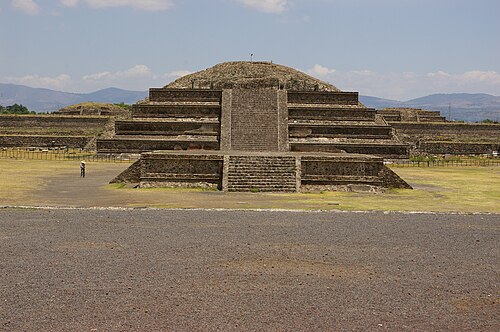
Pyramid of the Feathered Serpent (Teotihuacan)

·       Pyramid is made in Talud-tablero: Mesoamerican masonry construction consisting of alternating inward-sloping surfaces or panels with panels or structures perpendicular to the ground; also called ‘slope-and-panel’ masonry

·       Ascended by tall staircases

·       Would have been brightly painted

·       Notable for architectural sculpture that covers over much of the surface—Quetzalcoatl (feathered serpent)—they represent earlier versions of the gods known in the later Aztec era

·       Related to warfare—skeletal remains have been discovered here, sacrifices occurred here

  • South end of Avenue of the Dead


<p><span>·</span><span style="font-family: &quot;Times New Roman&quot;; line-height: normal; font-size: 7pt;">&nbsp;&nbsp;&nbsp;&nbsp;&nbsp;&nbsp; </span>Pyramid is made in Talud-tablero: Mesoamerican masonry construction consisting of alternating inward-sloping surfaces or panels with panels or structures perpendicular to the ground; also called ‘slope-and-panel’ masonry</p><p class="MsoListBulletCxSpMiddle"><span>·</span><span style="font-family: &quot;Times New Roman&quot;; line-height: normal; font-size: 7pt;">&nbsp;&nbsp;&nbsp;&nbsp;&nbsp;&nbsp; </span>Ascended by tall staircases</p><p class="MsoListBulletCxSpMiddle"><span>·</span><span style="font-family: &quot;Times New Roman&quot;; line-height: normal; font-size: 7pt;">&nbsp;&nbsp;&nbsp;&nbsp;&nbsp;&nbsp; </span>Would have been brightly painted</p><p class="MsoListBulletCxSpMiddle"><span>·</span><span style="font-family: &quot;Times New Roman&quot;; line-height: normal; font-size: 7pt;">&nbsp;&nbsp;&nbsp;&nbsp;&nbsp;&nbsp; </span>Notable for architectural sculpture that covers over much of the surface—Quetzalcoatl (feathered serpent)—they represent earlier versions of the gods known in the later Aztec era</p><p class="MsoListBulletCxSpLast"><span>·</span><span style="font-family: &quot;Times New Roman&quot;; line-height: normal; font-size: 7pt;">&nbsp;&nbsp;&nbsp;&nbsp;&nbsp;&nbsp; </span>Related to warfare—skeletal remains have been discovered here, sacrifices occurred here</p><ul><li><p class="MsoListBulletCxSpLast">South end of Avenue of the Dead</p></li></ul><p></p>
7
New cards

Pyramid of the Sun (Teotihuacan)

·       Over 200ft tall, tallest structure in the Americas at its time

·       Thought to be a monument for the origins of the earth—idea of cosmic movements of the sky, cycles of the sky

·       Built over a cave, unclear to whom or to what it was built, and what it commemorates

·       Maybe the celebration of a creation myth because caves and water sources in later cultures are places of fertility and origin

  • midway point of Avenue of the Dead


<p><span>·</span><span style="font-family: &quot;Times New Roman&quot;; line-height: normal; font-size: 7pt;">&nbsp;&nbsp;&nbsp;&nbsp;&nbsp;&nbsp; </span>Over 200ft tall, tallest structure in the Americas at its time</p><p class="MsoListBulletCxSpMiddle"><span>·</span><span style="font-family: &quot;Times New Roman&quot;; line-height: normal; font-size: 7pt;">&nbsp;&nbsp;&nbsp;&nbsp;&nbsp;&nbsp; </span>Thought to be a monument for the origins of the earth—idea of cosmic movements of the sky, cycles of the sky</p><p class="MsoListBulletCxSpMiddle"><span>·</span><span style="font-family: &quot;Times New Roman&quot;; line-height: normal; font-size: 7pt;">&nbsp;&nbsp;&nbsp;&nbsp;&nbsp;&nbsp; </span>Built over a cave, unclear to whom or to what it was built, and what it commemorates</p><p class="MsoListBulletCxSpLast"><span>·</span><span style="font-family: &quot;Times New Roman&quot;; line-height: normal; font-size: 7pt;">&nbsp;&nbsp;&nbsp;&nbsp;&nbsp;&nbsp; </span>Maybe the celebration of a creation myth because caves and water sources in later cultures are places of fertility and origin</p><ul><li><p class="MsoListBulletCxSpLast">midway point of Avenue of the Dead</p></li></ul><p></p>
8
New cards

Pyramid of the Moon (Teotihuacan)

·       Built over many different campaigns

·       Burials with offerings discovered inside and below

·       Carefully placed caches in different points within the space below the pyramid and within

·       Remains of male body was found

·       Groups of individuals found decapitated, buried with skeletons of decapitated animals, obsidian blades (used in sacrificial rituals)

·       Deeply connected to sacred landscape, deeply reflects mountain behind it—extinct volcano—gives directionality of the city and movement

  • Terminus of Avenue of the Dead


<p><span>·</span><span style="font-family: &quot;Times New Roman&quot;; line-height: normal; font-size: 7pt;">&nbsp;&nbsp;&nbsp;&nbsp;&nbsp;&nbsp; </span>Built over many different campaigns</p><p class="MsoListBulletCxSpMiddle"><span>·</span><span style="font-family: &quot;Times New Roman&quot;; line-height: normal; font-size: 7pt;">&nbsp;&nbsp;&nbsp;&nbsp;&nbsp;&nbsp; </span>Burials with offerings discovered inside and below</p><p class="MsoListBulletCxSpMiddle"><span>·</span><span style="font-family: &quot;Times New Roman&quot;; line-height: normal; font-size: 7pt;">&nbsp;&nbsp;&nbsp;&nbsp;&nbsp;&nbsp; </span>Carefully placed caches in different points within the space below the pyramid and within</p><p class="MsoListBulletCxSpMiddle"><span>·</span><span style="font-family: &quot;Times New Roman&quot;; line-height: normal; font-size: 7pt;">&nbsp;&nbsp;&nbsp;&nbsp;&nbsp;&nbsp; </span>Remains of male body was found</p><p class="MsoListBulletCxSpMiddle"><span>·</span><span style="font-family: &quot;Times New Roman&quot;; line-height: normal; font-size: 7pt;">&nbsp;&nbsp;&nbsp;&nbsp;&nbsp;&nbsp; </span>Groups of individuals found decapitated, buried with skeletons of decapitated animals, obsidian blades (used in sacrificial rituals)</p><p class="MsoListBulletCxSpLast"><span>·</span><span style="font-family: &quot;Times New Roman&quot;; line-height: normal; font-size: 7pt;">&nbsp;&nbsp;&nbsp;&nbsp;&nbsp;&nbsp; </span>Deeply connected to sacred landscape, deeply reflects mountain behind it—extinct volcano—gives directionality of the city and movement</p><ul><li><p class="MsoListBulletCxSpLast">Terminus of Avenue of the Dead</p></li></ul><p></p>
9
New cards

Residential structures at Teotihuacan

·       Often situated around courtyards

·       Larger as they get closer to Avenue of the Dead—maybe for higher social class

·       Painted bright colors

·       Some residential structures found evidence of vast mural panels

·       Some other residential areas were apartment buildings

·       Fresco decoration with different types of animals—pumas, eagles

10
New cards

Aztec city of Tenochtitlan (now Mexico City)

·       Mexico City, Mexico, 1325, Mexica/Aztec, as seen in a 1524 map published in Nuremberg, Germany

·       Situated in wet landscape that had been drained manually

·       Sits on Lake Texcoco, built by draining portions of the lake to create portions of dry land, connected by canals, which formed the streets

·       Ceremonial heart of the city in the center, surrounded by neighborhoods built up on drained areas

·       Created a fertile landscape

·       Districts connected to center and each other by causeways of earth and rubble

·       Gridded city using cardinal axes

·       Basin of Mexico with two volcanic peaks, reflected in the architecture of the two temple areas

·       Open plaza in center, raised temples in the complex

·       Great Temple as the most important ceremonial site, in alignment with one of the major causeways and two other causeways that stretch out in two other directions

·       Built over several campaigns

·       Several altars dedicated to numerous gods were located at different areas of the Templo Mayor’s top platform and its sides

·       Enormous monolith of Coyolxauhqui discovered later

·       Ball Court in the Temple Complex—demonstration of war skills and ritualistic game

·       Nearby is the palace for the ruling elite

·       Only ruins exist today—purposely destroyed by Spanish for cathedral

<p><span>·</span><span style="font-family: &quot;Times New Roman&quot;; line-height: normal; font-size: 7pt;">&nbsp;&nbsp;&nbsp;&nbsp;&nbsp;&nbsp; </span>Mexico City, Mexico, 1325, Mexica/Aztec, as seen in a 1524 map published in Nuremberg, Germany</p><p class="MsoListBulletCxSpMiddle"><span>·</span><span style="font-family: &quot;Times New Roman&quot;; line-height: normal; font-size: 7pt;">&nbsp;&nbsp;&nbsp;&nbsp;&nbsp;&nbsp; </span>Situated in wet landscape that had been drained manually</p><p class="MsoListBulletCxSpMiddle"><span>·</span><span style="font-family: &quot;Times New Roman&quot;; line-height: normal; font-size: 7pt;">&nbsp;&nbsp;&nbsp;&nbsp;&nbsp;&nbsp; </span>Sits on Lake Texcoco, built by draining portions of the lake to create portions of dry land, connected by canals, which formed the streets</p><p class="MsoListBulletCxSpMiddle"><span>·</span><span style="font-family: &quot;Times New Roman&quot;; line-height: normal; font-size: 7pt;">&nbsp;&nbsp;&nbsp;&nbsp;&nbsp;&nbsp; </span>Ceremonial heart of the city in the center, surrounded by neighborhoods built up on drained areas</p><p class="MsoListBulletCxSpMiddle"><span>·</span><span style="font-family: &quot;Times New Roman&quot;; line-height: normal; font-size: 7pt;">&nbsp;&nbsp;&nbsp;&nbsp;&nbsp;&nbsp; </span>Created a fertile landscape</p><p class="MsoListBulletCxSpMiddle"><span>·</span><span style="font-family: &quot;Times New Roman&quot;; line-height: normal; font-size: 7pt;">&nbsp;&nbsp;&nbsp;&nbsp;&nbsp;&nbsp; </span>Districts connected to center and each other by causeways of earth and rubble</p><p class="MsoListBulletCxSpMiddle"><span>·</span><span style="font-family: &quot;Times New Roman&quot;; line-height: normal; font-size: 7pt;">&nbsp;&nbsp;&nbsp;&nbsp;&nbsp;&nbsp; </span>Gridded city using cardinal axes</p><p class="MsoListBulletCxSpMiddle"><span>·</span><span style="font-family: &quot;Times New Roman&quot;; line-height: normal; font-size: 7pt;">&nbsp;&nbsp;&nbsp;&nbsp;&nbsp;&nbsp; </span>Basin of Mexico with two volcanic peaks, reflected in the architecture of the two temple areas</p><p class="MsoListBulletCxSpMiddle"><span>·</span><span style="font-family: &quot;Times New Roman&quot;; line-height: normal; font-size: 7pt;">&nbsp;&nbsp;&nbsp;&nbsp;&nbsp;&nbsp; </span>Open plaza in center, raised temples in the complex</p><p class="MsoListBulletCxSpMiddle"><span>·</span><span style="font-family: &quot;Times New Roman&quot;; line-height: normal; font-size: 7pt;">&nbsp;&nbsp;&nbsp;&nbsp;&nbsp;&nbsp; </span>Great Temple as the most important ceremonial site, in alignment with one of the major causeways and two other causeways that stretch out in two other directions</p><p class="MsoListBulletCxSpMiddle"><span>·</span><span style="font-family: &quot;Times New Roman&quot;; line-height: normal; font-size: 7pt;">&nbsp;&nbsp;&nbsp;&nbsp;&nbsp;&nbsp; </span>Built over several campaigns</p><p class="MsoListBulletCxSpMiddle"><span>·</span><span style="font-family: &quot;Times New Roman&quot;; line-height: normal; font-size: 7pt;">&nbsp;&nbsp;&nbsp;&nbsp;&nbsp;&nbsp; </span>Several altars dedicated to numerous gods were located at different areas of the Templo Mayor’s top platform and its sides</p><p class="MsoListBulletCxSpMiddle"><span>·</span><span style="font-family: &quot;Times New Roman&quot;; line-height: normal; font-size: 7pt;">&nbsp;&nbsp;&nbsp;&nbsp;&nbsp;&nbsp; </span>Enormous monolith of Coyolxauhqui discovered later</p><p class="MsoListBulletCxSpMiddle"><span>·</span><span style="font-family: &quot;Times New Roman&quot;; line-height: normal; font-size: 7pt;">&nbsp;&nbsp;&nbsp;&nbsp;&nbsp;&nbsp; </span>Ball Court in the Temple Complex—demonstration of war skills and ritualistic game</p><p class="MsoListBulletCxSpMiddle"><span>·</span><span style="font-family: &quot;Times New Roman&quot;; line-height: normal; font-size: 7pt;">&nbsp;&nbsp;&nbsp;&nbsp;&nbsp;&nbsp; </span>Nearby is the palace for the ruling elite</p><p class="MsoListBulletCxSpLast"><span>·</span><span style="font-family: &quot;Times New Roman&quot;; line-height: normal; font-size: 7pt;">&nbsp;&nbsp;&nbsp;&nbsp;&nbsp;&nbsp; </span>Only ruins exist today—purposely destroyed by Spanish for cathedral</p>