Ch.11 Genome Annotation
 Call Kai
 Learn
 Practice Test
 Spaced Repetition
 Match
 Flashcards
 Knowt Play
1/14

There's no tags or description
Looks like no tags are added yet.
15 Terms
How to identify genes in genome (3)
Look for Long Open Reading Frames (ORFs)
Sequence conservation between species
Identify actively transcribed regions via reverse transcription
Open Reading-Frame (ORF)
reading frame uninterrupted by stop codons, which serves as a good indication of a protein-coding region
DNA read 6 reading frames (3 forward, 3 reverse)

Phylogenetic tree
constructed by comparing genomic DNA sequences across different organisms
Branch point: series of nested common ancestors
Number at branch: millions of years before the present
Conserved DNA sequences
good indication of genes
Locating Transcribed Regions
Direct Method
mRNA is too rare to purify so made into cDNA
uses reverse transcriptase to copy RNA into cDNA

oligo(dT)
(Converting RNA to cDNA)
single strand DNA fragments of 20 nucleotides made of dT only
purifies mRNA by poly A tail
Component used in synthesis of hyrbid cDNA-mRNA (3)
(Converting RNA to cDNA)
Reverse transcriptase
oligo(dT) primer
four deoxynucleotides (dATP, dGTP, dTTP, and dCTP)

Steps to synthesis 2nd cDNA strand (3)
Digest mRNA with RNase; the cDNA 3' end folds back to act as a primer
Synthesize the second strand using DNA polymerase and dNTPs
Cut the hairpin loop using S1 nuclease to yield double-stranded cDNA

Proteome
all the proteins made in an organism

Alternative Splicing for cDNA
sequence many individual cDNA clones from libraries made using mRNAs from different tissues
Gene-Rich Regions
Chromosomal regions that have many more genes than expected from average gene density over entire genome
EX: class III region of MHC

Gene Deserts
Large DNA stretches (greater than 500 kb) with no identifiable protein-coding genes

Class III region of the human major histocompatibility (MHC) complex
contains 60 genes within a 700 kb region (human chr6)
Most gene rich region of human genome

Syntenic blocks
Colored segments contain genes whose order is conserved in the mouse genome.
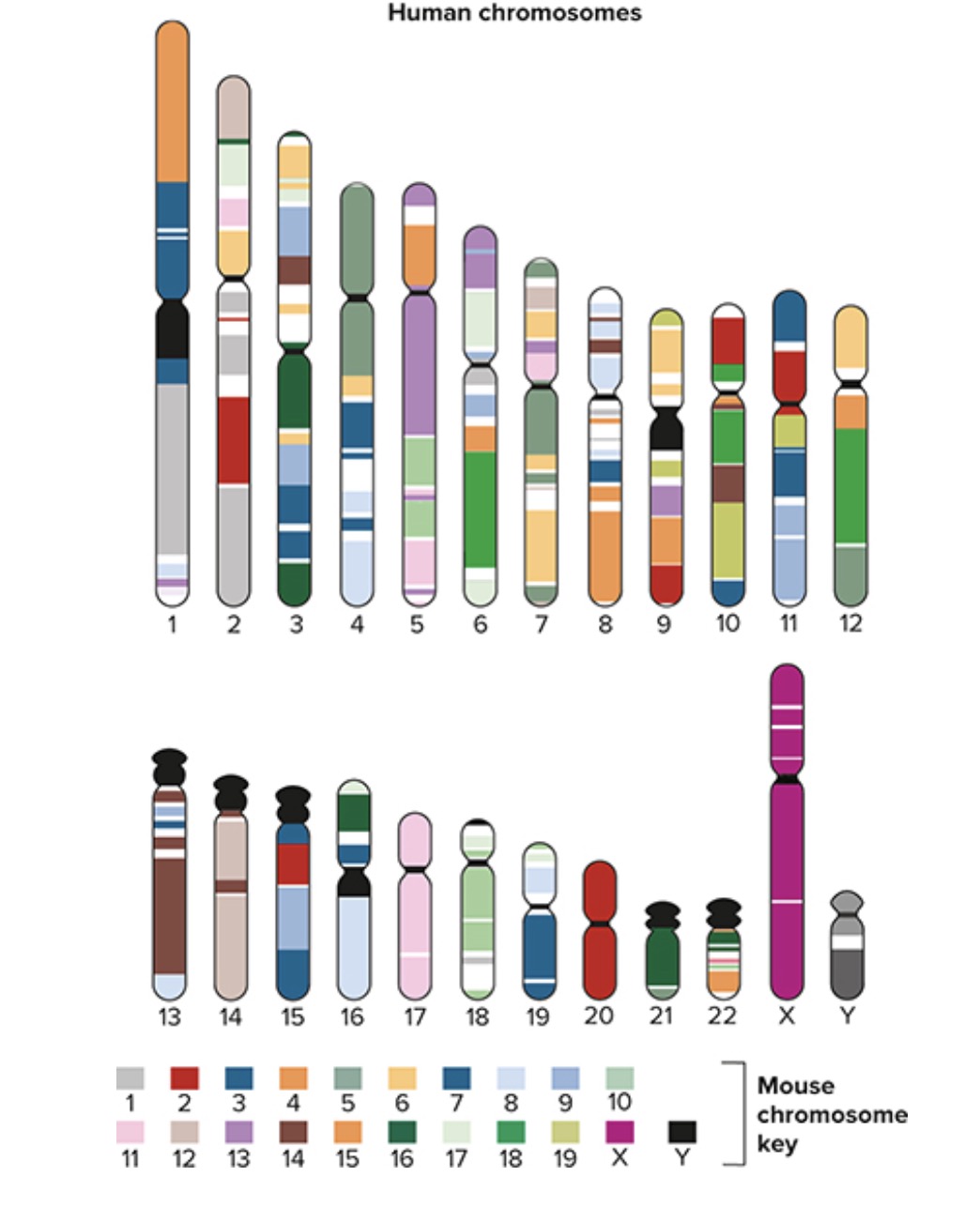
Chromosomal Rearrngements
moved the blocks to different places in the mouse genome.