Neuro E3 Hail Mary

0.0(0)
Studied by 2 people
call kaiCall Kai
learnLearn
examPractice Test
spaced repetitionSpaced Repetition
heart puzzleMatch
flashcardsFlashcards
GameKnowt Play
Card Sorting

1/85

encourage image

There's no tags or description

Looks like no tags are added yet.

86 Terms
1
New cards
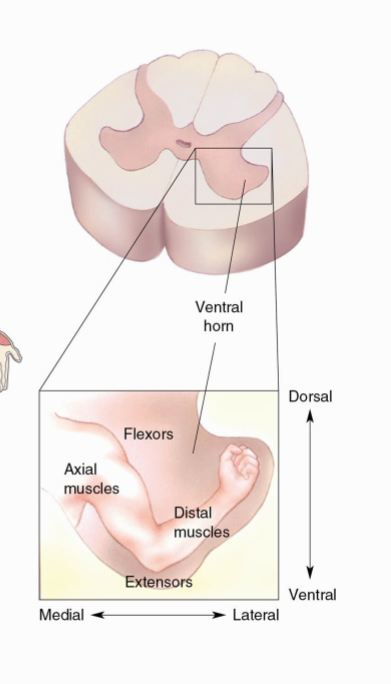
<p>What do axial muscles do (and where are their lower motor neurons located)?</p>

What do axial muscles do (and where are their lower motor neurons located)?

Control trunk movement and posture; their lower motor neurons lie medially in the ventral horn.

2
New cards
<p>What do proximal muscles do (and where are their lower motor neurons located)?</p>

What do proximal muscles do (and where are their lower motor neurons located)?

Control movement of the shoulder, elbow, pelvis, and knee; their lower motor neurons lie in the intermediate ventral horn.

3
New cards
<p>What do distal muscles do (and where are their lower motor neurons located)?</p>

What do distal muscles do (and where are their lower motor neurons located)?

Control fine movements of the hands, feet, and digits; their lower motor neurons lie laterally in the ventral horn.

4
New cards
Where is the cervical enlargement located and what muscles does it innervate?
Located at spinal segments C3–T1; it houses extra motor neurons that innervate the upper limbs (arms and hands).
5
New cards
Where is the lumbar enlargement located and what muscles does it innervate?
Located at spinal segments L1–S3; it houses extra motor neurons that innervate the lower limbs (legs and feet).
6
New cards
What are gamma motor neurons?
Lower motor neurons that innervate intrafusal muscle fibers inside the muscle spindle to regulate the set point of the stretch reflex during muscle contraction.
7
New cards
What are Golgi tendon organs (GTOs)?
Proprioceptors (with Group Ib sensory axons) located at the muscle-tendon junction that act as strain gauges to monitor muscle tension/force and inhibit alpha motor neurons via inhibitory interneurons.
8
New cards
What are upper motor neurons (UMNs)?
Motor neurons originating in the brain (motor cortex or brainstem) whose axons descend to synapse in the spinal cord.
9
New cards
What are lower motor neurons (LMNs)?
Motor neurons with cell bodies in the spinal ventral horn whose axons exit via the ventral root to directly innervate skeletal muscles.
10
New cards
How do upper motor neurons (UMNs) and lower motor neurons (LMNs) differ in location and lesion signs?
UMNs project from the brain to the spinal cord (lesions cause spasticity, hyperactive reflexes, and positive Babinski sign), whereas LMNs project from the ventral horn to skeletal muscles (lesions cause flaccid paralysis of individual muscles, severe atrophy, and hypoactive/absent reflexes).
11
New cards
What are red muscle fibers?
Muscle fibers rich in mitochondria and oxidative enzymes that contract slowly and sustain contraction without fatiguing easily.
12
New cards
What are white muscle fibers?
Anaerobic muscle fibers with few mitochondria that contract and fatigue rapidly.
13
New cards
How do red and white muscle fibers compare?
Red fibers have many mitochondria, use aerobic metabolism, contract slowly, and resist fatigue; white fibers have few mitochondria, use anaerobic metabolism, and contract and fatigue rapidly.
14
New cards
What are slowly fatiguing fibers?
Red muscle fibers that generate low force, contract slowly, and sustain contraction for prolonged endurance (e.g., long-distance running).
15
New cards
What are fast fatigable fibers?
White muscle fibers that produce the fastest, strongest contractions but fatigue rapidly (e.g., sprinting).
16
New cards
How do slowly fatiguing and fast fatigable fibers compare?
Slowly fatiguing fibers produce low force over a long duration without fatiguing, whereas fast fatigable fibers produce high peak force rapidly but lose nearly all force within minutes.
17
New cards
What is the main cause of spinal cord injuries (SCI)?
Motor vehicle accidents (45%) are the leading cause, followed by falls (18%), violence (17%), and sports (13%), occurring mostly in males aged 16–30 via trauma, compression, or ischemia.
18
New cards
What are the three reflexes in infancy shown as developmental milestones?
The grasping reflex, the extensor plantar reflex (Babinski sign), and the rooting reflex.
19
New cards
Why are infant reflexes present at birth and why do they disappear?
Reflexes are innate at birth and do not require brain input; they disappear as descending cortical inhibitory pathways mature (their reappearance in adults indicates an UMN lesion).
20
New cards
What is the dorsolateral tract?
A descending motor pathway from the primary motor cortex (and red nucleus) whose axons all decussate at the medulla to control muscles of the arms, legs, hands, feet, and face.
21
New cards
What is the ventromedial tract?
A descending motor pathway from the superior colliculus, vestibular nuclei, and reticular formation (half decussating at the medulla) that controls neck, shoulder, and trunk muscles for posture and head movements.
22
New cards

How do the dorsolateral and ventromedial tracts differ?

The dorsolateral tract originates in the motor cortex/red nucleus, fully decussates at the medulla, and controls distal limbs and face;

the ventromedial tract originates in brainstem nuclei, decussates half-and-half, and controls axial/proximal muscles for posture.

23
New cards
What is affected by damage to the motor cortex or dorsolateral tract?
Causes paralysis on the contralateral side of the body (with some recovery over time).
24
New cards
What is affected by damage to the ventromedial tract?
Enhances or destroys antigravity reflexes (disrupting posture) and can cause coma.
25
New cards
What is the highest level of the motor control hierarchy (Strategy)?
Controlled by the neocortex and basal ganglia; it determines the overall goal and strategy of a movement.
26
New cards
What is the middle level of the motor control hierarchy (Tactics)?
Controlled by the motor cortex and cerebellum; it plans the muscular sequences, timing, and tactics to execute the strategy.
27
New cards
What is the lowest level of the motor control hierarchy (Execution)?
Controlled by the brainstem and spinal cord; it directly executes muscle contractions via motor neuron pools (with sensory feedback used at all three levels).
28
New cards
What muscles and functions are affected by the descending motor pathways?
Lateral pathways (corticospinal and rubrospinal tracts) control distal muscles of the arms, legs, hands, feet, and face; ventromedial pathways (vestibulospinal, tectospinal, reticulospinal tracts) control neck, shoulder, and trunk muscles for posture and head movements.
29
New cards
What are the implications of damage to the primary motor cortex or corticospinal tract?
Contralateral paralysis/weakness (due to pyramidal decussation in the medulla) and UMN signs, with some partial recovery possible.
30
New cards
Where is the primary motor cortex (M1) located?
In the precentral gyrus of the frontal lobe (Brodmann's Area 4), located just anterior to the central sulcus and somatotopically organized.
31
New cards
What are the symptoms of unilateral cerebellar damage?
Ipsilateral arm intention tremor and ipsilateral leg gait deficits.
32
New cards
What are the symptoms of bilateral cerebellar damage?
Slowed speech and ataxia (uncoordinated movements).
33
New cards
How do unilateral and bilateral cerebellar damage differ in their symptoms?
Unilateral damage causes ipsilateral arm tremor and leg gait problems, whereas bilateral damage causes slowed speech and generalized ataxia.
34
New cards
What is Parkinson's Disease?
A movement disorder caused by degeneration of dopaminergic neurons in the substantia nigra projecting to the striatum, resulting in difficulty initiating voluntary movement, resting tremor, and rigidity.
35
New cards
What is Huntington's Disease?
A basal ganglia disorder caused by degeneration of striatal neurons, resulting in excessive, involuntary jerky movements (chorea) and cognitive decline.
36
New cards
How do Parkinson's Disease and Huntington's Disease compare?
Parkinson's results from loss of substantia nigra dopamine input to the striatum causing hypokinesia (difficulty initiating movement), whereas Huntington's results from striatal degeneration causing hyperkinesia (involuntary chorea).
37
New cards
What are the four defining principles of the diffuse modulatory systems?

1) Small core set of neurons,

2) arise from the brainstem/central brain,

3) widely divergent axons where one neuron influences many others,

4) release neurotransmitters into the extracellular fluid.

38
New cards
Where does the noradrenergic diffuse modulatory system originate and project?
Originates in the locus coeruleus (pons) and projects widely to the cerebral cortex, thalamus, hypothalamus, olfactory bulb, cerebellum, midbrain, and spinal cord.
39
New cards
Where does the serotonergic diffuse modulatory system originate and project?
Originates in the midline raphe nuclei of the brainstem and projects widely to the neocortex, basal ganglia, thalamus, hypothalamus, cerebellum, and spinal cord.
40
New cards
Where does the dopaminergic diffuse modulatory system originate and project?
Originates in the substantia nigra (projecting to the putamen/striatum via the nigrostriatal pathway) and the ventral tegmental area (projecting to the nucleus accumbens/amygdala via the mesolimbic pathway and prefrontal cortex via the mesocortical pathway).
41
New cards
Where do the cholinergic diffuse modulatory systems originate and project?

1) Basal forebrain complex (medial septal nuclei to hippocampus; basal nucleus of Meynert to neocortex)

2) Pontomesencephalotegmental complex (projecting to thalamic sensory relay nuclei).

42
New cards
How do stimulant drugs alter monoamine release and reuptake?
Cocaine, methylphenidate (Ritalin), amphetamines, methamphetamine, MDMA, and ephedrine block monoamine transporters (such as DAT) and/or affect VMAT2 to prevent reuptake, increasing extracellular dopamine and norepinephrine.
43
New cards
How do hallucinogens and SSRIs alter serotonin signaling?
Hallucinogens (LSD, psilocybin, mescaline, DMT) act as serotonin (5-HT2A) receptor agonists, while SSRIs block serotonin reuptake to elevate synaptic serotonin.
44
New cards
What are the effects of elevated serotonin (5-HT) levels?

Elevates mood (e.g., SSRIs treat depression;

eating food spikes tryptophan and serotonin),

promotes wakefulness/arousal (via the ARAS),

suppresses appetite (while receptor agonists disturb logical thought).

45
New cards
What are the effects of the hypothalamus (and what happens when it is damaged)?
Regulates bodily homeostasis (temperature, blood composition, thirst, feeding, endocrine/ANS control); hypothalamic defects cause broad, often fatal disruptions to body functions.
46
New cards
What is the function of the dorsal thalamus (and what happens when it is damaged)?
Relays specific sensory and motor signals to the cortex; dorsal thalamus defects cause discrete sensory or motor deficits.
47
New cards
How do the effects of damage to the hypothalamus and dorsal thalamus differ?
Hypothalamic damage causes widespread, often fatal disruptions to systemic homeostasis, whereas dorsal thalamic damage causes discrete, localized sensory or motor deficits.
48
New cards
What is the "master gland"?
The pituitary gland (controlled by hypothalamic neurosecretory cells), which secretes hormones into the bloodstream to regulate other endocrine glands throughout the body.
49
New cards
Which system is related to addictive behavior?
The mesocorticolimbic dopamine system (VTA dopamine projections to the nucleus accumbens), which mediates reinforcement, reward, and incentive motivation ("wanting") and is activated by drugs like cocaine, heroin, and nicotine.
50
New cards
What are magnocellular neurosecretory cells and what hormones do they release?
Large hypothalamic neurosecretory cells whose axons extend directly into the posterior pituitary to release oxytocin and vasopressin into the bloodstream.
51
New cards
What are parvocellular neurosecretory cells and what hormones do they release?
Small hypothalamic neurosecretory cells that secrete releasing and inhibiting (hypophysiotropic) hormones into the hypothalamo-pituitary portal circulation to regulate the anterior pituitary.
52
New cards
How do magnocellular and parvocellular neurosecretory cells differ?
Magnocellular cells project directly to the posterior pituitary to release oxytocin and vasopressin, whereas parvocellular cells secrete releasing/inhibiting hormones into portal blood vessels to control the anterior pituitary.
53
New cards
What occurs during short-term cortisol release?
The hypothalamus secretes CRH -> anterior pituitary releases ACTH -> adrenal cortex secretes cortisol, which raises blood sugar for prolonged vigilance and boosts immune function.
54
New cards
What occurs during chronic, prolonged cortisol release?

Leads to exhaustion/immune system shutdown

causes atrophy of the hippocampus (increased neuronal death and decreased neurogenesis), impairing hippocampal negative feedback over the HPA axis.

55
New cards
What is the role of the lateral hypothalamus in feeding behavior?
Promotes hunger and feeding (and influences taste); lesions cause lateral hypothalamic syndrome (anorexia/starvation).
56
New cards
What is the role of the ventromedial hypothalamus (VMH) in feeding behavior?
Inhibits feeding and promotes satiety; lesions cause ventromedial hypothalamic syndrome (overeating and obesity).
57
New cards
How do the lateral hypothalamus and ventromedial hypothalamus differ in feeding behavior?
The lateral hypothalamus stimulates hunger (lesions cause anorexia), whereas the ventromedial hypothalamus inhibits feeding (lesions cause obesity).
58
New cards
What is diabetes insipidus?
A condition caused by the loss of vasopressin-secreting neurons in the hypothalamus, resulting in the kidneys failing to concentrate urine, excessive water loss, and a strong motivation to drink water.
59
New cards
What occurs during the cephalic phase of feeding behavior?
Triggered by the sight and smell of food while an empty stomach releases ghrelin (activating arcuate NPY/AgRP hunger neurons), preparing the body to eat.
60
New cards
What occurs during the gastric phase of feeding behavior?
Occurs during chewing, swallowing, and stomach filling; gastric distension (via the vagus nerve) and intestinal cholecystokinin (CCK) send satiety signals to the brain.
61
New cards
What occurs during the substrate phase of feeding behavior?
Nutrients are absorbed in the intestines; blood glucose rises and blood insulin reaches its highest peak to move glucose into cells for use/storage and suppress hunger.
62
New cards
What is serotonin's role in feeding behavior?
Hypothalamic serotonin rises in anticipation of food and spikes during a meal (elevating mood via tryptophan) to promote satiety; serotonin-elevating drugs suppress appetite, and dysregulation is linked to anorexia nervosa, bulimia nervosa, and depression.
63
New cards
What is osmotic thirst?
Thirst triggered when high extracellular salt concentration pulls water out of cells, shrinking them; osmoreceptors in the OVLT and subfornical organ detect this and trigger drinking (via lateral hypothalamus) and vasopressin release.
64
New cards
What is hypovolemic thirst?
Thirst triggered by a loss of total blood/fluid volume (e.g., bleeding, diarrhea, profuse sweating); baroreceptors and kidneys releasing angiotensin II trigger vasoconstriction, water thirst, and salt cravings.
65
New cards
How do osmotic thirst and hypovolemic thirst differ?
Osmotic thirst is caused by high extracellular solute concentration (cellular shrinkage) and drives pure water intake, whereas hypovolemic thirst is caused by loss of blood/fluid volume and drives cravings for both water and salt.
66
New cards
Which hormones are excreted from the posterior pituitary gland?
Oxytocin (lactation/bonding) and vasopressin/ADH (constricts blood vessels and concentrates urine in kidneys).
67
New cards
Which hormones are excreted from the anterior pituitary gland?
Tropic hormones regulated by hypothalamic releasing/inhibiting hormones, including ACTH, FSH, and LH (as well as GH, TSH, and prolactin).
68
New cards
How do posterior and anterior pituitary hormones differ in origin and release?
Posterior pituitary hormones (oxytocin, vasopressin) are made in hypothalamic magnocellular neurons and released from their axon terminals, whereas anterior pituitary hormones (ACTH, FSH, LH) are made by anterior pituitary endocrine cells in response to hypothalamic portal hormones.
69
New cards
How does vasopressin influence pair bonding (in prairie vs. montane voles)?
Monogamous male prairie voles form lasting pair bonds and have high densities of vasopressin receptors in the ventral pallidum (VP), whereas promiscuous montane (meadow) voles have far fewer VP vasopressin receptors.
70
New cards
How does oxytocin influence pair bonding (in prairie vs. montane voles)?
Monogamous prairie voles have high densities of oxytocin receptors in the nucleus accumbens (NAcc) and medial prefrontal cortex (mPFC) that promote partner bonding, unlike promiscuous montane voles.
71
New cards
Where is the most distinct sexual dimorphism in the brain?
In the hypothalamus—specifically the Sexually Dimorphic Nucleus (SDN) of the Medial Preoptic Area (MPA) in rats and the 3rd Interstitial Nucleus of the Anterior Hypothalamus (INAH3) in humans (larger in heterosexual men than women or homosexual men), as well as the bed nucleus of the stria terminalis (BNST, 2.5x larger in men).
72
New cards
What is the cause of Congenital Adrenal Hyperplasia (CAH)?
Large, overactive fetal adrenal glands that produce abnormally high levels of testosterone during prenatal development.
73
New cards
How does Congenital Adrenal Hyperplasia (CAH) affect anatomy and behavior in females (XX)?
External genitals are slightly masculinized; girls show a stronger preference for male-typical toys, and adult women usually identify as female but report less sexual interest than unaffected women.
74
New cards
How and when does the male reproductive system develop?
Early in fetal development, XY fetal testes secrete testosterone (which stimulates the Wolffian system to develop into male internal sex organs) and Anti-Müllerian Hormone (AMH, which inhibits the female Müllerian system).
75
New cards
What happens when fetal testicular hormones do not develop/are absent?
Without testosterone and Anti-Müllerian Hormone (AMH), the male Wolffian system regresses and the female Müllerian system develops by default into female internal sex organs.
76
New cards
How do the Wolffian and Müllerian systems compare during fetal development?
The Wolffian system is the embryonic male precursor requiring fetal testosterone to develop, whereas the Müllerian system is the embryonic female precursor that develops unless inhibited by fetal Anti-Müllerian Hormone (AMH).
77
New cards
What are the direct (fast) effects of steroid hormones on neurons?
Rapidly alter membrane excitability, ion channel function, enzyme activity, neurotransmitter release, and receptor sensitivity.
78
New cards
What are the indirect (slow) effects of steroid hormones on neurons?
Steroids diffuse across the cell membrane, bind to cytoplasmic and nuclear receptors, and act as transcription factors on DNA to alter gene expression.
79
New cards
What are the organizing effects of sex hormones?
Permanent structural changes that occur during a limited sensitive period of development (usually prenatal or early postnatal) to prepare the brain for later activating effects.
80
New cards
What are the activating effects of sex hormones?
Temporary physiological or behavioral responses triggered by hormones at any time of life (especially in adulthood).
81
New cards
How do organizing and activating effects of sex hormones differ?
Organizing effects occur during an early sensitive period and cause permanent brain differentiation, whereas activating effects occur throughout adulthood and temporarily trigger behaviors.
82
New cards
What are the 4 stages of the sexual arousal/response cycle?
1) Arousal, 2) Plateau, 3) Orgasm, and 4) Resolution (regulated by the cerebral cortex and spinal cord).
83
New cards
How do the parasympathetic and sympathetic divisions of the ANS regulate sexual arousal and orgasm?
Parasympathetic ANS (releasing ACh, VIP, and nitric oxide [NO]) relaxes smooth muscle in the penis and clitoris for arousal/erection, whereas sympathetic ANS triggers muscular contractions and ejaculation during orgasm.
84
New cards
What is polygyny?
A mating strategy in which one male mates with many females.
85
New cards
What is polyandry?
A mating strategy in which one female mates with many males.
86
New cards
What is monogamy?
A mating strategy in which one male and one female mate exclusively (the most common strategy across human cultures and eras).



