Ecology Exam 2
 Call Kai
 Learn
 Practice Test
 Spaced Repetition
 Match
 Flashcards
 Knowt Play
1/67

There's no tags or description
Looks like no tags are added yet.
68 Terms
Mutualism
Mutually beneficial interaction between individuals of two species (+/+)
Commensalism
Individuals of one species benefit, while individuals of the other species do not benefit and are not harmed (+/0)
Trophic mutualism
A mutualist receives energy or nutrients from its partner (ex: Mycorrhizal fungi & plants - Fungus gets energy in the form of carbohydrates - Plant gets help in taking up limiting nutrients, such as phosphorus)
Service mutualism
Interactions in which one partner performs an ecological service for the other (ex: Pollination, seed dispersal, defense against herbivores/predators/parasites)
Habitat mutualism
One partner provides the other with shelter, a place to live, or favorable habitat (ex: Bluehead Chub nests and associated minnow species)
Examples of cheating in mutualism
Nectar robbers, Deceptive orchids
How do Yucca plants prevent cheating?
Yuccas are able to abort flowers with too many eggs, before the moth larvae hatch
Parasite
obtains nutrition from single or alternate hosts, but usually don’t kill the prey
Endoparasites
Live in the host
Ectoparasite
Live on the host
Examples of parasitism
Induced fruit mimicry in the gliding ant, Epifagus (beech drops) grows on the roots of oak and beech trees, mistletoe takes nutrients from most disciduous trees
Parasitoids
Single prey (host) consumed by one or more young, and the host is always killed
Examples of parasitoids
Wasps in goldenrod plants
Red Queen Hypothesis
For an evolutionarily labile system, change is needed to maintain fitness relative to systems it is co-evolving with. (Advantage of sexual reproduction)
New Zealand Mudsnail Example
They can reproduce both sexually and asexually. Asexual reproduction allows for more efficient reproduction but less defense against parasitsm.
Chemical herbivory defense
Producing noxious or poisonous chemicals to deture consumption from herbivores
Mechanical herbivory defense
Developing structures like thorns to make the plant harder to eat
Nutritional herbivory defense
Growing structures that are less nutritious for herbivores
Tolerance herbivory defnese
Adapted to regrow quickly after being grazed
Chemical Predation defense
Producing chemicals that are noxious or poisonous to predators
Physical predation defense
Creating physical barriers to prevent predation (shells, armor)
Aposematism
Warning colors, sound, or characteristics to alert predators that they are not good for consumption
Crypsis
Was of camoflaging or hiding from predators (colors, shapes)
Mimicry
Looking or sounding like a species predators avoid
Behavioral
Behaving in ways to minimize risk from predation
What is a zero-growth isocline?
When the prey population size at which the change in predator population size is zero, or vice versa.
Assumptions for the Lotka - Volterra model
No prey density-dependence
Well-mixed predator and prey populations
The predator only feeds on the prey species
The predator is the only significant cause of prey
mortality
Handling time for prey = 0
No immigration or emigration of prey or predators
Numerical response
Predator population size as a function of prey population size
Functional response
Predator consumption rate as a function of prey population size
Type 1 Functional Response
As long as prey density increases, predation rate will increase proportionally. Often drawn without any upper limit
Type 2 Functional Response
As prey density increases, predation rate becomes limited by handling time associated with each prey item
Type 3 Functional Respone
At high prey density, similar to Type II. At low prey densities, predation rate is slow to increase until prey becomes more common, a result of learning to eat a rare prey type or having alternative prey to focus on when this prey is rare.
Fundamental Niche
The complete set of conditions under which an organism can survive and reproduce
Realized Niche
The subset of the fundamental niche describing the conditions, under which an organism actually lives, given limitations created by interactions with other species.
Interspecific competition
Competition for resources between individuals of different species
Intraspecific Competition
Competition for resources between individuals of the same species
Indirect (resource) competition
Consumption of a resource by oneorganism means there is less of that resource available to other organisms
Direct (interference) competition
Individuals interact with each other directly to limit access to resources
Connell’s barnacles experiment
Two different types of barnicles on different parts of tide pools. Testing to see if it is a niche reason or a competition reason for why they are distributed a certain way. Move the barnicles around and see fitness.
“Ghost of competition past”
Competition, acting as an evolutionary force in the past, can explain present-day phenotypes even when no present-day competition exists
Limiting Similarity
If the niche overlap is near 100%, then it results in the competative exclusion of one species
Resource Partitioning
If there is an overlap in niches, then the species who sit in the middle of the overlap will be selected against, until the two species have seperated niches
Character Displacement
Competition causes the phenotypes of competing species to evolve to become more different over time
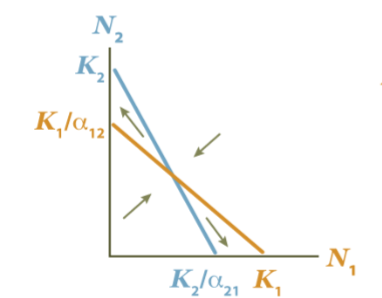
Unstable equilibrium
both species co-exist until there is a small perturbation, then one or the other goes to extinction

Stable equilibrium
both species co-exist and perturbation does not cause one or the other species to go extinct; rather, they return to their equilibrium pop. abundances
What does αij mean in lotka-voltera
the competitive effect on species i by species j

Zero Growth isocline for population 1

Zero growth isocline for population 2
Species 1 wins

Species 2 wins

Succession
the relatively repeatable change in community composition through time following a disturbance
Disturbances
alter communities by killing organisms, altering resource availability, and changing the physical structure of the environment.
Life-history traits
Differences in physiology & behavior that make each species well suited to grow in particular environments
Facilitation model
colonizing species make the environment more suitable for later arriving species
Inhibition model
colonizing species make the environment less suitable for later arriving species; replacement by death/damage
Tolerance model
colonizing species have little or no effect on the growth of later arriving species (late arrivals tolerate early colonizers); replacement by better competitors
Trophic Cascades
when addition or removal of a top predator affectsmultiple, lower trophic levels in the community
Behavioral trophic cascade
predators affect the behavior of herbivores, with cascading effects on lower trophic levels
Ecosystem engineers
Autogenic - alter resource availability through their own physical structures (forest, coral reef)
Allogenic - alter resource availability by transforming or redistributing parts of the environment (beavers, woodpeckers, gophers)
The Step Model
Both top-down and bottom-up forces can act simultaneously, Producer biomass provides the
foundation for consumer populations
Resistance
the ability to withstand a disturbance
Return time
the time required to return to “equilibrium” after disturbance
Resilience
how closely the post-recovery community resembles the pre-disturbance community
Alturnative stable states
After a major change, it is hard to return to form.
diversity-stability hypothesis
species-rich communities are more stable
Food web theory
communities with higher connectance (i.e., with many species interacting trophically) should be more stable
SIR model
Susceptible to infection, Infected (and capable of transmitting pathogen), Recovered (not capable of transmitting pathogen; may be immune to further infection)
Zoonosis
a disease communicable from animals to humans under natural conditions