Chapter 1: Definitions of Crime and Deviance
 Call Kai
 Learn
Learn Practice Test
 Spaced Repetition
 Match
Match Flashcards
 Knowt Play
1/67

There's no tags or description
Looks like no tags are added yet.
Name | Mastery | Learn | Test | Matching | Spaced | Call with Kai | Chat |
|---|
No analytics yet
Send a link to your students to track their progress
68 Terms
What is a crime?
A crime is any act which breaks legal rules and can lead to official punishment.
In short, to break the law within society.
Crime is seen as a more “serious act”.
What can criminal behaviour lead to?
Criminal behaviour may lead to: a number of sanctions from fines to community service to jail to the death penalty.
Give an example of the punishment for crimes
Life imprisonment
Community service
Fines
What is deviance?
In everyday language, 'to deviate' means 'to stray from an accepted path'.
Most sociological definitions simply elaborate on this idea.
Thus, deviance consists of those acts which do not follow the norms and expectations of a particular group.
How is deviance sanctioned?
Deviance is sanctioned in an informal manner.
It may be positively sanctioned (rewarded, for example within a subculture), negatively sanctioned (punished through social exclusion), or simply accepted or tolerated.
Give examples of being negatively sanctioned due to deviance
Family: taking your phone off you
Social media: cancel culture
Education: cards as a form of consequence
What can some acts be?
Some acts can be either criminal, deviant or both.
For example, a murderer not only deviates from society's norms and expectations, but also from its values and laws - in this case the value placed on human life
What does this deviance result in?
This deviance results in widespread disapproval and (if the murderer is caught) severe punishment.
What do some forms of deviance consist?
Some forms of deviance consist of acts which depart from the norms of a particular society, but are generally tolerated, for example eccentrics and beggars.
Also, in this group of deviants are those who depart from norms because they don't know they exist, or have forgotten them, for example children, or people with learning disabilities. Generally, this form of deviance is tolerated and seen as relatively harmless.
Give an example of an act that can be criminal and deviant (Breaking both social and legal rules)
Murder
Give an example of an act that can be deviant but not criminal (Breaking social, but not legal, rules.)
Spitting
Give an example of an act that can be criminal but not deviant (Breaking legal, but not social, rules)
speeding
What are the two definitions of Crime and Deviance and who supports each definition?
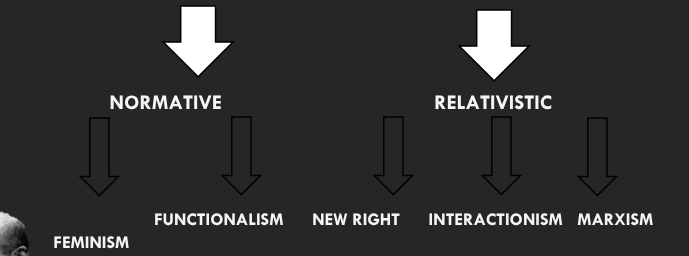
What do Functionalists and the New Right believe there is in society?
A value-consensus in society
What do they assume?
They assume that we all collectively share and agree on the same values, such as materialism or privacy
What did Durkheim assumed there was in society?
There was a collective conscience in society – agreement of our norms and values.
What do we all agree?
Thus, we all agree what is deviant and what is normal or what is legal or illegal
This means that a minority are deviant or criminal as most people conform
What happens if the If the collective conscience breaks down?
then the crime rate or deviance increases.
Can you think of another value that we share in British Society?
education, family
What is the Normative Definition of Deviance?
Deviance means, in this sense, breaking the consensual formal norms
e.g. pushing in a formalised queue at a theme park or outside a club using a roped off area, or breaking consensual informal norms by jumping in a queue at a pub.
What is still seen as normatively deviant in British society?
Pushing in or jumping a queue
Can you think of an act we all agree is deviant?
littering, talking in a cinema, not wearing a mask in lockdown
What is the Normative definition of Crime?
Mooney suggests that the normative definition of crime suggests crime is an injurious act which offends against society’s consensual norms and values.
Crime, in this sense, is seen as an illegal act which we all agree is illegal and unacceptable, especially as we democratically elect our Government which passes these laws.
However, can the same be said of all countries?
No, such as homosexuality which is punishable by death in 50 countries
What do Functionalists and the New Right argue that value consensus is?
It is the basis for social order in society
How is value consensus and social order maintained?
through informal and formal agents of social control,
which they believe is functional and beneficial for society and its’ individuals.
Give an example of an agent of social control and how it ensures we conform to society’s norms.
Give an example of an agent of social control and how it ensures we conform to society’s norms. | |
Informal Social Control | Formal Social Control |
Family
| Police |
Education
| Courts |
Fill in the gaps!
Formal agents of social control such as ………………………… and ………………………keep individuals in society following the consensual norms of society by passing laws, policing these laws and applying sanctions - punishment – to rectify anyone who breaks these norms through their deviant behaviour. Thus, these agents of social control are seen as functional for society with Durkheim arguing that they are a means of boundary maintenance ensuring individuals conform to society’s norms and values ensuring social order as it sets out the limits of our behaviour and the consequences if we cross these limits. Informal agents of social control such as ………………………………. and ………………… also help to ensure we conform to the value consensus through the process of socialisation. Through the use of …………………………, imitation, role-models and expectations we are taught how to behave, ensuring conformity and order in society. Functionalist and the New Right would see crime and deviance emerging from dysfunctional families with poor socialisation skills. New Right theorist Murray would argue dysfunctional families are single-parent families who form part of the underclass.
Why might the New Right see single-parent families as dysfunctional?
Fail to adequately socialise children and produce a welfare dependent state
Evaluation
1. Postmodernists would suggest that we live in an individualistic society with varying beliefs. In a multi-cultural society like Britain, we might disagree with some norms and values. There are some illegal or deviant acts that many of us regard as inconsequential e.g. smoking marijuana or speeding on a motorway.
2. Interactionists would argue that crime and deviance is socially constructed in society. An act that may be considered deviant or illegal at one point in time may not be at another. For example, homosexuality was illegal until 1967, and considered deviant for many years after that.
What is the relativistic definition of crime & deviance?
It challenges the normative definition, which assumes a consensual set of norms and values.
Instead it argues that society is complex and thus a consensus cannot exist in any meaningful way.
So society is viewed as made up of competing or emerging values.
What do both Interactionists and Marxists argue that crime and deviance is?
It is relative, not normative.
For Interactionists, What is vitally important to recognise?
that crime and deviance is relative,
the context in which behaviour occurs is crucial to how it will be viewed by society.
What does this mean there is no absolute way of defining?
not an absolute way of defining a deviant act
What can deviance only be defined in relation to?
a particular standard of behaviour, and no standards are fixed forever.
How does deviance vary?
deviance varies from time-to-time, place-to-place and person-to-person.
Thus, What is crime and deviance?
crime and deviance are not static but dynamic emerging from complex interactions between groups and individuals.
An act that is considered criminal or deviant today, may be defined as normal in the future, and vice-versa.
This is due to the fact values change across generations.
For example domestic violence was once seen as acceptable, however this is now both a criminal and deviant act.
An act defined as deviant in one society may be seen as perfectly normal in another.
For example, in the UK it’s deemed acceptable to eat a number of meat products such as chicken and lamb, however it was viewed as deviant when horse meat was being sold in supermarkets.
In other countries such as France, horse meat is sold and eaten regularly.
From this viewpoint, crime and deviance is culturally determined; cultures differ both from each other and over time.
According to Interactionists Crime and Deviance is relative in relation to what three things? (Give examples)
According to Interactionists Crime and Deviance is relative in relation to: | ||
Time:
| Place:
| Person:
|
What does Interactionist Becker argue that what is defined as deviant or criminal depends on?
labelling and the societal reaction of others,
therefore he argued that no act is inherently deviant.
What will this process of labelling & societal reaction depend upon?
who commits the act, who sees it and the action taken.
How does labelling turn into a master status?
Compare the two situations below and decide on the action taken!
Compare the two situations below and decide on the action taken | |||
Act | Who commits it | Who sees it | Action taken |
Urinating in the street | Marathon runner | Spectators | No action |
Drunken man | Police Officer | Arrested | |
Smoking cannabis | Student | Student’s friends | No action |
Student | Headteacher | Exclusion | |
What do Interactionists argue about some people?
some people have more power to label certain groups or acts as deviant or criminal.
What did Cicourel argue that some people are more capable of doing?
negotiating with those who label them,
so changing the label attached or getting it removed altogether.
What did he find about middle class delinquents?
He found that middle class delinquents negotiated their way out of a deviant or criminal label.
In support of this point, What is the Campbell and the Chivalry Theory?
The Campbell and the Chivalry Theory highlights that females may be able to negotiate more successfully with male agents of social control
e.g. police officer.
Why do Marxists argue that crime is relative?
as the powerful Ruling (capitalist) Class create laws that benefit them and disadvantage the working class and selectively enforce these.
What do Marxists argue about middle class behaviour?
middle class behaviour is less likely to be criminalised and seen as deviant,
thus white-collar or middle-class crimes like tax fraud are overlooked or downgraded as less serious,
whilst tax avoidance is still seen as normal and acceptable.
What is the law apart of?
The law is part of societies superstructure
which socially constructs what is legal in order to support the interests of the bourgeoisie and maintain their position of privilege within the economic base.
What does this mean the law is not considered?
the law is not considered to be neutral or objective,
instead it is created so that it supports one dominant group in society.
What is created through ideological state apparatuses within the superstructure?
a false class consciousness is created amongst the proletariat so they are not able to recognise the bias which exists within the law.
Law Creation – How would Snider and Hadfield support this?
(See page 3 in chapter 3)
Snider and Hadfeild - laws are created to protect the ruling class
In addition, What do they believe about the law?
the law is selectively enforced and used more aggressively against the working class,
to create the impression that crime is a working class phenomenon,
thus distracting our attention from middle class crimes and allowing us to scapegoat the working class.
Law Enforcement – How would Chambliss and Croall support this?
(See page 5&6 in chapter 3)
Web of connections - bribery (Chambliss)
Softening of white collar crime by the media
Do these laws help or hinder the Working Class? (Example)
For example: The 1834 Poor Law Amendment Act. In 1834 the Poor Law Amendment Act was passed by Parliament. This was designed to reduce the cost of looking after the poor as it stopped money going to poor people except in exceptional circumstances.
Do these laws help or hinder the Working Class? (activity)
Law/Policy | Help | Hinder |
The bedroom tax |
|
|
Minimum/Living Wage
|
|
|
Health & Safety at Work
|
|
|
What is the Feminist view on laws?
Feminists argue that it is powerful men who create laws to oppress women.
Feminists would argue that this is a way of controlling women’s movements and independence.
What do Feminists argue about some countries?
In some countries which are patriarchal and/or religious, often laws are created which oppress and criminalise women.
Give three examples of this
For example, in Saudi Arabia, until 2017 it was illegal for women to drive or own a vehicle, although able to legally drive today, culturally it is the norm for men to escort women at all times.
Furthermore, in the USA the former Trump administration is accused of attempting to reduce women’s control of their bodies and fertility by changes to laws and funding for Planned Parenthood.
In Northern Ireland, abortion became legalised in 2019 and yet there is a strict criterion for expectant mothers to adhere to.
How would Sutherland support this?
(See page 3 in chapter 6)
Sex role theory - Boys and girls are socialised differently
What do Feminists also argue about behaviours?
Feminists also argue behaviours that are seen as deviant for women are seen as normal for men,
e.g. walking around with your top off, or having multiple sexual partners.
Arguably, this is a way for men to dominate and control women’s sexuality in society.
How would the work of Smart and Heidensohn support this?
(See page 6 in chapter 6)
Double deviance - women get very high sentences such as Lucy Letby, Myra Hindley
Do these laws help or hinder females? (Example)
For example: In countries such as Cameroon and Guinea, men have more of a say in where their wives will work than the women themselves. In Cameroon, a husband may prohibit his wife from taking a job in a different trade or profession than him if it is in the best interest of his marriage and children. Cameroon is one of 18 countries where women can’t get a job if their husbands feel it isn’t in their family’s interest.
Do these laws help or hinder females? (Activity)
Law/Policy | Help | Hinder |
Sex Discrimination Act |
|
|
Maternity Leave/Pay |
|
|
Evaluation
1. Postmodernists would argue that in today’s individualistic society, none of these explanations are appropriate as people make their own judgments and decisions, rather than following a dominant set of norms such as capitalism or patriarchy.
2. Functionalists and the New Right would argue that our behaviour today is still governed by a value consensus. This exists in every given society, whereby this consensus is enforced by formal and informal agents of social control.
Summary!
In summary, Conflict theorists such as Marxists and Feminists argue that crime is relative as it is dependent on the power and ability of a dominant ruling group to impose their norms and values through ideology – whether it be Ruling Class Ideology or Patriarchal Ideology – on society.
Thus, what acts are deemed criminal or deviant is decided by these powerful groups and agents of social control are help ensure these ideologies and resulting laws are adhered to. This maintains their powerful position and ensures the oppression of the powerless groups, be it the working class or women.