Genetic Recombination
 Call Kai
 Learn
 Practice Test
 Spaced Repetition
 Match
 Flashcards
 Knowt Play
1/37

There's no tags or description
Looks like no tags are added yet.
38 Terms
Why are we so diverse?
Mutation
Random Fertilization
Recombination
Mechanisms of Genetic Recombination
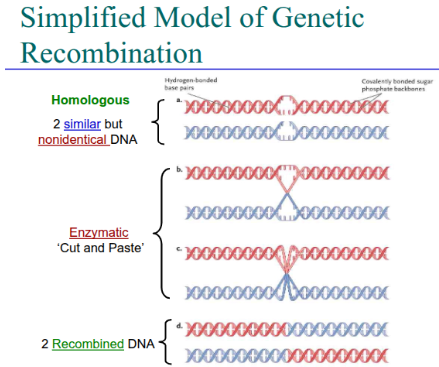
Requires 2 DNA molecules that are similar but non-identical
Homology allows DNA on different molecules to line up and recombine precisely
Enzymatic cutting and pasting of both DNA backbones from each of 2 DNA molecules required for recombination
Genetic Recombination in Bacteria
Genetic recombination occurs in E. coli
Bacterial conjugation brings DNA of two cells into close proximity
Transformation and transduction provide additional sources of DNA for recombination
Some bacteria genetically reshuffle
Genes transferred from one individual to another recombine with existing DNA
How did they figure this out?
Genetically identical clones allow molecular genetics studies
Genetic Recombination in E. coli what are the definitions of Prototrophs and Auxotrophs, along with complete medium and minimal media
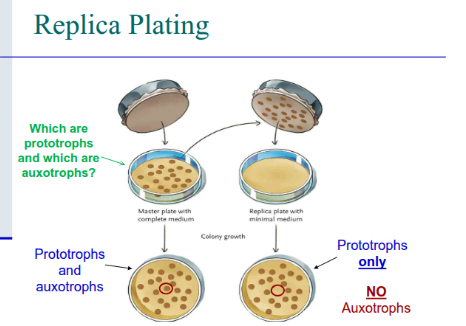
Prototrophs - Bacteria grow on minimal media because they make their own amino acids
Auxotrophs - Bacteria with mutations does not grow on minimal medium
Three letter gene name:
+normal - mutated allele
Ex. arg+ and arg_
Complete medium - full complement of nutrients
Minimal media - missing some nutrients
What is Replica Plating and what does it do
Replica plating - is a technique that is used to:
Identify prototrophs versus auxotrophs
Identify and count genetic recombinations in bacterial colonies
How is Bacterial recombination by conjugation done
Bacteria are haploid
Sex pilus/Pilus connects two bacteria
Donor sends DNA via cytoplasmic bridge to recipient
Recipient undergoes recombination
Plasmids Circular, nonchromosomal transferable DNA
R plasmids confer resistance to antibiotics
Horizontal Gene Transfer
F-Factor and conjugation what is F factors what does it do
Donor cell must have F Factor (fertility) plasmid
F+ cells are donors with F Factor
F- cells are recipients without F Factor
F Factor has genes that encode for sex pilus cytoplasmically connects F+ cell to F- cell
F- cell converts to F+ cell

Fill in the Blanks
No chromosomal DNA is transferred
No DNA recombination
Hfr Cells and Recombination what do Hfr Cells do and what are they
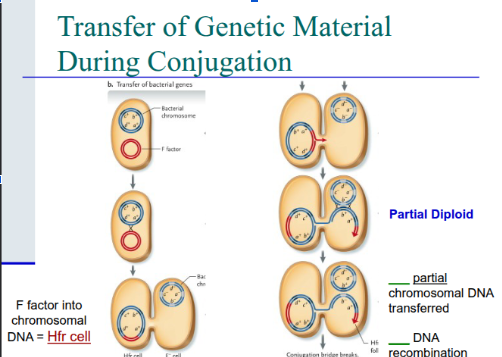
Hfr (high frequency) cells integrate F factor into bacterial chromosome through recombination
Hfr cells can conjugate with F- cells
Recipient becomes F-
Genetic recombination occurs by double crossing over in recipient
New generations have new gene combinations
FIll in the Blanks
Yes partial chromosomal DNA transferred
Yes DNA recombination
What happens when Mapping Genes by Conjugation
Mated Hfr and F- cells that differed in number of alleles
At regular intervals after conjugation commenced, remove cells and break apart mating pairs
Cultured separated cells and analyzed for recombiants
Greater time to conjugate before separation the greater number of donor genes into recipient
Therefore greater number of recombinants
Note order and time at which genes were transferred
→ able to map and assign relative positions of several genes of E. coli chromosome
Transformation occurs when bacteria take up DNA from disintegrated bacteria what are the steps
Linear fragments recombine by double crossovers
Transformation bacteria usually have DNA binding protein in wall
Artificial transformation
Alters cell membrane for DNA penetration
Electroporation
Transduction occurs when bacterial phages transfer DNA from one bacteria to another what does the bacteria DNA do to the host cell
Virus incorporates DNA fragments from host cell
If DNA fragments are homologous
→ bacteria become partial diploid
Recombination by double crossovers
Horizontal Gene Transfer

FIll in the Blank
Phage with Bacterial DNA

Virulent vs. Temperate Bacteriophage
Virulent Bacteriophage - uses only lytic cycle of infection
→kills/lyses host bacteria
Temperate Bacteriophage - uses both lysogenic and lytic cycle of infection
→ may or may not kill host bacteria
Prophage - bacteriophage integrated into host DNA
Genetic Recombination in Eukaryotes: Meiosis
Meiosis occurs in different places in different organismal life cycles
Meiosis changes both chromosome number and DNA sequence
Meiosis produces four genetically different daughter cells
Several mechanisms contribute genetic diversity
What happens in Sexual Reproduction
Sexual reproduction produces offspring by union of male and female gametes (sperm and egg)
Meiosis produces gametes with half chromosome number
Evolutionary advantage: Genetic shuffling
What happens in Fetilization
Fertilization fuses nuclei of egg and sperm → Zygote
Restores parental chromosome number
What happens in Animal Life Cycles
Diploid phase dominates animal life cycles
Meiosis followed directly by gamete formation
Haploid phase is reduced and short, no mitosis
In males, all four nuclei from meiosis form separate sperm cells
In females, only one nucleus becomes an egg
Homologous Chromosome Pairs what are they and where do they come from
Paternal chromosomes from male parent
Maternal chromosomes from female parent
Homologous chromosome pairs
Alleles may be different within homologous pairs
What does meiosis do to homologous pairs
Meiosis separates homologous pairs
Before meiosis - diploid (2n)
After meiosis - haploid (n)
What happens in meiosis 1
Meiosis l: First meiotic division
Recombination exchanges segments between homologues
Produces two haploid cells with chromatids attached
What happens in meiosis 2
Meiosis ll: Second meiotic division
Sister chromatids separate into separate cells
Produces 4 recombined haploid cells

Steps in the Meiotic Cell Cycle
Prophase l - Sister chromatids condense chromosomes
Synapsis → pairing of homologs
Tetrads → fully paired homologs
Recombination → mixes alleles across tetrads

What happens in Prometaphase 1
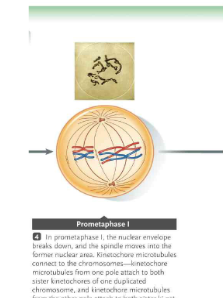
Nuclear envelope breaks down
Kinetochores attach to polar spindles
What happens in Metaphase l and Anaphase 1
Tetrads align on metaphase plate
Homologs segregate - move to poles (sister chromatids attached)
Nondisjunction creates abnormal chromosome numbers

What happens in Meiotic Divisions Telophase 1 and Interkinesis
NO change in chromosomes
Spindle disassembles
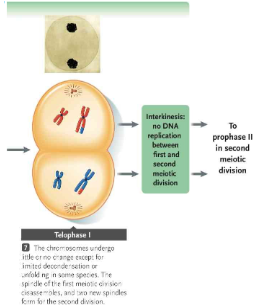
Meiotic Cell Cycle what happens in Prophase 2 and Prometaphase 2
Chromosomes condense, spindles form
Nuclear envelope breaks, kinetochores attach to microtubules
What happens in Metaphase 2
Chromosomes align on metaphase plate

What happens in Anaphase ll and Telophase ll
Spindles separate chromatids
Spindles disassemble
New nuclear envelopes form
4 genetically different haploid cells

What is nondisjunction and what are the results
Both members of pair of homologous chromosomes connect to spindles from same pole
Following anaphase, one pole then receives both copies of pair and other pole receives none
Result is gametes that have 2 copies of a chromosome
After fertilisation, zygote has 3 copies of chromosome instead of 2
Ex. Trisomy 21
How do Sex Chromosomes relate to Meiosis
Meiosis and sex chromosome inheritance:
Gametes produced by females may receive either X chromosome
Gametes produced by males may receive either X or Y chromosome
Compare Meiosis and Mitosis
Both: Similar cell divisions, meiosis divides twice
Mitosis: Two identical daughter cells (diploid)
Meiosis: Four genetically different cells (haploid)
Premeiotic interphases similar to mitotic interphase
Chromosomes copied into sister chromatids

What are the Four main things for Genetic Variability
Genetic recombination
Random segregated at anaphase l
Alternative combo at anaphase ll
Random Fertilization
What happens in Genetic Recombination
Recombination (crossing-over)
Key genetic shuffle of prophase l
Tetrads held together at synaptonemal complex
2 of 4 chromatids exchange alleles
Chiasmate or crossovers are points of exchange

What happens in Random Segregation
Key genetic shuffle of metaphase l
Each chromosome of a homologous pair may randomly end up at either spindle pole
Any combo of maternal and paternal chromosomes → segregated to gametes
2^x number of possible combinations

Alternative Combo at Anaphase ll

What is Random Fertilization
Random chance of male and female gamete forming zygote
Meiosis allows randomness necessary for Mendelian laws of inheritance