chat gbt generated flashcards for microbiol exam 2
 Call Kai
 Learn
 Practice Test
 Spaced Repetition
 Match
 Flashcards
 Knowt Play
1/90

There's no tags or description
Looks like no tags are added yet.
91 Terms
Microorganisms + history/economy
Disease can reshape society, migration, warfare + history; Public health: infection waves, mortality, healthcare overload; Economy: supply-chain collapse, job loss, market crashes; Social/political: closures, travel bans, policy change, unrest, cooperation/division
Disease occurrence patterns
Outbreak/epidemic = more disease than expected in a time/place
Pandemic = epidemic spread across countries/continents
Endemic = continually present, often at stable level
Types of disease/infection
Infectious = invasion + multiplication of microorganisms
Acute = sudden + short; e.g. smallpox, measles, influenza
Chronic = extended duration; e.g. HIV/AIDS, TB
Latent viral = dormant/inactive period → possible reactivation
Vector-borne = transmitted by infected arthropods
Zoonotic spillover
Pathogen starts in animal host
Jumps to susceptible human through close contact
May then spread human → human
Plague of Athens
430–426 BCE
Pathogen uncertain
Crowding + poor sanitation favored spread
Killed up to ~2/3 of Athens
Contributed to Athens’ defeat by Sparta
Plague of Justinian
Pathogen = Yersinia pestis
Gram-negative bacterium
Reservoir = rodents/other mammals
Vector = fleas
Major historical plague outbreak
Black Death / plague
Caused by Yersinia pestis
Flea/rodent transmission important
Spread widely through Europe and beyond
Massive mortality reshaped European society/economy
Spanish conquest of Mexico + smallpox
Smallpox = Variola virus; Devastated Aztecs during Spanish conquest
Native population had little/no prior immunity
Weakened resistance + contributed to drastic population decline
Typhus + history
Caused by Rickettsia prowazekii
Gram-negative bacterium
Transmitted by human body louse
Thrives in crowded/unsanitary conditions
Historically affected soldiers
Irish potato famine
Pathogen = Phytophthora infestans
Fungus-like organism, more closely related to algae than fungi
Potato disease → crop failure/famine + major social effects
role of the USDA
Monitor foreign diseases and shut down exports/imports to prevent a pandemic
Yellow fever + Panama Canal
Yellow fever = viral disease
Mosquito control/disease control was important for canal construction
Example of microbiology affecting infrastructure/history
Microbial cell factories
Chaim Weizmann developed bacterial acetone synthesis
Organism = Clostridium acetobutylicum
Example of microbes driving industrial/economic innovation
Ages of microbiology
Ancient microbiology: ~3000 BCE–1665
Early microbiology: 1666–1857
Golden Age: ~1858–1914
Modern microbiology: 1914–present
Redi + Hooke
Redi: meat/maggot experiment argued against spontaneous generation
Hooke: microscopy + foundations of cell theory
Cell theory: living things are composed of one or more cells
Anton van Leeuwenhoek
First to describe microorganisms
Used early microscopes
Documented “animalcules” in detailed drawings
Louis Pasteur
Father of modern microbiology in lecture framing
Strong use of scientific method
Work helped reject spontaneous generation
Major work on microbes/fermentation + rabies vaccine
Discovered vaccination, pasteurization, germ theory, and microbiology tools
Disproved spontaneous generation with S-shaped flask experiment
Scientific method
Ask question → background research → hypothesis
Design/run experiment → collect data
Analyze → conclusion → communicate; Revise + repeat
Important because microbial claims are tested experimentally
Koch + Koch’s postulates
Linked specific microorganisms with specific diseases
1: microbe in diseased, not healthy hosts
2: isolate + grow in pure culture
3: culture causes disease in susceptible host
4: re-isolate same microbe
Semmelweis
Associated childbed fever with transmission by physicians
Handwashing/cleanliness reduced disease
Important early evidence for infection control
Ancient Microbiology
3000 BCE to 1665
Early Microbiology
1666 - 1857
Golden Age microbiology
~1858–1914
Rapid development of germ theory + disease-microbe links
Ignaz Semmelweis - handwashing tech against childbed fever
Florence Nightingale - modern nursing
Louis Pasteur - rabies vaccine and pasteurization
Joseph Lister - wounds and bandages with phenol
Robert Koch - postulates, linking microbes to diseases for anthrax and tuberculosis
Weil-Felix testing - found antibodies present to detect typhus
Modern Microbiology
1914-present
DNA
Information molecule in living cells
Determines which proteins a cell can produce
Made of nucleotides with A, T, G, C
Organized into genes
DNA structure
Nucleotide = 5-C deoxyribose + phosphate + N-base
Phosphate on C5; base on C1
Free phosphate side = 5′ end
unlinked C3 = 3′ end
Purines A/G = double ring
pyrimidines T/C = single ring
Double-stranded + antiparallel
Complementary base pairing
A pairs with T = 2 H bonds
G pairs with C = 3 H bonds
Specific pairing lets either strand serve as template
Opposing strands run antiparallel
Genes
DNA nucleotide sequence containing information for a protein
Base sequence specifies amino-acid sequence
Gene expression determines which proteins are produced
Genome
All genetic information of an organism
Includes genes coding for proteins/functional RNAs
Includes regulatory DNA, noncoding DNA + repetitive sequences
Chromosomes
DNA organized into discrete chromosome units
Chromosome = DNA + associated proteins
Packaging condenses DNA + helps organize it by wrapping/looping around the proteins
Bacterial vs eukaryotic DNA organization
location: chromosome in the cytoplasm vs the nucelus
dna shape: circular vs linear
chromosome count: one vs 23 pairs
gene copies: one vs two
Why DNA replicates ?
DNA copied before cell division; Each daughter cell must receive genetic information; Complementary base pairing allows accurate template copying
Prokaryotic DNA replication
Circular DNA
starts at single origin and forks move in opposite direction
complementary daughter stand created with opposite base pairing
Forks meet when complete
Produces 2 identical circular DNA molecules

DNA Polymerase
Enzyme that moves along each strand to read the nucleotide sequence and adding the complimentary daughter strand
One strand is serial and another strand is chunked
Makes very few errors and can detect & correct them
Mutations arise however during this part of replication

Eukaryotic DNA Replication
Linear
Multiple origins and happens simultaneously at opposite directions
Replication enzymes
DNA encodes proteins → proteins can act as enzymes → therefore dna can catalyze biological rxns
Initiator proteins help open origin; Helicase = separates/unwinds strands; Primase = RNA primer; DNA polymerase = adds complementary DNA nucleotides; Ligase = joins DNA fragments
Leading vs lagging strand
DNA strands are antiparallel; New DNA synthesis proceeds 5′→3′; Leading = continuous synthesis; Lagging = discontinuous fragments joined later
Central dogma
DNA → RNA → protein
Replication = DNA → DNA
Transcription = DNA → RNA
Translation = RNA → protein
Transcription
DNA → RNA thru complementary base pairing
RNA polymerase is an enzyme that finds start of gene, binds, unwinds dna sequence
RNA polymerase assembles nucelotide strands into mRNA with Uracil instead of Thymine
reaches termination site, detatches and release mRNA
T/T concurrent in bacteria/prokaryotic but not in eukaryotic bc mRNA has to leave nucleus first
Only on the non coding is transcribed bc it has the promoter region
The coding strand has the complementary version of the promoter

Transcription across kingdoms
“Christmas trees” rep genes being transcribed by multiple RNA polymerase with varying lengths of mRNA bc of varying start times
DNase digest DNA
RNase digest RNA
Bacteria has RNA polymerase bind to promotor and start transcribing
Eukaryotes have transcription factors bind to promoter and the RNA polymersae binds to them
Archae use transcription factors too

Introns & Extrons
Introns - noncoding regions, not in mRNA 0-100 in eukaryotic cells
the nonsense letters
Exons - coding regions translated into proteins
Types of RNA
mRNA = carries protein-coding message, 1-10%
tRNA = carries amino acids to ribosome, 10-25%
rRNA = structural/functional part of ribosome & catalyst for protein synthesis - 50-90%
Translation
RNA → protein
Initiation - ribosome reads mRNA to look & start codon
Elongation - complimentary amino acids brought sequentially by tRNA
trna is basically holding another set of 3 N-bases that are also holding onto an amino acid
peptide bond is formed between the amino acids and chains together above the nucleotide while the trna releases
Termination - stop codon triggers release of protein synthesized
aug most common start codon, or gug and uug
stop codons are only for ribosome to stop translation not for the amino acids
ts is actually like coding where lines are super specifc to make specific rules

recoding
removes specific codons
reassigns different meanings for codons
making essential genes depend on synthetic components not found in nature
i assume its for like if u naturally dont have the capability
Prokar & Eukar differences in protein synthesis and gene regulation
t/t happens simultaneous vs sequential
smaller vs complex
operons common vs individual regulated
gene regulation
regulated genes - turned on/off based on cellular need
constitutive genes - always on, for producing essential proteins like strx
eukaryotic: inactive genes tightly bound, active genes loose
microRNAs - small rna molecules that regulate genes
Genotype vs phenotype
Genotype = genetic makeup/information
Phenotype = observable characteristics; DNA → gene expression/proteins → phenotype
Prokaryotic (bacterial) DNA Replication
Circular single origin with replication forks at opposite ends and meet at the end
Bacteria reproduce by binary fission
Genetic variation comes from mutation + DNA exchange
Variation can alter phenotype, adaptation + drug resistance
asexual reproduction
bacteria
single parent cells divided into two identical daughter cells
sexual reproduction
multicellular organisms
new genetic combo by using two halves from parents
male and female gametes
Alleles
different forms of genes for heredity
when m/f gametes unite, their scrambled alleles combine and no two offspring r the same
Horizontal gene transfer
Transformation = naked DNA, no contact between donor and recipient
Transduction = bacteriophage-mediated DNA transfer
Conjugation = direct cell-to-cell DNA transfer
Plasmid is like a needle to inject it, F+ (fertility)
Can rapidly spread traits such as antibiotic resistance
Transposons in bacteria
Short DNA sequences that can move from one location to another
In prokaryotes, can involve plasmids and chromosomes
Encode for transposase, enzyme that cuts/reseals DNA
Large transposons carry drug/toxic resistance/production

Mutation types
Changes in DNA from errors in replication
Neutral/Silent - DNA change, same amino acid
Missense = change in amino acid sequence, ±
Nonsense = premature stop codon
Frameshift = insertion/deletion of a base → changes all subsequent codons
Spontaneous = naturally due to errors in DNA replication from polymerase

Mutagens
agents that increase frequency of mutations
nitrous acid - remove amino group from n-bases → base pairing errors
intercalating agents - mold molecules insert into DNA causing frameshift mutations
Why mutations matter
Can arise spontaneously or from DNA damage; DNA repair can correct damage/errors; Unrepaired changes create genetic variation; Variation can support adaptation + antibiotic resistance
Mutation repair techniques
Enzymes - p/e cells have enzymes that correct mutations
Proofreading - DNA polymerase checks itself as it adds the nucleotides during replication
Mismatch repair - enzymes cut out the dmgd dna section and replace it with correct ones, back up to proofreading
radiation
gamma radiation and x rays can cause DNA dmg by creating free radicals
uv radiation = thymine make covalent bonds with each other → thymine dimers → distort dna, block replication → skin dmg
uv light for microbial control = kill microorganisms but doesnt penetrate human skin
vancomycin resistance = bacterium developed resistance to vancomycin from mutagens
genetic variability
some individuals better to survive in their environments
caused from mutations
if no mutations present, all species would be identical → preventing evolution & adaptation
Operons
Cluster of genes functioning together
Related genes can be turned on/off together
Common in prokaryotes
i.g. lac operon regulates genes responsible for lactose digestion and makes all enzymes produced
Lac operon
Inducible system for lactose digestion
No lactose: repressor binds operator → RNA polymerase blocked → transcription blocked
Lactose present: lactose binds to repressor→ releases operator → transcription
Low glucose: CAP-cAMP helps RNA polymerase → high transcription
Trp operon
Repressible system controlling tryptophan synthesis
High tryptophan: activates repressor → operator blocked → OFF
Low tryptophan: repressor inactive/detached → transcription ON

Constitutive vs induced vs repressible genes
Constitutive = expressed continually/housekeeping
Induced = expression increases when inducer/condition is present
Repressible = expression can be shut off when product/condition activates repression
Regulation changes protein concentration in cell
Antibiotic targets
Different antibiotics target essential bacterial functions
Major targets in course: cell wall, DNA/RNA processes, protein synthesis
Blocking essential function prevents normal growth/reproduction
Metabolism
Sum total of reactions in a cell for energy
Extracts energy from molecules
Uses energy for vital processes + synthesis of new material
Closely tied to microbial growth
Other materials for metabolism
Uses sugar, fats, proteins, for enegy like glucose
Fats → broken into glycerol & fatty acid by lipases
Proteins → amino acids by protease
Exergonic / endergonic / coupled
Exergonic = releases energy from bond breaking; products lower energy, heat/light
Endergonic = requires energy; products higher energy, intakes
Coupled = exergonic reaction supplies energy for endergonic reaction

ATP + ADP
ATP = cell main energy source; captures energy from exothermic rxns for fueling endothermic rxns
ribose, adenine, three phosphate groups
ATP hydrolysis can drive energy-requiring reactions
ADP + Pi can be phosphorylated to regenerate ATP
ATP/ADP cycle couples energy release to energy use
redox rxn
energy tranferrence
electrons held loosely have more energy and energy is released when transferred to another more tightly bound atoms
molecule losing electrons is oxidized and loose hydrogen
one gaining electrons is reduced and gain hydrogen

Electron carriers
NAD+ accepts electrons/H → NADH
Can later be oxidized and donate the electrons to another molecule
Facilitates transfer of electrons, and the energy released is for ATP
Cellular respiration overview
break down of biological molecules to produce ATP for cells
glucose is the main energy as polysaccharides
Glycolosis - glucose broken down into chunks with some energy captured as NADH
Krebs Cycle - further oxidized, forming more NADH and some ATP
Electron transport - all energy carriers oxidized, oxygen is reduced, and ATP final stage

Glycolysis balance
Glucose → 2 pyruvate → 2 NADH produced and lite ATP from exothermic rxn
Partial oxidation of glucose
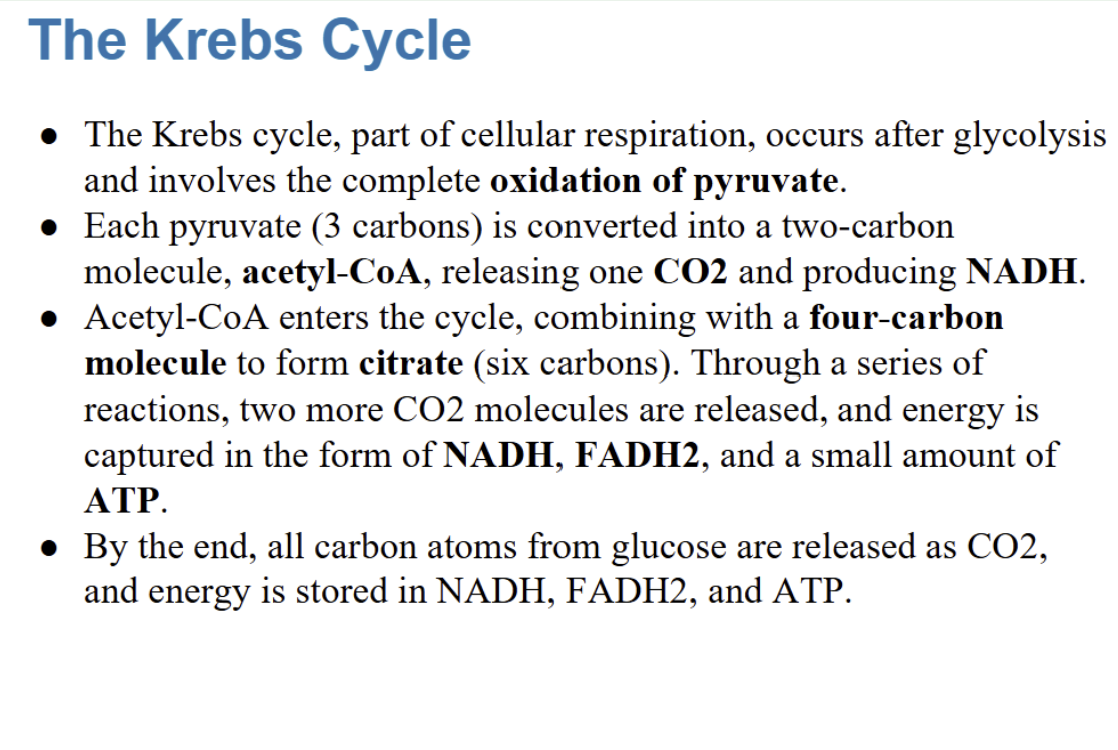
Krebs cycle
Oxidation of pyruvate
pyruvate (3C) → acetyl-CoA (2C) + 1 CO2
Enters the cycle → forms citrate with 4 Cs → more CO2 released and captured as NADH, FADH2, and lite ATP
Electron transport chain
NADH/FADH2 are oxidized & Electrons move through membrane carrier
Released energy pumps H+ across membrane
Creates proton gradient
H+ flows through an enzyme complex → ATP sythesized
Electrons + oxygen = water, generating most of the ATP

Aerobic respiration
O2 as the final electron acceptor
O2 accepts electrons + forms H2O
ETC makes most ATP
Course slide total = 38 ATP/glucose; 32 from ETC

Anaerobic respiration
Does not use O2 as final electron acceptor
Can use acceptors such as nitrate or sulfate; Usually lower ATP yield than aerobic respiration
May produce wastes such as H2S or methane
Anerobes are the microorganisms that do this
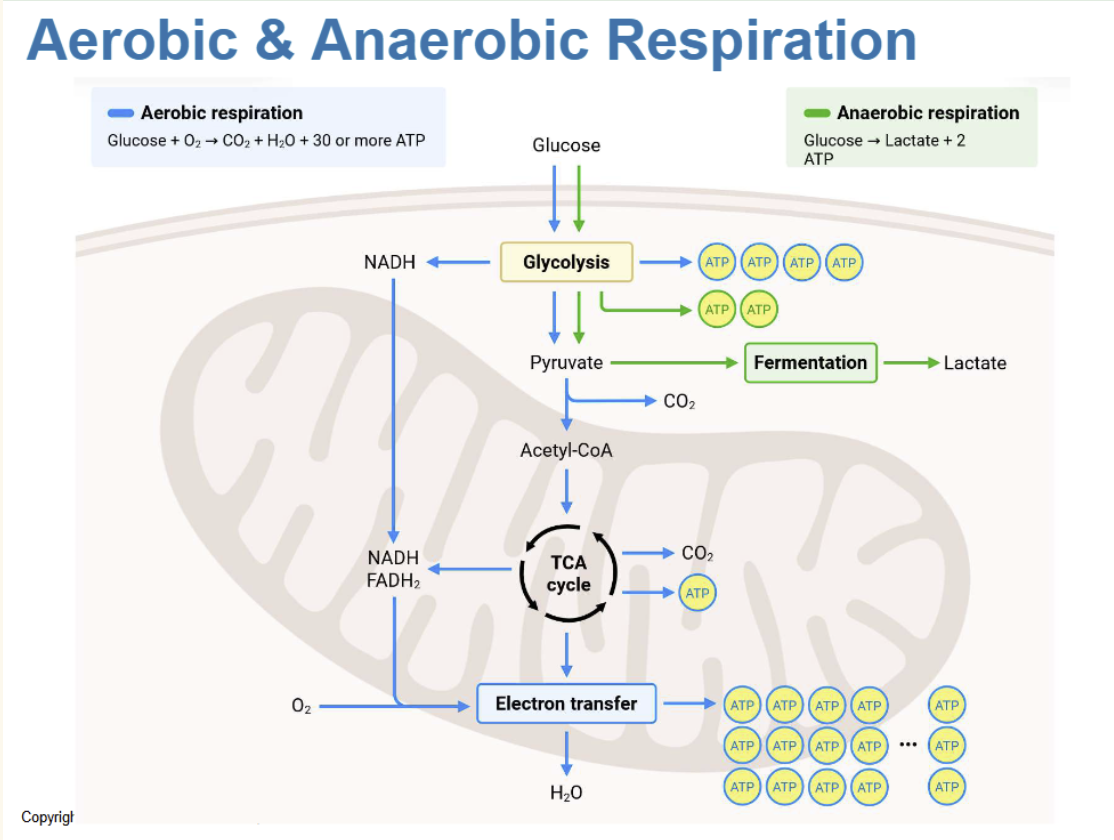
Fermentation
For cells that only use glycolysis for ATP production bc of no oxygen
pryvuate is reused to generate NAD+ for continuation
produces waste products like lactate
NAD+ regeneration lets glycolysis continue → Low ATP yield = glycolysis only
Saccharomyces cerevisiae → yeast → ethanol + CO₂ fermentation.
Heterotrophs vs autotrophs
Heterotrophs eat/absorb organic biological molecules, fungi/animal
Autotrophs make their own biological molecules from raw materials such as CO2, thru light (photo) or chem (chemo)
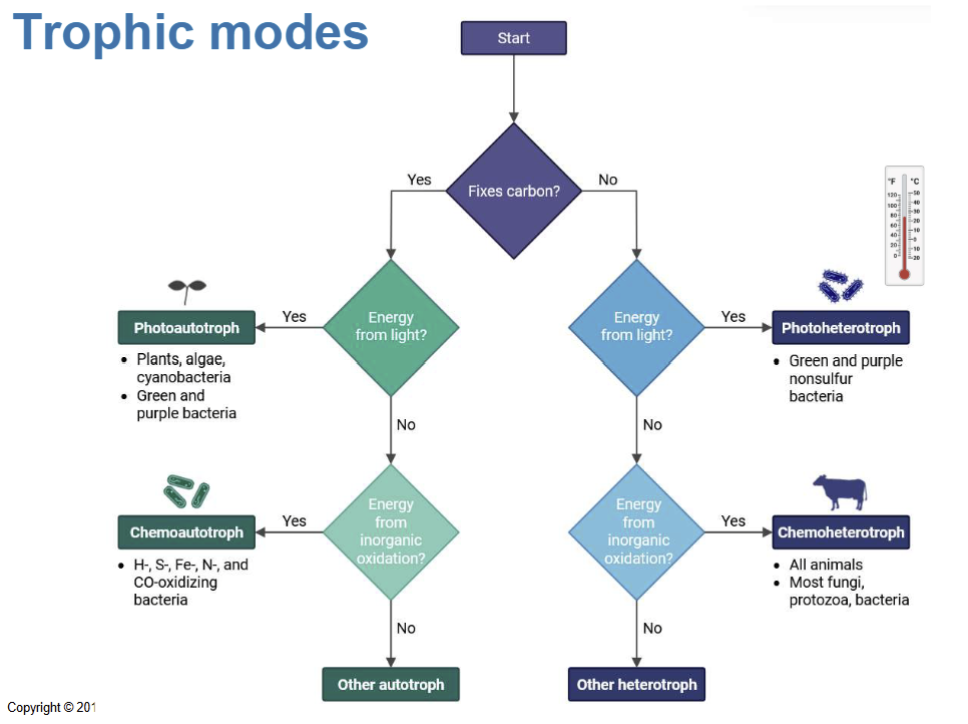
Trophic modes
Photo- = energy from light
Chemo- = energy from chemical reactions
autotroph = carbon from CO2/inorganic carbon
heterotroph = carbon from organic compounds
Phototrophic Metabolism
Sunlight used to gen atp & reduce NADP+ to NADPH to be electron and hydrogen carrier
Calvin Cycle - ATP & NADPH convert CO2 into glucose
carbon fixation - CO2 incoperated into organic materials
nadph provided electrons for carbon reduction and atp is energy
happy plants
cytoplasm for pro, chloroplast for euk
Chemoautotrophs
Use reduced chemical compounds as energy sources: ammonia, methane, hydrogen sulfide
ATP generated from oxidation of compounds
For nutrient cycling of anaerobic prokaryotic waste
Photosynthesis (?)
Endergonic synthesis of glucose/biological molecules; Light reactions use sunlight → ATP + reduced NADP+; CO2 supplies carbon; In plants/cyanobacteria, water supplies H and O2 is released
Binary fission + population calculation
1 parental cell → 2 daughter cells
Population doubles each generation → rapid population increases
N = N0 × 2^n; n = elapsed time ÷ generation time
Fastidious vs Nonfastidious organism
For ideal lab growth
Fastidious - demanding nutritional requirements like media with vitamins to grow
Nonfastidious - not demanding, not picky
Microbial growth curve
Lag = adaptation; little population increase
Log/exponential = rapid division
Stationary = new cells ≈ dying cells; nutrients limited/waste accumulates
Death/decline = deaths exceed new cells
Oxygen classes
Obligate aerobe = requires O2, catalase neutralizes harmful O compounds
Obligate anaerobe = O2 harmful/not tolerated bc they don’t have catalase
Facultative anaerobe = uses O when available (aerobic), but is anaerobic if needed
Aerotolerant anaerobe = tolerates O2 but does not use it
Microaerophile = needs lower-than-atmospheric O2
Temperature classes
Psychrophile = cold-loving
Mesophile = moderate temperature
Thermophile = high temperature
Hyperthermophile = extremely high temperature

pH classes
Acidophile = low pH/acidic <5
Neutrophile = near-neutral pH 6-8
Alkaliphile = high pH/basic 8.5
Halophiles
Microorganisms that thrive in high salt envio
Salt prevented microbial growth by dehydrating cells
Salt concentration affects water movement/osmotic stress; Different microbes have different salinity optima
Historical Microorganisms
Variola virus = smallpox → Spanish conquest/New World
Y. pestis = plague → Justinian + Black Death; rodents → fleas → humans
R. prowazekii = typhus → body louse
P. infestans = potato disease → Irish Potato Famine
Yellow fever virus → Panama Canal
C. acetobutylicum = acetone production → Weizmann
M. tuberculosis = TB → Koch
Plague of Athens = pathogen uncertain
Fermentation Microorganisms
Lactobacillus → lactic acid
Yeast / S. cerevisiae → ethanol + CO₂
Propionibacterium → propionic acid
Escherichia / Salmonella / Shigella → mixed acids