Flashcards ap bio quiz 4.4-4.5 signal transduction pathways and feedback
 Call Kai
 Learn
 Practice Test
 Spaced Repetition
 Match
 Flashcards
1/7

There's no tags or description
Looks like no tags are added yet.
8 Terms
The epinephrine signaling pathway plays a role in regulating glucose homeostasis in muscle cells. The signaling pathway is activated by the binding of epinephrine to the beta-2 adrenergic receptor. A simplified model of the epinephrine signaling pathway is represented in Figure 1.
Which of the following outcomes will most likely result from the irreversible binding of GDP to the G protein?
A
The intracellular concentration of glycogen will increase.
B
The intracellular concentration of activated protein kinase A will increase.
C
The intracellular concentration of cyclic AMP will increase.
D
The intracellular concentration of glucose-1-phosphate will increase.
A
The intracellular concentration of glycogen will increase.
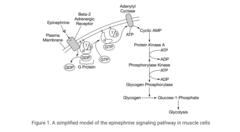
The epinephrine signaling pathway plays a role in regulating glucose homeostasis in muscle cells. The signaling pathway is activated by the binding of epinephrine to the beta-2 adrenergic receptor. A simplified model of the epinephrine signaling pathway is represented in Figure 1.
Cyclic AMP phosphodiesterase is an enzyme that catalyzes the conversion of cyclic AMP to a different molecule. Which of the following best predicts the effect of inhibiting cyclic AMP phosphodiesterase in a muscle cell stimulated by epinephrine?
A
The concentration of cyclic AMP will decrease because adenylyl cyclase will no longer be activated.
B
The G protein will diffuse out of the cell because it will no longer bind to the plasma membrane.
C
Phosphorylase kinase will remain active because protein kinase A will no longer be deactivated.
D
Glycolysis will stop because epinephrine signaling will no longer stimulate glycogen breakdown.
C
Phosphorylase kinase will remain active because protein kinase A will no longer be deactivated.

Glucocorticoids are steroid hormones that control cellular responses through several different signaling pathways. One of the signaling pathways involves the glucocorticoid receptor, an intracellular protein that is activated by binding to a glucocorticoid molecule. A simplified model of the glucocorticoid receptor signaling pathway is represented in Figure 1.
Which of the following statements best predicts the effect of a mutation that results in a loss of the glucocorticoid receptor's ligand binding function?
A
The transduction of the glucocorticoid signal across the plasma membrane will be blocked.
B
The glucocorticoid receptor will remain associated with the accessory proteins.
C
The rate of diffusion of glucocorticoid molecules into the cell will increase.
D
The concentration of glucocorticoid receptors inside the nucleus will increase.
B
The glucocorticoid receptor will remain associated with the accessory proteins.
Figure 1 shows a model of a signal transduction cascade, initiated by the binding of a ligand to the transmembrane receptor protein A.
A DNA mutation changes the shape of the extracellular domain of transmembrane receptor protein A produced by the cell. Which of the following predictions is the most likely consequence of the mutation?
A
Production of activated molecule 1 will stop, but production of activated molecules 2 and 3 will continue.
B
The molecule that normally binds to protein A will no longer attach, deactivating the cellular response.
C
The molecule that normally binds to protein A will not enter the cell, thus no cellular response will occur.
D
Since protein A is embedded in the membrane, the mutation will be silent and not affect the cellular response.
B
The molecule that normally binds to protein A will no longer attach, deactivating the cellular response.

The coagulation cascade controls blood clot formation in response to blood vessel injury. Thrombin is an enzyme that plays a key role in regulating the coagulation cascade. A simplified model of thrombin's role in regulating the coagulation cascade is represented in Figure 1.
Figure 1. A simplified model of thrombin's role in regulating the coagulation cascade
Argatroban is a competitive inhibitor of thrombin. Which of the following effects on the coagulation cascade is most likely to result from inhibiting thrombin activity with argatroban?
A
The activation of clotting factors will be blocked.
B
The rate of fibrin formation will decrease.
C
Thrombin will be converted to prothrombin.
D
The rate of blood clot formation will increase.
B
The rate of fibrin formation will decrease.

Figure 1 is a proposed model of the feedback system controlling erythrocyte (red blood cell) production.
Figure 1. Model of erythrocyte production control
Air is less dense at very high elevations, so less oxygen is available than in the denser air at sea level. Based on the model in Figure 1, if a person travels from sea level to a high elevation location, which of the following correctly predicts the response to the decreased blood oxygen level?
A
More erythropoietin will be secreted from the kidneys, decreasing production of erythrocytes.
B
More erythropoietin will be secreted from the kidneys, increasing production of erythrocytes.
C
Less erythropoietin will be secreted from the kidneys, decreasing production of erythrocytes.
D
Less erythropoietin will be secreted from the kidneys, increasing production of erythrocytes.
B
More erythropoietin will be secreted from the kidneys, increasing production of erythrocytes.
Figure 1. A model of an endocrine signaling pathway showing involved body parts and hormones. GnRH = gonadotropin-releasing hormone, LH = luteinizing hormone, and FSH = follicle-stimulating hormone.
Figure 1 shows a model of the endocrine signaling pathway that regulates ovulation. Which of the following observations would provide evidence of a positive feedback mechanism in this system?
A
Estrogen from the ovaries inhibits the release of GnRH from the hypothalamus.
B
Progesterone from the ovaries stimulates the thickening of the uterine lining.
C
Progesterone from the ovaries inhibits the release of LH and FSH from the anterior pituitary.
D
Estrogen from the ovaries stimulates the hypothalamus and anterior pituitary to secrete more GnRH, LH, and FSH.
D
Estrogen from the ovaries stimulates the hypothalamus and anterior pituitary to secrete more GnRH, LH, and FSH.
Melanocytes are skin cells that can become cancerous and develop into a cancer known as melanoma. Some cancerous melanocytes have developed resistance to the drugs currently used to treat melanoma. As a result, researchers are investigating the effects of a new compound (drug X) on four different melanoma cell lines. Researchers analyzed cell survival in two cell lines (Figure 1) and oxygen consumption in the presence of drug X in all four cell lines (Figure 2). Figure 3 shows the proposed mechanism by which drug X affects cells.
Figure 1. Percent survival of normal melanocytes and cancerous melanocyte (melanoma) lines 1 and 2 after treatment with different concentrations of drug X
Figure 2. Oxygen consumption per cell in four melanoma lines after treatment with either solvent alone or solvent containing drug X. Error bars represent ±2SEx¯.
Figure 3. Pathway leading to cell survival, growth, and proliferation and the likely effect of drug X
A researcher has identified a compound that reverses the effect of drug X. Based on Figure 3, which of the following best explains how the compound acts in the pathway to reverse the effects of drug X?
A
B
C
D
C