Week 10b — Dual Process Model (Nov 11)
 Call Kai
 Learn
 Practice Test
 Spaced Repetition
 Match
 Flashcards
 Knowt Play
1/29

There's no tags or description
Looks like no tags are added yet.
30 Terms
What is the difference between Type 1 and Type 2 processing?
Type 1 is fast, automatic, low-effort, low-working-memory processing — intuitive and associative, based on prior knowledge — while Type 2 is slow, controlled, effortful, deliberative, and rule-based, with greater working-memory demand.
Can Type 1 and Type 2 both be right and both be wrong?
Yes — Type 2 doesn't guarantee the right answer and Type 1 isn't necessarily wrong; they can operate together, with one monitoring or overriding the other.
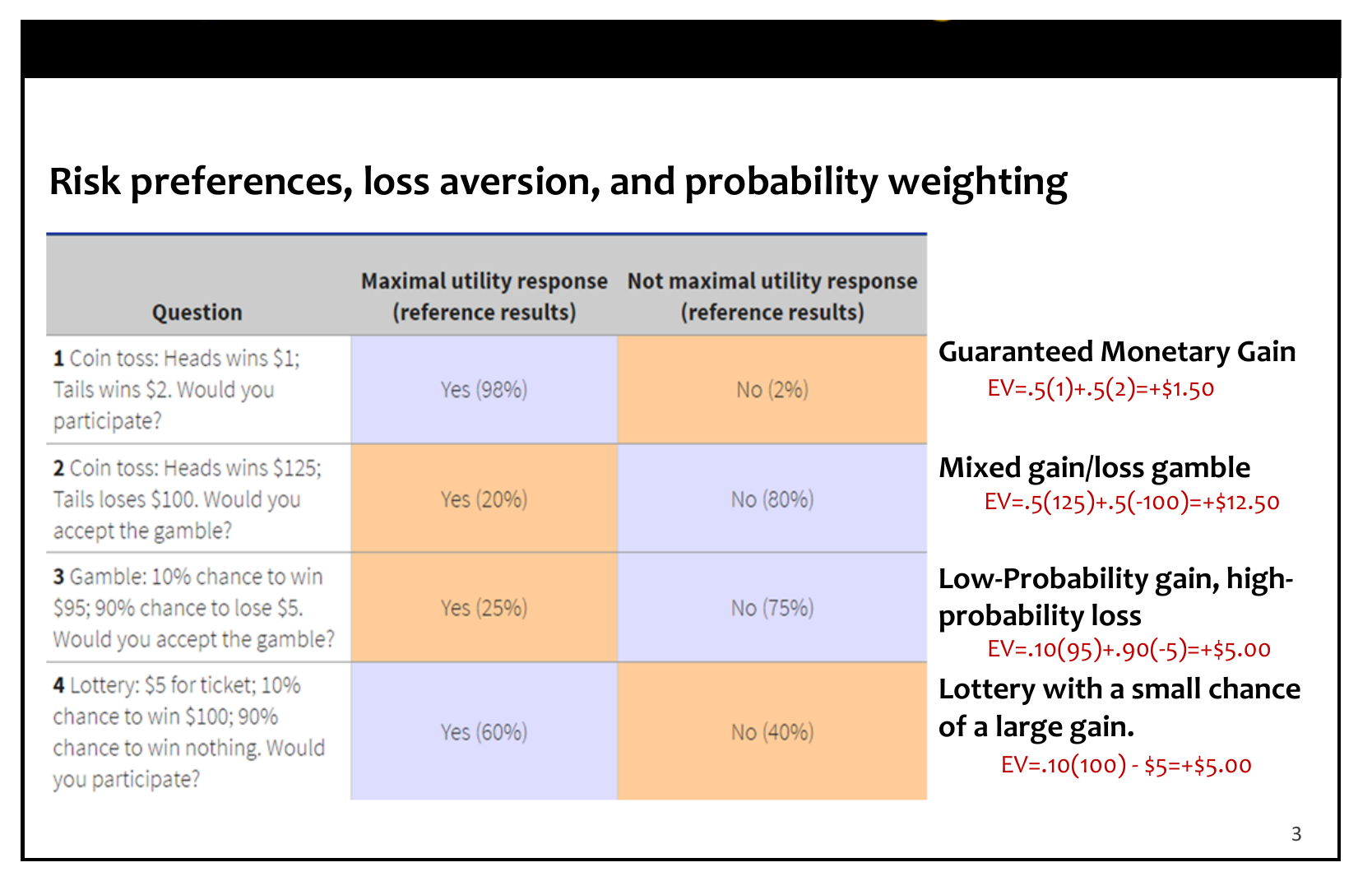
What is Gamble 1 in the decision-making activity, and what does it show? [Figure: gamble-table.png]
"Coin toss: heads you win $1, tails you win $2. Would you participate?" Expected value = .5(1) + .5(2) = +$1.50. Yes: 98%, No: 2%. The rational choice is yes — a guaranteed monetary gain, and almost everyone says yes.
What is Gamble 2 in the decision-making activity, and what does it show? [Figure: gamble-table.png]
Coin toss: heads you win $125, tails you lose $100 (EV +$12.50) — yet only 20% said yes, because loss aversion makes the $100 loss loom larger than the $125 gain.

What is the comparison of Gambles 3 and 4, and what does it show? [Figure: gamble-table.png]
Gambles 3 (10% win $95, 90% lose $5) and 4 ($5 lottery ticket, 10% win $100) share EV +$5.00, yet acceptance was 25% vs 60% — probability weighting and framing make a small chance of a big gain attractive but a loss unattractive.
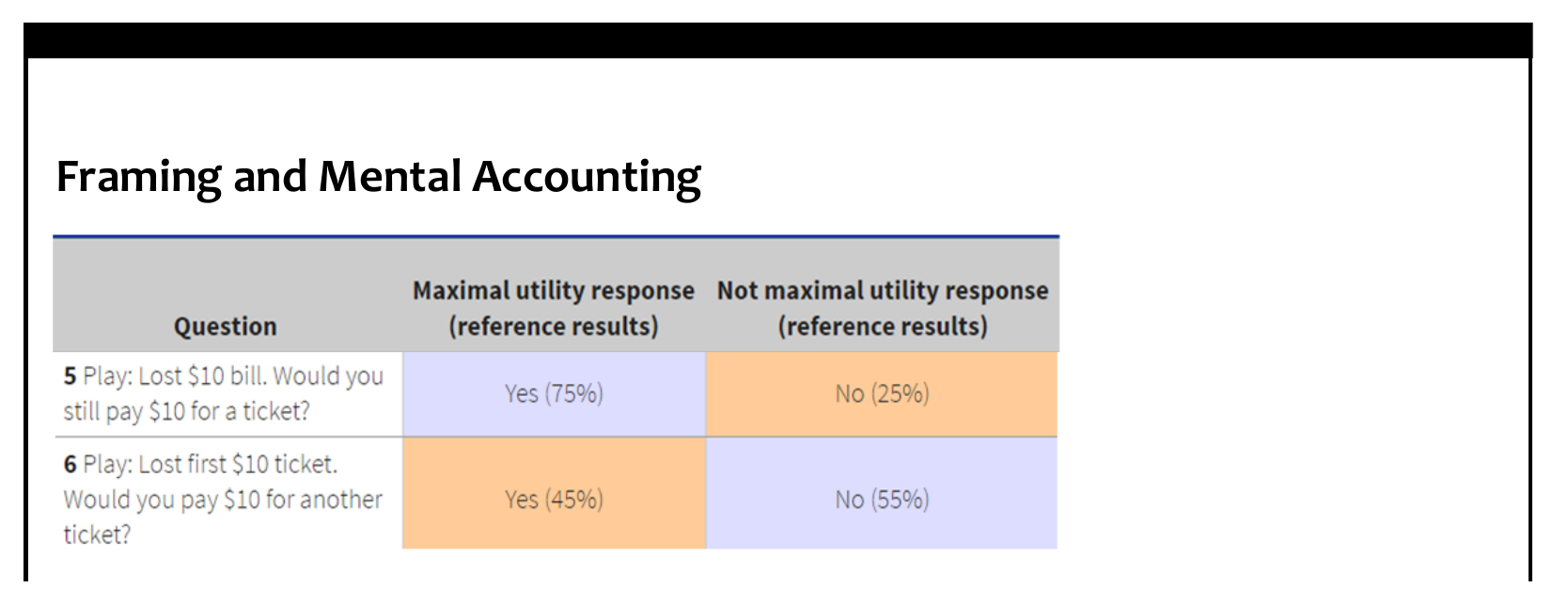
What is mental accounting, and what do Questions 5 and 6 show? [Figure: mental-accounting-table.png]
Mental accounting is keeping separate mental accounts for different kinds of money — 75% would still buy a $10 ticket after losing a $10 bill, but only 45% would after losing a $10 ticket, though both leave you $20 down.
What is the redwood anchoring example, and what did Festa say about it?
With a 1,200-foot anchor, 90% said the tallest redwood is shorter; with a 400-foot anchor, 60% said taller — the anchor pulls estimates, though Festa said this 'doesn't quite do the job' since the anchors seem plausible, not arbitrary.
What is the K-words availability example, and how does it differ from the Kristen representativeness example?
Asked whether more words start with K or have K third, 90% said start with K — K-initial words come to mind easily (availability) — while Kristen (85% picking bank teller + liberal Democrat) is representativeness; both are attribute substitution.
What is the difference between inductive and deductive reasoning?
Inductive reasoning builds a probable generalization from observations (not guaranteed — other explanations may hold), while deductive reasoning reaches a conclusion that MUST be true if the premises are true.
What is the syllogism example, and why do 70–90% of people endorse it?
'All P are M, all S are M, therefore all S are P' is NOT valid — students and nurses are human, but not all nurses are students — yet 70–90% endorse it because it matches prior beliefs.
What did the Tom example show about intuitive vs. analytical reasoning?
People pick the intuitive answer (Tom is an engineer) because resemblance is salient, but analytical reasoning engages when the conflict is apparent — presenting the base rates (90 lawyers vs 10 engineers) alongside the description makes people notice it.
When are people most likely to engage in analytical (Type 2) reasoning?
Type 2 reasoning is most likely with (1) time and resources, (2) relevant knowledge, (3) a presentation that reveals the conflict, and (4) motivation to notice the intuitive response may be wrong.
How can background knowledge increase attention to base rates?
If a base rate is surprising or personally relevant, it gets noticed and used — background knowledge makes it salient, like being shocked that only 30% pass the orgo exam.
What did the island generalization study show?
People needed the most samples to generalize a property to humans (3 samples only ~20% confidence), the fewest for a mineral (1 sample, near 100%), with birds in between — low-variability categories generalize from one instance, high-variability ones need many.
What does the one-meal restaurant example show about sampling?
No — one randomly chosen meal is unreliable evidence, because a random sample may not be representative, so you need more observations before generalizing.
Why are frequency formats easier to reason about than probability formats?
"10 out of 1,000" is easier to use than "1%" — frequencies present the numerator and denominator explicitly, making the base rate concrete. Probability formats let the base rate stay abstract and easy to ignore.

What did the statistics-training study (Fong & Nisbett 1991) show about transfer of training? [Figure: training-transfer-graph.png]
Statistics training improved statistical reasoning and the improvement transferred — same-domain problems stayed improved at a delayed test (~1.77 → ~1.74), different-domain problems faded (~1.74 → ~1.56), and an untrained control scored lowest (~1.45).
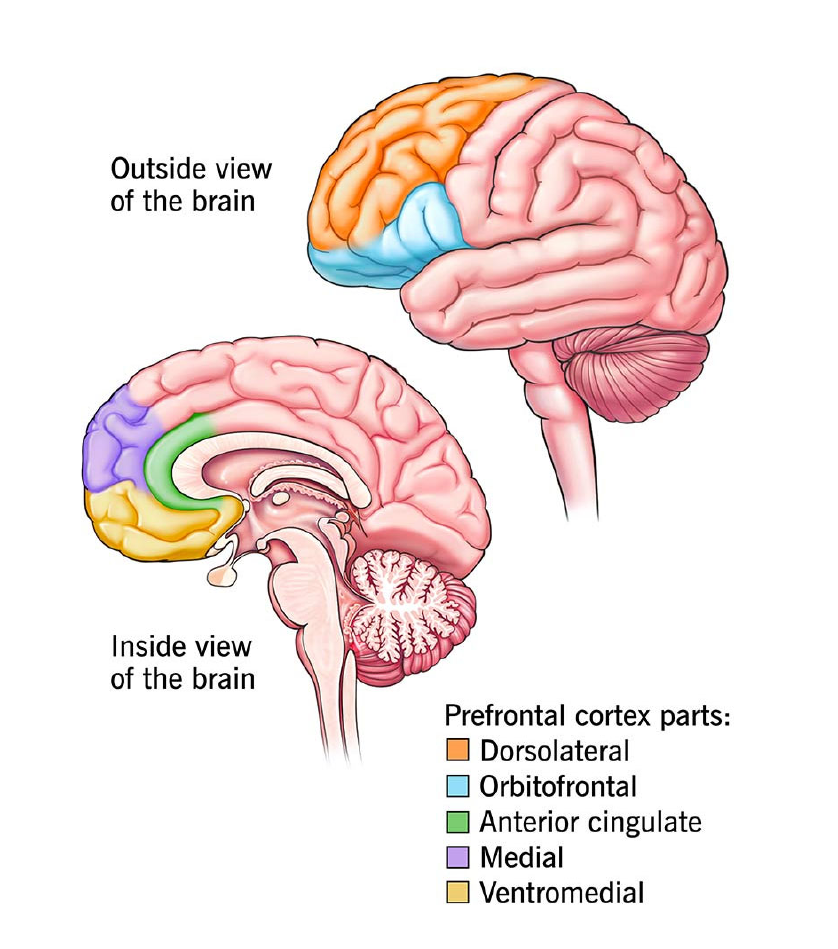
What are the roles of the orbitofrontal cortex (OFC) and ventromedial prefrontal cortex (vmPFC) in decision making? [Figure: pfc-brain.png]
The OFC detects and interprets emotional information. The vmPFC integrates that information about outcomes into subsequent decision-making behavior. Other prefrontal parts: dorsolateral (planning/executive control), anterior cingulate, and medial PFC.
What was the DiMarzio (Damasio) case?
After surgery removed a tumor in his orbital frontal area, a man lost emotional processing (no skin conductance response to emotional stimuli) and became hopelessly indecisive — suggesting affective 'gut' responses are necessary for adaptive decision making.
What was the design of Bechara et al. (1997), the Iowa Gambling Task?
6 vmPFC patients and 10 controls got $2,000 play money for 100 picks from four decks — two 'bad' (big wins, bigger losses) and two 'good' (net gain) — tracking deck choices, anticipatory skin conductance, and self-reported knowledge every 10 choices through pre-punishment, pre-hunch, hunch, and conceptual periods.

What did Bechara et al. (1997) find? [Figure: bechara-results.png]
Controls increasingly chose good decks with rising anticipatory skin conductance before bad-deck picks, while patients kept choosing bad decks with no anticipatory SCR signal — even though many could name the good decks — so adaptive decisions need vmPFC somatic signals, not explicit knowledge alone.
What did Goel & Dolan (2003) find about the neural basis of deductive reasoning?
Belief-based reasoning activated the left temporal lobe, belief-neutral reasoning activated bilateral parietal areas, correctly inhibiting a prepotent response activated lateral PFC, and incorrect answers showed vmPFC (affective) activity.
What was the design of De Neys & Goel (2011)?
Four trial types combining a stereotype with a base rate: congruent (5 Swedes, 995 Italians; soccer, pizza/pasta → Italian), incongruent (5 men, 995 women; engineering degree, loud-music nights → woman), neutral heuristic (5 Bush, 995 Kerry campaigners; base rate only), and neutral analytic (500 40-year-olds, 500 17-year-olds; stereotype only → 17).

What did De Neys & Goel (2011) find behaviorally? [Figure: deneys-behavior-table.png]
Accuracy was 88–93% for neutral and congruent trials but only 45% for incongruent trials, which were slowest (3,553 ms vs ~3,000 ms) — when stereotype conflicted with base rate, people followed the stereotype and Type 2 failed to override it.

What did De Neys & Goel (2011) find neurally? [Figure: deneys-brain-rois.png]
Type 2 (analytic) processing activated bilateral parietal ROIs (blue), and Type 1 (heuristic) processing activated left temporal ROIs (orange/green) — consistent with Goel & Dolan (2003): belief-based reasoning recruits temporal areas, belief-neutral/analytic reasoning recruits parietal areas.

What is the Wason selection task, and what is the correct answer? [Figure: wason-cards.png]
With rule 'vowel means even number' and cards A, 6, J, 7, turn over A and 7 — only an odd number with a vowel violates it — yet a third say only A and many pick A + 6, testing confirming rather than disconfirming cases.
What is the Wason 2-4-6 task?
Given 2, 4, 6, people test confirming sequences assuming the rule is 'add 2,' but the rule is 'ascending numbers' — a disconfirming test like 10, 10, 10 would have falsified it, showing people seek confirming rather than disconfirming evidence.
What is belief perseverance, and what did Ross et al. (1975) show?
Belief perseverance is clinging to a belief after its evidence is discredited — in Ross (1975), students got random 'good'/'bad judge' feedback on rating suicide notes, were told it was arbitrary, yet 'bad judges' still rated low and 'good judges' high on social sensitivity.
What are the five manifestations of confirmation bias?
(1) Seeking only confirming evidence; (2) failing to use disconfirming evidence; (3) taking confirming evidence at face value but reinterpreting disconfirming evidence; (4) having a better memory for confirming evidence; (5) failing to consider alternative hypotheses.
What four factors determine how we make decisions?
(1) Available information: probability, context, previous experience. (2) Affective processes: reward, punishment, anticipated emotion. (3) Cognitive processes: intuition, deliberation, executive control. (4) Prior beliefs: expectations, biases, personal knowledge