Ecosystem and Living Organism
 Call Kai
 Learn
 Practice Test
 Spaced Repetition
 Match
 Flashcards
 Knowt Play
1/54

There's no tags or description
Looks like no tags are added yet.
55 Terms
Ecosystem
A system consisting of biotic
and abiotic components that
function together as a unit.
Biotic components
include all the living things
Abiotic components
are the non-living things
biotic components
abiotic components
Major Components of an Ecosystem
Eukaryotes
Prokaryotes
2 major types of living things
Eukaryotes
characterized by having
membrane-bound organelles (such
as a nucleus) inside their cells.
Examples:
plants, animals, fungi, and protists.
Prokaryotes
are those lacking
membrane- bound organelles.
Examples:
Bacteria and archaea represent the
prokaryotes.
Abiotic components
include all the non-living
things such as rocks, soil,
minerals, water sources, and
the local atmosphere.
Examples:
- elements and compounds serve
as sources of nutrients.
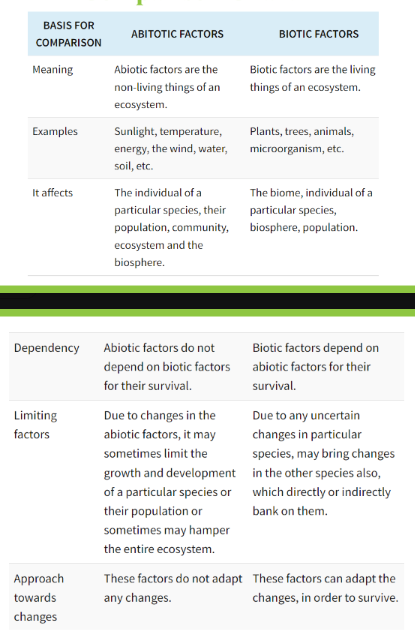
Comparison Chart
Biotic factors
fungi
plants
protists
animals
archaea
bacteria
Abiotic factors
air
salinity
soil
temperature
light
water
minerals
pH
humidity
Terrestrial Ecosystem
Freshwater Ecosystem
Marine Ecosystem
Artificial Ecosystem
Types of Ecosystem
Terrestrial Ecosystem
one that occurs on land.
Forest ecosystem
Grassland ecosystem
Tundra ecosystem
Desert ecosystem
Examples of land-based ecosystems
Forest ecosystem
consists of various plants, particularly trees.
Grassland ecosystem
typically found in tropical or temperate regions.
Tundra ecosystem
characterized as being treeless and snow-covered.
Desert ecosystem
the ones occurring in desert habitats.
Freshwater ecosystem
the aquatic ecosystems that
do not contain saltwater.
Lentic ecosystem
Lotic ecosystem
2 major types of Freshwater ecosystem
Lentic ecosystem
refers to
ecosystems in still waters.
Examples: ponds, puddles, and lakes
Lotic ecosystem
an aquatic
ecosystem characterized by a freshwater
habitat that is freely flowing.
Examples: rivers and streams
Marine ecosystem
- an aquatic ecosystem that contains saltwater.
- the most abundant type of ecosystem in the world.
Examples:
ecosystems in the seas and
oceans
Artificial ecosystem
- a man-made system, which can be further classified as
terrestrial, freshwater, or marine.
Examples: terrarium
Producers (Autotrophs)
Makes their own food using energy from the sun.
Consumers (Heterotrophs)
Consumes other organisms to gain energy
Primary Consumers (Herbivores)
Secondary Consumers (Carnivores)
Tertiary Consumers (Apex Predators)
3 classified groups of consumer
Primary Consumers (Herbivores)
Eat producers (e.g. grasshoppers)
Secondary Consumers (Carnivores)
Eat primary consumers (e.g. rabbits)
Tertiary Consumers (Apex Predators)
At the top of the chain, eat secondary consumers (e.g. tigers)
Decomposers (Detrivores)
Break down dead organisms and return nutrients to the ecosystem.
Trophic level
- refers to a level or a position in a food
chain, a food web, or an ecological
pyramid.
Autotrophs
Heterotrophs
The trophic levels have two major categories:
Autotrophs
organisms that can
produce organic matter from
inorganic matter.
- they are also referred to as the
producers of an ecosystem.
Heterotrophs
- organisms that obtain organic
matter directly by
consumption.
- they do not have the ability to manufacture their
food from inorganic sources.
- referred to as the consumers.
- they may be further grouped into primary
consumers, secondary consumers, tertiary
consumers, and so on.
Food Web
Complex networks of interconnected food chains, depicting the various feeding relationship within an ecosystem.
Food Chains
These are like small pictures that only show one animal eating another (e.g. plant → rabbit → fox)
Food Webs
This is the big picture that shows many animals and plants connected by who eats who (e.g. grass eaten by rabbits, mice, and insects; rabbits eaten by foxes and owls)
Homeostasis
Cells
Metabolism
Growth
Adaptation
Reproduction
What keeps organisms alive?
Food
Water
Shelter
Space
Examples of things that keep organisms
alive include:
- Ecologists study ecosystems through research,
of which there are three main methods.
How do scientists study ecosystems?
Observation
Modeling
Experimentation
Examples of how scientists
study ecosystems:
Observation
Scientists observe
ecosystems by watching the natural world
using their eyes.
Modeling
Scientists use models to
simulate ecosystems and test hypotheses
about how they work.
Experimentation
Scientists conduct
experiments to test hypotheses about how
ecosystems work.
Competition
Predation
Symbiosis
Mutualism
Parasitism
Commensalism
Types of Species Interactions
Competition
Struggle to compete for same limiting resources such as foods, water, and territory
Intra-specific competition
Competition of same kind of species in a particular resources.
Inter-specific competition
Relationship that shows the interaction between two different species competing for the same particular resources.
Competitive exclusion principle
Two different species cannot share the same resource in the same condition; one will always be excluded from the resource if it has a competitive disadvantage.
Predation
The predator survives by feeding the prey
Mutualism
Refers to the relationship wherein both of them are beneficial
Parasitism
Inter relationship where organism live in the expense of the host
Commensalism
A symbiotic relationship in which other organism is benefitted and the other is neither benefit nor harm
Herbivory
Relationship in which organism feed only on plants