Biol 2110 Chapter 12-13: Neurons and Synapses
 Call Kai
 Learn
Learn Practice Test
 Spaced Repetition
 Match
Match Flashcards
1/48

There's no tags or description
Looks like no tags are added yet.
Name | Mastery | Learn | Test | Matching | Spaced | Call with Kai | Chat |
|---|
No analytics yet
Send a link to your students to track their progress
49 Terms
What are the similarities between the nervous system and endocrine system?
Both are specialized for control and coordination to ensure smooth and coordinated function of organisms
Nervous system functions
Initiates responses rapidly
Short-duration responses
Acts via action potentials and neurotransmitters
Acts at specific locations determined by axon pathways
Nuerotranmitters act over short-distances
Endocrine system function
Initiates responses slowly
Long-duration responses
Acts via hormones released into blood
Acts at diffuse locations (targets can be anywhere blood reaches)
Hormones act over long-distances
Neuronal signalling and hormonal signalling
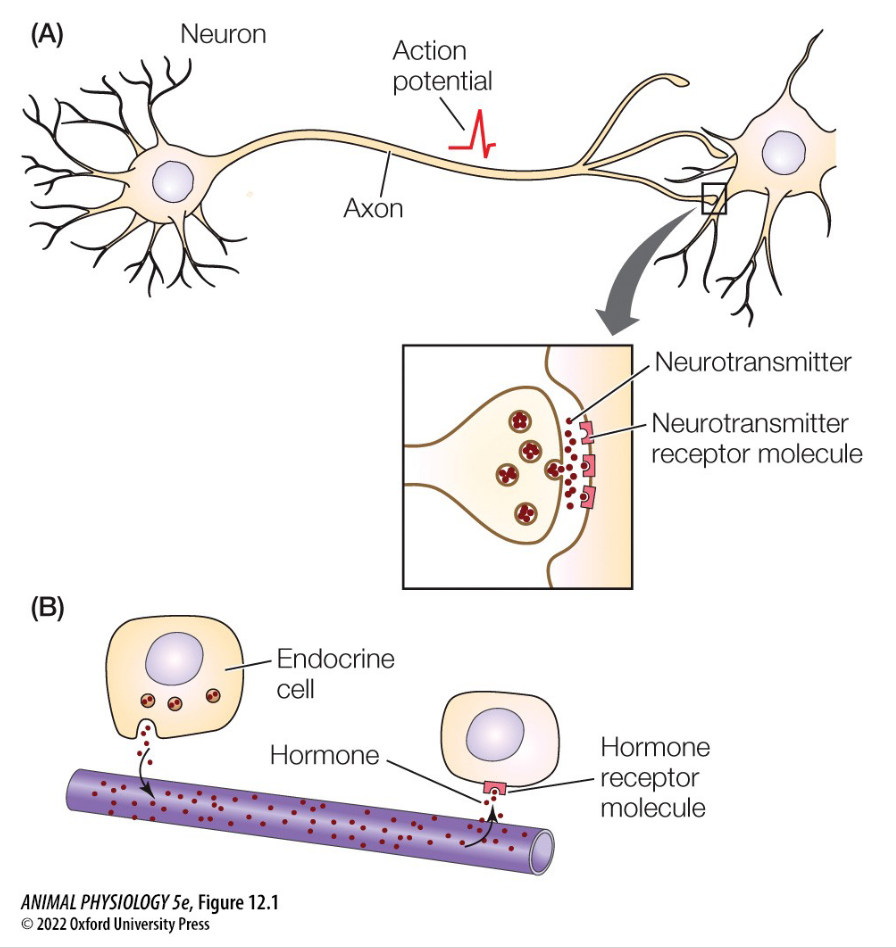
What are the 4 basic parts of a neuron?
Dendrites, cell body, axon and presynaptic terminal
What are the four functional properties of neurons?
Synaptic input (dendrites)
Integration of synaptic potentials (cell body)
Conduction of action potentials (axon)
Synaptic output (presynaptic terminal)

Structural classifications of neurons
Unipolar, bipolar and multipolar

Functional classifications of neurons
Sensory (afferent) neurons
Interneurons (association neurons)
Motor (efferent) neurons

Sensory neurons
Relay sensory signals from PNS to CNS for integration
Interneurons
Exclusively in CNS, between sensory and motor neurons.
Shuttle signals through CNS pathways for integration
Motor neurons
convey motor from CNS to PNS to appropiate effectors (muscles and glands)
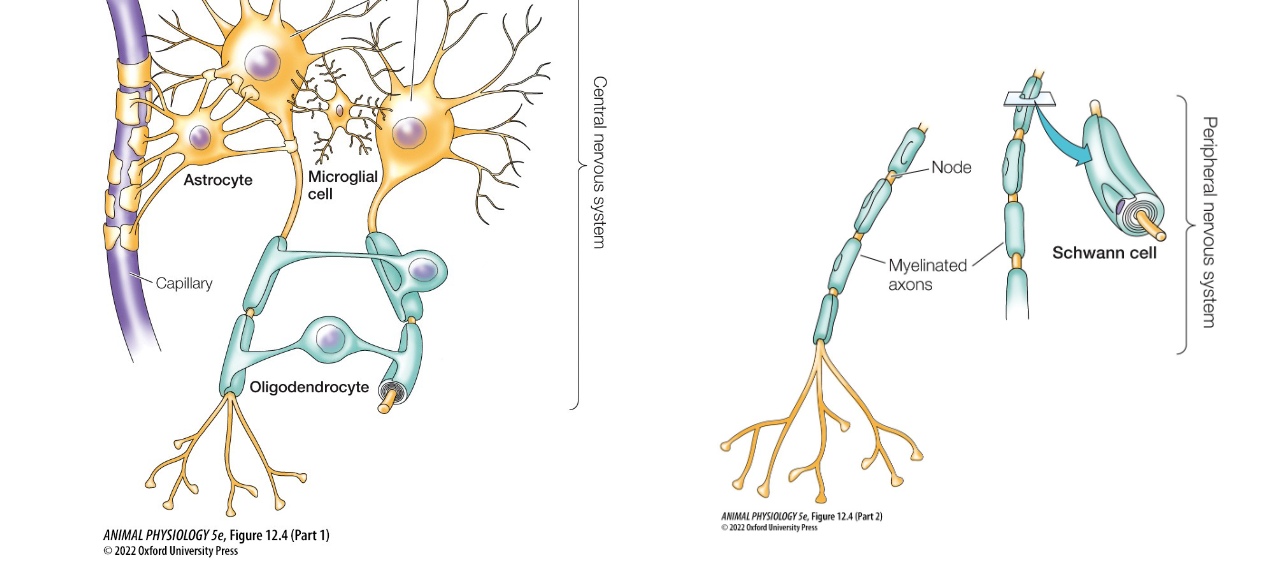
Glial cells
Supportive cells of neurons
Membrane potential
Voltage across plasma membrane
Resting membrane potential
Electrical potential difference across the plasma membrane in a non-excited
Ion channels
Cause changes in membrane permeability, as ions can flow in/out and RMP can change
Ligand-gated channel
ion channel that opens/closes in response to specific ligand stimulus
mechanically gated channel
Ion channels that open/close in response to mechanical stimulation (touch, pressure, tissue stretching, vibration)
voltage-gated channel
Ion channel that opens in response to change in membrane potential
Determinants of resting membrane potential
Unequal distribution of ions in ECF and cytosol
Differences in membrane permeability
Action of Na+/K+ ATPase (maintains high intracellular K+ and extracellular Na+)
In a K+ only cell, how is membrane potential maintained?
K+ flows out, K+ electrical gradient increases
K+ flows back into cell, the electrical
gradient and concentration gradient
would be equal (equilibrium potential)
equilibrium potential close to typical RMP
In a Na+ only cell, how is membrane potential maintained?
Na+ flows in, Na+ electrical gradient increases
Na+ flows back out of cell, the electrical
gradient and concentration gradient
would be equal (equilibrium potential)
equilibrium potential not close to typical RMP
Graded potential
Small deviation from RMP, graded due to amplitude depending on stimulus strength
Can result in hyperpolarizing or depolarizing

What is the basic mechanism of a graded potential?
Neurotransmitter binds to ligand-gated Na+ channel
Na+ enters cell through channel, and current spreads through. cell
Strength of signal decreases with distance
Why does the current spread in graded potentials?
Positive ions attracted to negative ions, causing spread from initial site
Why do graded potentials decrease with distance?
Resistance in cytoplasm, leak channels and membrane properties
In addition to ligand binding, what else triggers graded potentials?
Mechanical deformation in mechanically-gated ion channels
Light energy activating GPCR in photoreceptor cells
What is the main difference between graded and action potential?
Graded potentials decrease with distance while action potentials maintain their amplitude over long distances.
What are the three phases of action potentials?
Depolarizing, Repolarizing, After-hyperpolarizing
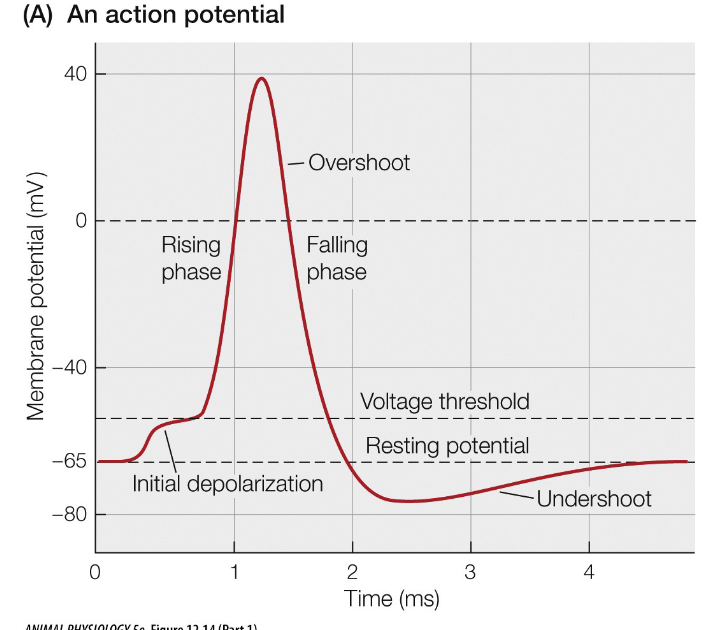
Shape, magnitude or duration of each AP reflects…?
Type and distribution of ion channels in membrane
Specialized function of cell
Spatial summtion
Graded potentials occur from different sites, then summate at axon hillock
Can result in action potential if both stimuli are polarizing and reaching threshold, but also could cancel each other out

Temporal summation
Graded potentials can occur
from the same site but with increased frequency of stimuli and then summate at the axon hillock
Occurence of action potential depends on sum of graded potentials reaching threshold at the axon hillock
Resting state
Na and K channels closed, RMP
Depolarizing/Rising phase
Membrane potential reaches threshold, Na channel opens. As Na moves in, membrane becomes depolarized
Repolarization/Falling stage
Na inactivation gate close, K channels open. As K leaves, the membrane starts to repolarize towards RMP.
Na activation gates close and inactivation gate opens, K gates close, and RMP is restored.
Conduction velocity of AP is influenced by..?
Axon diameter
Myelination of axon
Temperature
Myelin sheath function
Increases speed of conduction, insulates axon
How does myelin speed up conduction?
Prevents ions from leaking out as charge spreads through axon
Charge spreads unimpeded until reaching node of Ranvier
Signals continue to jump down the axon
How does axon diameter affect conduction velocity?
Large diameter axons conduct action potentials more rapidly, due to longer length constants, thus a more distant spread of local currents
How does temperature affect conduction velocity?
Higher temperatures increase conduction velocity, as the gating kinetics of voltage-gated ion channels are temperature-dependent
Synapse
Point at which one neuron communicates with another neuron, or target tissue (skeletal muscle)
What are the two types of synapses?
Electrical synapse
Chemical synapse
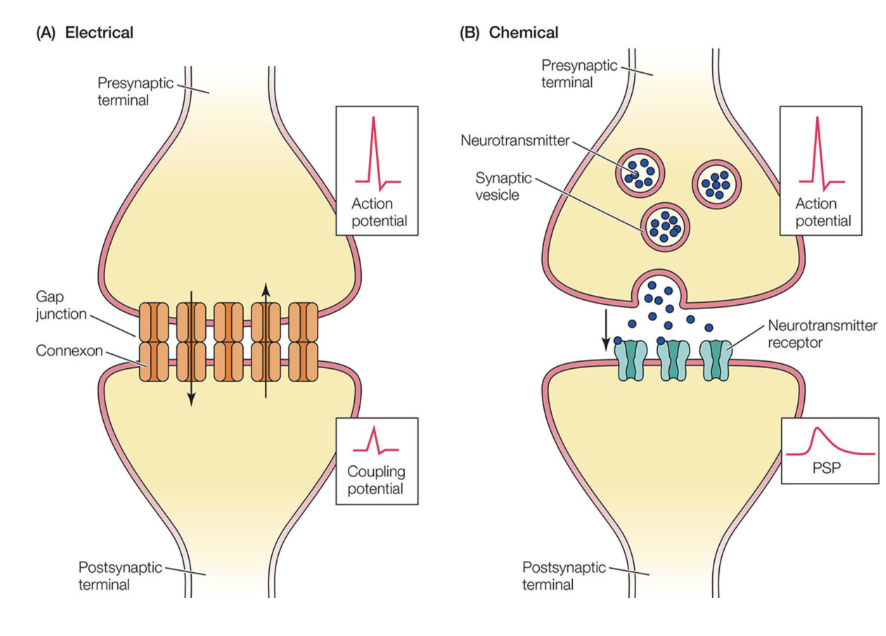
Summarize events of chemical synaptic transmission
Action potential reaches the axon terminal, Ca2+ ions flow into presynaptic terminal, triggering the release of neurotransmitters from synaptic vesicles into the synaptic cleft.
Neurotransmitters bind to receptors on the postsynaptic membrane, leading to depolarization or hyperpolarization of the postsynaptic neuron.
Excitatory postsynaptic potentials
Increased likelihood of an action potential in the postsynaptic neuron due to the binding of neurotransmitters, causing depolarization.
Inhibitory postsynaptic potentials
Decreased likelihood of an action potential in the postsynaptic neuron due to the binding of neurotransmitters, causing hyperpolarization.
Signal transmission at the
neuromuscular junction

End plate potential is a..?
Graded potential
Microglia function
Mediate immune responses in neural tissue, consume pathogens and cell debris
Astrocytes
Take up neurotransmitters from extracellular space, help supply metabolic substrates to neurons
Compare and contrast Electric synapse and Chemical Synapse
Chemical synapses are either excitatory or inhibitory, while electrical synapses are nearly always excitatory
Chemical synapses are one-way, while electrical synapses are two-way
Chemical synapses are more modifiable (use makes them stronger, disuse makes them weaker) in their properties than electric synapses