Single Gene Disorders
 Call Kai
 Learn
Learn Practice Test
 Spaced Repetition
 Match
Match Flashcards
 Knowt Play
1/57

There's no tags or description
Looks like no tags are added yet.
Name | Mastery | Learn | Test | Matching | Spaced | Call with Kai | Chat |
|---|
No analytics yet
Send a link to your students to track their progress
58 Terms

square
male

circle
female

diamond
sex unstated

unfilled symbol
unaffected

filled symbol
affected

symbol with dot in middle
obligate carrier (who will not manifest disease)

symbol with line inside
carrier who may go on to manifest disease
symbol with strike through
deceased


symbols connected with straight line
mating

symbols connected with two lines
consanguineous mating

symbols connected with bracket
siblings

symbols connected by pointed bracket
twins

symbols connected by triangle
identical twins

diamond with 4 inside
four children, sex unstated

triangle
spontaneous abortion

filled triangle with strike through
termination of affected pregnancy
pedigree
graphical representation of a family tree that uses standard symbols
sibship
a series of brothers and sisters
probrand
the affected individual through whom a family with the genetic disorder comes to medical attention
generations
1^0: parent and child; sibs
2^0: grandparent and grandchild; uncle/aunt and nephew/niece; half-sibs
3^0: first cousins
dominant, recessive
When a human monogenic disorder (or trait) is determined by a nuclear gene, the disorder (or trait) is said to be ______ if it is manifested in the heterozygote (who carries a normal allele and a mutant allele), or _____ if it is not
5 basic Mendelian inheritance patterns
Autosomal dominant
Autosomal recessive
X linked dominant
X linked recessive
Y linked
dominant conditions
50% chance
(assuming parent is heterozygous dominant)
recessive conditions
25% chance
(assuming both parents are carriers)
NO
__ male to male transmission in X linked diseases
male is not an X carrier because there is no normal copy
autosomal dominant
only one abnormal gene copy is required for the individual to be affected

autosomal dominant pedigree
Both sexes are affected and may transmit the gene to the offspring of either sex
When an affected person has children with an unaffected person, each child would normally have a 50% chance of developing the disease
autosomal recessive
two mutant alleles are required (one from each parent) at the disease locus
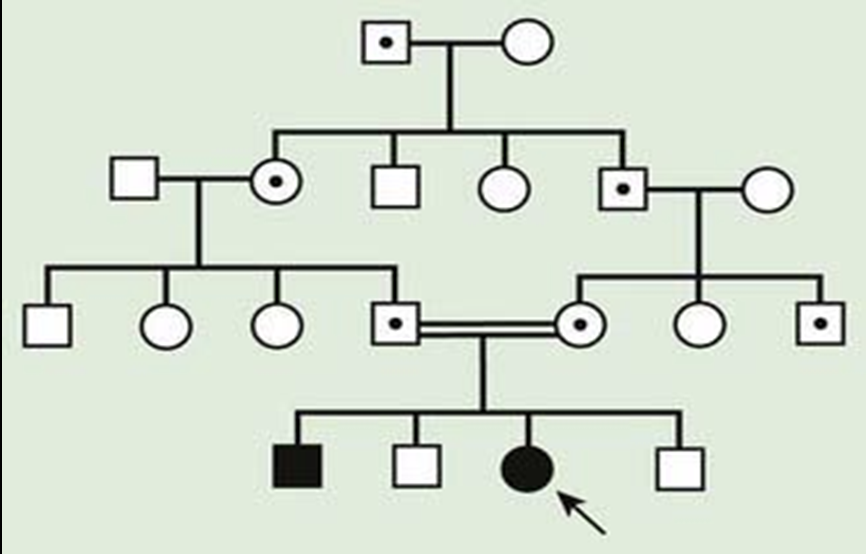
autosomal recessive pedigree
a person affected can be of either sex and is usually born to unaffected parents (heterozygotes – asymptomatic carriers)
the chance that each future child born the carrier parent is also affected is 25%
consanguinity
Couples who have one or more recent ancestors in common are said to be consanguineous
A feature of many recessive disorders, especially rare conditions, is that affected individuals often have two identical mutant alleles because the parents are close relatives; such couples are said to be consanguineous
X linked inheritance
Most whole-autosome aneuploidies are incompatible with survival, except trisomies 13, 18, and 21 – can result in live birth; also several sex-chromosome aneuploidies, including 45, X, 47, XXX, and 47,XXY – problems with gene dosage
Most of the very few genes on the Y chromosome have male specific functions, or they have an equivalent gene copy on the X
X inactivation
a mechanism to compensate for having different numbers of X chromosomes in males in females
stage it occurs: Initiated after a cellular mechanism counts the number of X chromosomes in each cell of the early embryo
If the number of X chromosomes is two (or more), all except one is randomly inactivated (only in somatic cells) à induced to form a transcriptionally inactive Barr body
X linked dominant inheritance
Affected individuals can be of either sex and at least one parent is affected
There are significantly more affected females than affected males
Affected females typically have milder (but more variable) expression than affected males
Excess of affected females – because there is no-male-to-male transmission of the disorder

X linked dominant pedigree
All children born to an affected mother (and unaffected father) have a 50% chance of being affected
An affected father with a single X chromosome will consistently have unaffected sons (they do not inherit this X chromosome); But his daughters will always be at risk (they will always in inherit his affected X)

X linked recessive pedigree
Affected individuals are mostly male, and affected males are often born to heterozygous carrier mothers and unaffected mothers
There is no father to son transmission
A distinguishing feature is that there is no male to male transmission because males pass a Y chromosome to sons

Matrilineal inheritance
Tissues that have a high energy requirement (ex. Muscle and brain) are primarily affected in mtDNA disorders
The sperm does not contribute mtDNA to the zygote, but the paternal mtDNA is destroyed in the very early embryo
Inheritance occurs exclusively through the mother (matrilineal inheritance)
Individuals with a mitochondrial DNA disorder can be of either sex, but affected males do not transmit the condition to any of their children
penetrance
probability that a person who has a mutant allele will express the disease phenotype
dominantly inherited disorders
100% penetrance (ex. Huntington disease)
variable penetrance or non penetrance
ex. BRCA1
age related penetrance
some disorders: late age at onset
severity increases with age; harmful products slowly build up
locus heterogeneity
Production of identical phenotypes by mutations at two or more different loci/genes
Explains how parents who are both affected with a recessive disorder that has a common phenotype produce multiple unaffected children
Ex. Recessively inherited deafness
compound heterozygote
the presence of two different mutant alleles at a particular gene locus, one on each chromosome of a pair
Ex. HFE gene – patients who inherit one C282Y mutation from one parent and another H63D mutation from another parent
anticipation
Some disorders show consistent generational differences in phenotype
Ex. Fragile X syndrome, myotonic dystrophy, and Huntington disease
It can be expressed at an earlier age and become increasingly severe with each new generation of affected individuals – anticipation
Purifying (negative) selection
selective removal of deleterious alleles
Assertive/non-random mating
humans seldom mate at random and prefer phenotypes like themselves
genetic drift
random changes in allele frequencies, particularly in small populations
bottleneck effect
genetic drift resulting from a marked reduction in population size
founder efect
altered allele frequencies when a new population is established by a small number of individuals
influx of migrants
if a population absorbs a large influx of migrants with rather different allele frequencies – gene pool change
neurofibromatosis type 1 mutation
mutations in the gene neurofibromin at chromosome location 17q11.2
neurofibromatosis pattern of inheritance
autosomal dominant
neurofibromatosis genetic mechanisms
Neurofibromin gene is a tumor suppressor gene – mutation causes lots of tumors – neurofibromas
Neurofibromas originate from non-myelinating Schwann cells
neurofibromatosis clinical features
Very painful
When you remove they come back
Benign tumors
Café au lait spots
Bone defects, scoliosis
Lisch nodules (eyes)
Optic nerve glioma
Can have other tumors —> shorten lifespan
Duchenne muscular dystrophy mutation
mutations in the dystrophin gene located in X chromosome
Duchenne muscular dystrophy pattern of inheritance
X linked recessive
Duchenne muscular dystrophy age of onset
2-3 years
Duchenne muscular dystrophy genetic mechanisms
Dystrophin gene —> cell membrane integrity
Progressive degeneration
Affect heart and respiratory muscles
Duchenne muscular dystrophy clinical features
Boys with this condition show a progressive degeneration of muscle that leads to weakness
Problems with ambulation, respiration
Pass away in 30s
Extremely expensive and mutation specific gene therapy
Increased creatinine phosphokinase (CPK or CK) correlate with the degree of muscle deterioration – diagnostic biomarker