5. Solubility
 Call Kai
 Learn
 Practice Test
 Spaced Repetition
 Match
 Flashcards
 Knowt Play
1/64

There's no tags or description
Looks like no tags are added yet.
65 Terms
Why is solubility important in drug development?
Almost all drugs act in solution in the body.
Solubility matters during formulation, testing, absorption, and drug development.
What is a solution?
A homogeneous mixture of at least two components, mixed at the molecular level (one phase). - down to the molecular level (true solution)
What are a solvent and a solute?
Solvent: component determining the phase of a solution.
Solute: substance dissolved as molecules or ions.
What is solubility?

What is dissolution?
The process of molecules or ions leaving a solid and entering a solution. It describes how a solid dissolves over time.
more a kinetik
How do solubility and dissolution differ?
Solubility is an equilibrium property (how much can dissolve)
dissolution is a kinetic process (how fast it dissolves) process of a solid dissolving in a liquid

What happens at dynamic equilibrium?
Dissolution and crystallization (return to the solid phase) occur simultaneously at equal rates.
solubility results form the simultaneous and opposing processes of dissolution and phase joining
How can the intrinsic solubility of a molecule be changed?
By chemical modification, such as forming a salt, complex, or prodrug.
die gemessene Löslichkeit kann auch durch Bedingungen wie pH und Temperatur beeinflusst werden - intrinsische Stoffeigenschaften
How does the European Pharmacopoeia classify solubility?
By the approximate mL of solvent needed to dissolve 1 g of solute:
Very soluble: < 1 mL
Freely soluble: 1–10 mL
Soluble: 10–30 mL
Sparingly soluble: 30–100 mL
Slightly soluble: 100–1,000 mL
Very slightly soluble: 1,000–10,000 mL
Practically insoluble: > 10,000 mL
More solvent needed = lower solubility!!

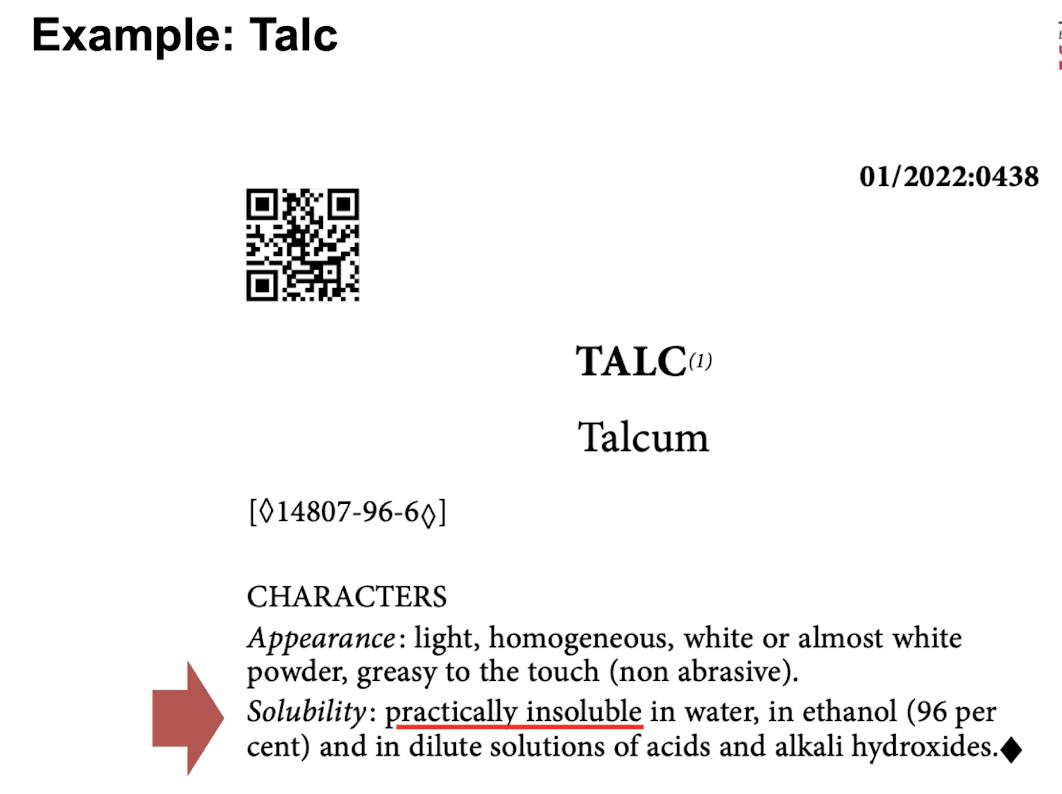
How is talc described in the Ph. Eur.?
Practically insoluble in water, ethanol (96%), and dilute acid and alkali hydroxide solutions.
man muss im Buch dann wieder die Tabelle suchen um das zu verstehen!
What is needed to measure the solubility of a solid in a liquid?
Pure solute and solvent: Verunreinigungen können die gemessenen Löslichkeiten verändern
a saturated solution must be obtain prior to analysis
- vor der Analyse muss eine gesättigte Lösung hergestellt werden
- das bedeutet, dass sich bereits die maximale Menge des Stoffes gelöst hat und ein GG erreicht wurdesuitable separation/filtration:
- man braucht eine geeignete Methode, um ungelöste Feststoffpartikel von der gesättigten Lösung zu trennen.accurate analysis and reliable:
- man muss die [c] des gelösten Wirkstoff konkret bestimmen könnencontrolled temperature
- die Löslichkeit hängt von der T ab!
Merksatz: Eine korrekte Löslichkeitsmessung braucht eine gesättigte Lösung, eine zuverlässige Analyse und eine kontrollierte Temperatur.

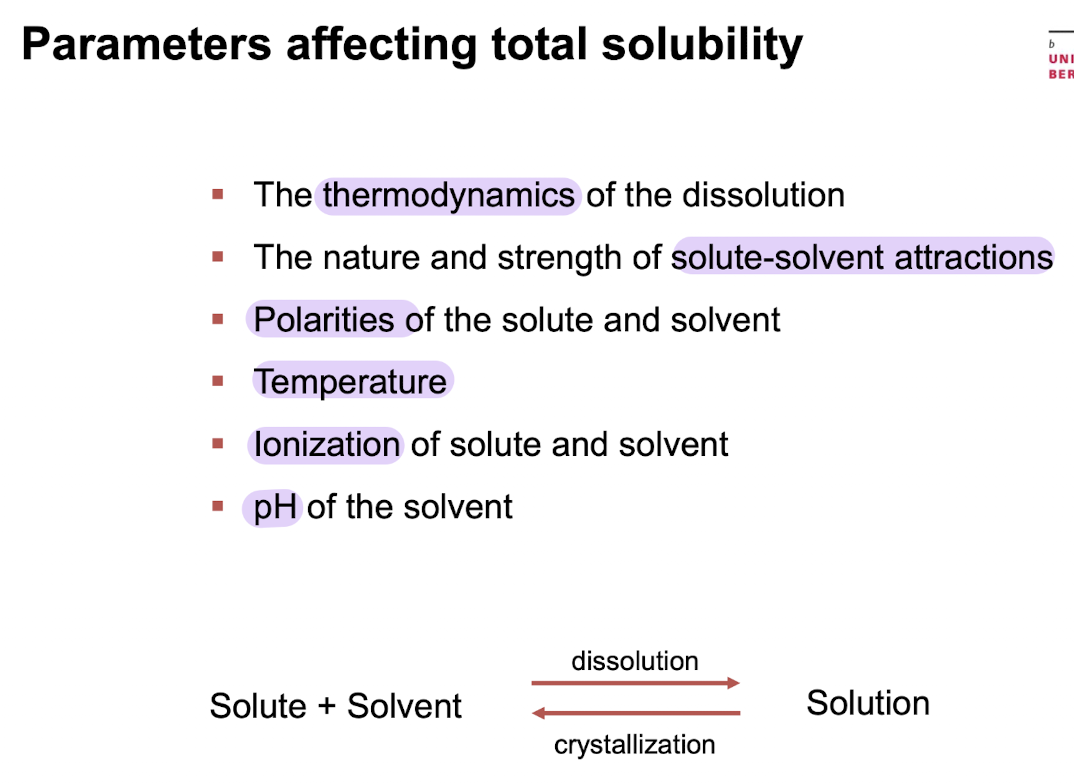
What factors affect total solubility of an API?
dissolution thermodynamics
solute–solvent attractions
polarity
temperature
ionization
solvent pH
a
What is thermodynamic solubility for a crystalline solid?
The maximum amount of its most stable crystalline form that stays dissolved at equilibrium at a given temperature and pressure.
der Wirkstoff liegt zunächst als Kristallin vor
ein Teil des Wirkstoff löst sich in LM — irgendwann GG
die [c] im GG entspricht der thermodynamischen Löslichkeit
What must happen energetically during dissolution?
Solute–solute and solvent–solvent interactions must be disrupted, while stabilizing solute–solvent interactions form.
Solute–solute interactions must be overcome.
Solvent–solvent interactions must be partly overcome.
New solute–solvent interactions are formed and stabilize the solution.
STRONG, FAVORABLE SOLUTE-SOLVENT INTERACTIONS HELP DISSOLUTION!
je günstiger diese Neune WW im Verhältnis zu den ursprünglichen sind desto energetisch günstiger ist der Lösungsvorgang
die Lösung hängt nicht nur von diesen WW ab, sondern auch von der Entropie!!!1

Why are pharmaceutical solvents used?
To deliver liquid drugs
improve oral taste - palatability to oral delivery systems
act as drug vehicles - als Trägemedium um Wirkstoff zu verabreichen
influence product stability (disadvantage)
What safety problems must be considered when choosing solvents?
Toxicity
volatility = Flüchtigkeit, das LM kann leicht verdampfen
instability = Formulierung kann sich verändern bzw. zersetzten
flammability = Entzündlichkeit, kann leicht brennen
What is a pharmaceutical solvent?
einen Wirkstoff auflösen kann auf molekularer Ebene
einen Wirkstoff suspendieren kann, er wird in der Flüssigkeit verteilt, ohne sich vollständig aufzulösen
Dissolution | Suspension |
|---|---|
Wirkstoff ist gelöst | Wirkstoff ist nicht gelöst |
Moleküle oder Ionen sind verteilt | Feste Partikel sind verteilt |
Homogene Lösung | Heterogenes Gemisch |
What does the sulfanilamide disaster teach us?
In 1937, toxic diethylene glycol was used in a sulfanilamide elixir, causing over 100 deaths.
Solvent safety is essential; contamination remains a global problem.
antimikrobiell and it was not BV!

Why are elemental impurities and residual solvents controlled?
They have no therapeutic benefit and may be harmful; their levels must be kept within acceptable limits.
die ICH und EMA verlangen dass elementare Verunreinigungen kontrolliert werden

What do TDI, ADI, and PDE mean?
TDI = tolerable daily intake
ADI = acceptable daily intake
PDE = permitted daily exposure
What are residual solvents?
Volatile organic chemicals remaining from manufacturing drug substances, excipients, or drug products.
sind LM Reste die nach der Herstellung im Arzneimittel zurückbleiben können
no therapeutic benefit from residual solvents
What are Class 1 residual solvents?
Solvents to avoid because of unacceptable toxicity or environmental hazards, e.g. benzene.
sehr giftig
können Krebs verursachen
Umwelt schädigen und die Toxizität kann man nicht akzeptieren
Ausnahme: wenn sie für einen bedeutenden therapeutischen Fortschritt unvermeidbar sind, dürfen sie unter strengen begrenzten Bedingungen verwendet werden

What are Class 2 residual solvents?
Solvents whose amounts must be limited because of inherent toxicity; specific PDE limits apply.
Menge muss begrenzt werden

What are Class 3 residual solvents?
Solvents with low toxic potential; generally up to 50 mg/day of residual solvent is acceptable without justification.
diese LM sind weniger giftig
keine bekannten Gesundheitsgefahren bei normaler Menge

Why is water an important pharmaceutical solvent?
It is widely used in medicine manufacturing and has strong, directional hydrogen-bond interactions.
sie binden Wasserstoffbrückenbindungen, sie sorgen dafür dass Wassermoleküle miteinander ww und Netzwerke bilden
Temperatur: hohe kann sie H-Brücken verändern
Salze
Chaotropic
Kosmotropic
Stören das Wasserstoffbrückennetzwerk
Stabilisieren das Wasserstoffbrückennetzwerk
Disrupt hydrogen bonds
Stabilize hydrogen bonds

What are chaotropes and kosmotropes?
Chaotropes disrupt water's hydrogen-bond network
kosmotropes stabilize hydrogen-bond interactions
Chaotropic | Kosmotropic |
|---|---|
Stören das Wasserstoffbrückennetzwerk | Stabilisieren das Wasserstoffbrückennetzwerk |
Disrupt hydrogen bonds | Stabilize hydrogen bonds |

What are polar solvents? Give examples.
Solvents with strong molecular dipoles, often capable of hydrogen bonding.
Examples: water and alcohols.

What does the dielectric constant indicate in the solvent table?
Solvent polarity: a higher dielectric constant generally indicates a more polar solvent (water about 80).

What are semipolar solvents used for?
They can induce polarity in nonpolar molecules and help polar and nonpolar liquids mix; acetone is an example.
sind Moleküle mit einem Dipol
Je höher ε, desto stärker ist im Allgemeinen die Polarität

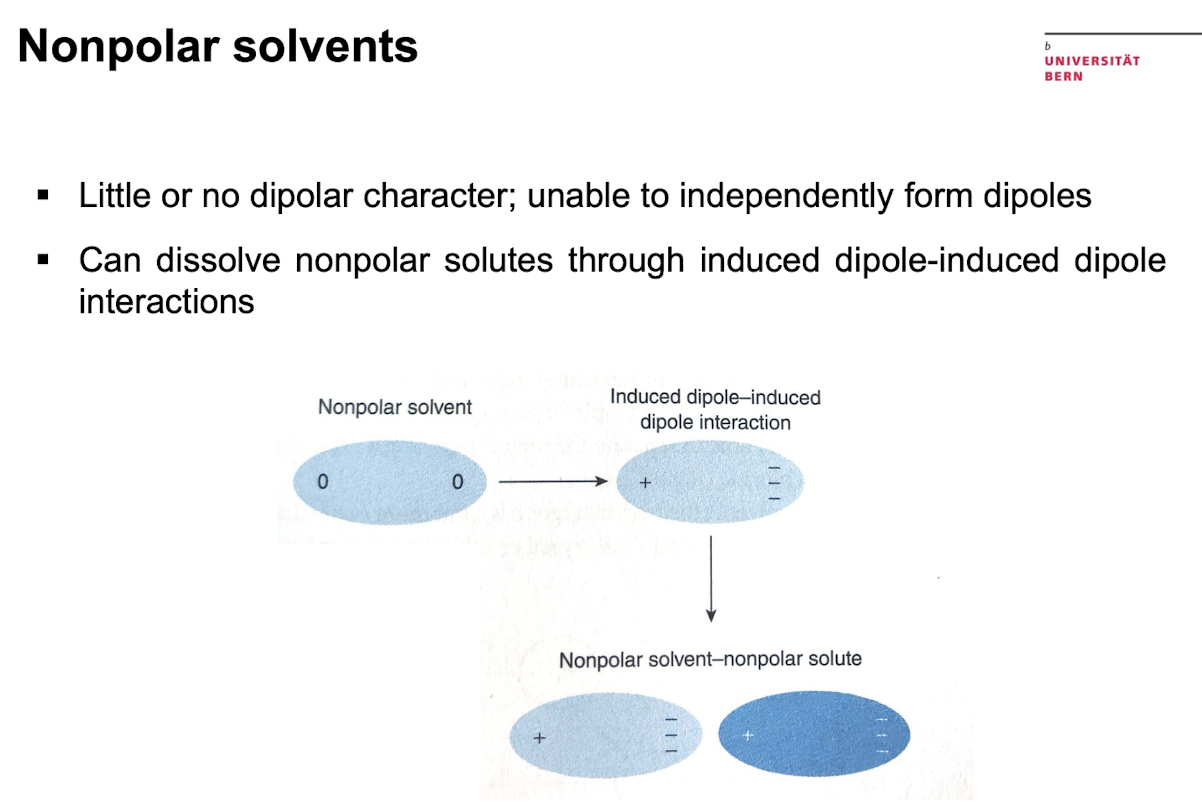
What are nonpolar solvents?
Solvents with little or no permanent dipole; they dissolve nonpolar solutes through induced dipole interactions.
sie können aber vorübergehende Dipole bilden
wie lösen sie Stoffe?
durch induced dipole-induces Dipol interactions (London Dispersionskräfte)
Öl löst sich gut in unpolaren LM, aber schlecht in Wasser
What does a high dielectric constant mean for ions?
The medium can more easily reduce the attraction between oppositely charged ions, helping separate them.
ε = bleibt wie gut ein LM die elektrische Anziehungskraft zwischen geladenen Teilchen anschwächen kann
high ε = starke elekt. Anziehungskraft könne leichter überwunden werden
low ε = elect. Anziehungskräfte werden weniger stark abgeschwächt
Cosolvency = man mischt LM, um die Löslichkeit eines Wirkstoffs zu verbessern

What is a co-solvent and why is it used?
A water-miscible organic solvent added to improve drug solubility or stability, e.g. alcohol in a water mixture.
verschiedene LM mischen um die schlecht Wasserlöslichkeit besser zu löse

What does the phenobarbital example show?
Changing the alcohol/glycerin mixture can greatly increase solubility; solvent composition also changes the drug's apparent pKa.
Diagramm zeigt den kombinierten Einfluss von pH und Lösungsmittelzusammensetzung auf die Löslichkeit von Phenobarbital
pH: Phenobarbital ist eine schwache Säure. Bei höherem pH wird es stärker ionisiert und dadurch besser wasserlöslich.
Co-solvent: Durch Veränderung der Lösungsmittelzusammensetzung kann die Löslichkeit ebenfalls steigen
wenn man die Zusammensetzung ändert oder pH kann die Löslichkeit wieder abnehmen
What is a possible risk of co-solvency?
If the formulation is diluted, the drug's solubility may fall and precipitation can occur.
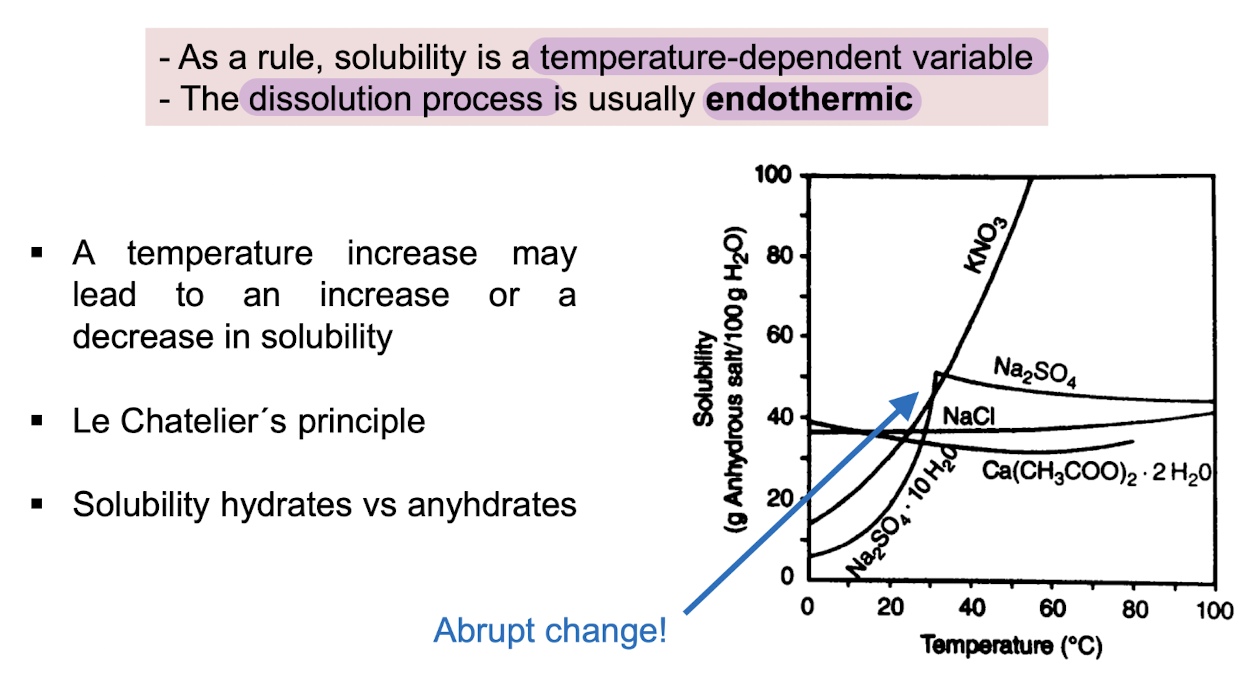
How does temperature affect the solubility of solids?
Solubility depends on temperature.
Heating often increases solubility for endothermic dissolution, but it can also decrease it.
Le Chateliers Principle:
ein System reagiert auf eine TemperaturändeungEndothermic dissolution:
Mehr Wärme → höhere Löslichkeit.Exothermic dissolution:
Mehr Wärme → geringere Löslichkeit.
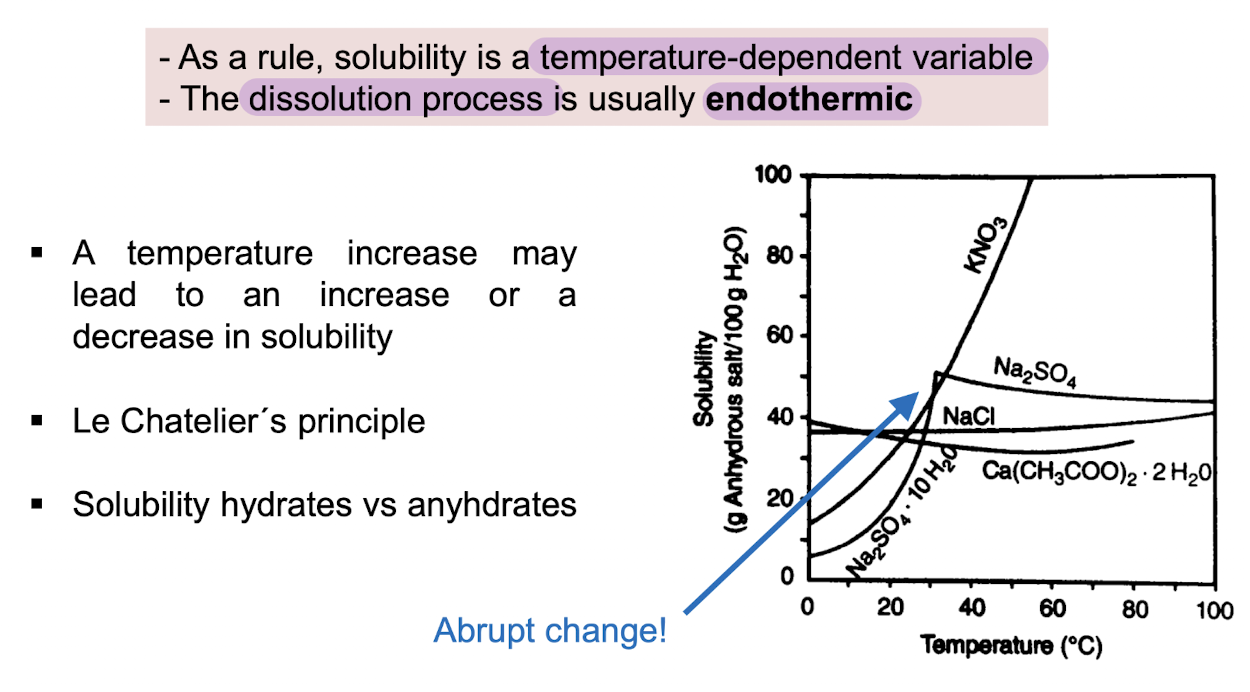
Why can solubility change abruptly with temperature?
A change between solid forms, such as hydrate and anhydrate, can cause a sudden change in solubility.
Hydrate: Kristalle enthalten Wasser.
Anhydrate: Kristalle enthalten kein Kristallwasser.
Bei einer bestimmten T kann sich die stabile Kristallform ändern = erklärt den Knick in Diagramm
What affects the solubility of gases in liquids?
The gas and liquid involved, temperature, and pressure.
Pressure ↑ → Gas solubility ↑ (mehr Druck = mehr Gas löst sich)
Temperature ↑ → Gas solubility ↓ (bei höherer Temperatur lösen sich die meisten Gase schlechter)
What is Henry's law?
w = kp
the amount of gas dissolved per unit solvent volume (w) is proportional to its equilibrium pressure (p), with constant k, if no chemical reaction occurs.
Je höher der Gasdruck, desto mehr Gas kann sich in der Flüssigkeit lösen, solange keine chemische Reaktion zwischen Gasen und Flüssigkeiten stattfindet

What happens to gas solubility when temperature increases?
For most gases, solubility decreases
heating can help remove dissolved gases
What does miscibility mean?
Two liquids can mix to form one homogeneous phase.
Ideal solutions are miscible in all proportions
partial miscibility can depend on temperature
What is the Gibbs phase rule?
F = C − P + 2
F = degrees of freedom
C = components
P = phases
Phasenregel beschreibt wie viele Grössen unabhängig verändert werden können, ohne dass sich die Anzahl der Phasen ändert
What does the phase-solubility diagram of a pure drug show? (links)
A–B: one unsaturated solution phase - löst sich vollständig
B–C: saturated solution in equilibrium with excess solid; the dissolved concentration stays constant.
B: Sättigungsgrenze ist erreicht = ist die Solubility!!!
!! die Linie bleibt ab B horizontal, weil die [c] des gelöste Wirkstoffs nicht weiter steigt
PURE DRUG: nach erreichen der Sättigung bleibt die Konzentration konstant!!!

What can a change of slope in a phase-solubility diagram indicate?
Impurities or additional components/phases; a pure drug shows a constant plateau after saturation.
Drug + IMPURITIES : Verlauf der Löslichkeitskurve ändern
am Rand von den Diagrammen D und E kann man die Solubility ablesen

What are the main steps of solid dissolution?
Molecules leave the solid surface.
They enter the liquid and become solvated.
They move through the boundary layer into the bulk solution.
!! kinetik!!
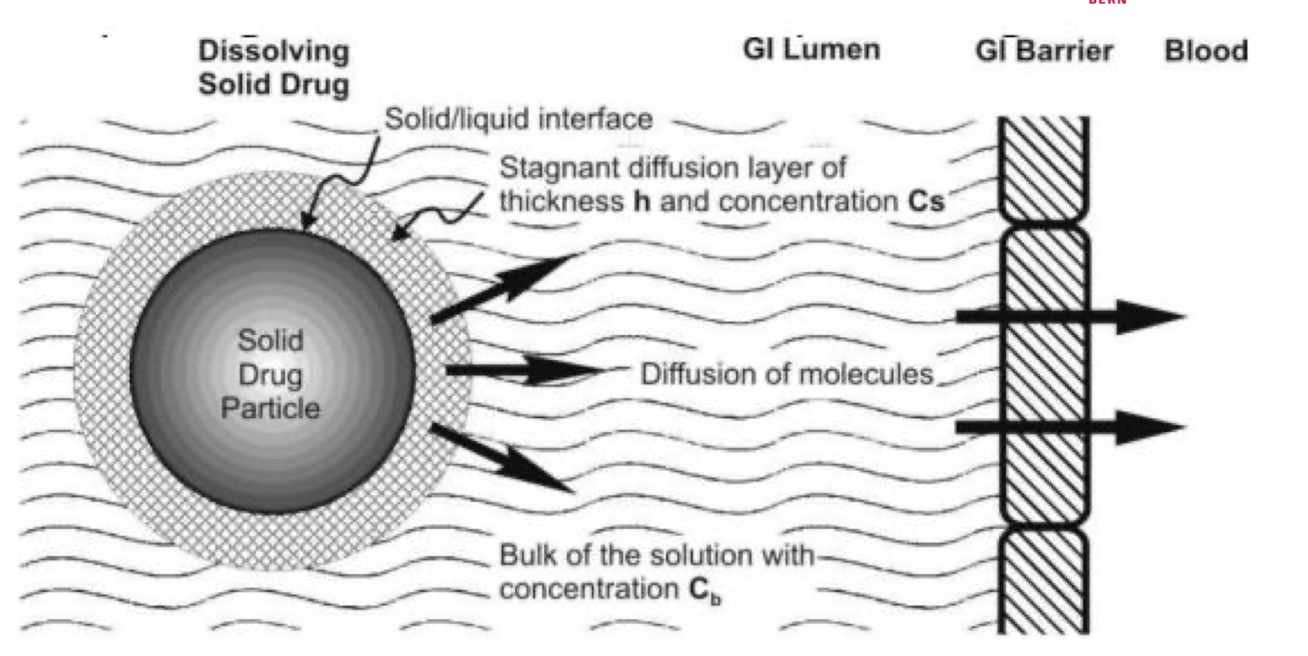

What are Cs and C in the dissolution diagram?
Cs = concentration at the solid surface (near saturation)
C = concentration in the bulk liquid
Boundry layer: Bereich zwischen Kristalloberfläche und restlicher Flüssigkeit
Direkt am Kristall ist die Wirkstoffkonzentration höher als weiter entfernt, deshalb diffundieren die Moleküle von hoher zu niedriger [c]
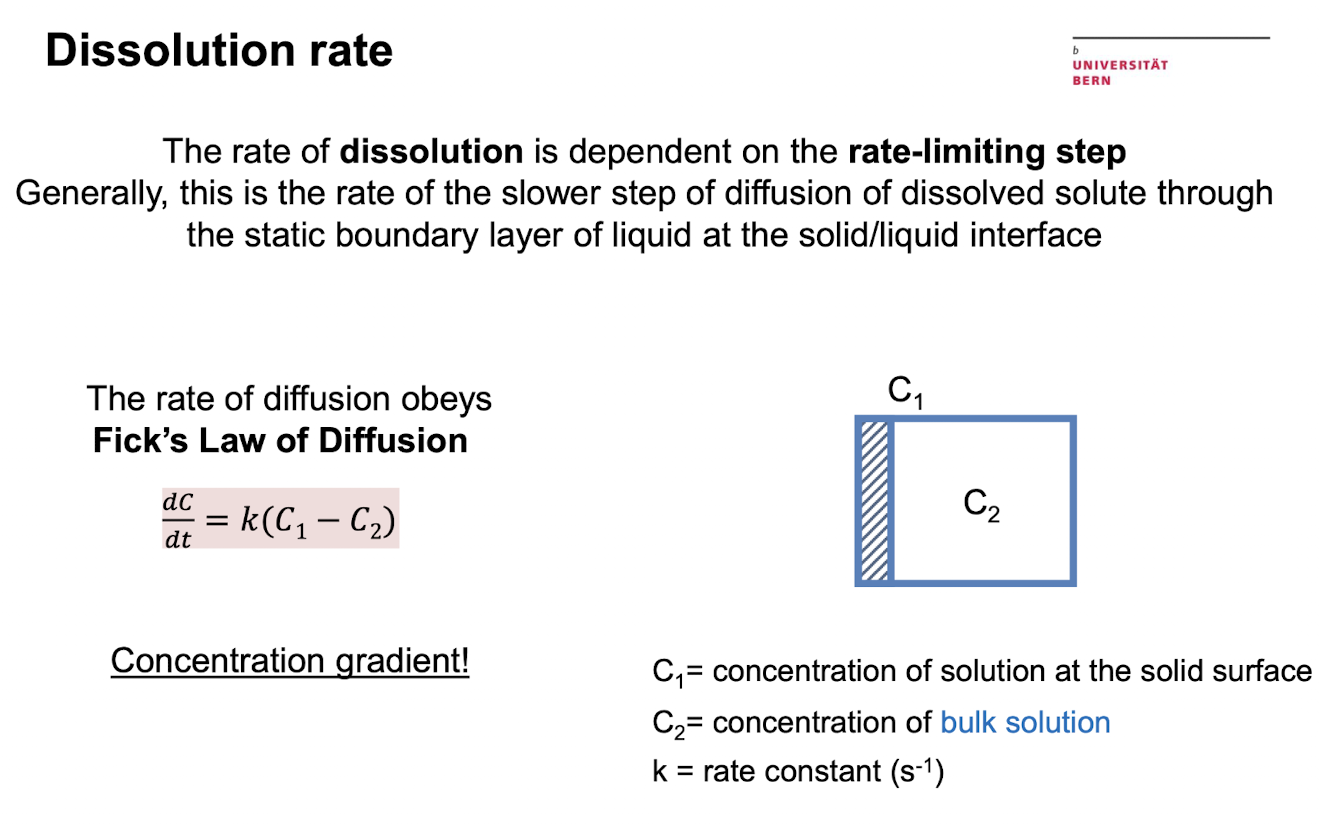
What usually limits the dissolution rate?
The slow diffusion of dissolved molecules through the stagnant boundary layer around the solid.
Leaving the surface: Drug molecules leave the crystal.
Moving into the liquid: Drug molecules become surrounded by solvent molecules.
Diffusion: Drug molecules move through the boundary layer into the bulk solution.

How does the concentration gradient affect diffusion?
A larger difference between surface and bulk concentration gives faster diffusion: dC/dt = k(C1 − C2).
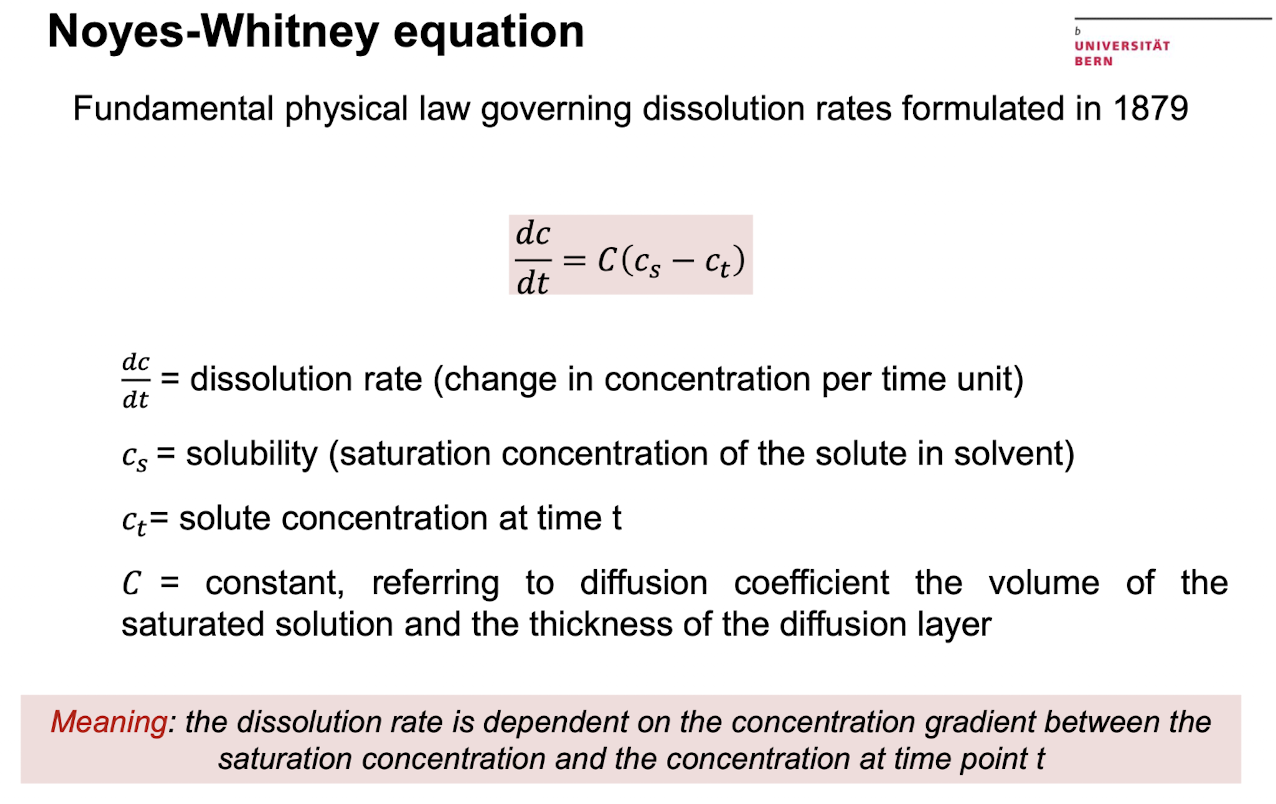
What is the Noyes–Whitney equation?
dc/dt = K(cs − ct). Dissolution rate depends on the difference between saturation concentration (cs) and concentration at time t (ct).
A larger concentration gradient means faster dissolution.
As the solution approaches saturation, dissolution slows down.
Am Anfang: Kaum Wirkstoff gelöst → grosser Konzentrationsunterschied → schnelle Auflösung.
Später: Immer mehr Wirkstoff ist gelöst → kleinerer Unterschied → langsamere Auflösung.
Bei Sättigung: \(c_s=c_t\) → keine Nettoauflösung mehr.
Grosser Konzentrationsunterschied = schnelle Auflösung.
[What does the Nernst–Brunner equation describe? wichtig!!!
Dissolution rate depends on diffusion coefficient D, surface area A, concentration difference (cs − c), diffusion layer thickness h, and volume V. The slide writes dm/dt = DA(cs − c)/(hV).

Why does reducing particle size increase dissolution rate?
Smaller particles provide more total surface area (A) for the same amount of solid, allowing faster dissolution.

How does stirring influence dissolution rate?
Stirring reduces the thickness (h) of the diffusion boundary layer and increases dissolution rate.
What influences saturation concentration (cs)?
Temperature, dissolution medium, and the crystalline form of the solid.
What are sink conditions?
The dissolution medium is large enough to keep bulk concentration low: C < 10% of Cs; commonly the volume is 3–10 times the saturation volume.

Why are sink conditions useful?
The concentration difference stays nearly constant, so dissolved solute concentration has little influence on the dissolution rate.
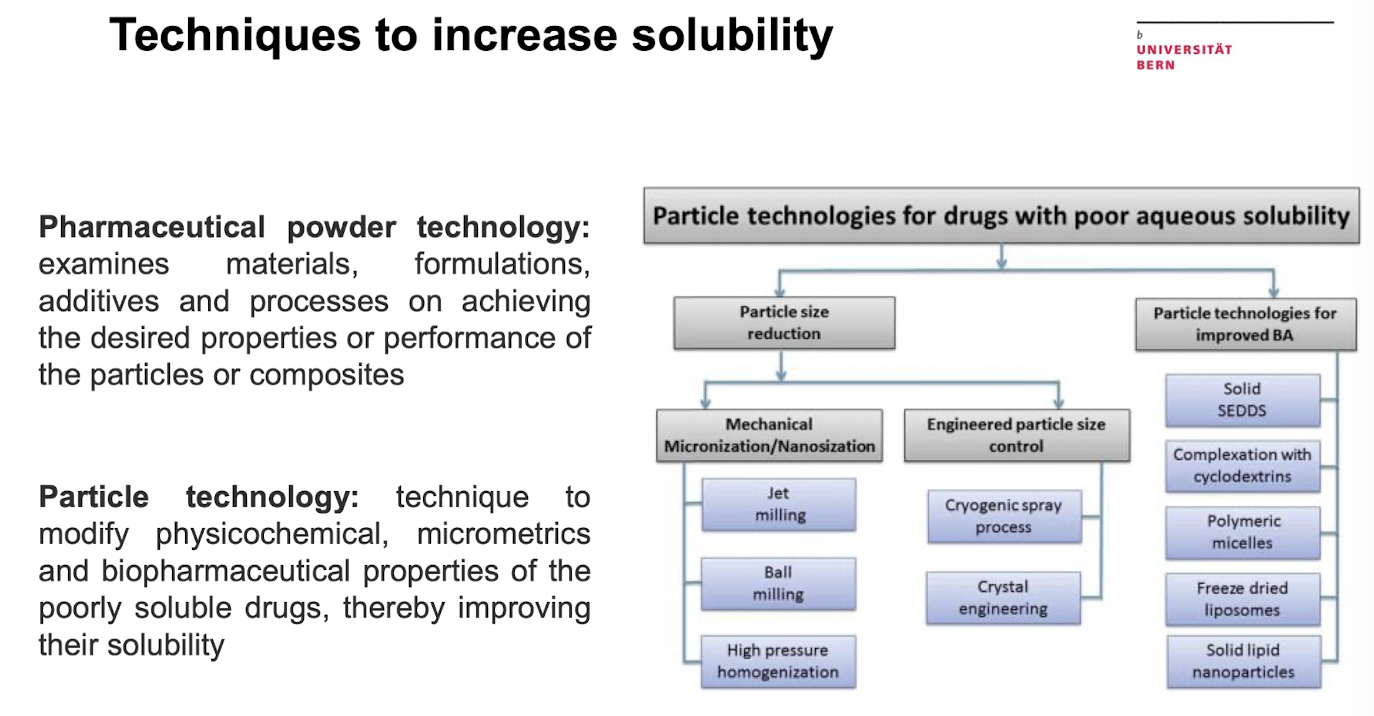
How can the dissolution rate be increased?
Increase saturation concentration
reduce particle size; improve wettability with surfactants
use spray/freeze drying or solid dispersions.
▪ Increase of saturation concentration
▪ Comminution
▪ Recrystallization from a surfactant-containing solution
▪ Spray and freeze-drying
▪ Solid dispersion
Which apparatuses are used for dissolution testing?
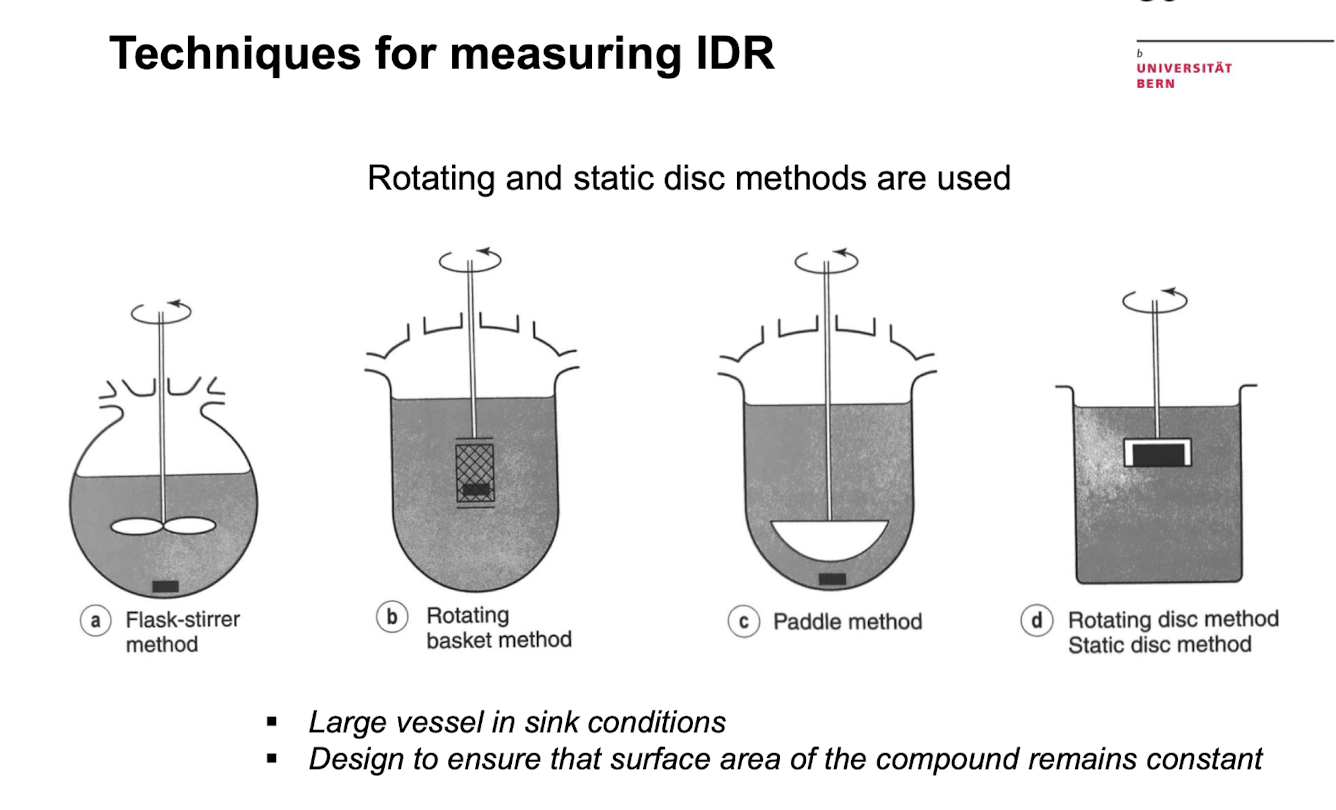
A rotating basket or a paddle in a standard dissolution vessel (shown as 1 L).

What is intrinsic dissolution rate (IDR)?
Mass of drug dissolving per unit exposed surface area per unit time, measured with a controlled solid surface and dissolution medium.

How is intrinsic dissolution rate measured?
Compress the drug into a non-disintegrating disc, expose one face to the medium, and sample the liquid over time; rotating or static disc methods are used.

Why must the surface area remain constant during IDR measurement?
To compare the drug's intrinsic dissolution behavior without changes caused by varying exposed surface area.
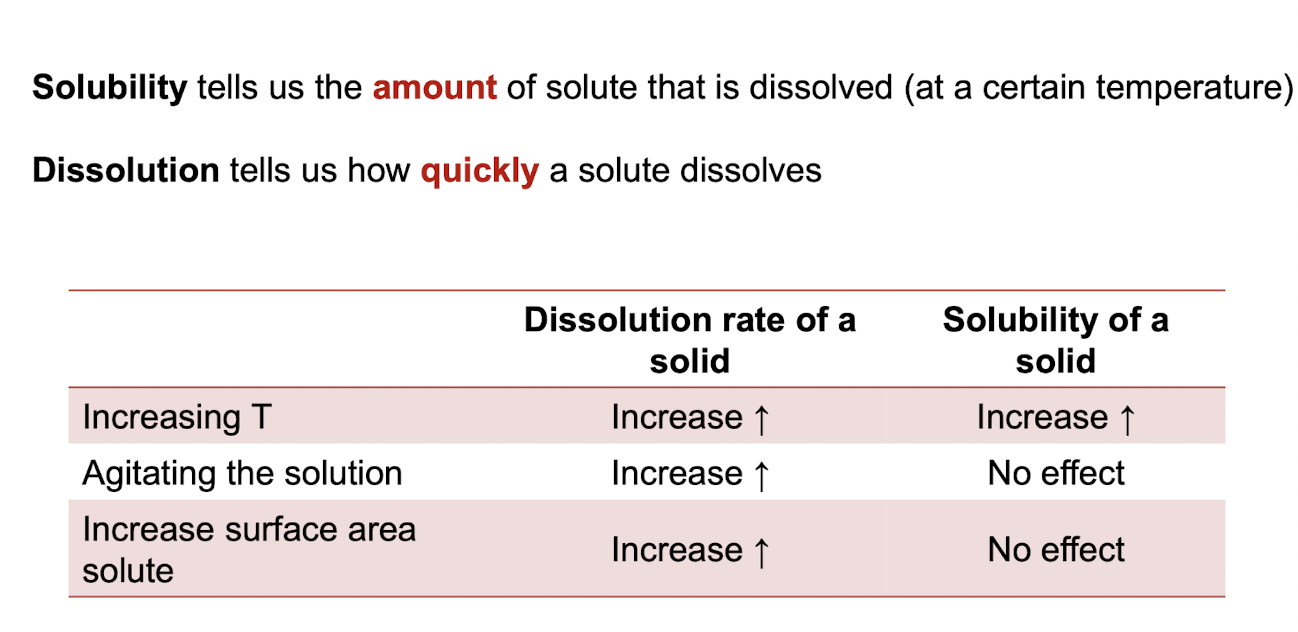
How do temperature, stirring, and surface area affect solubility vs dissolution?
Temperature often increases both; stirring increases dissolution rate but not equilibrium solubility; larger surface area increases dissolution rate but not equilibrium solubility.
What determines oral drug absorption and bioavailability?
Drug solubility, dissolution rate, and gastrointestinal permeability.

What is the Biopharmaceutics Classification System (BCS) based on?
The drug's aqueous solubility and intestinal permeability.
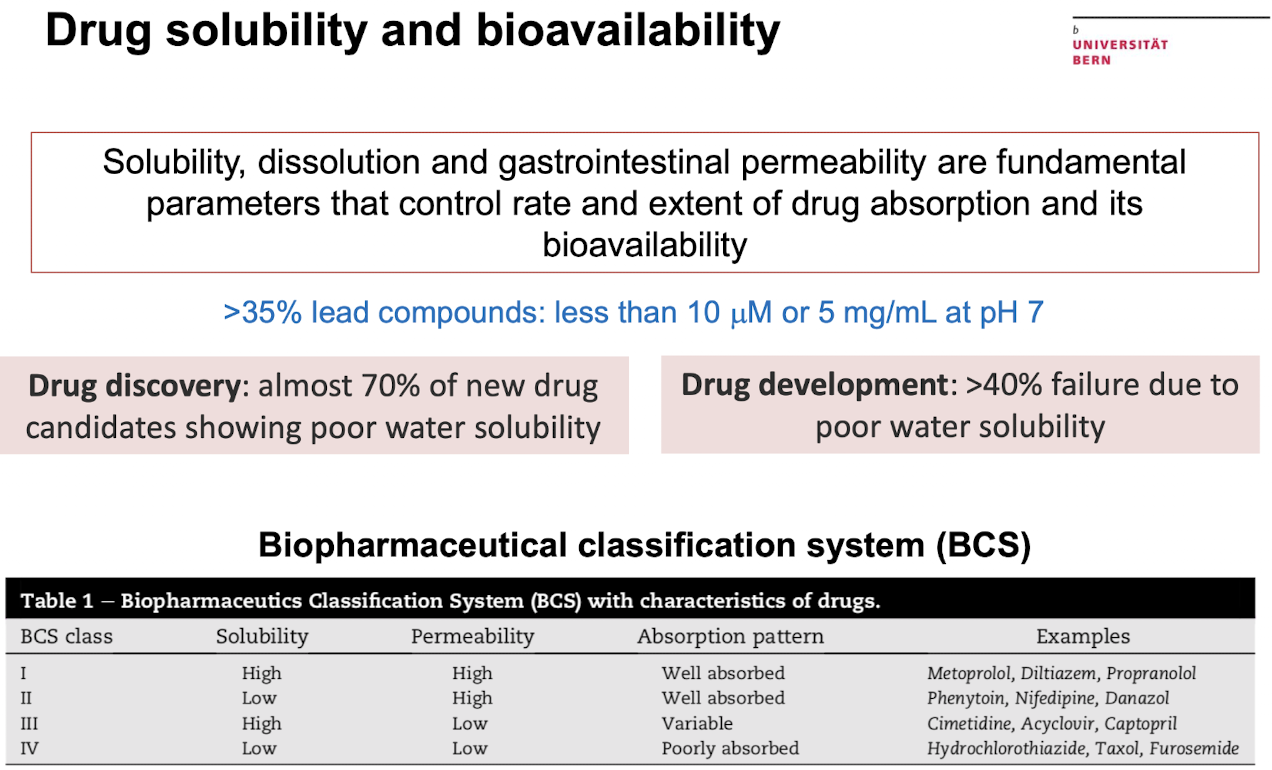
Why is poor water solubility a problem in drug development?
It can limit dissolution and absorption, reducing bioavailability and contributing to drug-development failure.
What is the goal of particle technology for poorly soluble drugs?
To change physicochemical, particle-size, and biopharmaceutical properties to improve drug performance and solubility.