Unit 2 Biology
 Call Kai
 Learn
 Practice Test
 Spaced Repetition
 Match
 Flashcards
 Knowt Play
1/317

There's no tags or description
Looks like no tags are added yet.
318 Terms
How does genetic diversity occur in gametes?
Gametes are produced in gonads (specialised reproductive organs — ovaries and testes) and unite via fertilisation
Each parent contributes distinct genetic information, producing genetically unique offspring
Genetic material undergoes recombination between generations, generating genetic variation

How do asexual and sexual reproduction differ?
Asexual reproduction: a form of reproduction in which offspring are produced from a single parent, producing genetically identical daughter cells
Sexual reproduction: a form of reproduction involving the fusion of gametes (sperm and egg) from two parents, producing genetically unique offspring
What is fertilisation and what is a zygote?
Fertilisation: the fusion of the sperm and egg to form a zygote.
Zygote: a fertilized egg.
There are 2 types of fertilisation:
1. Internal fertilisation.
2. External fertilisation.

What is internal fertilisation and what are examples?
Gamete mixing occurs inside the body, so chances of gametes meeting are greater, increasing the chance of fertilisation.
Females produce a smaller number of eggs each reproductive cycle.
Males have specialised genitalia that enable the sperm to get inside the female's egg.
Less gamete wastage occurs.
Examples: mammals, octopuses, insects.

What are the features of external fertilisation and what are examples?
Gamete mixing occurs outside the body.
Smaller chance of gametes coming into contact with each other.
High energy usage to produce large amounts of gametes.
Limited to reproduction occurring in an aquatic environment for sperm to swim.
Examples: bony fish, amphibians, coral.

What are the advantages of sexual reproduction?
Increases genetic diversity.
Population more likely to survive in a changing environment.
Facilitates adaptations.
Diseases less likely to attack all members of the population.

What are the disadvantages of sexual reproduction?
Time and energy needed to find a mate.
Slower reproductive rate, less offspring.
Potentially spread sexually transmitted diseases (STIs).
Requires at least two individuals to increase the population.

What is asexual reproduction and what does it produce in which cells?
A form of reproduction in which offspring are produced from a single parent.
Produces 2 genetically identical daughter cells (natural cloning)
Occurs in prokaryotic cells (binary fission) and eukaryotic cells (mitosis).
What are the advantages of asexual reproduction?
Rapid population growth (no energy needed to find a mate, only one sex needed)
Repopulation - surviving members can rebuild numbers after population loss.
Exploitation - species can quickly exploit resources in newly available habitats.
Inherited genetics - offspring of survivors will also survive (only suitable in stable environments).
What are the disadvantages of asexual reproduction?
Reduces genetic variation - offspring have identical DNA.
Vulnerable to environmental changes - existing phenotypes may not suit new conditions.
Susceptible to disease.
Overcrowding leads to increased competition for resources.
Mutations are inherited (both advantageous and disadvantageous traits).
What are the 6 types of asexual reproduction?
Fission.
Budding.
Fragmentation.
Vegetative reproduction (in plants).
Spore formation (in fungi).
Parthenogenesis.
What is fission and what are the two types?
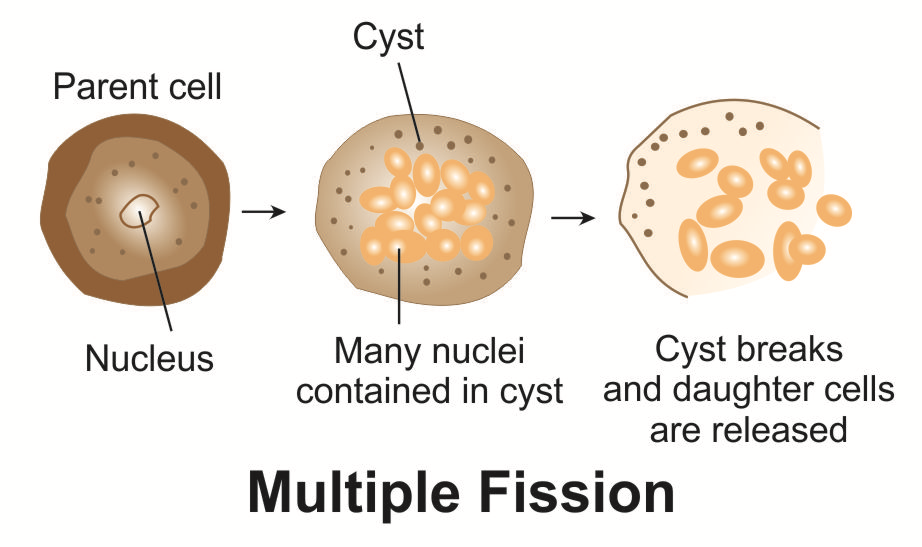
The division of a parent cell into 2 or more cells
Binary fission: division into 2 equally sized cells (prokaryotes, e.g. bacteria).
Multiple fission: division into many genetically identical daughter cells (e.g. algae).
What is budding and what are examples?
Reproducing asexually from small groups of cells formed by mitosis that bud or break away from the main organism
Examples: sponges, yeast and hydra.

What is fragmentation and what are examples?
A process where an organism is divided into parts, and each part regenerates the missing parts of the organism.
Examples: sea stars, flatworms, sponges and coral (mainly aquatic organisms).

What is vegetative reproduction and what are its features?
Asexual reproduction from vegetative parts (roots, stems and leaves).
Features:
No fertilisation occurs
New plants form by mitosis and are genetically identical clones of the parent
Reduces genetic diversity in populations

Why is vegetative reproduction possible in basically all parts of adult plants?
As adult plants have meristematic tissue, which is totipotent (undifferentiated).
Therefore virtually all types of roots and shoots are capable of vegetative propagation.
What are runners and rhizomes and what are examples?
Horizontal stems that grow above (runners) or below (rhizomes) ground
New roots and shoots sprout at nodes, forming genetically identical plantlets
Examples: strawberry runners, ginger rhizomes.

What are bulbs and what are examples?
A short stem surrounded by fleshy, food-storing leaves
Small bulblets split off to grow into new plants.
Examples: onion, daffodil, garlic, spring onion.

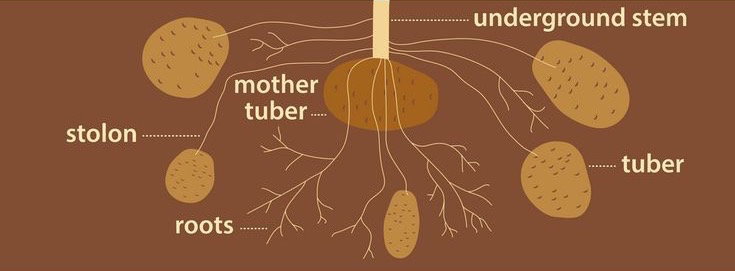
What are tubers and what are examples?
Swollen underground stems that store nutrients.
Tuber eyes sprout into a new separate plant.
Example: potatoes.
What are plantlets and what are examples?
Structures that arise from the plant, drop off and then take root.
Examples: some ferns and succulents.

What is asexual spore formation?
Occurs in fungi and some algae.
Spores form from mitosis and are dispersed, then develop into new organisms genetically identical to each other.
Some spores are sexually produced, but in fungi and algae they are asexually produced

What is parthenogenesis and what are examples?
Reproduction without fertilisation, almost always involving the development of an unfertilised egg
Offspring are genetically identical to the female parent.
Examples: aphids (give birth to live young), Komodo dragons, and bees (when conditions are favorable).

What is a species?
A group of organisms that can potentially interbreed to produce fertile, viable offspring.
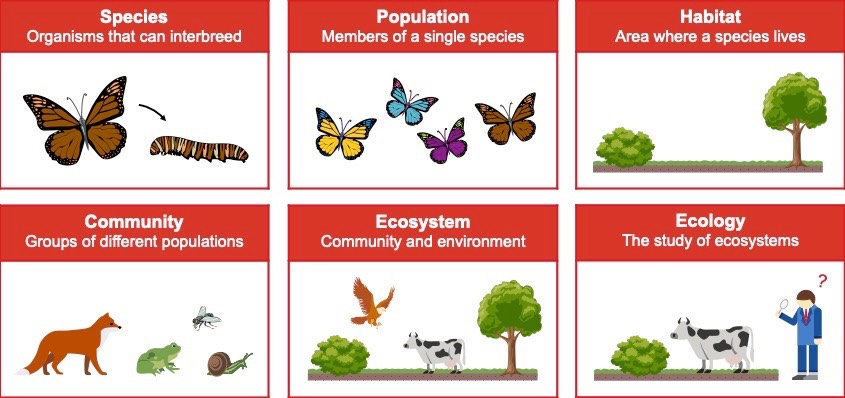
What is a population?
A group of organisms of the same species, living in the same area at the same time.

What is a community?
A group of populations living together and interacting with each other within a given area.
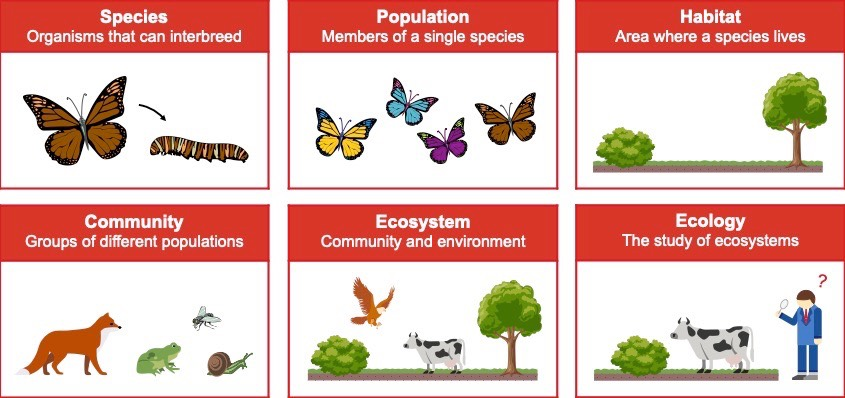
What is a habitat?
The environment in which a species normally lives, or the location of a living organism.

What is an ecosystem?
A community and its abiotic environment (i.e. habitat).
Population + habitat.

What is ecology?
The study of the relationship between living organisms, or between living organisms and their environment.
What is population structure?
The variety of genotypes and phenotypes within a population.
Helps scientists determine how populations change over time and predict future changes.
Based on 3 factors: Size, density and distribution
What are the factors considered for population structure?
Size.
Density.
Distribution.
What is population size?
The number of individual organisms of the same species, living in the same area at the same time.
Small populations are more vulnerable if the environment changes, due to a smaller gene pool (less genetic variation).

What is population density, and how does it relate to carrying capacity?
Population density: The average number of individuals in a population per unit area or volume
Carrying capacity: The total population that can be supported by an environment
As population density approaches carrying capacity, resources (food, water, shelter) become more limited relative to demand
If population density exceeds carrying capacity, competition for resources increases
This can can lower survival and reproduction rates until the population decreases to within the carrying capacity

What is population distribution?
Describes how individuals are spread across a specific area
What are interspecific relationships? How are they classified?
Interspecific relationships: Relationships between species
Classified according to whether they help, harm, or have no effect on the species involved
What are the main types of interspecific relationships?
Competition.
Predation.
Herbivory.
Symbiosis (4 types).
What is interspecies competition?
Interaction that occurs when individuals of different species compete for a resource that limits their growth and survival (e.g. food, water, shelter)
Can be described as amensalism
A driver for evolution, as advantageous traits can increase success in competition, leading to adaptations in the population.
What is predation? What are some adaptations of each in the relationship?
An interaction between species in which one species (the predator) kills and eats the other (the prey)
Predator adaptations: Acute senses to enable them to locate + identify potential prey, and structural adaptations including claws, teeth, fangs, stingers or poison to catch and subdue prey
Prey adaptations: Eyes on the side of the head, playing dead, more herding and socialisation, distinct feeding times to avoid predation
What does the predator-prey relationship describe?
Because the predator relies on the prey as a food source, their population levels are inextricably intertwined
If the prey population drops (e.g. due to over-feeding), predator numbers will decrease as intraspecific competition increases
If the prey population rises, predator numbers will increase due to the over-abundance of a food source.

What is herbivory? How do plants defend themselves against it?
An interaction where an organism eats part of a plant or algae
Unlike prey animals, plants cannot run away to avoid being eaten
Instead, plant defences against herbivores include chemical toxins or structures (e.g. spines and thorns)
Most herbivores are invertebrates such as grasshoppers and beetles.

What are examples of herbivory on land and in aquatic environments?
Land examples: mammals and birds eating grasses and leaves.
Aquatic examples: snails, urchins, and some fish and mammals.

What is symbiosis?
A close and long-term interaction between two different species living together
What are the types of symbiotic relationships?
Parasitism.
Mutualism.
Commensalism.
Amensalism.
What is parasitism? How does it affect the population structure of their host?
A symbiotic interaction in which one organism (the parasite) gets its nutrition from another organism (its host), which is harmed in the process.
Parasites can change how a host acts to help themselves move to a new host.
They can significantly affect the population structure of their host population by affecting survival, reproduction and population density.
What is an example of parasitism?
Ticks (ectoparasites) live on moose, weakening the host by withdrawing blood and causing hair breakage and loss.
This increases the chances of the moose dying from cold stress or predation by wolves.
What are the types of parasites?
Endoparasites: exist inside a host's body.
Examples: tapeworm, roundworm, flatworms.
Ectoparasites: exist outside a host's body.
Examples: ticks, lice, fleas, mites, mosquitoes.

What is mutualism and what are some examples?
A symbiotic relationship where both species benefit.
Examples: Clown fish + sea anemone, bees and flowers (cross-pollination), fruiting trees and animals (seed dispersal), algae and coral (algae get shelter, coral get food).

What is commensalism? How often and how do they occur in nature?
A symbiotic relationship where one species benefits but doesn't harm or help the other
Commensal interactions are rare in nature, because any close interaction between species likely affects both species, even if only slightly.
Some possibly commensal associations involve one species obtaining food that is inadvertently exposed by another.
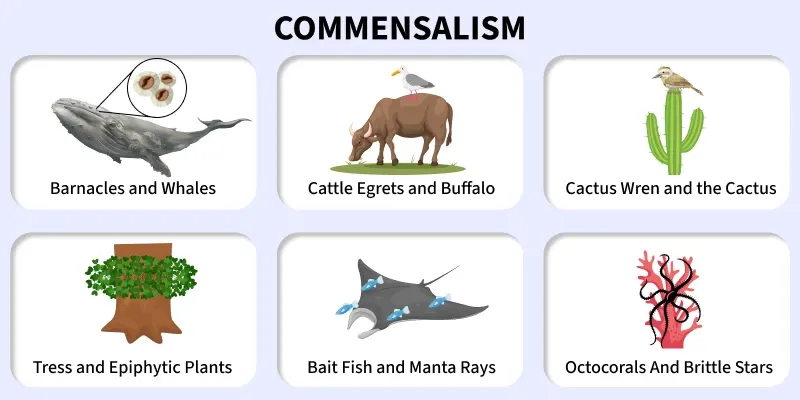
What are examples of commensalism?
Herbivores tilling land: Exposes insects in the soil for other mammals but doesn't affect the herbivores.
Barnacles on whales: Barnacles get a safe habitat and access to food sources, while the whale is generally unaffected.

What is amensalism?
A symbiotic relationship where one species is harmed and the other is unaffected (neither helped nor harmed).
Occurs in the form of competition or antibiosis.
How to remember: think "anti-biology" - goes against living things.

What are the types of amensalism?
Competition.
Antibiosis.

What is competition, as a type of amensalism?
One organism is harmed because a larger or more powerful organism excludes it from a resource (food or shelter), while the larger organism is unaffected.
Example: Large trees shading out and stunting the growth of smaller plants beneath them

What is antibiosis as a type of amensalism?
One organism releases a chemical that harms another organism, without being affected itself
Example: Penicillium releases penicillin, which kills nearby bacteria.

What are key features of food chains?
Only one food source for each organism
Indicate only organisms for each trophic level (linear)
Only one pathway for the flow of energy
Doesn't show the energy flow from dead organisms, parts of organisms, or their waste products

What are key features of food webs?
Include many food chains, much better for accurate description of environment
Show various pathways for energy flow
Shows flow of chemical energy from organic matter of dead organisms (involves decomposers)
What are keystone species and what are some examples?
Each species has a particular role within an ecosystem
Keystone species: Species that are essential to the maintenance of their ecosystem and have a large impact on it
EG Elephants, Whale Sharks, Otters, Dingoes

How are elephants a keystone species?
Keystone species in the grasslands of Africa
Elephants consume small acacia shrubs through their feeding activities that would otherwise grow into trees
They control the population of trees on the grassland, maintaining the ecosystem as an open grassland
Herbivores (EG Zebras) depend on the existence of these grasslands

What is the contribution of Aboriginal and Torres Strait Islander peoples to understanding country?
Aboriginal and Torres Strait Islander peoples have a long, deep and continuing understanding of the organisms that inhabit their country
Have sustainably monitored and managed lifecycles for thousands of years
Their perspectives continue to shape land and water management practices today.
What is the value of billabongs to Aboriginal and Torres Strait Islander peoples?
Billabongs provide water which is an integral part of country, with cultural, social and economic importance
Water is a precious resource - during drought or dry seasons, knowing where and how to find drinking water is critical
Billabongs and their species are key to survival
What is a billabong?
Billabong: A pond or pool of water left behind when a river alters course, or after floodwaters recede.
As billabong levels recede, the Ngan'Gi people of the Daly River region (NT) use several sustainable harvesting practices
What are the Ngan'Gi people's sustainable harvesting practices?
Water lilies and red lotus lilies
Stems are eaten (similar to celery), seeds are ground into bread, and flowers provide nectar.
Freshwater turtle eggs and meat
Harvested sustainably, as their lifecycle is well understood
Water-holding frogs (including northern burrowing frogs)
located by reading ground markings or tapping with the butt of a spear, then squeezed to release stored water
What are features of all Aboriginal and Torres Strait Islander practices?
More sustainable, as all parts of the animal are used and harvested according to their lifecycles (full resource utilisation)
Show how deep environmental understanding enables survival within that environment.
How do Torres Strait Islander peoples manage dugong populations? Why are they culturally significant?
They haave sustainably managed dugong populations for thousands of years
Through selective hunting and ecological knowledge (movement patterns, breeding cycles, feeding habits)
Dugongs are totemic animals with deep cultural and ancestral significance, not simply a food source
Considered controversial, as dugongs are an endangered species, though hunting is carried out sustainably
What is fire-stick farming?
Fire-stick farming: The practice of Aboriginal Australians regularly using fire to burn vegetation, also known as cultural burning
Controlled by specific conditions: no wind, a cool day, monitored burning, and correct timing within the burning season
What is the purpose of firestick farming? How does it improve the environment?
Purpose: Facilitates hunting, changes plant and animal species composition, controls weeds, reduces hazards, and increases biodiversity.
Increases biodiversity by adding nutrients to soil, creating new habitats for animals, and promoting seed turnover
How does fire-stick farming show traditional interdependency?
Shows a two-way relationship between people and country: Fire shapes the ecosystem, while the ecosystem in turn sustains the community
Controls weeds and hazards, maintaining balance between competing plant species
Creates new habitats and promotes seed turnover, supporting interdependent relationships between plants, animals, and soil
Reflects deep traditional knowledge built by timing burning around the lifecycles and needs of interacting species
What is genetic diversity?
Genetic diversity: The total number and variety of different alleles present within a species or a population

What is the gene pool?
Gene pool: the complete set of alleles carried by all the individuals in a population.
Basically the sum of all genetic variation in a population, including all possible alleles present (not just the genes).
What is a genome, and how does it differ from a gene pool?
Genome: all the genetic information (base pairs) found in one complete set of an organism's genetic material (all the genes).
The genome belongs to an individual, while the gene pool is within a population.
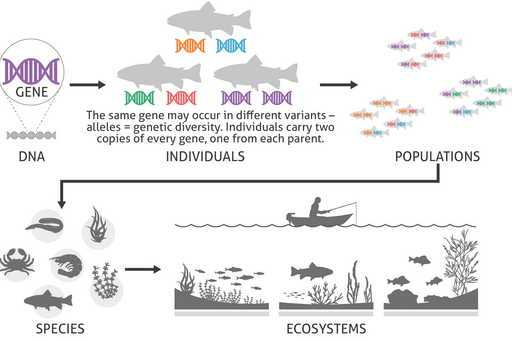
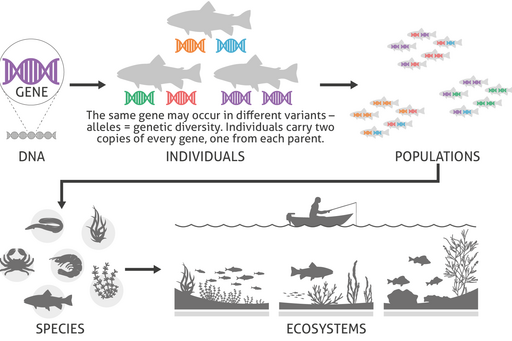
What are the levels of ecological organisation in genetic diversity?
Individual.
Species.
Population.
Community.
Ecosystem.
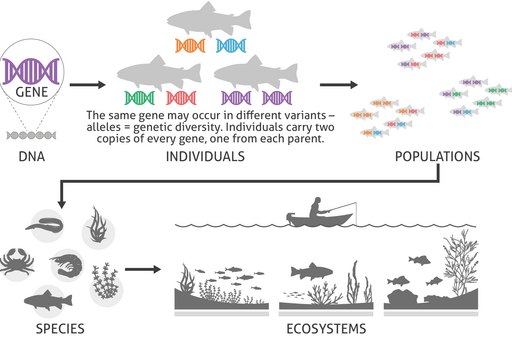
What is an individual, in ecological organisation?
Individual: a single living organism of a particular species.


What is a species, in ecological organisation?
Species: a group of organisms that share similar characteristics and are capable of interbreeding to produce fertile offspring.
What is a population, in ecological organisation?
Population: members of one species living in one region at a particular time.

What is a community, in ecological organisation?
Community: all the different populations of different species interacting and living together in the same area at the same time.
What is an ecosystem, in ecological organisation?
Ecosystem: a community of interacting organisms (biotic factors) together with the non-living (abiotic) components of their environment, and the interactions between them.
What is the level of biodiversity, species diversity?
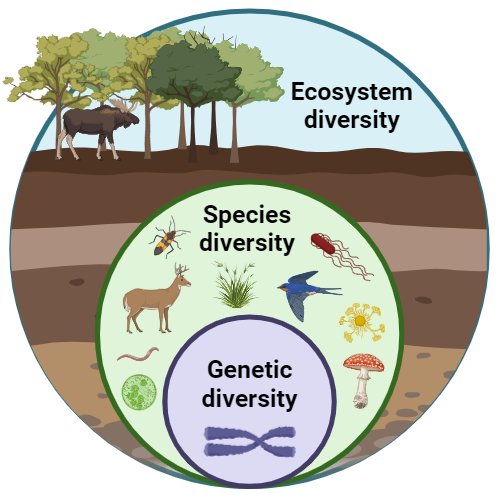
The variety of different kinds of organisms living in a particular habitat or region. Example: all the different plant species in the Australian Desert.
What is genetic diversity, as a level of biodiversity, and why is it important?
Genetic diversity: The variety of genes or the number of different genes inherited.
A species with high genetic diversity has a large gene pool.
High genetic diversity is important as it increases the chances of the species surviving through environmental changes.
Example: Siberian tiger

How does genetic diversity in a population relate to tolerance and optimum range?
All organisms need to stay in their tolerance range in order to survive
Genetic diversity in a population ensures that individual organisms have diversity in their tolerance range
Means individuals of the species may be able to survive in changing environmental conditions

How does the tolerance range differ to the optimum range? How does genetic diversity in a population relate to this?
Tolerance range: the range of conditions in which an organism can survive.
Optimum range: the range of conditions within the tolerance range in which an organism carries out life processes (e.g. living, hunting, mating, raising offspring) at an optimal level.
Genetic diversity in a population ensures that individual organisms have diversity in their tolerance range

How does gene pool size relate to genetic diversity?
A large gene pool = high genetic diversity; a small gene pool = low genetic diversity.
High genetic diversity means individuals within a species have more variation in their tolerance ranges, increasing the chances of surviving changing environmental conditions.
Low genetic diversity makes a population more susceptible to environmental changes, since there's less variation for natural selection to act on.

Does population size determine genetic diversity?
Population size doesn't automatically determine genetic diversity.
A large population can still have low genetic diversity, especially if it started from a small number of genetically similar organisms (the founder effect).

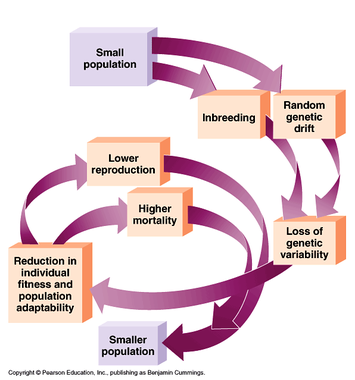
Why are small populations particularly at risk of low genetic diversity?
Fewer individuals to contribute different alleles to the gene pool.
Inbreeding becomes more likely, which reduces genetic diversity over generations.
Low genetic diversity in a population increases vulnerability to disease, environmental change, and reduces long-term survival prospects of the species (e.g. Siberian tiger, cheetah).
What is inbreeding and how does it decrease genetic diversity?
Inbreeding: members of the same family or close relatives breeding only amongst themselves.
Reduces the variety of alleles passed into the gene pool over generations
Results in a population more vulnerable to disease and environmental change
What are the advantages of genetic diversity?
Ensures that individual organisms have diversity in their tolerance range.
Means individuals of the species may be able to survive in changing environmental conditions.
Large gene pool = high genetic diversity.
What are the implications of low genetic diversity?
A large population can have low genetic diversity, especially if the population was started with a small number of genetically similar organisms (founder effect).
Can also occur due to inbreeding, which reduces genetic diversity over time.
Low genetic diversity can result in a population being susceptible to environmental changes. Small gene pool = low genetic diversity.
What are adaptations?
Adaptations: a heritable trait that helps an organism (such as a plant or animal) survive and reproduce in its environment.
Basically any advantageous trait that helps organisms survive in their environment and pass on beneficial traits to offspring.
What is important to consider when describing adaptations in a test?
When defining adaptations, link them to the survival advantage for the specific organism in its specific environment.
What are the types of adaptations?
Structural.
Behavioural.
Physiological.
What are structural adaptations in animals? How is camouflage an example of a structural adaptation?
Structural adaptations: physical features of an organism that help them survive in the environment.
Example: camouflage - protective colouration that helps an organism blend into its environment, protecting it from predators and increasing its chances of survival.
What are some examples of structural adaptations in animals (desert animals, bilbies and camels)?
Desert animals: small size to reduce resource needs and increase SA:V (lose less water and more heat), and are easier to hide from predators.
Bilbies: large ears increase surface area, increasing blood supply and enabling more heat loss.
Camels: thick hair creates a moist microenvironment that prevents water loss.
What are structural adaptations in plants?
Structural adaptations: Physical features of an organism that help them to survive in the environment
Mostly related to photosynthesis and water retention, since plants need structures that regulate water levels while still capturing light.

What are some structural adaptations of plants in low light conditions?
Leaf shape (large SA:V), size, and positioning maximise light capture
Specialised root systems maximise water and oxygen uptake.
What are examples of structural adaptations in plants (8)?
Overall leaf surface area.
Number of stomata (fewer reduces water loss).
Stomatal hairs (reduce water loss).
Sunken stomata (create a moist microenvironment, reducing water loss).
Thick, waxy cuticles (reduce water loss).
Extensive root systems (maximise water uptake).
Rolled leaves (moist microenvironment).
Number of chloroplasts (maximise light capture in low-light environments).

What are behavioural adaptations in animals?
Behavioural adaptations: displays, movements or actions that provide communication to enhance survival and reproduction.
Include forms of communication (mating or aggression), migration and survival behaviours (e.g. nocturnal animals, herding).
Caused by changes in the environment or actions of other species (predator or prey).
What are examples of behavioural adaptations in animals (red pandas, birds, penguins, lizards, crocodiles and kangaroos)?
Red pandas (and other mammals): curl up to reduce body area exposed to cold, conserving heat.
Birds: fluff out feathers to reduce heat loss.
Emperor penguins: huddle together to reduce surface area exposed to the environment, reducing heat loss.
Lizards: run upright to reduce contact with hot ground.
Crocodiles: open their mouths to allow evaporation for heat loss.
Kangaroos: lick their skin, where the saliva cools them as it evaporates.
How do plants respond to their environment?
Plants don't have behaviours, but they move in response to changes in their environment.
Two main types of environmental responses: tropisms (directional growth) and nastic movements (non-directional movements).

What are tropisms?
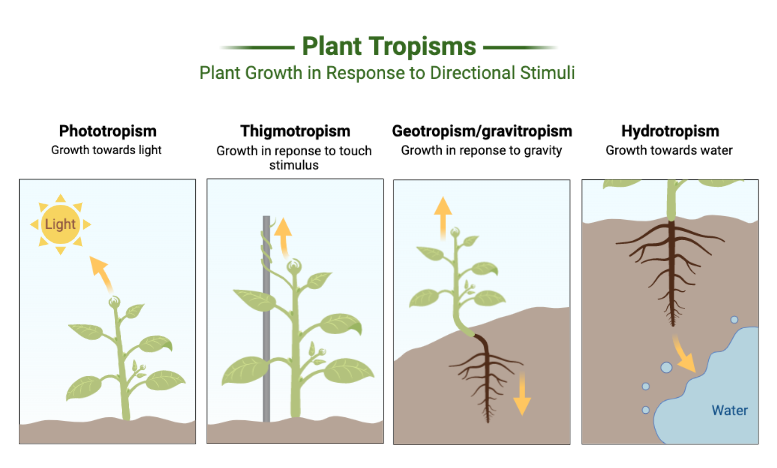
Tropisms: directional growth responses either towards (positive) or away (negative) from a physical environmental factor such as light, water or gravity.
Controlled by hormones such as auxin and ethene.
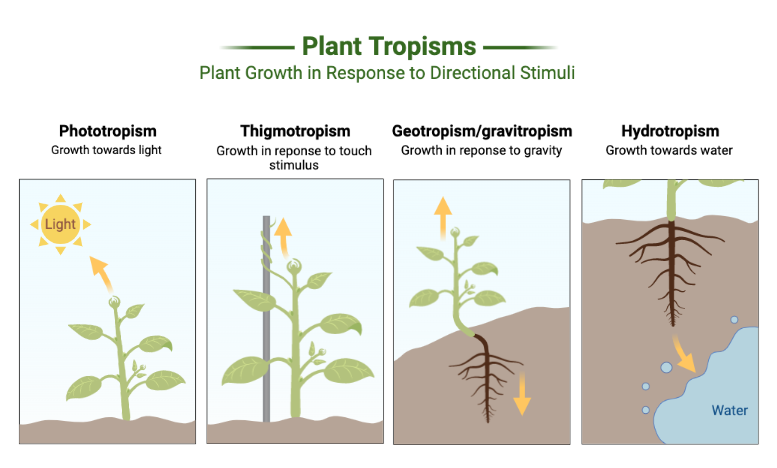
What are the types of tropisms?
Phototropism.
Thigmotropism.
Geotropism/gravitropism.
Hydrotropism.

What is phototropism?
Phototropism: growth towards light.
Example: stems growing towards light.

What is thigmotropism?
Thigmotropism: growth in response to a touch stimulus.
Example: vines growing around poles.

What is geotropism (gravitropism)?
Geotropism/gravitropism: growth in response to gravity.
Example: shoots growing up against gravity, roots growing down with it.