W4- Internal Control
 Call Kai
 Learn
 Practice Test
 Spaced Repetition
 Match
 Flashcards
 Knowt Play
1/28

There's no tags or description
Looks like no tags are added yet.
29 Terms
What is the objective of the auditor in terms of gathering evidence?
Is to design and perform audit procedures in such a way to enable the auditor to obtain sufficient appropriate audit evidence to be able to draw reasonable conclusions on which to base the auditor’s opinion.
What does it mean when we say sufficient and appropriate evidence?
We take into account the quality & quantity of the audit evidence.
What are the 2 main categories of collecting sufficient appropriate audit evidence?
Substantive procedures- tests of details & substantive analytical procedures
Tests of control- testing to see if the internal control systems work properly
What is the definition for internal control systems?
Systems put in place to detect, prevent and control any error or fraud in a timely manner.
How do auditors collect sufficient appropriate audit evidence?
Inspection- reviewing source documents and contracts
Observation- physical verification of assets or a control occurring
Inquiries- When you ask people within or outside the organisation about non-financial or financial information
External confirmation- Obtaining direct written confirmation from a third party
Recalculation- Verifying the mathematical accuracy of source documents (e.g. supplier invoices)
Re-performance- The auditor repeating the exact same procedure as previously performed by the entity’s staff.
Analytical procedures
What is the definition for internal control?
The system designed, implemented and maintained by those charged with governance, management and other personnel, to provide reasonable assurance about the achievement of an entity’s objectives with regard to:
Reliability of financial reporting
Effectiveness and efficiency of operations
Compliance with applicable laws and regulations
What are the tests of controls steps for an auditor?
The auditor assesses whether the control exists through inquiry with the client
Once the control is designed the auditor obtains corroborative evidence that the control is in place
The auditor needs to obtain sufficient and appropriate evidence that control is not only implemented at a point in time but that it has been in place throughout the financial period audited
What is control risk?
The risk of material misstatement that the internal controls of an entity will fail to correct, prevent and deter misstatement in the financial statements on a timely basis.
If the control risk if low do we place more or less reliance on internal control?
We can place more reliance on internal control
Reduce the quantity of detailed substantive procedures
Update audit strategy & plan
If the control risk is high do we rely more or less on internal controls.
Less
Increase the volume of procedures conducted at and after the year-end
Increase the level of substantive procedures ( tests of detail)
Place less reliance on written representation from management
What are the components of internal control?
Control activities
Risk assessment
Information system
Monitoring
Control environment
What are control activities?
Control activities include those activities designed to prevent or to detect and correct errors.
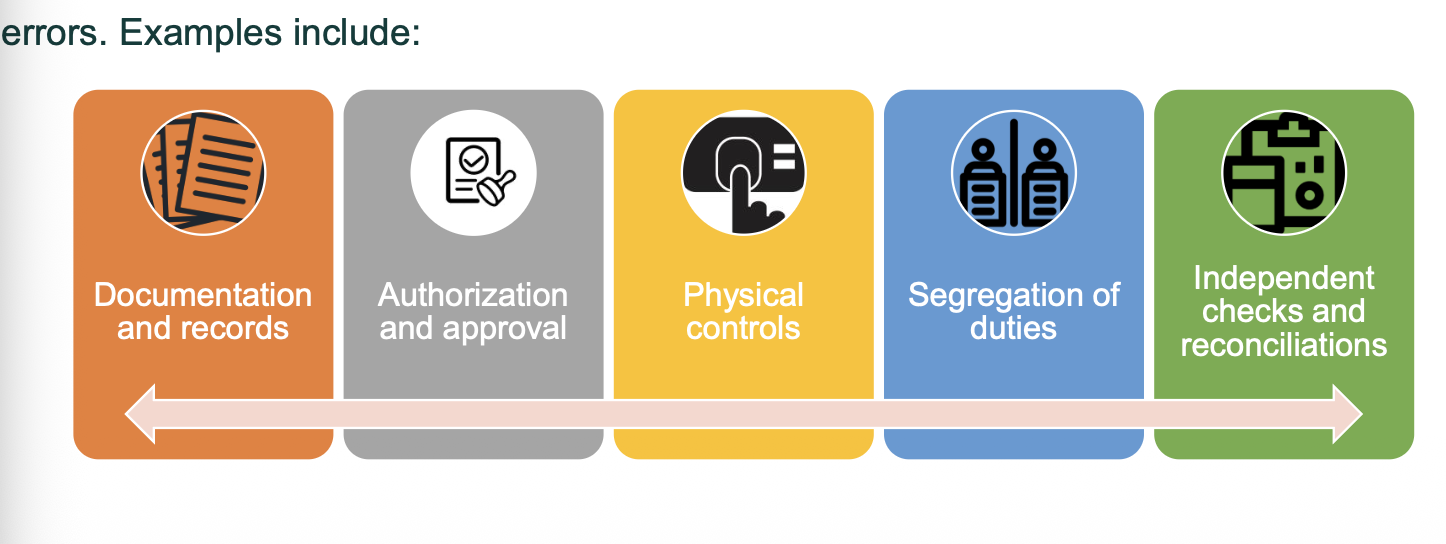
How can an auditor understand the internal control system?
Enquiry- aka you ask around e.g. who has the authority etc
Observation- Observe a control
Inspection- inspect documents, contracts & procedures to understand what is happening
Walkthrough test- You check how a transaction is passing through the system
How do you document internal control system as an auditor?
Narrative- a written description of the system
Flowcharts- diagrammatical representation of the system
Questionnaires
Organization chart
Tests show that a relevant control operated effectively. What can the auditor conclude?
Some substantive testing may be reduced.
What is the revenue & receivable cycle?
It is the process of a sale.

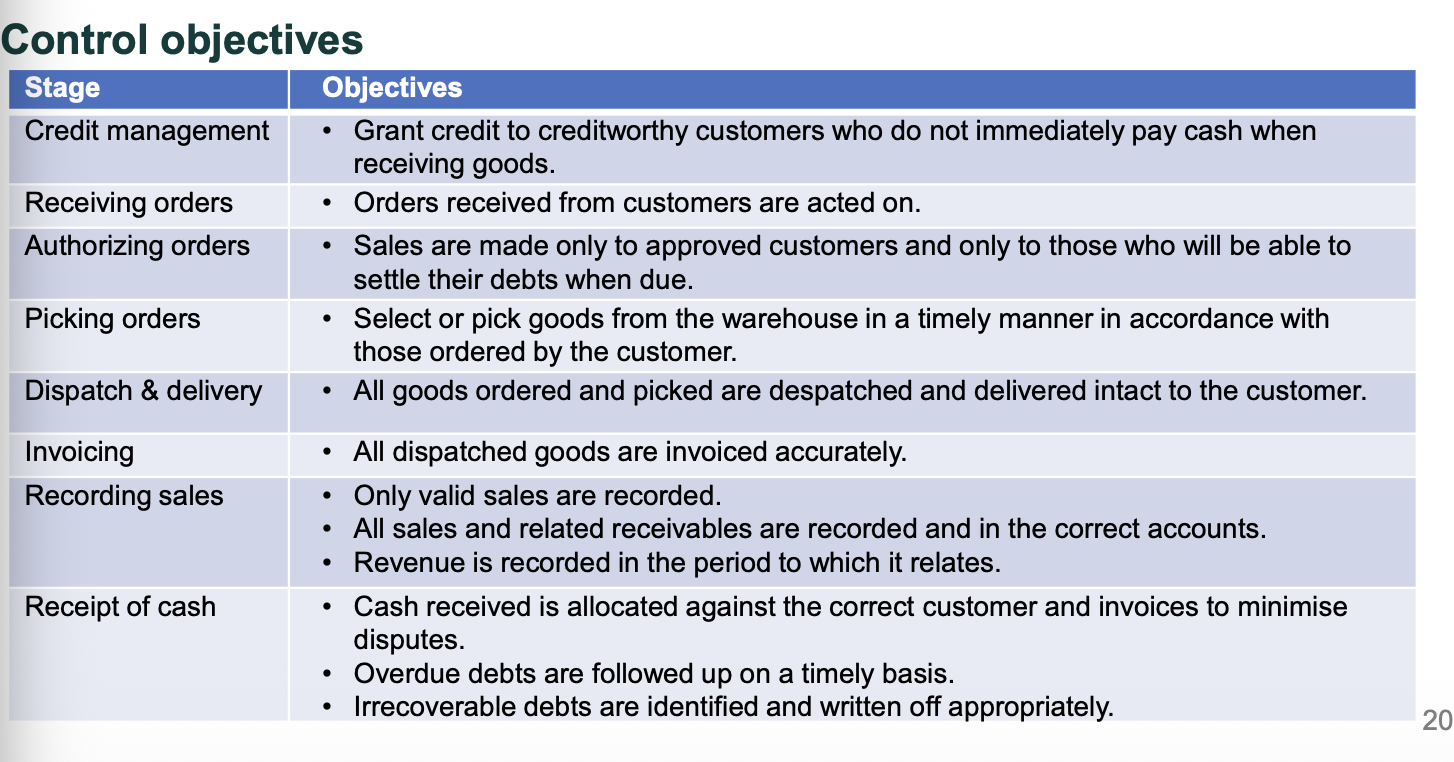
What are the different control objectives at each stage of the revenue & receivable cycle?
Credit management- grant credit to creditworthy customers who do not immediately pay cash when receiving goods
Receiving orders- Orders received from customers are acted on
Authorising orders- Sales are made only to approved customers and only to those who will be able to settle their debts when due
Picking orders
Dispatch and delivery
Invoicing
Recording sales- only valid sales are recorded
Receipt of cash- cash received is allocated against the correct customer
What are the different control objectives of the revenue and receivable cycle? (image)
What are the applicable assertions for sales transactions?
Occurence
Completeness
Accuracy
Cut off
Classification
Presentation
ABC Ltd sells goods to its customers. It carries out a detailed credit check on all customers before it allows customers to purchase goods on credits. Customer accounts cannot exceed USD15 000 at any point in time.
What are the controls? and how to check?
Control 1: New customers subject to credit checks
Select a sample of new customer orders. Enquire of management if the relevant credit checks have been performed. Corroborate by inspecting the supporting documents such as the credit application, proof of income etc.
Control 2: Credit limits set
Select a sample of customer balances at the end of each month and over the full 12-month period. Inspect the balances and confirm that the balances do not exceed USD15000.
What is the purchase & payable cycle?
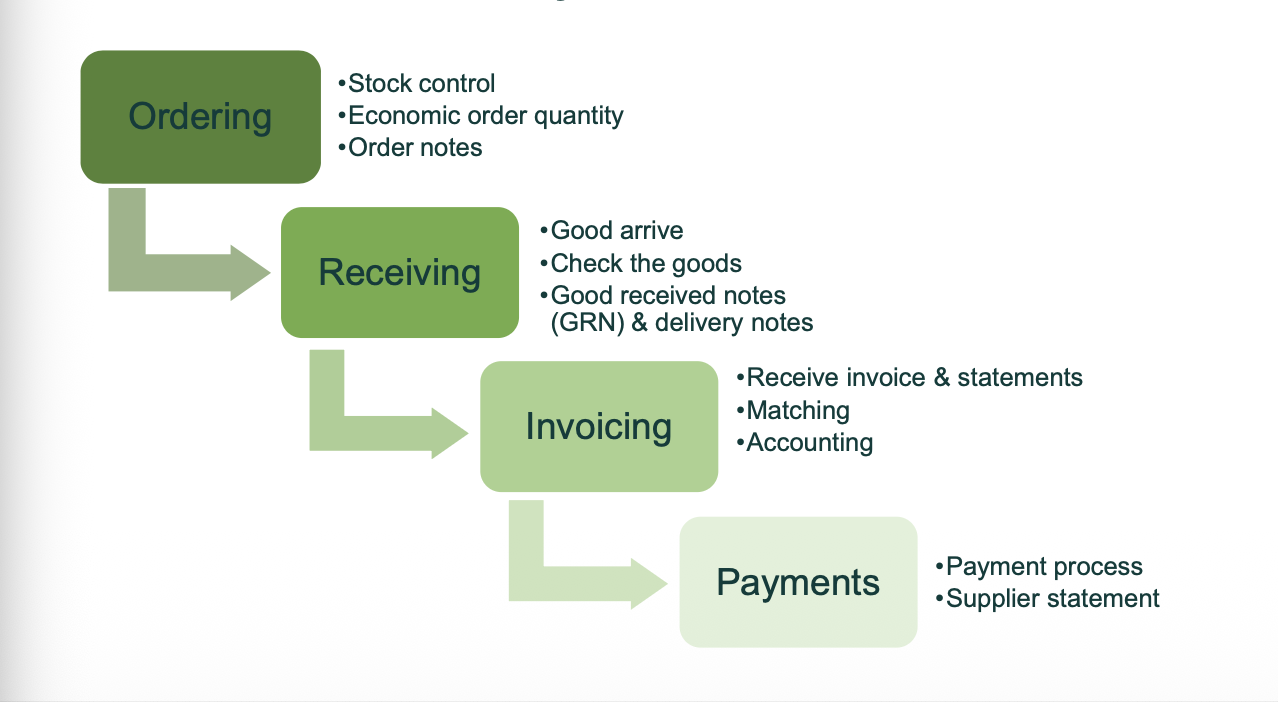
ABC Ltd only orders goods from pre-approved suppliers. This is to ensure that goods are of the correct quality. When ordered goods arrive, they are agreed to the goods ordered note. The delivery note is then signed and filed.
What are the controls in place and how do we check?
Control 1: Use of pre-approved suppliers
Select a sample of orders. Inspect the supplier details and agree these to the details per the pre-approved supplier list to ensure that only pre-approved suppliers are engaged.
Control 2: Ordered goods agreed to order note and delivery note
Observe the client receiving goods to confirm that goods received are inspected and agreed to the order form and delivery note.
What are the different control objectives at each stage of the purchase & payable cycle?
Purchase requisition- The operational and sales requirements are met in a timely manner
Ordering- Purchases are made from reliable suppliers in a cost-effective and timely manner based on approval acquisitions
Receiving goods & invoices
Recording purchase- All valid purchases and related payables are accurately accounted for in the entity’s financial records in a timely manner
Payment preparation
Paying- Pay suppliers based on valid payment documentation
Recording payment
Returning
What are the accounts affected in the purchase & payable cycle?

What is the inventory system?
Takes into account both your revenue and purchases.

What are the control objectives of the inventory system?
Inventory level meets the production needs and customer demand.
Inventory received and dispatched are recorded on a timely basis
All inventory is recorded
Only inventory owned by the company is recorded
Inventory is safeguarded from theft, loss, or damage ( e.g. make sure their is appropriate storage to prveent this)
Inventory should be recorded at an appropriate value
ABC Ltd stores all inventories in a secured warehouse accessible only to authorised staff. Regular inventory counts are performed and compared to inventory records, and any differences are investigated promptly.
What are the controls? and how to check?
Control 1: Access to inventory restricted to authorised staff
Inspect the list of authorised personnel and observe warehouse access procedures
Control 2: Regular inventory counts compared to inventory records
Reperform the comparison between physical counts and inventory records; and inspect documentation of follow-up actions.
What is the definition for a control deficiency?
A deficiency in internal controls exists when a control is designed, implemented, or operated in such a way that it is unable to prevent, correct, or detect misstatements in the financial statements on a timely basis.
Control doesn’t exist OR
Control exists but is not doing an effective job of preventing, detecting, or correcting misstatements on a timely basis
What assertions are applicable for the inventory system?
Existence
Completeness
Accuracy
Valuation and allocation
Cut-off
Right and obligations
Classification
Presentation