Phylogenetic Tree Reconstruction and Distance Methods
 Call Kai
 Learn
 Practice Test
 Spaced Repetition
 Match
 Flashcards
 Knowt Play
1/23

Earn XP
Description and Tags
Vocabulary flashcards covering phylogenetic tree representations, Newick format, UPGMA, neighbor relationships, and the Neighbor-Joining method from Lecture 2.
24 Terms
Gene Tree
A phylogenetic tree whose internal nodes depict substitution events occurring among specific gene sequences.

Species Tree
A phylogenetic tree whose internal nodes represent speciation events between different organismal lineages.
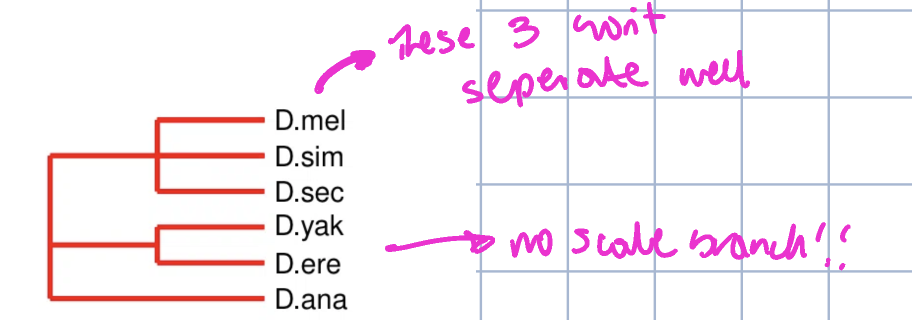
Scaled Tree
A phylogenetic tree in which branch lengths are proportional to the number of evolutionary changes that occur on each branch.

Unscaled Tree
A phylogenetic tree in which branch lengths are not proportional to evolutionary changes, illustrating only the branching topology.
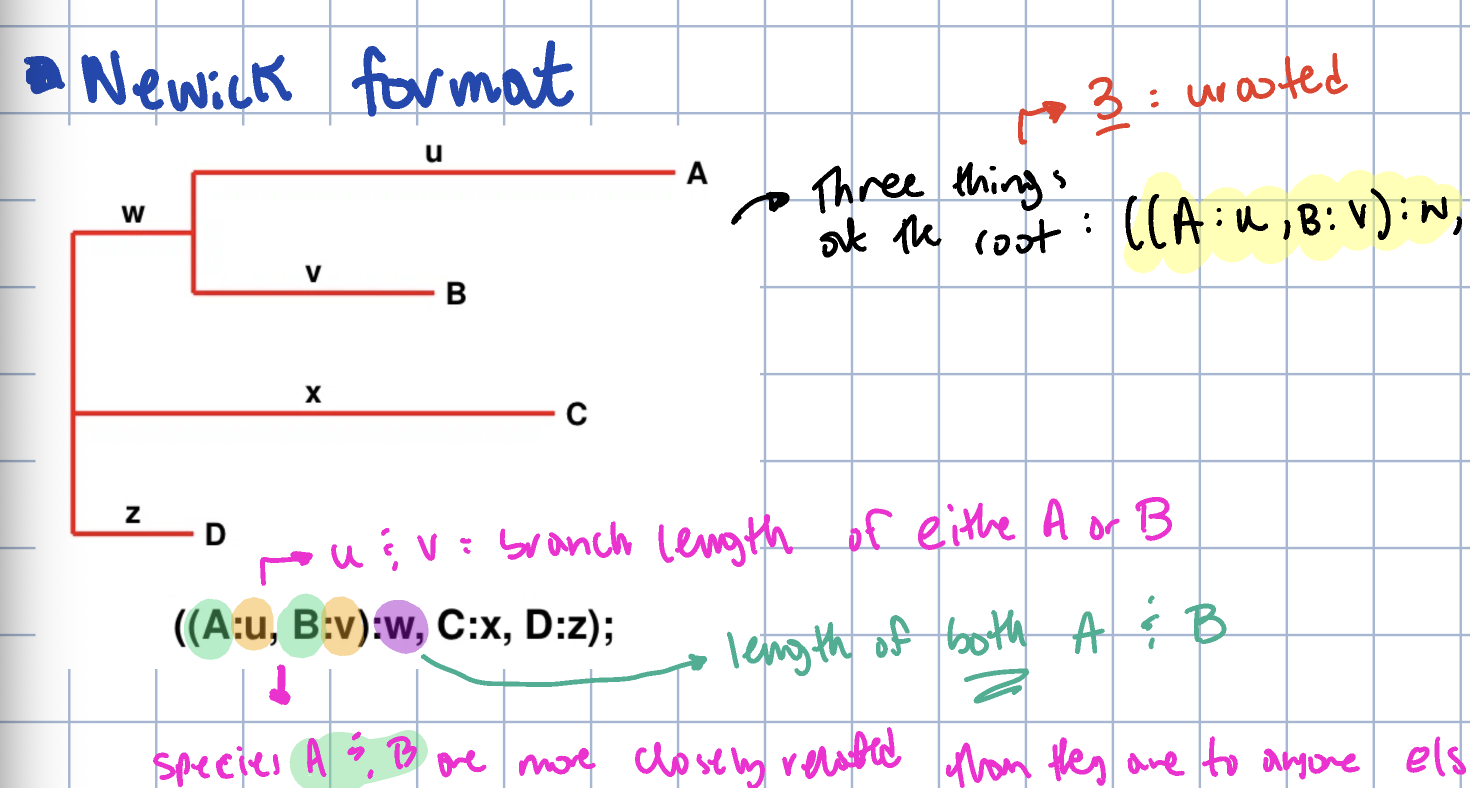
Newick Format
A bracket-based text notation used to represent phylogenetic tree topology and branch lengths using nested parentheses, commas, colons, and a terminal semicolon (e.g., ((A:u, B:v):w, C:x, D:z);).
W - branch length of both A and B
Tree of Life Web Project (ToL)
A collaborative global initiative covering more than 10,000 web pages that documents biodiversity, characteristics, and evolutionary history of organism groups in a hierarchical tree structure.
Distance Methods
Phylogenetic reconstruction methods that calculate pairwise genetic distances from aligned sequences and use clustering algorithms to infer evolutionary trees.
Methods to reconstruct a phylogeny
distance
parsimony
maximum likelihood
UPGMA (Unweighted Pair Group Method)
Unweighted Pair Group Method using Arithmetic Averages; a phenetic clustering method that iteratively joins the most similar taxa and sets branch lengths to half the pairwise distance (2dij).
construct distance matrix
Cluster the two most similar taxa
then repeatedly join together the most similar taxa
At each step of the algorithm, the matrix will lose one OTU
The algorithm will stop when the two last OTUs are clustered
what type of branches does UPGMA permit
only permit bifuracting (2) branches but branch lengths can be zero
Operational Taxonomic Unit (OTU)
A terminal taxon or cluster in a distance matrix; in UPGMA, the matrix loses one OTU at each step until the final two OTUs are clustered.
what does UPGMA assume?
assumes a constant rate of evolution - molecular clock across all lineages, meaning that all taxa evolve at the same rate.
does UPGMA produce an rooted or non-rooted tree?
rooted bc it uses an out group
Molecular Clock
The assumption that the rate of evolutionary change remains constant across all lineages over time; an assumption required by UPGMA that leads to errors when violated.
Strict Additivity
The condition where the pairwise distances in a distance matrix exactly equal the sum of the intervening branch lengths connecting those taxa on a phylogenetic tree.
Neighbor-Joining (NJ) Method
A distance-based tree-building method introduced by Saitou and Nei (1987) that iteratively selects the topology minimizing total branch length without assuming a constant rate of evolution.
does Neighbor-Joining (NJ) have a molecular clock?
No, the Neighbor-Joining (NJ) method does not assume a molecular clock, allowing for varying rates of evolution across lineages.
does Neighbor-Joining (NJ) need an out group for information about the location of the root
YES bc there is no molecular clock
is Neighbor-Joining (NJ) rooted or unrooted?
unrooted trees, as it does not require an outgroup or assumption of a molecular clock.
properties of neighbour joining
does not assume a constant rate of evolution (no molecular clock)
unrooted
topology gives the least total branch length at each step
Outgroup
A known external taxon added to an unrooted tree (such as one generated by the Neighbor-Joining method) to provide an evolutionary reference point and determine the position of the root.
are NJ and UPGMA distance methods?
Both algorithms rely on a distance matrix of pairwise evolutionary distances between taxa rather than analyzing raw character states directly.
are NJ and UPGMA parsimony or cladistic methods?
cladistic
it doesnt use raw data to construct phylogenetic trees.
and emphasizes shared derived characteristics to establish relationships. (similarities)
Advantage of distance methods
is that they can analyze large datasets quickly and efficiently, making them suitable for inferring phylogenetic relationships without complex model assumptions.