6. Fermi-Dirac and Bose-Einestein statistics: the quantum gases
 Call Kai
 Learn
 Practice Test
 Spaced Repetition
 Match
 Flashcards
 Knowt Play
1/50

Earn XP
Description and Tags
part 6 of stat mech notes
51 Terms
What is a quantum gas?
A gas where the number of accessible single-particle states is comparable to the number of particles, so quantum statistics must be used.
What determines whether a particle is a fermion or a boson?
Its spin.
What is a fermion?
A particle with half-integer spin(1/2,3/2…) whose N-body wavefunction is antisymmetric under the interchange of particles
Eg electrons, protons, helium-3 nuclei, etc.
What is a boson?
A particle with integer spin or zero spin whose N-body wavefunction is symmetric under interchange of identical particles
What is the Pauli exclusion principle?
2 or more identical particles (fermions) cannot occupy the same single-particle quantum state.
What is the occupancy number ni?
The number of particles occupying the i-th quantum state when the entire system is at the defined energy Ej
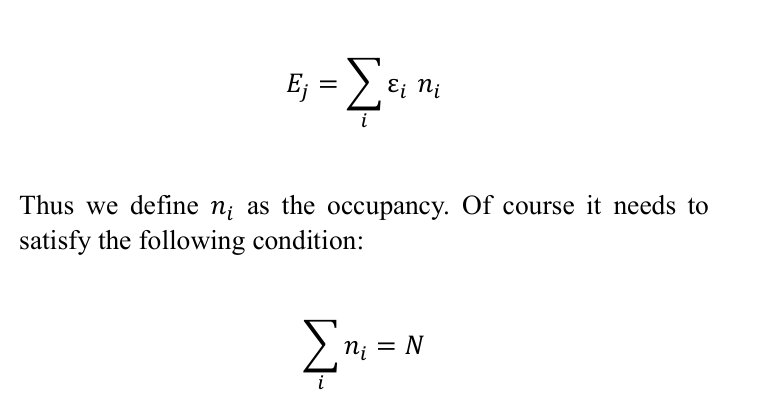
What condition must occupancies satisfy?
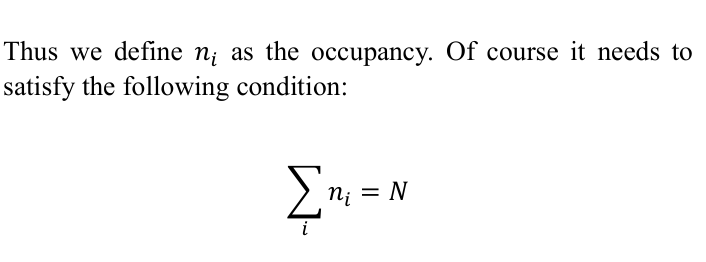
What is the total energy of a configuration?

What occupancies are allowed for fermions?
nk = 0 or 1
Why can fermion occupancies only be 0 or 1?
Because of the Pauli exclusion principle.
What occupancies are allowed for bosons?
nk = 0,1,2,…,∞
What is the fugacity λ?

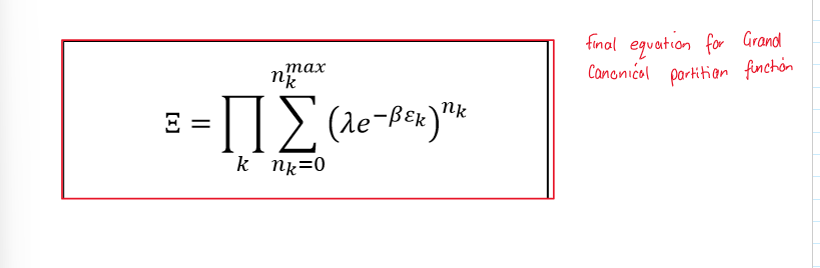
What is the general equation for the grand canomical partitian function?
k- energy state or level
nk- Number of particles occupying energy state k
nkmax - Maximum number of particles allowed in state k
λ-Fugacity, related to the chemical potential
εk- Energy of state k
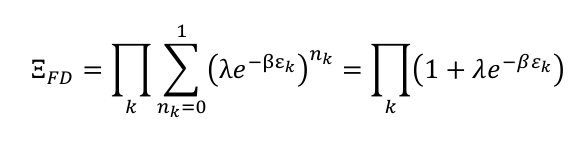
What is the grand canonical partition function for fermions?
What is the grand canonical partition function for bosons?
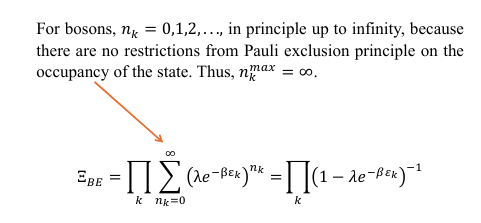
What is the combined quantum gas partition function?

What is the average occupancy of a state k?
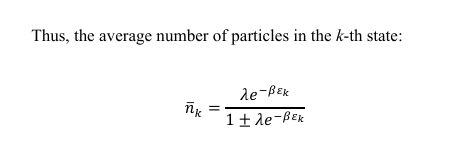
Which sign corresponds to fermions in quantum statistics?
The + sign.
Which sign corresponds to bosons in quantum statistics?
The − sign
What is the Fermi-Dirac distribution function?

What does the Fermi-Dirac distribution give?
The average number of fermions occupying a state of energy ε.
What is special about ε = μ in the Fermi-Dirac distribution?
The occupancy is 1/2
What is the maximum occupancy of a fermion state?
1
What is the Bose-Einstein distribution function?
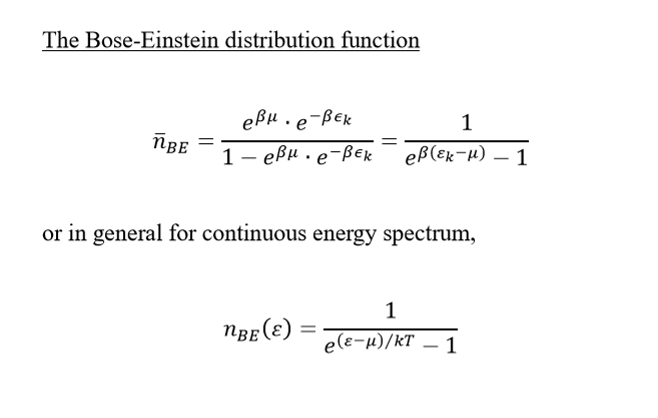
What does the Bose-Einstein distribution give?
The average number of bosons occupying a state of energy ε.
What restriction applies to the boson chemical potential?
μ must be less than the lowest (“ground-state”) energy ε0
This avoids unphysical infinite or negative occupancies nBE
When do Fermi-Dirac and Bose-Einstein statistics reduce to Boltzmann statistics?
In the low-density/high-temperature limit.
What is the classical-gas condition in terms of occupancy?
n(ε) ≪ 1
And a negligible chance of 2 partices trying to share one single particle state
What is the classical-gas condition in terms of particle density?

What is the Boltzmann form recovered at high temperature/low density?

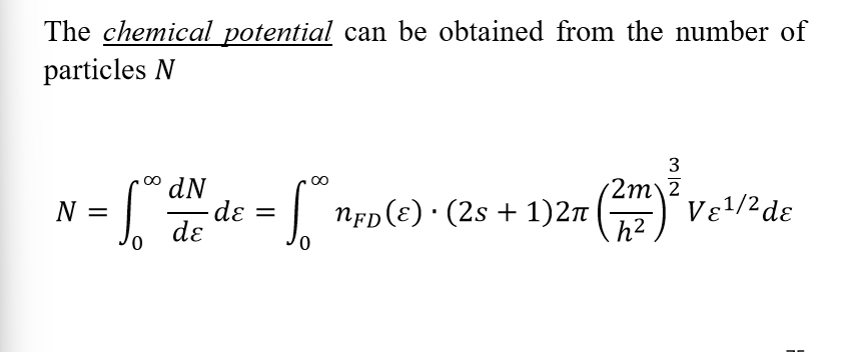
What is the number distribution?

What is the density of states for a particle in a box?

What is the fermion number distribution?
What happens to a fermion gas at T = 0?
All states below the Fermi energy are occupied and all states above are empty.
What is the Fermi energy εF?
The chemical potential μ in the limit T → 0 with the Fermi temperature defined by the equation εF

What is the Fermi temperature?
Rearrange for TF
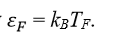

What is the Fermi-Dirac distribution at T = 0?

What is a degenerate fermion gas?
A fermion gas with T ≪ TF.

What characterises a degenerate fermion gas?;Most states below ε_F remain occupied, with only states near ε_F thermally affected.
continiue from here ph 74 in notes
What is a classical fermion gas?;A fermion gas with T ≫ T_F.
What happens to Fermi-Dirac statistics at T ≫ T_F?;They approach the Boltzmann distribution.
What is the Fermi energy for a particle in a box?;ε_F = (h²/2m)[3/(4π(2s+1))]^(2/3)(N/V)^(2/3)
What is the internal energy of an ideal fermion gas at T = 0?;E = (3/5)Nε_F
What is the average energy per particle at T = 0?;E/N = 3ε_F/5
Why is the internal energy non-zero at T = 0 for a fermion gas?;Because the Pauli exclusion principle forces fermions to occupy states up to the Fermi energy.