Plant Lecture FINAL
 Call Kai
 Learn
 Practice Test
 Spaced Repetition
 Match
 Flashcards
 Knowt Play
1/32

There's no tags or description
Looks like no tags are added yet.
33 Terms
Plants can be classified by their… (5)
Origin
Forage value
Growth habit
Season of growth
Lifespan
What is a rangeland?
Expansive area with 70% herbaceous cover and less than 30% woody cover.
Where is the Palouse prairie and where are the California grasslands?
Palouse prairie: washington, oregon, and idaho (Cascades and Rockies)
California grasslands: north central CA (Sierra Nevadas & Coast Ranges)

California grasslands- Regions & Climate
Regions:
Coastal Prairie (most sp. rich grassland in NA)
Central valley (tulare lake, sacramento valley, san joaquin valley)
Mediterranean climate (Winter rainfall)
What is the difference between a determinate and indeterminate inflorescence
determinate- oldest flowers at TOP youngest at bottom
indeterminate- youngest flowers at TOP
4 factors that influence toxicity of a plant?
Part of plant
Growth stage
Soils
Consumer
What are multiple specific ways to differentiate Pinus palustris (Longleaf pine) & Pinus elliottii (Slash pine)?
P. palustris:
cone prickles curve towards base
leaves in fascicles of 3
rough, thick twigs
Straight trunk and horizontal branches
P. elliottii:
cone prickles stand out straight
leaves in fascicles of 2 or 3
smooth, skinny twigs
Trunk can bend at crown and branches ascending
What part of a plant has the highest concentration of glycosides?
What type of plant has the highest concentration of glycosides?
UPPER leaves; YOUNGER plants
What are the traits (8) that an invasive species exhibits?
Grows tall w/ big leaves to shade other plants
Strong resilient roots
Produces flowers with many seeds & good dispersal systems
Rhizomes
Longer growing season (grows earlier in year)
Defensive mechanisms (so not being browsed by herbivores)
Allelopathy (plant produces biochemicals that affect other plants)
Survive wide range of climate conditions
What used to be the main species of the hardwood forest ecosystem? How did the blight kill them?
the American chestnut, Castanea dentata was affected by a blight fungus that girdled them and stripped off the bark, so the plant could no longer absorb nutrients/transport food and water.
A plant is considered poisonous when it expresses what 2 traits?
When touched or ingested it can be harmful or fatal to an organism
Any plant capable of invoking a toxic/fatal reaction
CONIFEROUS FOREST ZONES (traits & indicator species)
How can you tell the difference between Pinus, Picea, & Abies?
Pinus: needles fascicled in groups; cones face down w/ thick woody scales; bark smooth when young, red and rough with age.
Picea: square needles singular and sharply pointed; cones face down w/ thin scales; rough bark throughout life
Abies: flat blunt tipped singular aromatic needles; cones facing upwards; bark smooth and gray when young, furrows w/ age.
2 types of Ergotism caused by the fungus Claviceps spp.
Nervous Ergotism
Gangrenous Ergotism
What is an invasive species? (meets all 4 criteria)
Translocated from a distant range to a non-native range
establishes self-sustaining population in non-native range
experiences rapid population growth and range expansion (in non native range)
Imposes negative ecological impact
what kind of species dominate the climax stage of vegetation in the Southern Pine Region?
Hardwoods! (Does it often reach a climax stage?? no.)
When a glycoside is hydrolyzed it creates what acid that is a common cause of poisoning in livestock?
Prussic acid or Hydrocyanic acid
Most ruminant animals can process what toxin in low doses but at high levels can lead to acute intoxication?
Nitrates
Which grassland ecosystem is now dominated by all annual invasive grasses?
California Central Valley Grassland
Central Valley grassland species (old dom. grass, current dominant grass, forbs)
Old dominant grass: Nasella pulchra
Current dominant grasses: Avena fatua, Bromus spp., Taeniatherum asperum
Forbs: Medicago polymorpha, Trifolium
Describe California Coastal Prairie Grassland:
Persistent fog keeps it moist and green (humid)
Grasses maintained via fire, wind, grazing disturbances
Mainly threatened by urban development
California Coastal Prairie Grassland species
Natives: Deschampsia cespitosa, Festuca idahoensis
Invasive: Holcus lanatus
Describe the Palouse Prairie
Known for wheat production
One of the most ENDANGERED ecosystems in the US (acreage cultivated)
Palouse Prairie dominant sp. (native & non-native grasses)
Native: Festuca idahoensis, Elymus spicatus
Non-native: Poa secunda, Bromus tectorum
Range & Climate of Southern desert shrubland (Mojave desert)
Southeast Cali; Nevada; Arizona; Utah
Intermediate between hot desert grassland & cold desert shrubland
Topography of Southern desert shrubland (Mojave desert)
flat to gently undulating (small mountains and buttes)
280ft - 11,000ft +
Vegetation of Southern Desert Shrubland
short woody species are the major vegetation component, sparse and lot of bare ground
Indicator species: Joshua tree (Yucca brevifolia)
most endemic flora
Cacti, thorny & thornless shrubs, herbs
Common shrub & grass species in Mohave desert (Southern Desert Grassland)
Shrub: Larrea tridentata, Atriplex confertifolia
Grasses: Stipa speciosa, Sporobolus airoides
What is the Southern Desert Shrubland used for?
Mining (iron, silver, gold, tungsten)
Military training (Fort Irwin)
Ranching (winter forage sustains cattle)
Tourist developments (Las Vegas)
Off-road recreation
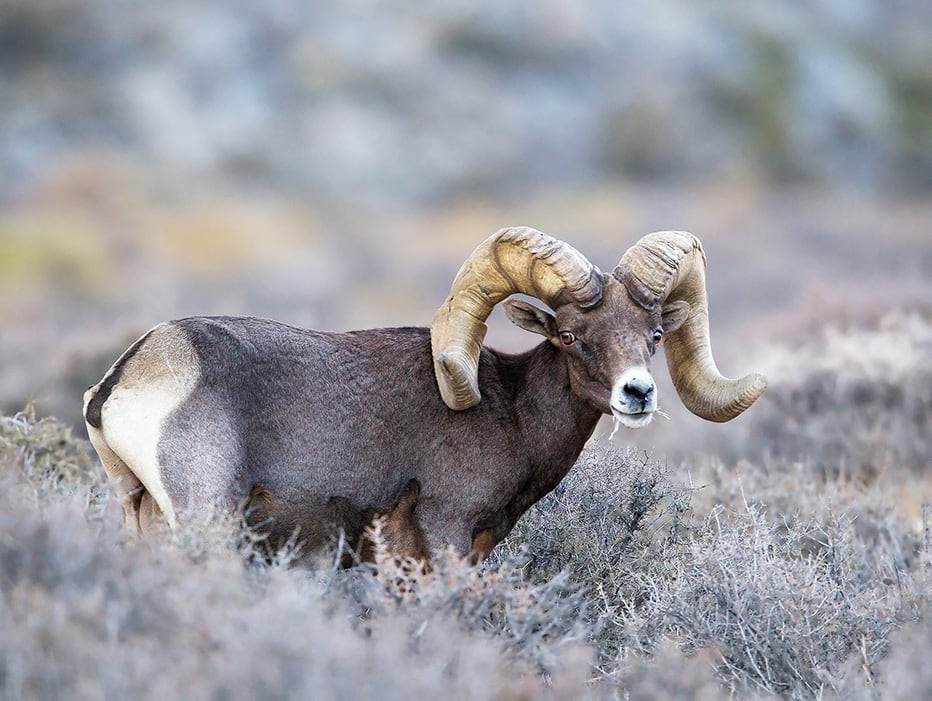
Southern desert shrubland fauna
Desert bighorn sheep! mountain lions, desert tortoise, horned lizard
Range, climate, and land use of Northern Desert Shrubland (Great Basin Desert)
Range: Nevada, Idaho, Oregon, Utah, and California
Climate: Low rain mainly as snow, short growing season, hot dry summer and cold snowy winter (plants are drought tolerant)
Land: majority is unallocated public land administered by Taylor Grazing Act of 1934 (established regulations on grazing)
Dominant species of Northern desert shrubland (woody & grasses & OLDEST NON CLONAL PLANT)
Woody: Artemisia spp., Krascheninnikovia lanata, Atriplex confertifolia
Grasses: Poa spp., Achnatherum hymenoides
World’s oldest nonclonal plant: Pinus longaeva (needles in fascicles of 5, 1-1.5” long)
Northern desert shrubland biological community zones (5)
Shadscale zone: 2,000 ft; Distichlis spicata, Krascheninnikovia lanata, no trees
Sagebrush zone: 4,000 - 6,000 ft; Artemisia tridentata, Bromus tectorum, Juniperus
Pinyon-juniper zone: 6,000 - 8,000 ft; Juniperus osteosperma, Pinus monophyla, Artemisia tridentata
Montane zone: 8,000 -10,000 ft; Populus tremuloides, Abies concolor
Alpine zone: >10,000 ft; low grasses & herbs