L6 - Chemotherapy-induced Nausea and Vomiting (siver)
 Call Kai
 Learn
 Practice Test
 Spaced Repetition
 Match
 Flashcards
 Knowt Play
1/60

There's no tags or description
Looks like no tags are added yet.
61 Terms
Which of the following is true regarding chemotherapy-induced nausea and vomiting (CINV)?
All of the above
What are the adverse effects of chemotherapy-induced nausea & vomiting?
QoL, dehydration, impaired absorption, malnutrition, electrolyte disturbances, treatment delays
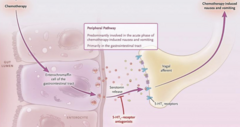
Which of the following best describes the pathophysiology of ACUTE chemotherapy-induced nausea and vomiting (< 24 hours)?
Chemotherapy causes serotonin (5-HT₃) release from enterochromaffin cells, which activates 5-HT₃ receptors on vagal afferent nerves and stimulates the vomiting center.
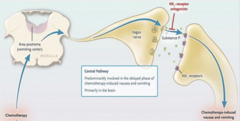
Which of the following best describes the pathophysiology of DELAYED chemotherapy-induced nausea and vomiting (> 24 hours)?
Chemotherapy activates the central pathway, leading to substance P release and activation of NK₁ receptors in the area postrema, inducing vomiting.
What is ACUTE chemotherapy-induced nausea & vomiting (CINV)?
Occurs WITHIN 24 hours after chemotherapy administration, and is mediated primarily through activation of serotonin-receptors in the GI trace
What is DELAYED chemotherapy-induced nausea & vomiting (CINV)?
Occurs any time AFTER 24 hours post-chemotherapy administration
What is ANTICIPATORY chemotherapy-induced nausea & vomiting (CINV)?
Occurs BEFORE administration of chemotherapy
What is BREAKTHROUGH chemotherapy-induced nausea & vomiting (CINV)?
Occurs within 5 days of chemotherapy administration, despite the use of guideline recommended anti-emetic therapy
What is REFRACTORY chemotherapy-induced nausea & vomiting (CINV)?
Persistent nausea & vomiting not relieved by guideline antiemetic agents in subsequent chemotherapy cycles after guideline directed therapy FAILS
Which of the following are risk-factors of chemotherapy-induced nausea & vomiting (CINV)?
1. Younger age
2. Female >> Male
3. Little or no history of alcohol consumption
4. Prior CINV with previous cycle
5. High emetogenic potential of chemotherapy regimen
6. Concomitant drug therapy (i.e. Opioids)
Which of the following correctly describes the classification of chemotherapy-induced nausea and vomiting (CINV) risk based on emetogenic potential?
High (≥90%), Moderate (30-90%), Low (10-30%), Minimal (less than 10%)
Which of the following best describes how the overall emetogenic risk of a combination chemotherapy regimen is determined?
The chemotherapy agent with the highest emetogenic potential determines the risk classification for the entire regimen.
The AC combination is defined as .....
Chemotherapy regimen that contains Anthracycline + Cyclophosphamide
Which of the following are HIGH emeteogenic parenteral chemotherapeutic agents?
Cisplatin and Fam-trastuzumab Deruxtecan
Which of the following chemotherapy combinations is ALWAYS classified as having a HIGH emetogenic risk, regardless of dosage?
Anthracycline + Cyclophosphamide (AC regimen)
Which of the following best describes the recommended duration of antiemetic therapy following multi-day chemotherapy?
3 days after HIGHLY emetogenic regimens and 2 days after MODERATELY emetogenic regimens
What is the MOA of Serotonin receptor antagonist (5-HT3RA's)?
Blocks serotonin, both peripherally on vagal-nerve terminals and centrally in the chemoreceptor trigger zone
Serotonin receptor antagonist (5-HT3RA's) are used for ....
The prevention of ACUTE CINV, and treatment of breakthrough + refractory CINV
What are the class side effects associated with the use of Serotonin receptor antagonist (5-HT3RA's)?
Constipation, QTc prolongation, Serotonin Syndrome
Which of the following 5-HT₃ receptor antagonists is indicated ONLY for the prevention of ACUTE chemotherapy-induced nausea and vomiting (CINV), NOT for breakthrough treatment?
Palonosetron
Which of the following 5-HT₃ receptor antagonists has the LOWEST risk of QTc interval prolongation?
Palonosetron
Which of the following 5-HT₃ receptor antagonists is associated with an increased risk of QTc interval prolongation, particularly with single IV doses greater than 16 mg or total daily doses greater than 24 mg?
Ondansetron
Which serotonin receptor antagonist (5-HT3RA's) is available as a SUBQ injection or transdermal patch?
Granisetron
Which of the following adverse effects is associated with supratherapeutic doses of palonosetron (Aloxi®)?
Bradycardia
________ has the longest half-life among the 5-HT₃ receptor antagonists (~40 hours).
Palonosetron
What is the MOA of Neurokinin-1 (NK1) Receptor Antagonists?
Inhibits the substance P/neurokinin 1 (NK1) receptor; augments the antiemetic activity of 5-HT3 receptor antagonist and corticosteroids
Neurokinin-1 (NK1) Receptor Antagonists are used for ....
Prevention of ACUTE and DELAYED phases of CINV (in combination with a 5-HT3 agonist and/or steroids)
What are the side effects associated with the use of Neurokinin-1 (NK1) Receptor Antagonists?
Fatigue, hiccups, diarrhea
Which of the following NK₁ receptor antagonists should NOT be administered with ifosfamide due to an increased risk of neurotoxicity?
All of the above
Which of the following NK₁ receptor antagonists is associated with major CYP3A4 inhibition and potential drug interactions?
All of the above
What is the MOA of corticosteroids, such as Dexamethasone?
Precise mechanism is largely unknown in CINV, theories suggest antiemetic effect may be due to interactions with various CNS receptors located centrally in the medulla
Corticosteroids, such as Dexamethasone, is used for the prevention of ...
ACUTE and DELAYED CINV in combination with other agents, and treatment of breakthrough and refractory CINV
What are the side effects associated with the use of Dexamethasone?
Insomnia, increased appetite, hyperglycemia, fluid retention, emotional lability, dyspepsia (H2RA/PPI)
What is the recommended dose of dexamethasone on Day 1 for highly emetogenic chemotherapy regimens when combined with an NK₁ receptor antagonist and a 5-HT₃ receptor antagonist?
12 mg IV/PO
Which of the following best explains why dexamethasone may be omitted from preventive antiemetic regimens in certain leukemia or lymphoma patients?
Corticosteroids may already be included as part of the chemotherapy regimen.
Which of the following best describes the use of dexamethasone as an antiemetic in patients receiving CAR T-cell therapy?
Avoid dexamethasone as an antiemetic for 3-5 days before and 90 days after CAR T-cell therapy.
What is the MOA of dopamine receptor antagonists?
Blocks multiple receptors associated with CINV: serotonin, dopamine-1, dopamine-2, histamine, and alpha-1 adrenergic
Dopamine receptor antagonists are used for ....
All of the above
What are the side effects associated with the use of dopamine receptor antagonists?
Extrapyramidal symptoms (EPS)
Which dopamine-2 receptor antagonists is used for ACUTE and DELAYED CINV?
Olanzapine
What are the toxicities associated with the dopamine-2 receptor antagonist: Metoclopramide
Tardive Dyskinesia
What are the toxicities associated with the dopamine-2 receptor antagonist: Olanzapine and Haloperidol?
QTc prolongation and anticholinergic effects
What are extrapyramidal symptoms?
Characterized by intermittent involuntary spasmodic contractions of muscles (most common → dystonia)
Which of the following combinations increases the risk of EPS?
1. Metoclopramide + Promethazine
2. Metoclopramide + Olanzapine
3. Metoclopramide + Prochloperazine
4. Olanzapine + Metoclopramide
What is the treatment of dystonic reactions (extrapyramidal symptoms)?
Diphenhydramine (or Benztropine is allergy to diphenhydramine)
What is the MOA of Benzodiazepines?
Enhance the inhibitory effect of GABA-A receptors and has anxiolytic and amnestic properties for CINV
Benzodiazepines are used for the treatment of ....
Breakthrough, refractory, or anticipatory CINV
What are the risks associated with the benzodiazepine: Lorazepam?
BBW for risks (respiratory depression) associate with concomitant opioid use -- use with caution in patients for fall risks
What is the MOA of antihistamines?
Competitive inhibition of H1 receptors on the cells in the GI tract, and vomiting center (NTS)
Antihistamines are used for ...
Breakthrough CNV
What is a class side-effect associated with the use of Antihistamines?
Anticholinergic effects (blurry vision, urinary retention, mydriasis)
The antihistamine ________ was available as a patch behind the ear
Scopolamine
What is the MOA of cannabinoids?
Activation of cannabinoid CB1 and CB2 receptors in both the brainstem and vomiting center (NTS)
Cannabinoids are used for ...
Breakthrough and refractory CINV
Which of the following parenteral antiemetic regimens is recommended on Day 1 for the prevention of chemotherapy-induced nausea and vomiting (CINV) in patients receiving HIGHLY emetogenic chemotherapy (HEC)?
Olanzapine + NK1RA + 5-HT3RA + Dexamethasone 12 mg IV/PO once
Which of the following parenteral antiemetic regimens is recommended on Days 2-4 for the prevention of chemotherapy-induced nausea and vomiting (CINV) in patients receiving HIGHLY emetogenic chemotherapy (HEC)?
Olanzapine + Aprepitant + Dexamethasone 8 mg IV/PO daily
Which of the following parenteral antiemetic regimens is recommended on Day 1 for the prevention of chemotherapy-induced nausea and vomiting (CINV) in patients receiving MODERATE emetogenic chemotherapy (MEC)?
1. 5-HT3RA + Dexamethasone 12 mg IV/PO once
2. Olanzapine + Palonosetron + Dexamethasone 12 mg IV/PO once
3. NK1RA + 5-HT3RA + Dexamethasone 12 mg IV/PO once
Which of the following parenteral antiemetic regimens is recommended on Days 2-4 for the prevention of chemotherapy-induced nausea and vomiting (CINV) in patients receiving MODERATE emetogenic chemotherapy (MEC)?
1. Dexamethasone 8 mg IV/PO once OR 5-HT3RA mono-therapy
2. Olanzapine
3. Aprepitant +/- Dexamethasone 8 mg IV/PO daily
Which of the following parenteral antiemetic regimens is recommended for the prevention of chemotherapy-induced nausea and vomiting (CINV) in patients receiving LOW emetogenic chemotherapy (LEC)?
Dexamethasone or Prochloperazine or ORAL 5-HT3RA
What is the preferred parenteral agent for the management of breakthrough CINV?
Olanzapine
Which of the following medications can be used for prevention of anticipatory chemotherapy-induced nausea and vomiting (CINV)?
Lorazepam (night before) or Olanzapine (single dose)