Marketing Chapter 4 & 5 (Market Research & Consumer Behaviour)
 Call Kai
 Learn
 Practice Test
 Spaced Repetition
 Match
 Flashcards
 Knowt Play
1/24

There's no tags or description
Looks like no tags are added yet.
25 Terms
Marketing Research Process

What are the 3 functional roles market research/analysis plays in an organization?
descriptive (factual statements)
diagnostic (relationships within data)
predictive (predicting results of decision)
Marketing Research Process — Step 1: Identify and Formulate
determine if there is enough info to define problem
output (results) depend on input
“garbage in, garbage out”
Marketing Research Process — Step 2: Plan Research Design & Gather Secondary Data
Research Design → what questions to answer, gather, analyze
Secondary Data → data that already exists, internal in org but external publicly

Research Design Process — Types of Research
Exploratory: informal, gain insights of problem
collection of secondary and qualitive data
e.g. case studies, focus groups, expert interviews
Conclusive: attempts to provide clarity, identify course of action
descriptive (describe marketing characteristics - used in business)
collection of quantitative data
casual (cause and effect of 2 variables, find relationship - used in academic research and environments)
collection of qualitive data

Marketing Research Process — Step 3: Specify Sampling Procedures
Sample → subset from large population
opinions, behaviours, attitudes, preferences
Must be representative of population
if YES = probability sample (every element could be selected)
if NO = nonprobability sample (little or no attempt)

Marketing Research Process — Step 4: Collect Primary Data
Primary: new info collected (through Qualitive and Quantitative)
Quantitative (needs to clear aspect of problem, requires understanding)
survey research (online, mail, telephone)
observation research (mystery shoppers)
Qualitive (needs specific numbers, to analyze data to provide stats info)
depth interview (one to one)
focus group (small groups, guided discussions)

Marketing Research Process — Step 5: Analyze Data
interpret, draw conclusions from the collected data
organize and analyze by techniques (proportion, regression)
Marketing Research Process — Step 6: Prepare & Present
clear, concise statement of
research issue studied
research objectives
brief explanation of research design employed
summary of major findings, build case how problem solved
Marketing Research Process — Step 7: Follow Up
conducted whether marketing researcher is external or internal provider
Internal (answer further questions, support decisions)
External (schedule follow-up with client to manage relationship)
Types of Primary Data

Second vs Primary Data

Impact of Tech on Marketing Research

Different Categories of Data
Structured (easily defined and organized)
similar to info found in excel sheet (clear category, precise values
e.g. customer lists, sales transactions, demo data, webs
Unstructured (not easily defined and organized)
contents of data that does not belong to clear category, undefined values
e.g. audio, video, photos, slides, social media posts, blogs, emails
Data Mining
sorting through large sets of data to find patterns and relationships
Consumer Behaviour
how consumers
make purchase decisions
use/dispose of purchased goods/services
can be affected by factors that influence decisions and product use
price, environment impact, value, view of themselves
Consumer Decision Making Process

Consumer Decision Making Process — Step 1: Need Recognition
Need Rec: result of imbalance between actual/desired states
imbalance, triggered when expose to internal or external stimulus
Internal Stimuli → within your body (hunger or thirst)
External Stimuli → influences from outside source
e.g. rec of restaurant, design of package, advertisement on TV
Consumers recognize unfulfilled needs in various ways…
when a current isn’t performing properly
when the consumer is about to run out of something, generally kept on hand
Consumer Decision Making Process — Step 2: Info Search
Internal → recalling info stored in one’s memory
External → process of seeking info in outside environment
nonmarketing controlled (doesn’t originate from company)
personal experience, personal sources, public sources
marketing controlled (originates within marketers promoting)
sales promotion, packaging/labelling, social media
consumer to consumer (past consumers post reviews)
C2C transparent and willing

Consumer Decision Making Process — Step 3: Evaluation of Alternatives & Step 4: Purchase
Consumer will
use info in memory or obtained from outside sources to develop criteria
uses it to evaluate and compare alternatives

Consumer Decision Making Process — Step 5: Postpurchase Behaviour
Consumers expect certain outcomes from purchase
depends if purchase was good or not
Fail to confirm decision = Cognitive Dissonance (buyer’s remorse)
realize inconsistency between behaviour, values, opinions
Marketers have to ensure outcomes meets or exceeds expectations

Types of Consumer Buying Decisions

Factors Determining Involvement Levels
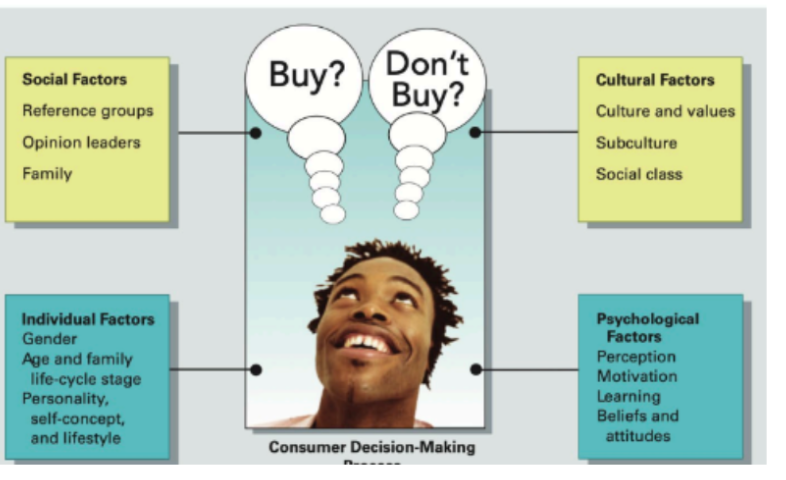
Factors that affect Consumer Buying Decisions

Influences on Consumer Buying Behaviour