Ise 402 Exam 2 Study Guide
 Call Kai
 Learn
 Practice Test
 Spaced Repetition
 Match
 Flashcards
 Knowt Play
1/138

There's no tags or description
Looks like no tags are added yet.
139 Terms
ch.7 job anaylis
job analysis
a method for describing jobs and/or the human attributes necessary to perform them.
It is a systematic procedure.
standardized job description.
two perspectives job analysis
Task-oriented💮
Person-oriented-💮
Combined- applies both
💮Task-oriented
- describing job
What do workers do on the job?
Position
Duty
Task
Activity
Element
When to use Task-Oriented only?
Limited time or resources
Identify what people do, and not how well someone does it
Questions to ask
Importance of the task
Frequency of task
💮Person-oriented JA (KSAOs)
describes human attributes necessary to perform that job
What kind of workers are suitable for this job?
Knowledge (what the worker should know)
Skill (what the worker can do, usually able to be changed/developed)
Ability (what the worker can do, but usually stable)
Other Characteristics
When to use
Limited time or resources
Identify who performs well, but not what they are doing
Questions to ask
Importance of the KSAO for performing the job well
Stability or can be trained?
Link to task

Positions
a specific job a person occupies
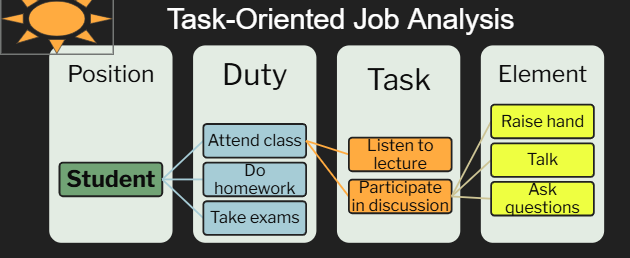
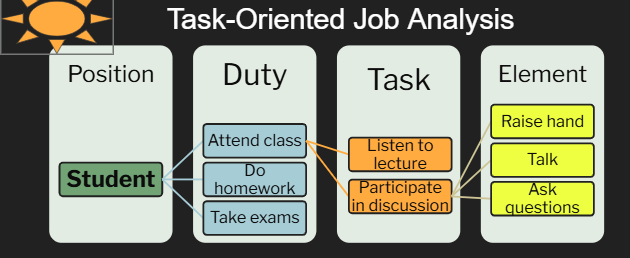
Duty-
segment made up of a collection of different tasks


Task
-an activity you do for a distinct purpose; help you accomplish something


Element-
smallest movement a person can make as part of job; completes no goal; interdependent

Ja foundation
Describe and understand a job
Tell employees what to do
Determine pay level (Job evaluation)
Select qualified candidates (Selection)
Train employees on important aspects (Training)
Evaluate employees on whether they did a good job (Performance appraisal)
Compare different jobs
Justify why some jobs are more important or valuable
Designing jobs and work groups
Create a position that includes relevant job components
Add new components to a current job that makes sense
Planning careers
Help individuals to find suitable positions
Legal Function of JA
Decisions are usually made based on:
Whether the job candidate has certain qualifications.
Or whether the worker has a certain level of performance, etc.
Good (legal) decisions needs to use
Job relevance
Essential functions
Summarry of JA

JA in Research
job target
define methods
collect data
anylzye data
write job description

Methods of Job Analysis
Observation
Interview/Focus Group-
JA Questionnaires-
Critical Incidents
Existing Data Sources
Methods of Job Analysis- Critical Incidents-
open-ended survey for snitching
Methods of Job Analysis-JA Questionnaires-
surveys
Methods of Job Analysis-Interview/Focus Group-
interactive q&a
Methods of Job Analysis-Observation-
watching someone do there job
Data Collection JA
Subject Matter Experts (SMEs) (interview)
the person doing the job
Job incumbents (can be yourself)
Supervisors
Outsiders’ Perspective (Observation)
Job analysts
Trained observers
Second hand information (Exisiting data)
Online database (O*NET, etc.)
Other archival data
Existing tools
⭐Task inventory
Using an existing list of specific tasks
Respondents (SMEs, observers) rate each task based on some questions of interest.
O*NET
PAQ

Data Source Consideration
Demographics (Race, Gender, etc.)
Experience of subject matter expert- more experienced vs
Performance Quality of SME
Enjoyment of Task- sme talk about what they like abt job
Concern Over Pay, Promotion, Retention
Supervisor vs. Incumbent?
Supervisor- know KSA better
Incumbent- know task more
Suggested Process for Job Analysis
Preliminary Research- use existing data to identify tasks & kso
Job Observations & Employee Interviews- fill in what's missing; shadow person
focus Groups- double checking accuracy
Questionnaire (Task, KSAOs Linkage)- survey
SME Review of Final List-
New Trends in Job Analysis
Job analysis for groups/teams
⭐Competency modeling
Focuses on more general “competencies” suitable for a range of job positions.
It covers a range of KSAOs.

Job Audit
-Condensed version of a job analysis
Reasons to use
Completely new position with newly created duties
Expecting only VERY minor changes to an existing position
Reason to Avoid
Most of the time
Unsure of how much a job has changed
Not legally defensible
Ch 8 Task Preformance/Criteria
performance-
how well they are doing their job and can they do it better
Ways of conceptualizing performance
goal success indicator
problem identifier
source of credibility
Importance of Performance and Performance Measurement
to figure out how to develop stronger employees

Multilevel Issues-
measure issues at different levels
Who is the good employee?
Rewards: recognitions, promotions, pay raises, etc.
Punishments: demotions, termination (firing), etc.
How to make employees to be good?
Feedback
Individualized Development
Prediction: related predictors to performance
Who is likely to be a good employee?
How to measure performance
Criterion💮- Set up a standard of comparison that defines good performance.
Methods- Develop a procedure to compare employees to this standard.
Criterion 💮
a standard by which one can judge the performance of anything, including a person
Distinguishes “good” from “poor” performance
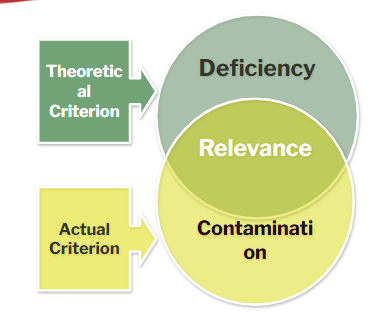
Theoretical vs. actual criterion
Theoretical
Actual
***When these two criteria do match, a criterion problem occurs.
Critiea- Theoretical
– theoretical definition/construct of what good performance is
Critiea- Actual
way in which performance is measured/operationalized
Criteria-Instability
Is performance always the same?
Typical Performance-
Maximal Performance
Minimal Performance-
Criteria-Instability- Minimal Performance-
lowest performance
Criteria-Instability- Maximal Performance
- peak performance
Criteria-Instability- Typical Performance-
average performance
Pattern Criteria
Are patterns as simple as constant, increase, and decrease? not constant
Dimension Criteria
Unidimensional
Multidimensional-
How to deal with multiple criteria?
Be methodical and careful; combine using a logic that aligns with the data
Dimension Criteria-Unidimensional
- Measures a single underlying trait, dimension, or factor
Dimension Criteria-Multidimensional
- Measures multiple distinct traits, factors, or dimensions
Relevance:
The actual assesses the theoretical it was designed to measure (i.e., construct validity)
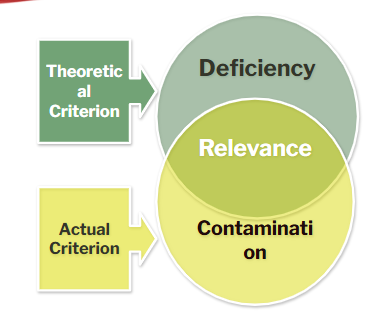
Deficiency:
The actual fails to capture the theoretical (i.e., low content validity)

Contamination:
The actual measures something other than the theoretical
Can stem from biases
Task Performance-
what your hired to do
Essential to understanding performance quality
Factors that affect Task Performance
Capability
Knowledge and Skills
Physical and Mental Abilities
Motivation
Goals
Incentives
Interest
Types of Task Criteria
Performance Quality vs. Performance Quantity
judgmental measurement vs. non-judgmental measurement
Performance Quality vs. Performance Quantity
Performance Quality- quality of task that is done
Performance Quantity- # of task done
ch9 Contextual Prefomance
Contextual Performance-
Different from task performance
Not in job description⭐⭐⭐
Includes behaviors that
Enhance the organization or the people in it
Hurt the organization or people in it
Why care about contextual Performance
Has an impact on company profit/success
Has an impact on success of other employees
Contextual Performance Tree💮
Organizational Citizenship Behavior (OCB)
Counterproductive Work Behavior (CWB)-

Organizational Citizenship Behavior (OCB)- 💮
Tasks that benefit the company
not included in job decript
A type of positive behavior
OCB Types- Organizational-
directly benefiting the company
ex. employee volunteers to take on additional responsibilities after the sudden departure of a coworker.
OCB Types- Interpersonal
employees goes above and beyond to help a fellow employee, aka helping employee
Predictor of OCB
job Satisfaction- happy employee
Personality Characteristics- agreeabness to help
Affective Disposition- emotional state
Leadership- encourage/motivation
Perceptions of Fairness- treated fairly
Affective Commitment - devotion to work
Outcome of OCB
Enhanced performance of coworkers, teams, and/or company
Decreased stress and emotional exhaustion in coworkers
Improved team dynamics
💮Counterproductive Work Behavior (CWB)-
tasks that cause harm to the company or other people at work
Withdrawal: absence & lateness (not due to illness), turnover, Aggression, bullying, harassment (toward other individuals)
Sabotage
CWB Types- Interpersonal
cause harm to employee
ex. harassment
CWB Types- Organizational
- cause harm directly to company
ex. stealing from company
Predictor of CWB
Job Satisfaction- unhappy employee
Personality Characteristics- gloomy, dark triad
Affective Disposition
Interpersonal Conflict- chain affect
Perceptions of Fairness- treated unfairly
Outcome of CWB
Decreased company/team performance
Lost company revenue
Toxic or negative work environment
Decreased work satisfaction
Contextual Preformance as Critieria
Hard to use OCBs in formal evaluations
CWB 👉 result in formal displine
CWB hard to catch
ch. 10 judgmet vs non judgement criteria/ perfomance appraisal
Critea- judgmental type, non judgement digram
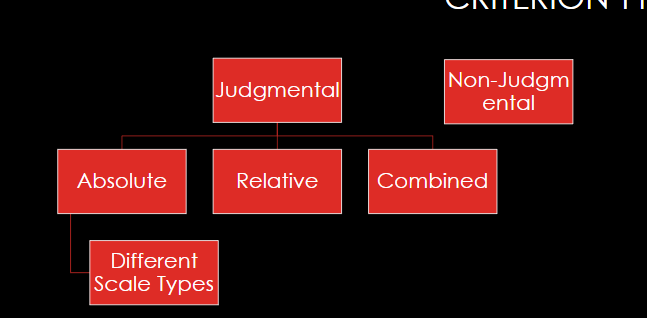
Non-judgmental Measures
Counts of behaviors (quantitative)
Ex. # of absenteeism, # of units made
Advantages
Consistent standards within jobs
Not biased by judgment
Easily quantified
Disadvantages
Not always applicable
Too simplistic, and often deficient
Judgmental Measures
Involves people’s judgments about performance.
Advantages:
Applicable to various criteria
Disadvantages:
Hard to quantify
Can be biased by judgment
360 Degree feedback:
multiple perspectives
Good for development purpose
Raters
Supervisor
Coworkers/team members
Self
Customer
Subordinates

Types of Judgmental Measures💮
Absolute-
Relative
Combined (One example-Anchor and Order Method)
Compares employees to a standard and then to each other
Types of Judgmental Measures- Absolute💮
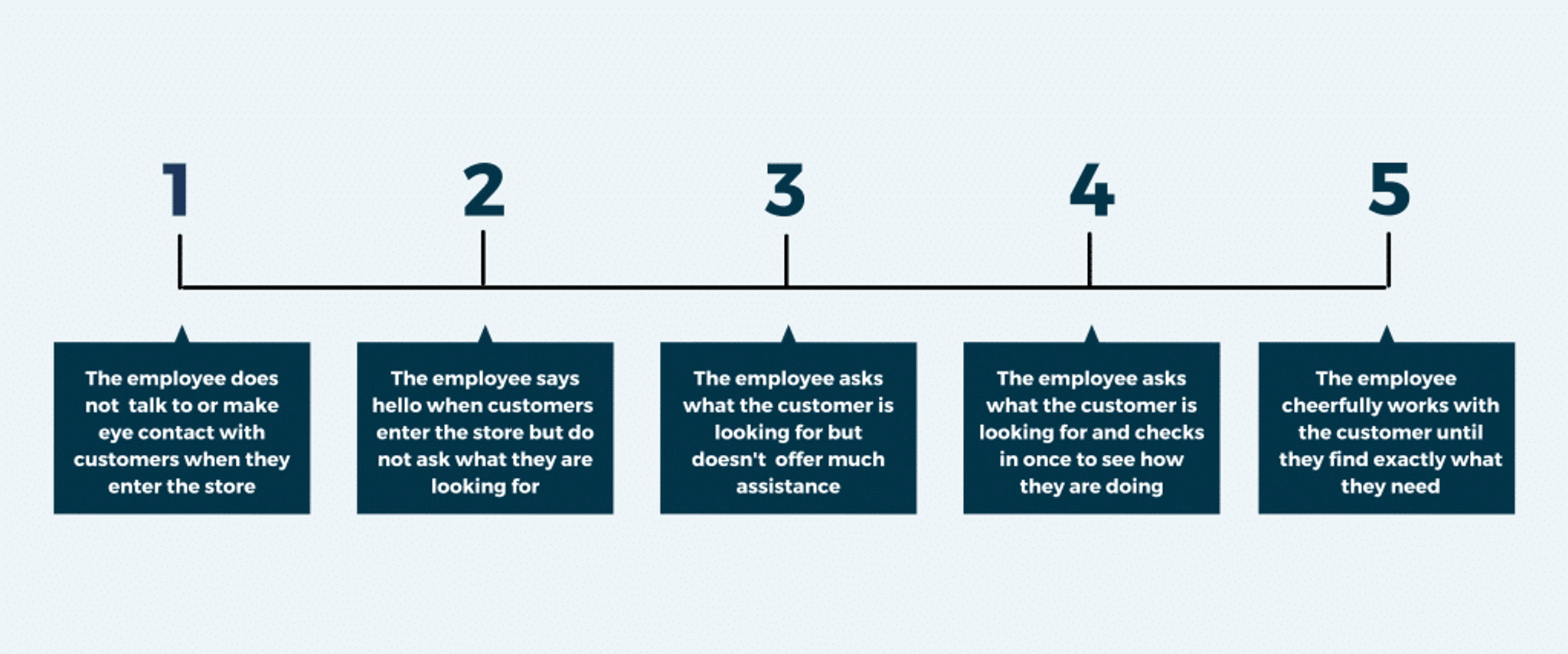
Compares employees to a standard
Absolute Rating Types
Graphic Rating Scales
Behavior Expectation Scales
Behaviorally Anchored Rating Scales
Computer Adaptive Scales
Frame of Reference Scales
Graphic Rating Scales
focus on a scale
Con: out of date; and vague

Behavior Expectation Scales
focus on how frequently they perform it
Con: out of date

Behaviorally Anchored Rating Scales (BARS)
a better form of the graphic scale, but there is an added rubric
Con: difficulty to create
Computer Adaptive Scales
focus on your knowledge through testing w/ various difficulties
Con: takes alot of time and effort
Frame of Reference Scales
a break down of a rubric

Which rating scale to use?
⭐Best Options
Computer Adaptive Scales
Frame of Reference Scales
Good Options
Behaviorally Anchored Rating Scales (BARS)
Acceptable Options
Behavioral Observation Scales
Weak Options
Graphic Rating Scales
Types of Judgmental Measures-Relative💮
Compares employees to each other
Less researched
Common rating errors
Leniency/Severity Bias- lencieny to nice, severity grade to harshly
Central Tendency Bias- over emphasize average rating because they dont want to over/ underrate
Halo Error- fixate on something whether good or bad
Performance Pattern Errors-
Primacy/Recency Effects- fixate on a certain memory that happened recently
Assimilation/Contrast Effects- comparing against employees
Rater Training Methods
Rater Error Training
Performance Dimension Training
Frame of Reference Training
Behavioral Observation Training
Rater Training Methods-Rater Error Training
effectively reduces rating error
Rater Training Methods-Performance Dimension Training
Increase accuracy
Rater Training Methods-Frame of Reference Training
increase accuracy
Considered the most effective type of training
Rater Training Methods-Behavioral Observation Training
Improves observation quality
ch.11 bias/ legal stuff
bia
discrepancy exists between outcomes for two or more demographic groups
Types of Bias Studied
race/ethnicity
gender
age
sexual orientation
generation
Cause of Demographic Bias
emotions felt toward group
representativeness heuristic creating stereotypes
ingroup favorability
Federal laws- civil rights act of 1964
cannot discriminate based on race, color, religion, national origin, or sex
Federal laws- age discrimination in employment act (adea)
prohibits discrimination by age for people over the age of 40
Federal laws- americans with disabilities act (ada)
employers must provide a reasonable accommodation
employers can’t use a disability as a selection criteria unless the disability prevents them from doing the job with a reasonable accommodation
Federal laws- genetic information non discrimination act (gina)
genetic information cannot be the basis for a personnel decision
Bias & Performance Appraisal
Performance data is inaccurate
This leads to errors in…
termination
promotion
training
hiring (validation procedure affected)
company performance
implication in personal selection
bias can affect interviews, resume screening, rated evaluations
evidence of discrimination in hiring based on any protected class is illegal
⭐quota hiring is illegal
Reduce Bias
make methods as objective as possible
pick raters with limited bias
train raters to identify sources of bias
frame of reference
structured free recall intervention
Avoid a Lawsuit
validate everything
change any process that is discovered to contain bias
diversity efforts must be fair
Ch.12 predictors of selection