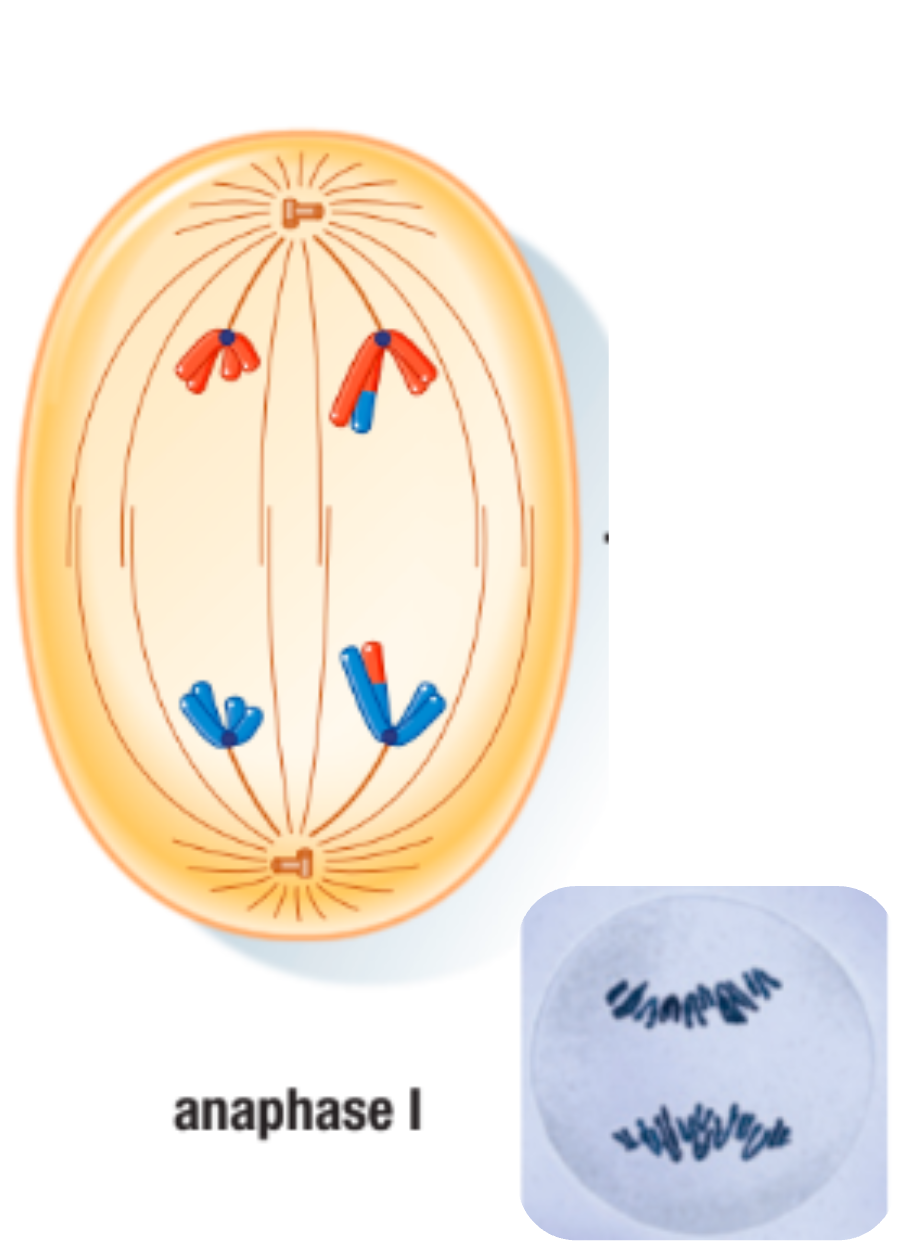
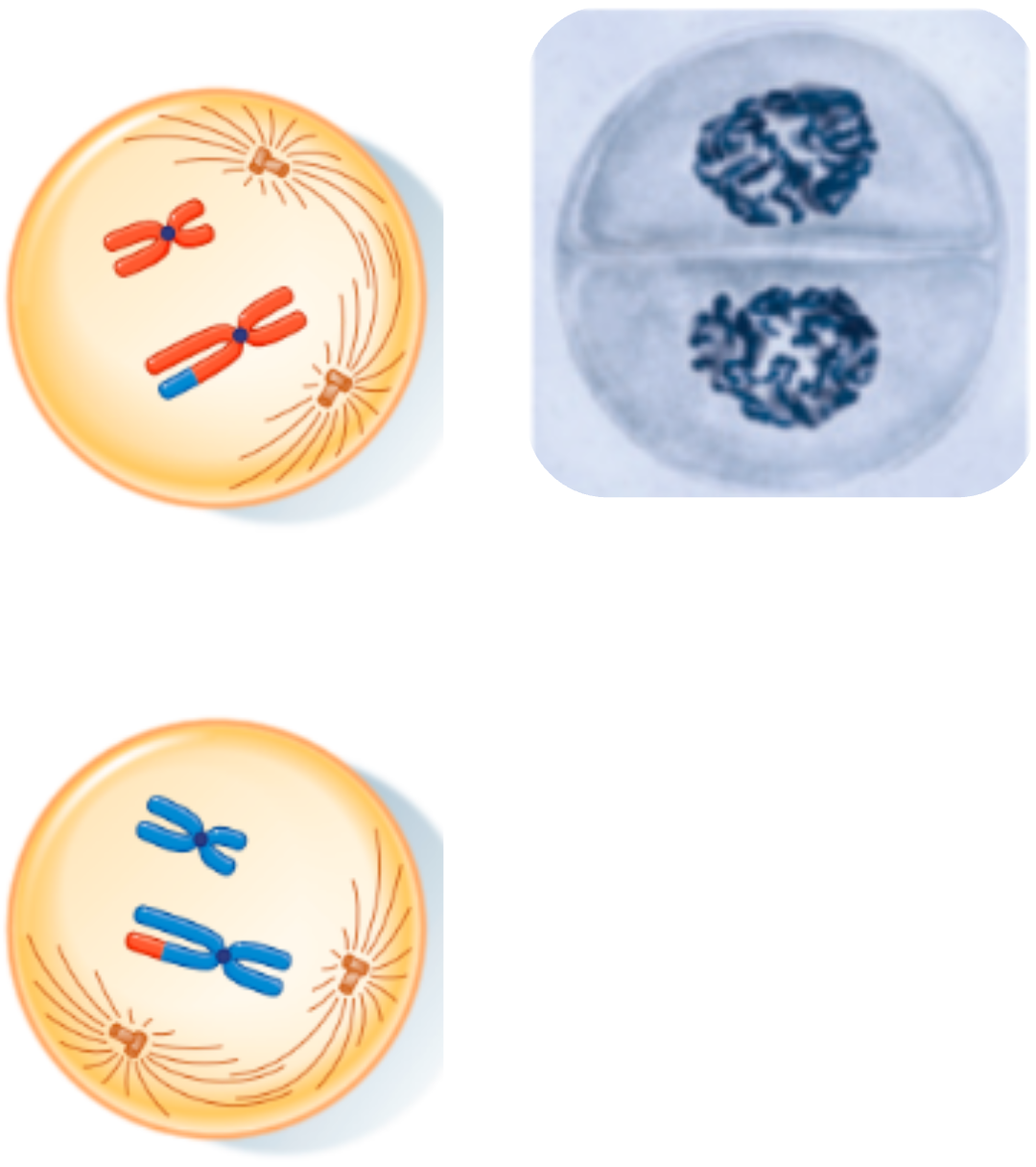
Genetics Unit

0.0(0)
Studied by 0 people
call kaiCall Kai
learnLearn
examPractice Test
spaced repetitionSpaced Repetition
heart puzzleMatch
flashcardsFlashcards
GameKnowt Play
Card Sorting

1/93

encourage image

There's no tags or description

Looks like no tags are added yet.

94 Terms

1
New cards

What is Genetics?

The study of genes, heredity, and genetic variation in living organisms.

2
New cards

What are Genes?

  • Each DNA molecule is composed of hundreds of thousands of chemical subunits called genes.

  • A gene is a segment of a DNA molecule that carries the instructions that helps to produce a particular trait of an organism.

  • Each gene has a specific position on a chromosome called a locus (plural: loci)


<ul><li><p><span style="background-color: transparent;">Each DNA molecule is composed of hundreds of thousands of chemical subunits called <strong>genes.</strong></span></p></li><li><p><span style="background-color: transparent;">A gene<strong> is a segment of a DNA molecule that carries the instructions that helps to produce a particular trait of an organism.</strong></span></p></li><li><p><span style="background-color: transparent;">Each gene has a specific position on a chromosome called a <strong>locus</strong> (plural: loci)</span></p></li></ul><p></p>
3
New cards

What is Heredity?

The passing of traits (genes) from parents to offsprings

4
New cards

What is a Trait?


  • Specific characteristics/traits of an individual, determined by genes

    • Examples of traits can be eye/hair colour, blood type, dimples, freckles, etc.


<p></p><ul><li><p><span style="background-color: transparent;">Specific characteristics/traits of an individual, determined by <strong><u>genes</u></strong></span></p><ul><li><p><span style="background-color: transparent;">Examples of traits can be eye/hair colour, blood type, dimples, freckles, etc.</span></p></li></ul></li></ul><p></p>
5
New cards

What is a Locus?

  • A locus (plural: loci) refers to a precise location on a chromosome where a gene or other DNA sequence resides


6
New cards

What are Macromolecules?

Large molecules that contains proteins, nucleic acid, polysaccharides, and many synthetic polymers.

7
New cards

What are the 4 Macromolecules?

  1. Carbohydrates (Monomers = Carbohydrates)

  2. Lipids (Monomers = Fatty acid + Glycerol)

  3. Proteins (Monomers = Amino acid)

  4. Nucleic Acids (Monomers = Nucleotides)


<ol><li><p>Carbohydrates (Monomers = Carbohydrates)</p></li><li><p>Lipids (Monomers = Fatty acid + Glycerol)</p></li><li><p>Proteins (Monomers = Amino acid)</p></li><li><p>Nucleic Acids (Monomers = Nucleotides)</p></li></ol><p></p>
8
New cards

How does the body use Nucleic Acid from our diet?

  • Our body uses nucleotides, the monomers of nucleic acids, to build DNA and RNA for cell division, growth, and tissue repair.


<ul><li><p><span style="background-color: transparent;">Our body uses nucleotides, the monomers of nucleic acids, to build DNA and RNA for cell division, growth, and tissue repair.</span></p></li></ul><p></p>
9
New cards

What is DNA?

  • The molecule containing the genetic instructions for the development, functioning, and reproduction of all living organisms.

    • “Blueprint” of the cell

  • Known as “Deoxyribonucleic acid”

  • Found in the nucleus of the cell for eukaryotic organisms

  • Purpose: stores and transmits genetic information from parent to offspring

  • Contains instructions to create proteins, but it never leaves the nucleus.

  • Protein synthesis takes place in 2 main steps: transcription and translation.

    • DNA → mRNA → Protein


<ul><li><p><span style="background-color: transparent;">The molecule containing the genetic <strong><u>instructions</u></strong> for the development, functioning, and reproduction of all living organisms. </span></p><ul><li><p><span style="background-color: transparent;">“Blueprint” of the cell</span></p></li></ul></li><li><p>Known as “Deoxyribonucleic acid”</p></li><li><p><span style="background-color: transparent;">Found in the <strong><u>nucleus</u></strong> of the cell for eukaryotic organisms</span></p></li><li><p><span style="background-color: transparent;"><strong>Purpose: </strong>stores and transmits genetic information from parent to offspring</span></p></li><li><p><span style="background-color: transparent;">Contains </span><span style="background-color: transparent; font-family: &quot;IBM Plex Sans&quot;, sans-serif;">instructions to create proteins, but it never leaves the nucleus.</span></p></li><li><p><span style="background-color: transparent; font-family: &quot;IBM Plex Sans&quot;, sans-serif;">Protein synthesis takes place in 2 main steps: <strong>transcription</strong> and <strong>translation</strong>.</span></p><ul><li><p>DNA → mRNA → Protein</p></li></ul></li></ul><p></p>
10
New cards

What is DNA made of?

  • A nucleic acid

  • Stands for deoxyribonucleic acid

  • Contains 3 main components (Known as Nucleotides)

    • Pentose Sugar - (Deoxyribose sugar - A cyclic, 5-Carbon sugar)

    • Phosphate Group - Has a negative charge

    • Nitrogenous Base - Contains different 4 Nitrogen bases
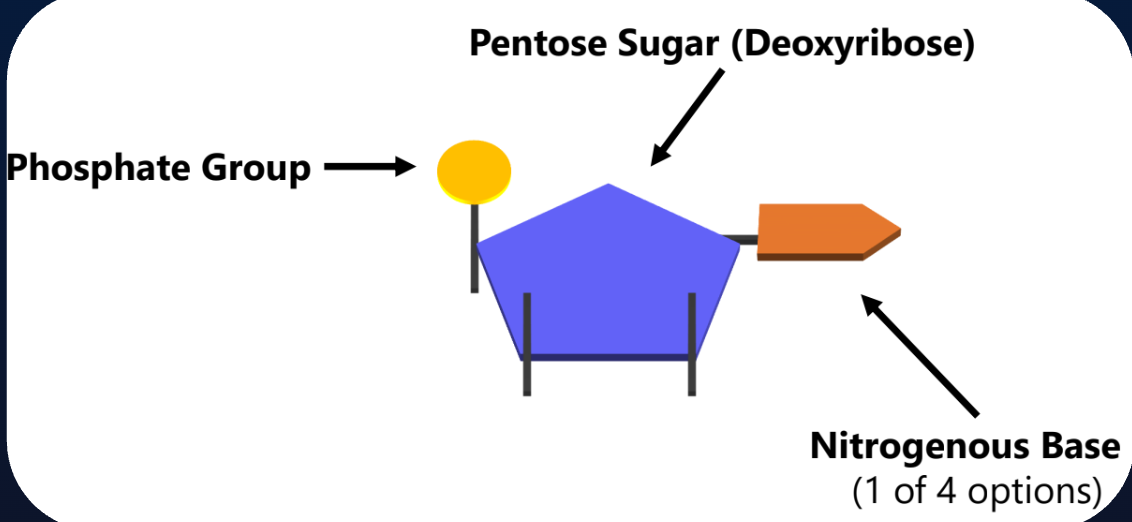

<ul><li><p><span style="background-color: transparent;">A nucleic acid</span></p></li><li><p><span style="background-color: transparent;">Stands for deoxyribo<strong>nucleic acid</strong></span></p></li><li><p><span style="background-color: transparent;">Contains 3 main components (Known as Nucleotides)</span></p><ul><li><p>Pentose Sugar - (Deoxyribose sugar - A cyclic, 5-Carbon sugar)</p></li><li><p>Phosphate Group - Has a negative charge</p></li><li><p>Nitrogenous Base - Contains different 4 Nitrogen bases</p></li></ul></li></ul><p></p>
11
New cards

What is the structure of the DNA?

  • James Watson and Francis Crick built on the work of the scientists before them to create their model of DNA. (1953)

  • Proposed DNA is made up of two strands (double helix) of repeating DNA nucleotides that run in opposite directions.

  • Backbone of DNA is made up of the sugar and phosphate components of the nucleotide (sugar-phosphate backbone)


<ul><li><p><span style="background-color: transparent;">James Watson and Francis Crick built on the work of the scientists before them to create their model of DNA.&nbsp;(1953)</span></p></li></ul><ul><li><p><span style="background-color: transparent;">Proposed DNA is made up of <strong><u>two strands</u></strong> (double helix) of repeating DNA nucleotides that run in opposite directions.</span></p></li></ul><ul><li><p><span style="background-color: transparent;">Backbone of DNA is made up of the <strong><u>sugar</u></strong><u> </u>and <strong><u>phosphate </u></strong>components of the nucleotide (sugar-phosphate backbone)</span></p></li></ul><p></p>
12
New cards

What are the 4 different Nitrogenous bases in DNA?

A - Adenine

C - Cytosine

T - Thymine

G - Guanine

13
New cards

What are the 4 different Nitrogenous bases in RNA?

A - Adenine

U - Uracil

T - Thymine

G - Guanine

14
New cards

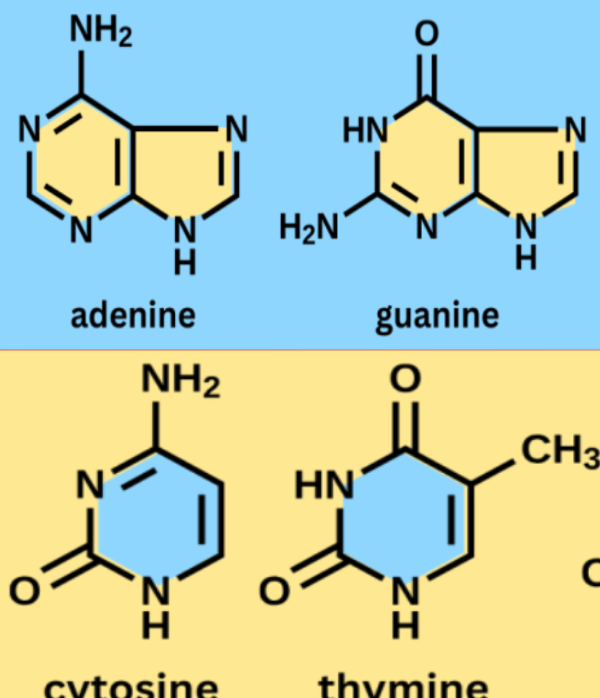
Whats the difference between Purines & Pyrimidines?

Adenine & Guanine

  • Have two carbon-nitrogen rings making them purines

  • End in “nine”

Cytosine & Thymine

  • Have one carbon-nitrogen rings making the Pyrimidines

  • Not end in “nine”


<p>Adenine &amp; Guanine</p><ul><li><p>Have two carbon-nitrogen rings making them purines</p></li><li><p>End in “nine”</p></li></ul><p>Cytosine &amp; Thymine</p><ul><li><p>Have one carbon-nitrogen rings making the Pyrimidines</p></li><li><p>Not end in “nine”</p></li></ul><p></p>
15
New cards

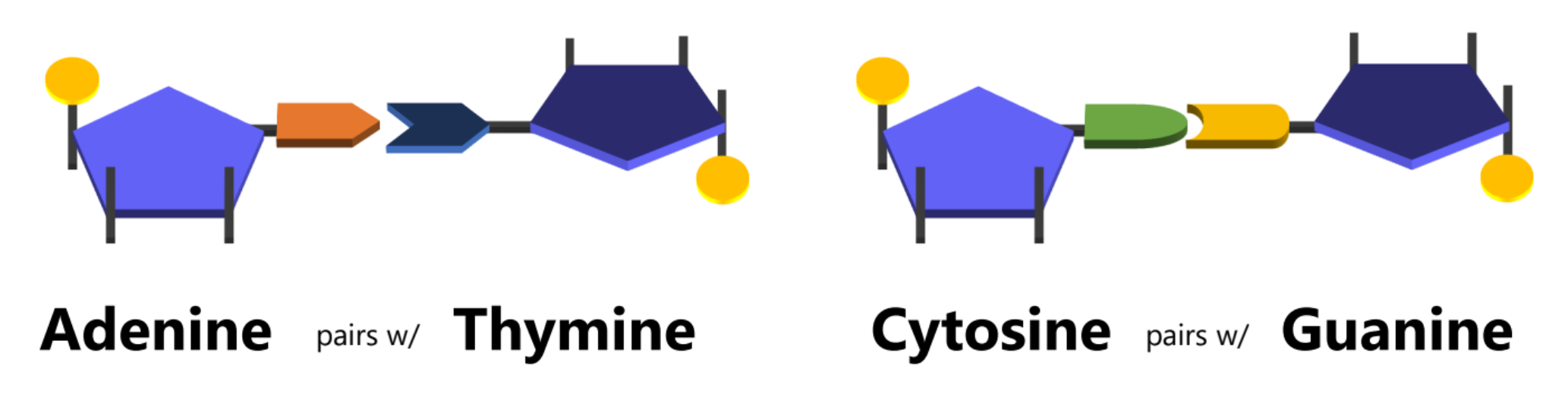
What are the Complementary Base pairs?

A-T

  • Adenine always pair with Thymine

  • 2 Hydrogen bonds

C-G

  • Cytosine always pair with Guanine

  • 3 Hydrogen bonds


<p>A-T</p><ul><li><p>Adenine always pair with Thymine</p></li><li><p>2 Hydrogen bonds</p></li></ul><p>C-G</p><ul><li><p>Cytosine always pair with Guanine</p></li><li><p>3 Hydrogen bonds</p></li></ul><p></p>
16
New cards

Whats the difference between a Nucleotide & Base pair?

knowt flashcard image
17
New cards

What is a Nucleosome?

  • DNA is wrapped around a collection of special proteins called histones which form a structure called a nucleosome 


<ul><li><p><span style="background-color: transparent; font-family: &quot;Open Sans&quot;, sans-serif;">DNA is wrapped around a collection of special proteins called <strong>histones</strong> which form a structure called a <strong>nucleosome&nbsp;</strong></span></p></li></ul><p></p>
18
New cards

What is Chromatin?

  • Nucleosome fold on top of each other to form chromatin

  • Chromatin is the loose, thread-like structure made up of DNA and proteins. 

  • For most of the cell’s life, DNA exists as chromatin in the nucleus

  • Can be either (before or after DNA replication, but still uncondensed)


<ul><li><p><span style="background-color: transparent; font-family: &quot;Open Sans&quot;, sans-serif;">Nucleosome fold on top of each other to form <strong>chromatin</strong></span></p></li></ul><ul><li><p><span style="background-color: transparent; font-family: &quot;Open Sans&quot;, sans-serif;"><strong>Chromatin </strong>is the <strong>loose</strong>, thread-like structure made up of DNA and proteins.&nbsp;</span></p></li></ul><ul><li><p><span style="background-color: transparent; font-family: &quot;Open Sans&quot;, sans-serif;">For <strong>most </strong>of the cell’s life, DNA exists as <strong><u>chromatin</u></strong> in the nucleus</span></p></li><li><p><span style="background-color: transparent;">Can be either (before or after DNA replication, but still uncondensed)</span></p></li></ul><p></p>
19
New cards

What are Chromosomes?

  • When a cell undergoes cell division, the chromatin fibres are further coiled/condensed into a chromosome

  • Can be unreplicated (1 chromatid) or replicated (2 sister chromatids)

  • Note: Humans have 46 chromosomes ; 23 from mother, 23 from father


<ul><li><p><span style="background-color: transparent; font-family: &quot;Open Sans&quot;, sans-serif;">When a cell undergoes <strong>cell division</strong>, the chromatin fibres are further <strong>coiled/condensed </strong>into a <strong>chromosome</strong></span></p></li><li><p><span style="background-color: transparent;">Can be <strong>unreplicated</strong> (1 chromatid) or <strong>replicated</strong> (2 sister chromatids)</span></p></li><li><p><span style="background-color: transparent; font-family: &quot;Open Sans&quot;, sans-serif;"><strong>Note:</strong> Humans have 46 chromosomes ; 23 from mother, 23 from father</span></p></li></ul><p></p>
20
New cards

Do chromosomes vary for each species?

  • The number of individual chromosomes each cell contains varies from one species to another. 

  • The number of chromosomes that a cell has does not necessarily reflect the complexity of the organism. 

    • For example, amoebas are unicellular organisms that have 500 chromosomes!


<ul><li><p><span style="background-color: transparent;">The number of individual chromosomes each cell contains varies from one species to another.&nbsp;</span></p></li><li><p><span style="background-color: transparent;">The number of chromosomes that a cell has does not necessarily reflect the complexity of the organism.&nbsp;</span></p><ul><li><p><span style="background-color: transparent;">For example, amoebas are unicellular organisms that have 500 chromosomes!</span></p></li></ul></li></ul><p></p>
21
New cards

What is a Chromatid?

  • One of two identical halves of a replicated chromosome

  • A single condensed DNA molecule; attached to its identical copy at the centromere

  • Present after DNA replication (S phase) and during early cell division

  • Always represents a replicated chromosome (each chromatid is one copy)

  • Sister Chromatid

    • Two identical chromatids produced from the same chromosome and held together at the centromere by cohesin.


22
New cards

What is the organization of DNA?

knowt flashcard image
23
New cards

What are Somatic Cells?

  • Cells that form the body of the organism; excludes reproductive cells

  • In humans this can include bone cells, nerve cells, blood cells, etc. 


24
New cards

What are Gametes?

  • A haploid reproductive or sex cell, Includes our reproductive cells

  • In humans this is our sperm or egg cells


25
New cards

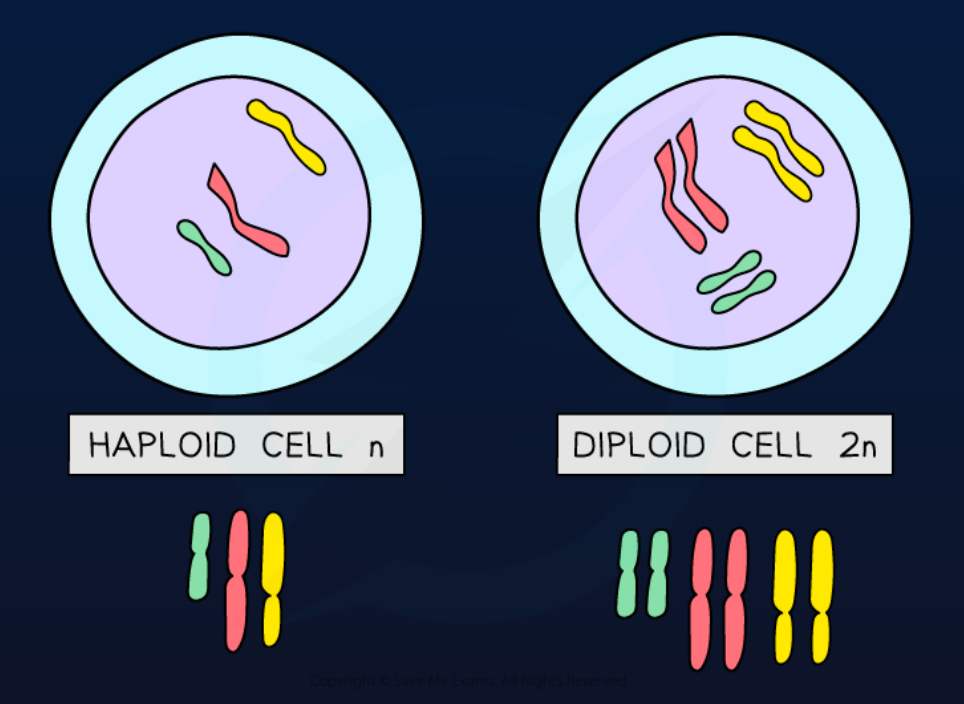
What are Diploid cells?

  • Diploid (2n) cells have two copies of every chromosome 

    • A cell containing two complete sets of chromosomes, one set inherited from each parent (arranged in homologous pairs).

    • In humans our body cells are diploid (46 chromosomes)

    • Created when two haploid gametes fuse during fertilization, or produced from another diploid cell via mitosis.


<ul><li><p><span style="background-color: transparent; font-family: &quot;Open Sans&quot;, sans-serif;"><strong>Diploid</strong> <strong>(2n)</strong> cells have two copies of every chromosome&nbsp;</span></p><ul><li><p>A cell containing&nbsp;<strong>two complete sets</strong>&nbsp;of chromosomes, one set inherited from each parent (arranged in homologous pairs).</p></li><li><p><span style="background-color: transparent; font-family: &quot;Open Sans&quot;, sans-serif;">In humans our body cells are diploid&nbsp;(46 chromosomes)</span></p></li><li><p>Created when two haploid gametes fuse during fertilization,&nbsp;or produced from another diploid cell via mitosis.</p></li></ul></li></ul><p></p>
26
New cards

What are Haploid cells?

  • Haploid (n) cells have half the normal number of chromosomes as the parent cell

    • In humans our sex cells are haploid (23 chromosomes)

    • A cell containing one complete set of unpaired chromosomes.

    • Produced from diploid cells through meiosis, which halves the chromosome number so that fertilization restores the diploid count instead of doubling it every generation.

<ul><li><p><span style="background-color: transparent;"><strong>Haploid</strong> <strong>(n) </strong>cells have half the normal number of chromosomes as the parent cell</span></p><ul><li><p><span style="background-color: transparent;">In humans our sex cells are haploid&nbsp;(23 chromosomes)</span></p></li><li><p>A cell containing&nbsp;<strong>one complete set</strong>&nbsp;of unpaired chromosomes.</p></li><li><p>Produced from diploid cells through&nbsp;<strong>meiosis</strong>,&nbsp;which halves the chromosome number so that fertilization restores the diploid count instead of doubling it every generation.</p></li></ul></li></ul><p></p>
27
New cards

What are Spindle Fibers?

  • A network of filaments called microtubules that move chromosomes during eukaryotic cell division.

  • Purpose: Their main function is to separate chromosomes by pulling sister chromatids to opposite ends of the cell. (Anaphase)

  • Significance: Without spindle fibers, cells could not reliably divide their genetic material, leading to errors such as missing or extra chromosomes.

    • Accurate chromosome separation is essential for growth, repair, and reproduction in organisms.

★ Prophase (Mitosis)

28
New cards

What is reproduction?

  • Organisms inherit genetic information from their parents

  • Some organisms have only a single parent (Asexual Reproduction)

  • While others have two parents (Sexual Reproduction)


29
New cards

What is Cell Division?

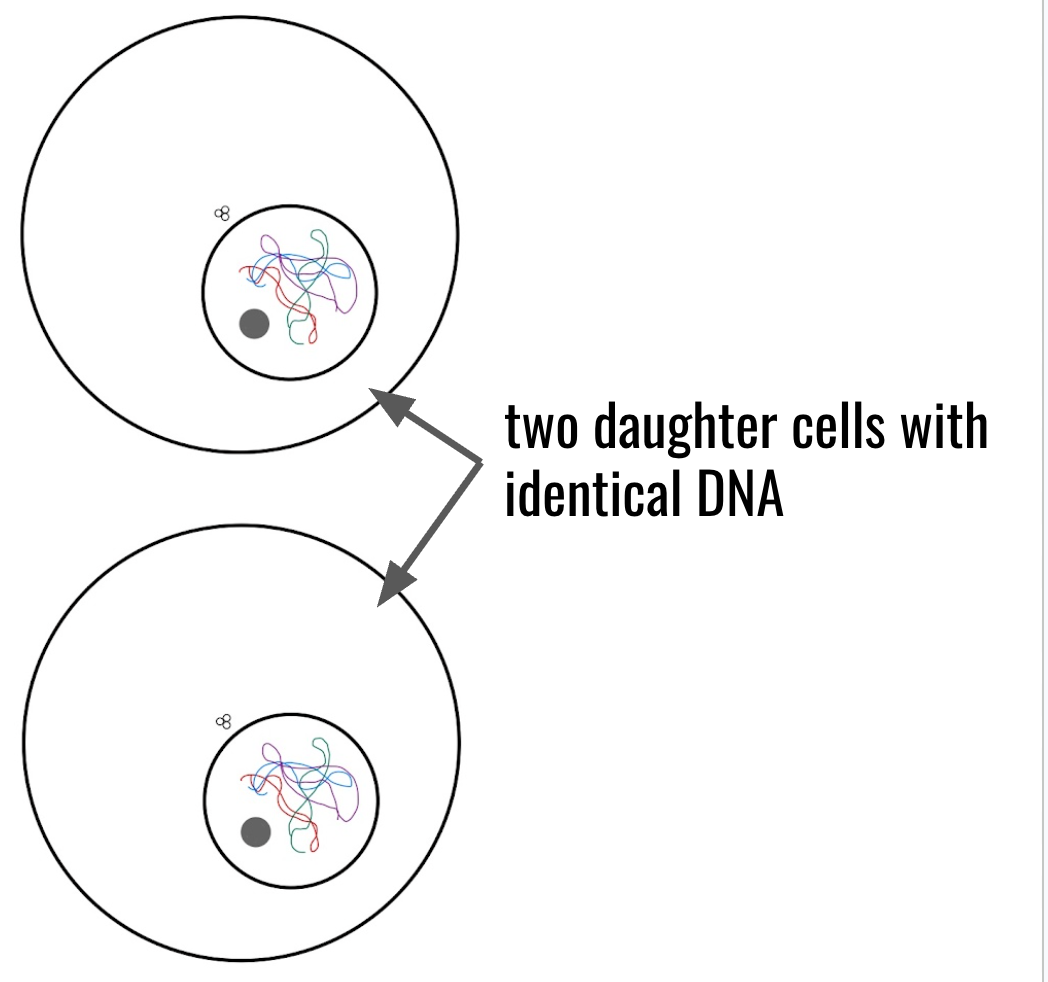
  • Cell division is a cellular process in which the chromosomes of the parent cell are duplicated, and then divided such that each of the two daughter cells receives one copy of each chromosome

  • The result is two new daughter cells that are genetically identical to one another, and to the parent cell


<ul><li><p><span style="background-color: transparent;">Cell division is a cellular process in which the <strong>chromosomes</strong> of the parent cell are <strong>duplicated</strong>, and then <strong>divided </strong>such that each of the two daughter cells receives one copy of each chromosome</span></p></li><li><p><span style="background-color: transparent;">The result is two new <strong>daughter cells</strong> that are <strong>genetically identical</strong> to one another, and to the parent cell</span></p></li></ul><p></p>
30
New cards

What is Asexual reproduction?

  • One parent goes through cell division to produce two new, identical, daughter cells

    • Daughter cells are identical to each other and to their parent cell – clones 

  • This process is done by single-celled organisms like bacteria and human body cells!


<ul><li><p><span style="background-color: transparent;"><strong>One parent </strong>goes through <strong>cell division</strong> to produce <strong>two</strong> new, <strong>identical</strong>, daughter cells</span></p><ul><li><p><span style="background-color: transparent;">Daughter cells are <em>identical</em> to each other and to their parent cell – clones&nbsp;</span></p></li></ul></li><li><p><span style="background-color: transparent;">This process is done by single-celled organisms like bacteria and <strong>human body cells</strong>!</span></p></li></ul><p></p>
31
New cards

What is Sexual Reproduction?

  • Occurs when a sex cell from one parent fuses with a sex cell from another parent (through mating) to produce an offspring 

    • The offspring receives half the genes from one parent, and half the genes from the other parent

    • Therefore, offspring are not genetically identical to either of their parents, and are rarely genetically identical to each other

      • Produces genetic variability (NOT identical clones)
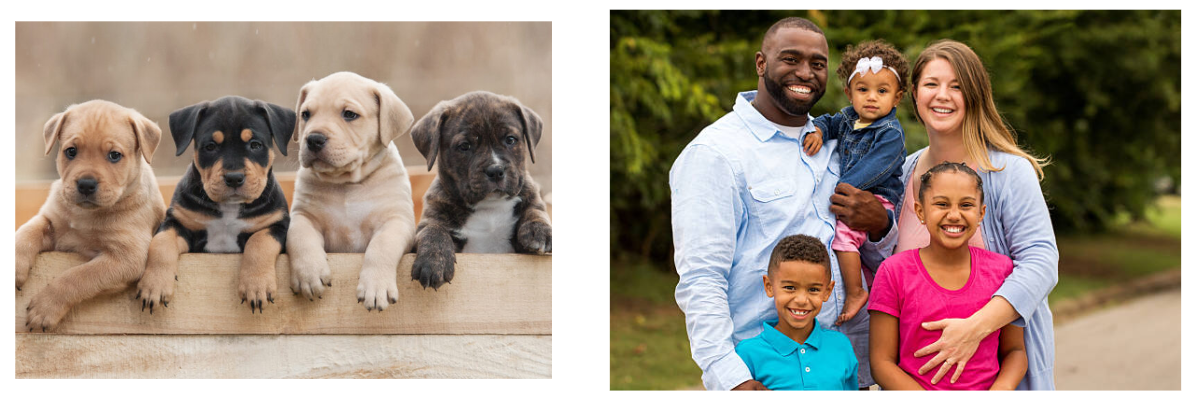

<ul><li><p><span style="background-color: transparent; font-family: &quot;Open Sans&quot;, sans-serif;"><strong>O</strong>ccurs when a <strong>sex cell</strong> from <strong>one parent </strong>fuses with a <strong>sex cell</strong> from <strong>another parent</strong> (through mating) to produce an offspring&nbsp;</span></p><ul><li><p><span style="background-color: transparent; font-family: &quot;Open Sans&quot;, sans-serif;">The offspring receives <strong>half </strong>the <strong>genes</strong> from one parent, and <strong>half </strong>the genes from the other parent</span></p></li><li><p><span style="background-color: transparent; font-family: &quot;Open Sans&quot;, sans-serif;">Therefore, offspring are <strong><u>not genetically identical</u></strong> to either of their parents, and are rarely genetically identical to each other</span></p><ul><li><p><span style="background-color: transparent; font-family: &quot;Open Sans&quot;, sans-serif;">Produces <strong>genetic variability</strong> (NOT identical clones)</span></p></li></ul></li></ul></li></ul><p></p>
32
New cards

Why is Sexual reproduction more common than Asexual reproduction?

  • Asexual Only: Produces nearly identical offspring, helpful only if the parent is well-adapted and the environment never changes.

  • Sudden Changes: Fires, eruptions, new diseases, or new competitors constantly alter environments.

  • Vulnerability: Genetically identical populations lack variation, so a single new disease can wipe out nearly everyone if conditions shift.


33
New cards

What is the purpose of Cell Division?

  • Our bodies need to continuously regenerate/repair cells!

    • For example, red blood cells only live for about four months, so new ones must be made. 

    • If you scrape your shin, your body produces new skin cells for healing

  • We also need cell division for growth!

    • Each of us started as one cell! We are now organisms with more than a trillion cells!


34
New cards

What is the difference between Sexual & Asexual reproduction?

knowt flashcard image
35
New cards

What are the benefits for Asexual reproduction?

  • A single organism can reproduce on its own, which is especially helpful when mates are scarce or when colonizing a new environment.

  • Offspring are genetically identical clones of the parent, so well-adapted traits in a stable environment are passed on directly without "infecting" them through gene mixing.


36
New cards

What are the drawbacks for Asexual reproduction?

  • A single threat, ex a new pathogen, toxin, or sharp temperature shift

    • Can wipe out an entire uniform population if none of the individuals have a resistance advantage.

  • Because offspring are clones (aside from rare mutations), the population has a narrow gene pool.


37
New cards

What are the 3 stages of cell cycle

  1. Interphase – Cell grows and carries out its normal functions, replication of chromosomes 

  2. Mitosis – genetic material in the nucleus is divided equally into two new nuclei

  3. Cytokinesis – rest of the cell divides -each ‘daughter’ cell is identical to the parent cell


38
New cards

What are the Interphase phases?

  1. G1 Phase

  2. S Phase

  3. G2 Phase


39
New cards

What happens during G1 Phase?

  • Cell grows physically larger

  • Duplicates organelles

  • Carries out all life activities except division (i.e., cellular respiration, any specialized function)

  • Genes in DNA are used to synthesize proteins to help the cell carry out its functions

  • DNA is in very long, loosely-packed strands (chromatin)

  • Contains 4 chromosomes (in chromatin form)
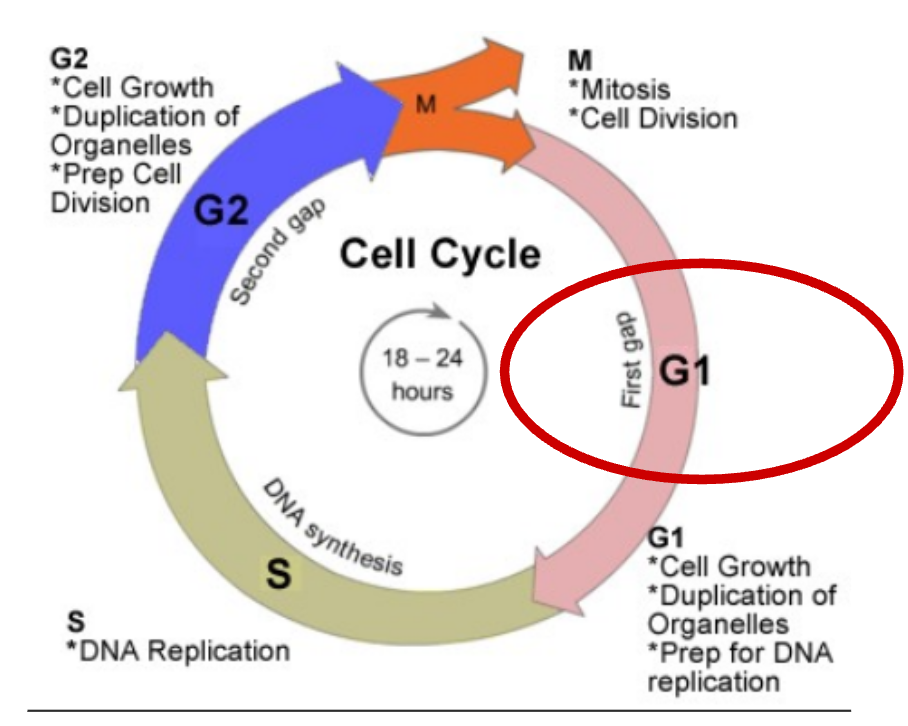

<ul><li><p><span style="background-color: transparent;">Cell grows physically larger</span></p></li><li><p><span style="background-color: transparent;">Duplicates organelles</span></p></li><li><p><span style="background-color: transparent;">Carries out all life activities except division (i.e., cellular respiration, any specialized function)</span></p></li><li><p><span style="background-color: transparent;">Genes in DNA are used to synthesize proteins to help the cell carry out its functions</span></p></li><li><p><span style="background-color: transparent;">DNA is in very long, loosely-packed strands (chromatin)</span></p></li><li><p><span style="background-color: transparent;">Contains 4 chromosomes (in chromatin form)</span></p></li></ul><p></p>
40
New cards

What happens during S Phase?

  • DNA replication occurs during this phase! (S - Synthesis)

  • Once the cell is fully grown, and all the organelles have been resynthesized, the chromatin begin to duplicate.

  • Two identical strands of the genetic material called “sister chromatids” form and are joined at the centromere (held by cohesin)

  • Contains 8 sister chromatids


<ul><li><p><span style="background-color: transparent;"><strong>DNA replication</strong> occurs during this phase! (S - Synthesis)</span></p></li><li><p><span style="background-color: transparent;">Once the cell is fully grown, and all the organelles have been resynthesized, the chromatin begin to <strong>duplicate.</strong></span></p></li><li><p><span style="background-color: transparent;">Two identical strands of the genetic material called “sister chromatids” form and are joined at the centromere (held by cohesin)</span></p></li><li><p><span style="background-color: transparent;">Contains 8 sister chromatids</span></p></li></ul><p></p>
41
New cards

What happens during G2 Phase?

  • The cell continually grows slightly larger

  • Cell continues to synthesize proteins from genes in DNA (ex. Make enzymes for digestion, or proteins for structure in muscles, etc.)

  • Cell inspects newly injected DNA for copying errors or damage and repairs issues before seperating chromosomes

  • Begins to reorganize its contents in preparation for mitosis


<ul><li><p><span style="background-color: transparent;">The cell continually grows slightly larger</span></p></li><li><p><span style="background-color: transparent;">Cell continues to synthesize proteins from genes in DNA (ex. Make enzymes for digestion, or proteins for structure in muscles, etc.)</span></p></li><li><p><span style="background-color: transparent;">Cell inspects newly injected DNA for copying errors or damage and repairs issues before seperating chromosomes</span></p></li><li><p><span style="background-color: transparent;">Begins to reorganize its contents in preparation for mitosis</span></p></li></ul><p></p>
42
New cards

Interphase - Under microscope

knowt flashcard image
43
New cards

What happens after Interphase phases?

Mitosis

  • Once all the chromatin has been duplicated, the division of the nucleus and its chromatin takes place in 4 stages, during the process of MITOSIS.

  • Mitosis is the stage of the cell cycle where nuclear division takes place.

Each cell division produces two genetically identical cells called daughter cells!

44
New cards

What are the Mitosis Phases?

P - Prophase

M - Metaphase

A - Anaphase

T - Telophase

45
New cards

What happens during Prophase?

  • The replicated chromatids condense, shorten and thicken 

  • The nuclear membrane begins to dissolve (the nuclear membrane disintegrates so that the chromosomes can move around during mitosis)

  • Spindle fibres begin to form from structures called centrioles. Spindle fibres are proteins that help move chromosomes around.
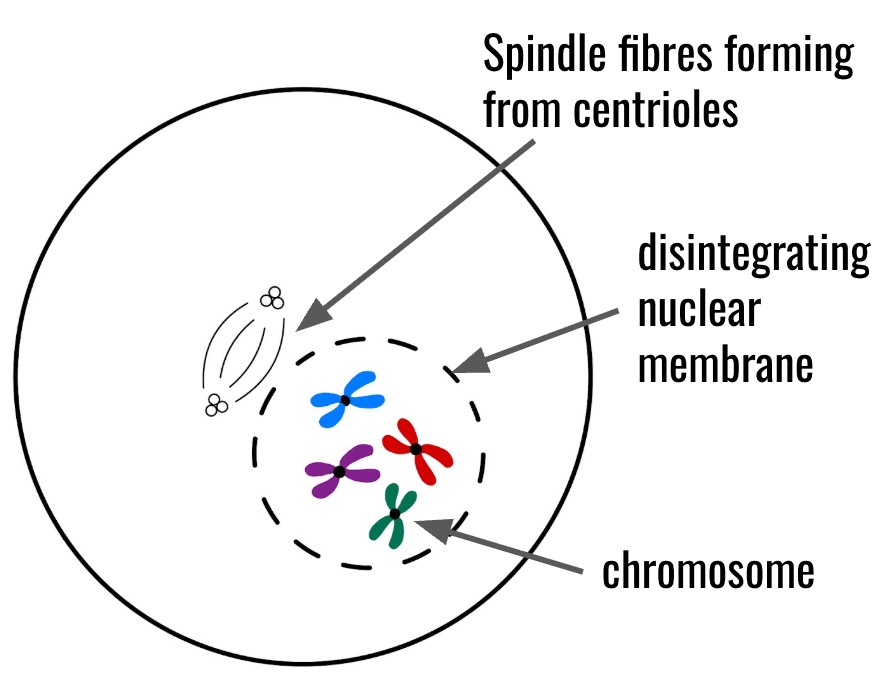

<ul><li><p><span style="background-color: transparent;">The replicated chromatids <strong><u>condense</u></strong>, <strong><u>shorten</u></strong> and <strong><u>thicken</u></strong>&nbsp;</span></p></li><li><p><span style="background-color: transparent;">The <strong>nuclear membrane </strong>begins to dissolve (the nuclear membrane disintegrates so that the chromosomes can move around during mitosis)</span></p></li><li><p><span style="background-color: transparent;"><strong>Spindle fibres</strong> begin to form from structures called <strong>centrioles</strong>. Spindle fibres are proteins that help move chromosomes around.</span></p></li></ul><p></p>
46
New cards

What happens during Late Prophase?

  • The chromosomes start to move towards the center of the cell.

  • Spindle fibres grow towards the center and attach to chromosomes at their centromeres.


<ul><li><p><span style="background-color: transparent;">The <strong><u>chromosomes</u></strong> start to <strong><u>move towards the center</u></strong> of the cell.</span></p></li><li><p><span style="background-color: transparent;">Spindle fibres grow towards the center and attach to chromosomes at their centromeres.</span></p></li></ul><p></p>
47
New cards

Prophase - Under microscope

knowt flashcard image
48
New cards

What happens during Metaphase?

  • The chromosomes line up along the middle (equator) of the cell called the metaphase plate with the help of the spindle fibres


<ul><li><p><span style="background-color: transparent;">The <strong><u>chromosomes line up</u></strong> along the middle (equator) of the cell called the <strong><u>metaphase plate</u></strong> with the help of the spindle fibres</span></p></li></ul><p></p>
49
New cards

Metaphase - Under microscope

knowt flashcard image
50
New cards

What happens during Anaphase?

  • The spindle fibres shorten and pull the chromatids to opposite poles/sides of the cell.

  • Centromeres split apart during this process


<ul><li><p><span style="background-color: transparent;">The <strong><u>spindle fibres</u></strong> <strong><u>shorten</u></strong> and pull the <strong><u>chromatids</u></strong> to opposite <strong><u>poles/sides</u></strong> of the cell.</span></p></li><li><p><span style="background-color: transparent;">Centromeres split apart during this process</span></p></li></ul><p></p>
51
New cards

Anaphase - Under microscope

knowt flashcard image
52
New cards

What happens during Telophase?

  • The chromatids begin to straighten and uncoil into chromatin again.

  • Spindle fibres disappears.

  • Two new nuclear membrane forms around each set of chromatin.

  • You begin to see the cell membrane pinch to begin cytokinesis (next stage after mitosis)


<ul><li><p><span style="background-color: transparent;">The chromatids begin to <strong><u>straighten</u></strong> and <strong><u>uncoil</u></strong> into <strong><u>chromatin</u></strong> again.</span></p></li><li><p><span style="background-color: transparent;"><strong><u>Spindle fibres disappears</u></strong>.</span></p></li><li><p><span style="background-color: transparent;">Two new <strong><u>nuclear membrane forms</u></strong> around each set of chromatin.</span></p></li><li><p><span style="background-color: transparent;">You begin to see the cell membrane pinch to begin cytokinesis (next stage after mitosis)</span></p></li></ul><p></p>
53
New cards

Telophase - Under microscope

knowt flashcard image
54
New cards

What happens after Mitosis phases?

  • The stage in the cell cycle when the cytoplasm divides to form two identical cells

  • Cytokinesis occurs AFTER Mitosis. Cytokinesis is NOT PART of Mitosis.

Each cell division produces two genetically identical cells called daughter cells!

55
New cards

What happens during Cytokinesis?

Cytokinesis is the splitting of the CYTOPLASM!

  • Special proteins begin to pinch the cell membrane between the two newly formed nuclei until the parent cell is divided into two daughter cells

  • The area where the cell membrane pinches in is called the cleavage furrow.
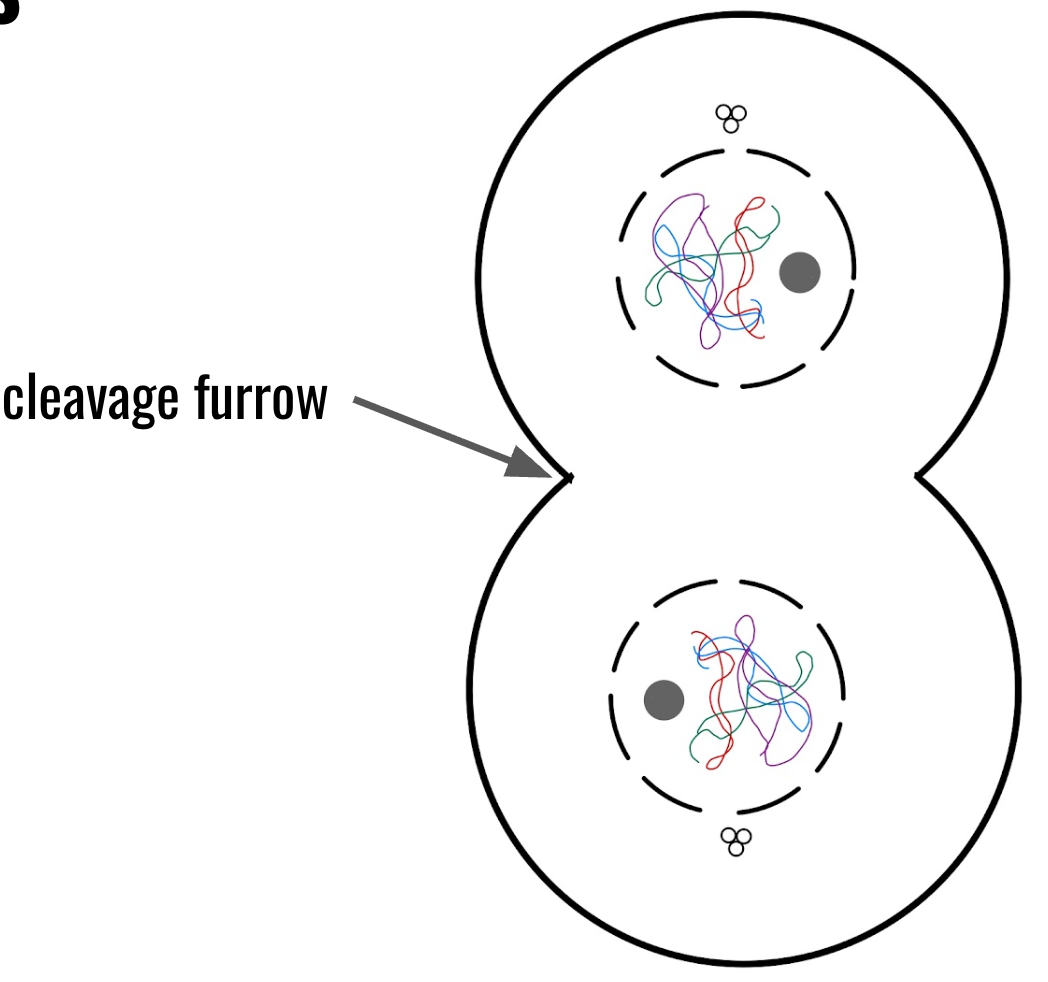

<p><span style="background-color: transparent;">Cytokinesis is the splitting of the <strong>CYTOPLASM!</strong></span></p><ul><li><p><span style="background-color: transparent;">Special proteins begin to<strong> <u>pinch the cell membrane</u></strong> between the two newly formed <strong><u>nuclei</u></strong> until the parent cell is divided into two daughter cells</span></p></li><li><p><span style="background-color: transparent;">The area where the cell membrane pinches in is called the <strong><u>cleavage furrow</u></strong>.</span></p></li></ul><p></p>
56
New cards

What happens after Cell Division?

  • After cell division is completed, the two new, genetically identical, daughter cells carry out their life functions and grow until it is time to reproduce/divide themselves.

    • They go through their own cell cycle!


<ul><li><p><span style="background-color: transparent;">After cell division is completed, the <strong><u>two new, genetically identical, daughter cells</u></strong> carry out their life functions and grow until it is time to reproduce/divide themselves.</span></p><ul><li><p><span style="background-color: transparent;">They go through their own cell cycle!</span></p></li></ul></li></ul><p></p>
57
New cards

How is Plant Cell division Different?

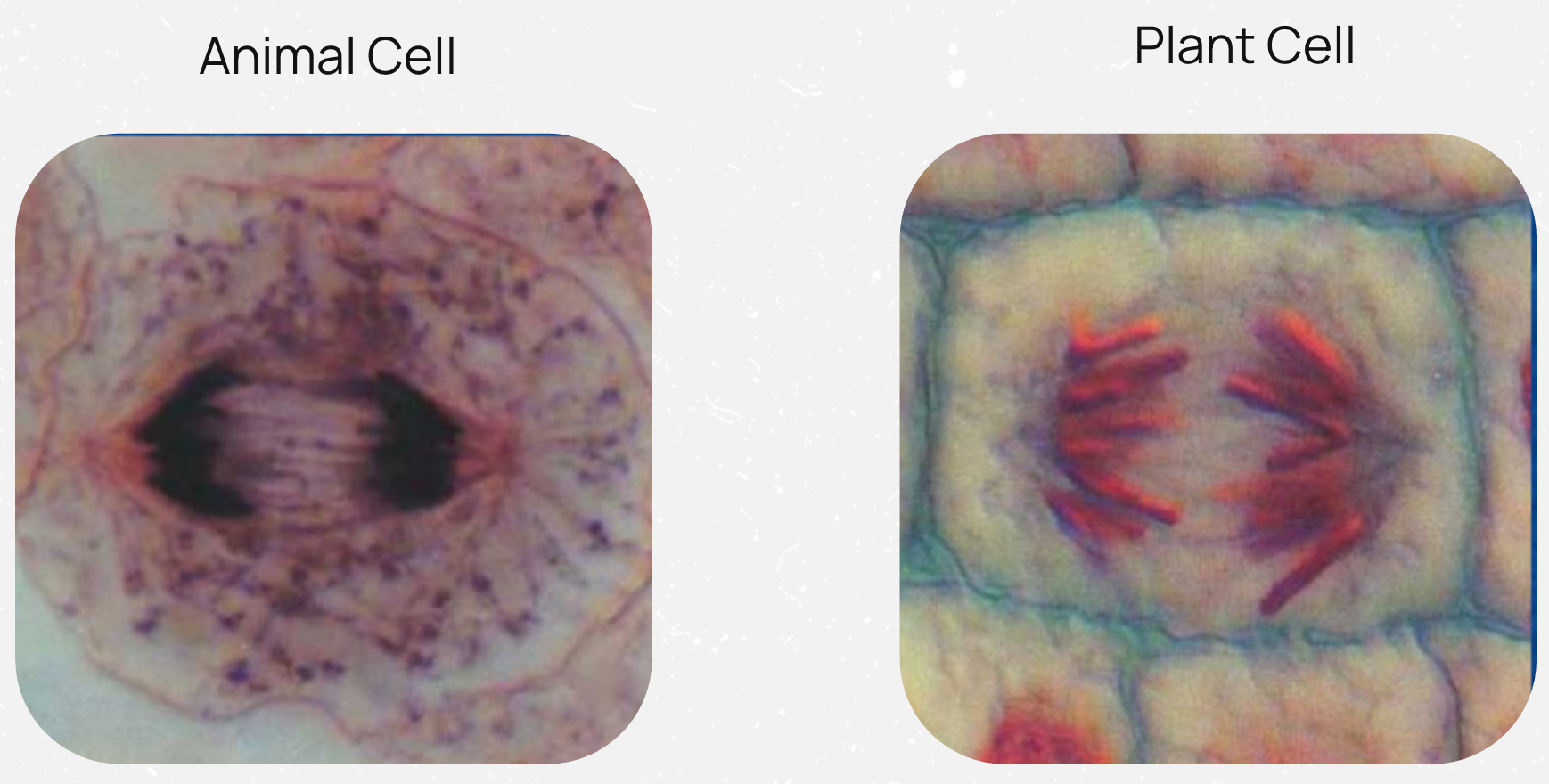
  • Proteins of the animal cells pinches in the cell membrane during cytokinesis to separate the daughter cells forming a cleavage furrow.

  • Plants cells have to build a cell wall between the two new nuclei. The new wall formed in the middle of the two cells is called the cell plate.
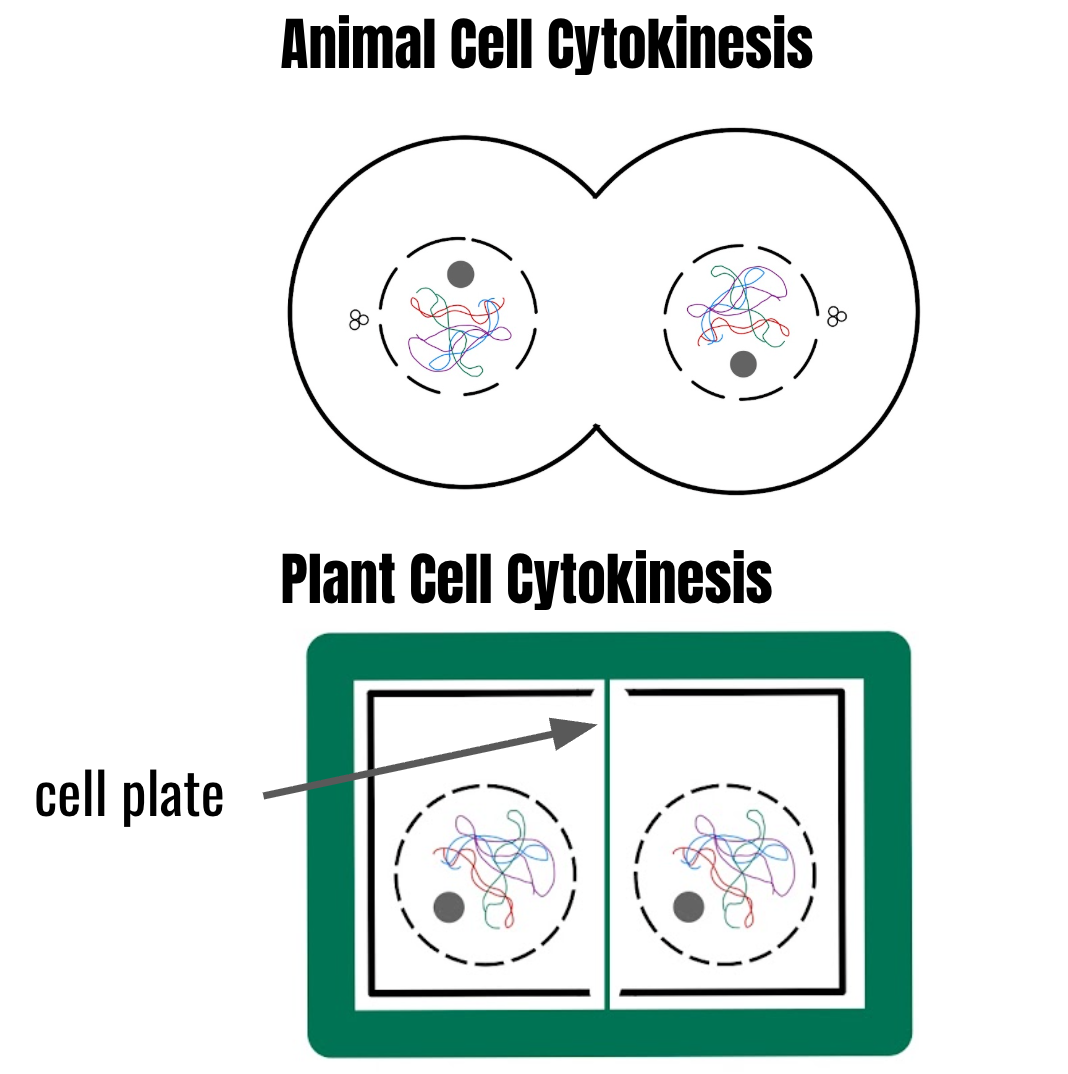

<ul><li><p><span style="background-color: transparent;">Proteins of the animal cells pinches in the cell membrane during cytokinesis to separate the daughter cells forming a cleavage furrow.</span></p></li></ul><ul><li><p><span style="background-color: transparent;">Plants cells have to <strong><u>build a cell wall between the two new nuclei</u></strong>. The new wall formed in the middle of the two cells is called the <strong><u>cell plate</u></strong>.</span></p></li></ul><p></p>
58
New cards

What would happen if one of the chromosomes failed to split at the end of Metaphase?

  • When a chromosome fails to separate after metaphase, the cell undergoes nondisjunction, meaning chromatids move together to the same pole instead of splitting evenly.

    • Producing daughter cells with unequal chromosome numbers (aneuploidy)

      • Can lead to cell death, developmental disorders, or cancer depending on the cell type.


59
New cards

Why is it important for DNA to replicate during interphase, before mitosis?

  • What It Means

    • During S phase, the cell duplicates its DNA into two identical sister chromatids held together by cohesin proteins.

    • Cell cycle checkpoints (G1/S and G2/M) make sure copying finishes cleanly before division starts.

    Why It's Important

    • Dividing without copying first leaves each daughter cell with only half its DNA, which usually kills the cell.

    • Proper replication prevents missing or extra chromosomes (aneuploidy) and DNA breaks linked to cancer.

    • Giving every new cell a full, exact genetic set lets your body grow and repair damaged tissue safely.

★ S Phase (Interphase)

60
New cards

What is Meisosis?

  • Process that produces haploid gametes (sperm/egg cells) from diploid germ cells

  • In meiosis, the chromosome number of the daughter cells (gametes) is half that of the parent cell (germ cell)

    • Ex. A human cell germ cell containing 46 chromosomes that undergoes meiosis will produce gametes (sex cells) that each have 23 chromosomes.

  • Gametes are haploid

  • Involves TWO divisions (Meiosis I and Meiosis II) that produce FOUR haploid cells from a diploid germ cell


<ul><li><p><span style="background-color: transparent; font-family: &quot;Encode Sans&quot;, sans-serif;">Process that produces <strong>haploid gametes</strong> (sperm/egg cells) from <strong>diploid germ cells</strong></span></p></li><li><p><span style="background-color: transparent; font-family: &quot;Encode Sans&quot;, sans-serif;">In meiosis, the chromosome number of the daughter cells (gametes) is <strong>half</strong> that of the parent cell (germ cell)</span></p><ul><li><p><span style="background-color: transparent; font-family: &quot;Encode Sans&quot;, sans-serif;">Ex. A human cell germ cell containing <strong>46 </strong>chromosomes that undergoes <strong>meiosis</strong> will produce <strong>gametes (sex cells) </strong>that each have<strong> 23 </strong>chromosomes.</span></p></li></ul></li><li><p><span style="background-color: transparent; font-family: &quot;Encode Sans&quot;, sans-serif;">Gametes are <strong>haploid</strong></span></p></li><li><p><span style="background-color: transparent; font-family: &quot;Open Sans&quot;, sans-serif;">Involves <strong>TWO</strong> divisions (Meiosis I and Meiosis II) that produce <strong>FOUR </strong>haploid cells from a diploid germ cell</span></p></li></ul><p></p>
61
New cards

What is a Germ Cell?

A special reproductive cells that give rise to gametes (sperm or egg) and are not part of most body tissues

62
New cards

What are Homologous Chromosomes?

  • The two copies of each chromosome in diploid cells are known as homologous chromosomes

    • One copy comes from the mother, one copy comes from the father 

  • Homologous chromosomes appear similar, in terms of their length, centromere location, gene loci/location

    • They are not identical to each other but carry genes for the same traits, such as hair colour, at the same location

    • They can carry different forms of the same gene called alleles


<ul><li><p><span style="background-color: transparent; font-family: &quot;Open Sans&quot;, sans-serif;">The <strong>two copies</strong> of each chromosome in diploid cells are known as <strong>homologous chromosomes</strong></span></p><ul><li><p><span style="background-color: transparent; font-family: &quot;Open Sans&quot;, sans-serif;">One copy comes from the mother, one copy comes from the father&nbsp;</span></p></li></ul></li><li><p><span style="background-color: transparent; font-family: &quot;Open Sans&quot;, sans-serif;"><strong>Homologous chromosomes</strong> appear similar, in terms of their length, centromere location, gene loci/location</span></p><ul><li><p><span style="background-color: transparent; font-family: &quot;Open Sans&quot;, sans-serif;">They are not identical to each other but carry genes for the same traits, such as hair colour, at the same location</span></p></li><li><p><span style="background-color: transparent; font-family: &quot;Open Sans&quot;, sans-serif;">They can carry different forms of the same gene called<strong> alleles</strong></span></p></li></ul></li></ul><p></p>
63
New cards

What is an Allele?

  • A variant form of a gene located at a specific position (locus) on a chromosome.

    • Representing alternative DNA sequences that can produce different traits.


64
New cards

What is the process of Synapsis?

  • Close, side-by-side pairing and intertwining of matching homologous chromosomes during Prophase I of meiosis.

  • Aligns matching genes along the two chromosomes so nonsister chromatids can exchange DNA segments through crossing over.


<ul><li><p>Close, side-by-side pairing and intertwining of matching <strong>homologous chromosomes</strong> during <strong>Prophase I</strong> of meiosis.</p></li><li><p>Aligns matching genes along the two chromosomes so nonsister chromatids can exchange DNA segments through <strong>crossing over</strong>.</p></li></ul><p></p>
65
New cards

What are the 2 process of Sexual Reproduction?

  1. Meiosis → The formation of haploid sex cells called gametes (formation of egg cell in females, and sperm cells in males)

  1. Fertilization → When two gametes fuse together to produce a zygote (the first cell of a new individual)


66
New cards

What do Germ cells do?

  • As in mitosis, germ cells will go through the growth and synthesis phase of interphase before dividing

  • This includes DNA replication! Each chromosome will get duplicated to form sister chromatids held together at the centromere

  • DNA is in chromatin form (loosely coiled)


67
New cards

What are the stages of Meiosis?

Meiosis I

Meiosis II

68
New cards

What happens during the Meiosis I phase?

  • The first division (prophase I, metaphase I, anaphase I, telophase I)

  • Described as a reduction division because the diploid, or 2n, chromosome number in the germ cell is reduced by half to the haploid, or n, chromosome number


69
New cards

What happens during Prophase I?

  • The chromatin begin to shorten and thicken

  • The nuclear membrane begins to dissolve 

  • The centrioles separate and move to opposite poles of the cell, and spindle fibres form
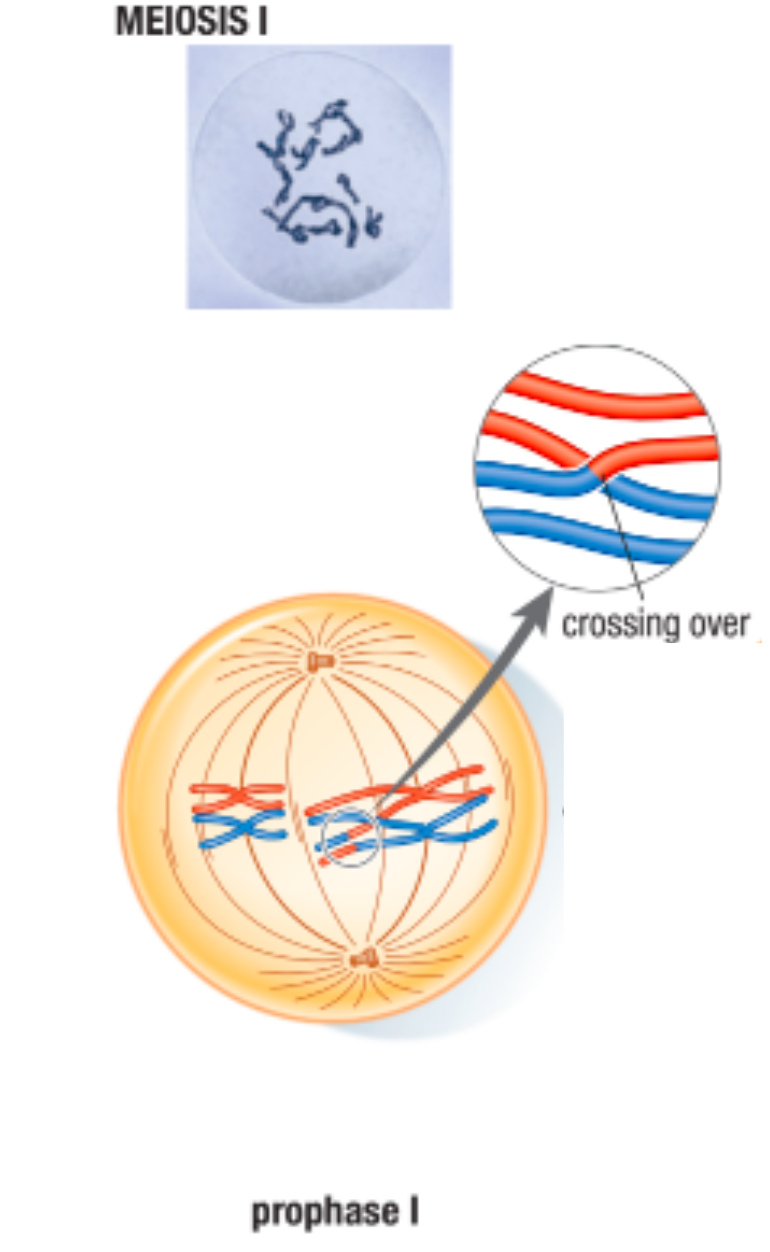

<ul><li><p><span style="background-color: transparent; font-family: &quot;Open Sans&quot;, sans-serif;">The <strong>chromatin</strong> begin to <strong>shorten and thicken</strong></span></p></li><li><p><span style="background-color: transparent; font-family: &quot;Open Sans&quot;, sans-serif;">The <strong>nuclear membrane</strong> begins to <strong>dissolve&nbsp;</strong></span></p></li><li><p><span style="background-color: transparent; font-family: &quot;Open Sans&quot;, sans-serif;">The centrioles separate and move to opposite poles of the cell, and <strong>spindle fibres form</strong></span></p></li></ul><p></p>
70
New cards

What happens in the chromosome during Prophase I?

  • Matching homologous chromosomes (one from each parent), each already made of two sister chromatids from interphase

    • Line up side by side into a 4-chromatid tetrad.

  • Nonsister chromatids from homologous chromosomes closely pair and intertwine.

  • Intertwined chromatids break and swap matching DNA segments, creating new allele combinations.

★ Tetrad: A paired structure of two homologous chromosomes (four chromatids total) lined up side by side.

71
New cards

What does Crossing over mean?

  • Crossing over results in the recombination (mixing) of genetic information between non-sister chromatids of a homologous pair


<ul><li><p><span style="background-color: transparent;">Crossing over results in the recombination (mixing) of genetic information between non-sister chromatids of a homologous pair</span></p></li></ul><p></p>
72
New cards

What happens during Metaphase I?

  • The tetrads (made up of pairs of homologous chromosomes) migrate toward the centre of the cell 

  • They align in pairs (2 lines)

  • Spindle fibres are attached to the centromeres of the chromosomes.


<ul><li><p><span style="background-color: transparent; font-family: &quot;Open Sans&quot;, sans-serif;">The <strong>tetrads</strong> (made up of pairs of homologous chromosomes) migrate toward the <strong>centre of the cell&nbsp;</strong></span></p></li><li><p><span style="background-color: transparent; font-family: &quot;Open Sans&quot;, sans-serif;">They align in pairs (2 lines)</span></p></li><li><p><span style="background-color: transparent; font-family: &quot;Open Sans&quot;, sans-serif;">Spindle fibres are attached to the centromeres of the chromosomes.</span></p></li></ul><p></p>
73
New cards

What happens during Anaphase I?

  • Spindle fibers pull homologous chromosomes apart to opposite poles of the cell.

  • Sister chromatids remain joined at their centromeres (unlike in mitosis, where sister chromatids separate).

  • One chromosome from each homologous pair still consisting of two sister chromatids moves to each pole.

  • Chromosome number drops from diploid (2n2n) to haploid (nn) as homologous pairs split up.


<ul><li><p>Spindle fibers pull homologous chromosomes apart to opposite poles of the cell.</p></li><li><p>Sister chromatids remain joined at their centromeres (unlike in mitosis, where sister chromatids separate).</p></li><li><p>One chromosome from each homologous pair still consisting of two sister chromatids   moves to each pole.</p></li><li><p>Chromosome number drops from diploid ($2n$) to haploid ($n$) as homologous pairs split up.</p></li></ul><p></p>
74
New cards

What happens during Telophase I & Cytokinesis I?

  • Nuclear membranes begin to form around the chromosomes at each end of the cell

  • Spindle fibres disappear.

  • Cell begins to divide into two Haploid daughter cells
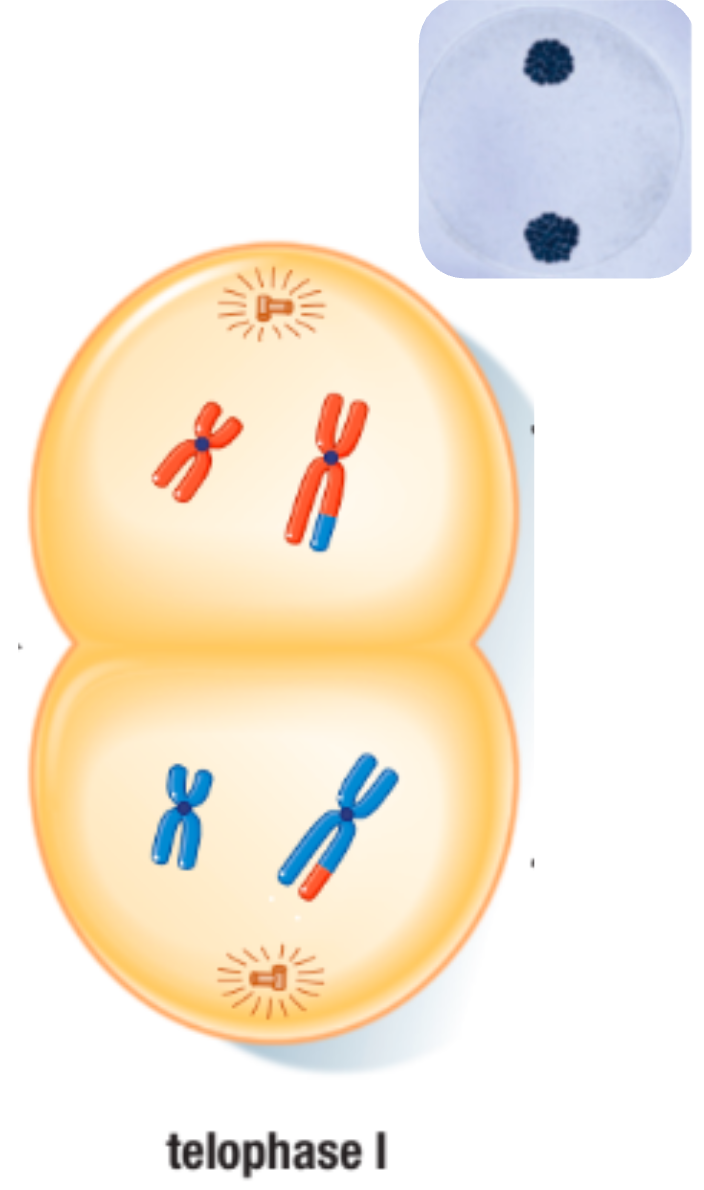

<ul><li><p><span style="background-color: transparent; font-family: &quot;Open Sans&quot;, sans-serif;">Nuclear membranes begin to form around the chromosomes at each end of the cell</span></p></li><li><p><span style="background-color: transparent; font-family: &quot;Open Sans&quot;, sans-serif;">Spindle fibres disappear.</span></p></li><li><p><span style="background-color: transparent;">Cell begins to divide&nbsp;into two Haploid daughter cells</span></p></li></ul><p></p>
75
New cards

Whats the difference between Mitosis and Meiosis I?

  • The chromosomes in the two nuclei are not identical with respect to their gene content

  • Each daughter nucleus receives only one member of each original chromosome pair

  • In humans, these cells have 23 chromosomes, still consisting of two sister chromatids each (46 chromatids)

    • NOTE: as a result of the crossing over events, the sister chromatids are no longer identical.


76
New cards

What happens during the Meiosis II phase?

  • The second division (prophase II, metaphase II, anaphase II, telophase II)

  • The number of chromosomes is unchanged at this stage, but the total number of cells increases to four


77
New cards

What happens during Prophase II?

  • The nuclear membrane dissolves 

  • Spindle fibres begin to form


<ul><li><p><span style="background-color: transparent; font-family: &quot;Open Sans&quot;, sans-serif;">The nuclear membrane dissolves&nbsp;</span></p></li><li><p><span style="background-color: transparent; font-family: &quot;Open Sans&quot;, sans-serif;">Spindle fibres begin to form</span></p></li></ul><p></p>
78
New cards

What happens during Metaphase II?

  • The chromosomes, each with sister chromatids, line up across the middle of the cell

    • Not a tetrad

  • The sister chromatids remain attached by their centromeres

  • Spindle fibers are attached to the centromeres, ready to pull


<ul><li><p><span style="background-color: transparent; font-family: &quot;Open Sans&quot;, sans-serif;">The chromosomes, each with sister chromatids, line up across the middle of the cell</span></p><ul><li><p><span style="background-color: transparent; font-family: &quot;Open Sans&quot;, sans-serif;"><u>Not</u> a tetrad</span></p></li></ul></li><li><p><span style="background-color: transparent; font-family: &quot;Open Sans&quot;, sans-serif;">The sister chromatids remain attached by their centromeres</span></p></li><li><p><span style="background-color: transparent; font-family: &quot;Open Sans&quot;, sans-serif;">Spindle fibers are attached to the centromeres, ready to pull</span></p></li></ul><p><br></p>
79
New cards

What happens during Anaphase II?

  • Sister chromatids are pulled apart at the centromere by the spindle fibres

  • Sister chromatids move to opposite poles of the cell


<ul><li><p><span style="background-color: transparent; font-family: &quot;Open Sans&quot;, sans-serif;">Sister chromatids are pulled apart at the centromere by the spindle fibres</span></p></li></ul><ul><li><p><span style="background-color: transparent; font-family: &quot;Open Sans&quot;, sans-serif;">Sister chromatids move to opposite poles of the cell</span><br></p></li></ul><p></p>
80
New cards

What happens during Telophase II?

  • The nuclear membrane begins to form around the chromatids, now called chromosomes.


<ul><li><p><span style="background-color: transparent; font-family: &quot;Open Sans&quot;, sans-serif;">The nuclear membrane begins to form around the chromatids, now called chromosomes.</span></p></li></ul><p></p>
81
New cards

What happens during Cytokinesis II?

  • The second nuclear division is completed, and the second division of cytoplasm follows.

    • Resulting in four haploid gamete cells, each with n number of chromosomes
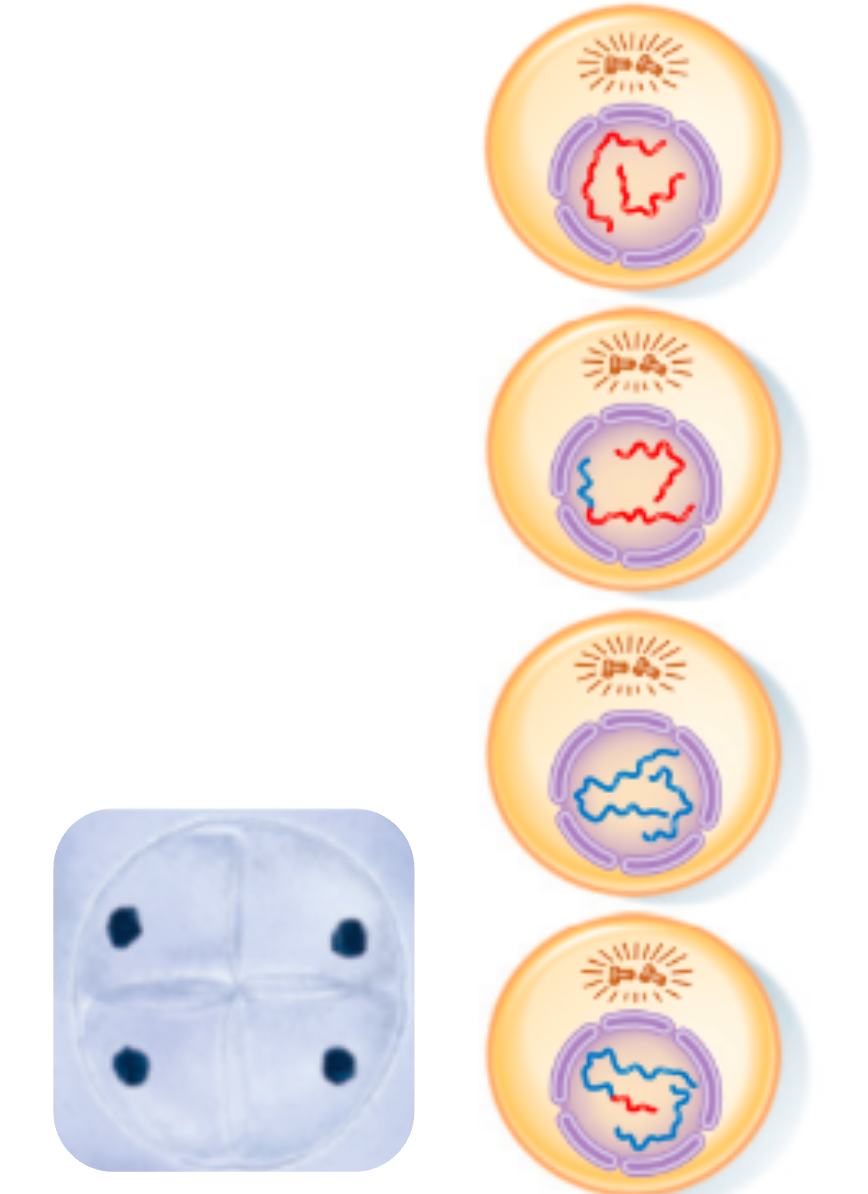

<ul><li><p><span style="background-color: transparent; font-family: &quot;Open Sans&quot;, sans-serif;">The second nuclear division is completed, and the second division of cytoplasm follows.</span></p><ul><li><p><span style="background-color: transparent; font-family: &quot;Open Sans&quot;, sans-serif;">Resulting in <strong>four haploid gamete cells</strong>, each with n number of chromosomes</span></p></li></ul></li></ul><p></p>
82
New cards

Whats the difference between Mitosis and Meiosis II?

  • The phases of meiosis II are similar to the phases of mitosis 

  • The key difference is that the cells are haploid and not diploid 


83
New cards

What happens to Sex cells?

  • After meiosis, four haploid daughter cells (gametes) have been produced. 

  • The recombination of genetic information that occurs during the crossing over stage of meiosis (prophase I) produces gametes (sex cells) that are genetically different from one another.

  • Genetic variation can also happen through random assortment in meiosis I - metaphase I


84
New cards

What does Random Assortment mean?

  • The number of genetically distinct gametes that can be produced from a diploid cell is 2n, where n is the number of chromosome pairs in the diploid cell. 

  • If a diploid organism has 3 pairs of chromosomes -> 23 = 8 genetically distinct gametes

  • Each human, with 23 pairs of chromosomes, can therefore produce 223, or 8 388 608, genetically distinct gametes.


85
New cards

Where do Gametes form in Animals?

  • In animals, meiosis takes place in the testes and ovaries

  • Gametogenesis is the overall process of forming sex cells (involves meiosis, but also includes cell maturation and specialization after meiosis)

  • The process of sperm production is called spermatogenesis

  • The process of egg production is called oogenesis 
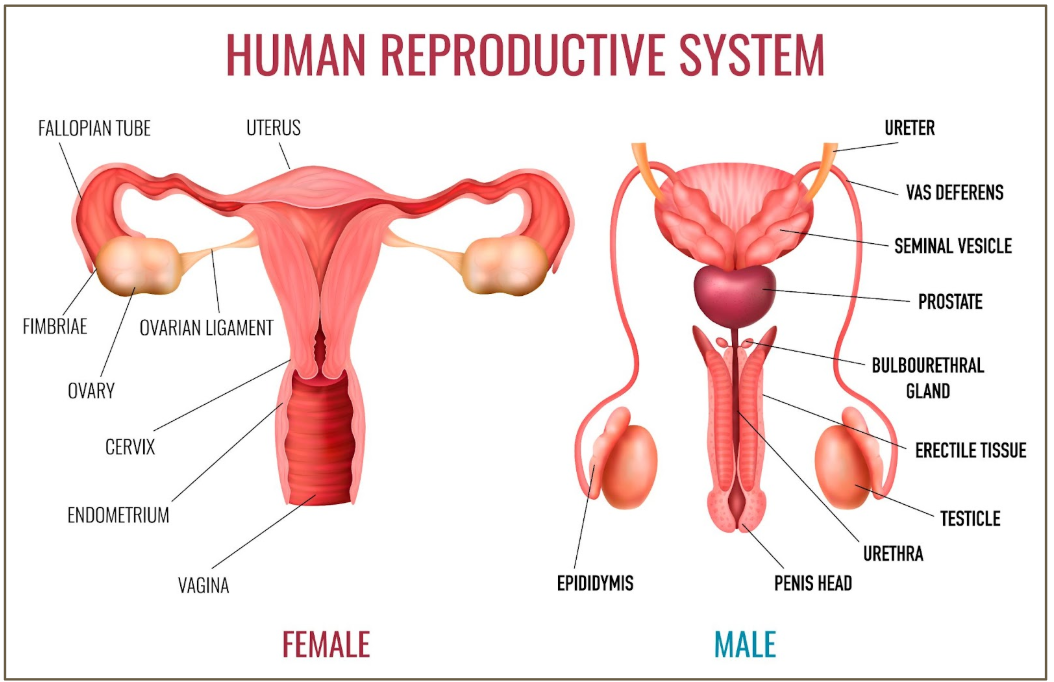

<ul><li><p><span style="background-color: transparent; font-family: &quot;Open Sans&quot;, sans-serif;">In animals, meiosis takes place in the <strong>testes </strong>and <strong>ovaries</strong></span></p></li><li><p><span style="background-color: transparent; font-family: &quot;Open Sans&quot;, sans-serif;"><strong>Gametogenesis </strong>is the overall process of forming sex cells (involves meiosis, but also includes cell maturation and specialization after meiosis)</span></p></li></ul><ul><li><p><span style="background-color: transparent; font-family: &quot;Open Sans&quot;, sans-serif;">The process of sperm production is called <strong>spermatogenesis</strong></span></p></li><li><p><span style="background-color: transparent; font-family: &quot;Open Sans&quot;, sans-serif;">The process of egg production is called <strong>oogenesis&nbsp;</strong></span></p></li></ul><p></p>
86
New cards

What is Spermatogenesis?

  • The production of sperm cells 

  • In spermatogenesis, the cytoplasm is divided equally during each cell division, resulting in the formation of four equal sized sperm cells. 

  • Each of the four sperm cells is small in size and streamlined for maximum motility.


<ul><li><p><span style="background-color: transparent; font-family: &quot;Encode Sans&quot;, sans-serif;">The production of sperm cells&nbsp;</span></p></li><li><p><span style="background-color: transparent; font-family: &quot;Encode Sans&quot;, sans-serif;">In spermatogenesis, the <strong><u>cytoplasm is divided equally </u></strong>during each cell division, resulting in the formation of <strong>four equal sized sperm cells</strong>.&nbsp;</span></p></li><li><p><span style="background-color: transparent; font-family: &quot;Encode Sans&quot;, sans-serif;">Each of the four sperm cells is small in size and streamlined for maximum motility.</span></p></li></ul><p></p>
87
New cards

What is Oogenesis?

  • The production of egg cells (ova) 

  • In oogenesis, the cytoplasm of the female gametes does not divide equally during each of the two cell divisions of meiosis.

    • Instead, one of the daughter cells receives most of the cytoplasm

  • The other cells, called polar bodies, die, and the final product of oogenesis is a single ovum (egg cell).

  • Results in production of ONLY ONE ova or egg cell and 3 polar bodies ( die)


<ul><li><p><span style="background-color: transparent; font-family: &quot;Encode Sans&quot;, sans-serif;">The production of egg cells (ova)&nbsp;</span></p></li><li><p><span style="background-color: transparent; font-family: &quot;Encode Sans&quot;, sans-serif;">In oogenesis, the cytoplasm of the female gametes <strong><u>does not divide equally during each</u></strong> of the two cell divisions of meiosis.</span></p><ul><li><p><span style="background-color: transparent; font-family: &quot;Encode Sans&quot;, sans-serif;">Instead, <strong>one of the daughter cells receives most of the cytoplasm</strong></span></p></li></ul></li><li><p><span style="background-color: transparent; font-family: &quot;Encode Sans&quot;, sans-serif;">The other cells, called <strong>polar bodies</strong>, die, and the final product of oogenesis is a single ovum (egg cell).</span></p></li><li><p><span style="background-color: transparent; font-family: &quot;Encode Sans&quot;, sans-serif;">Results in production of ONLY ONE ova or egg cell and 3 polar bodies ( die)</span></p></li></ul><p></p>
88
New cards

What is Fertilization?

  • Sexual reproduction involves the fusion of a male reproductive cell (gamete - sperm cell) with a female reproductive cell (gamete - egg cell or ovum). 

  • The cell that results from this fusion is called a zygote

  • The process of combining gametes to form a zygote is called fertilization.


<ul><li><p><span style="background-color: transparent; font-family: &quot;Open Sans&quot;, sans-serif;"><strong>Sexual reproduction</strong> involves the fusion of a male reproductive cell <strong>(gamete - sperm cell)</strong> with a female reproductive cell <strong>(gamete - egg cell or ovum)</strong>.&nbsp;</span></p></li><li><p><span style="background-color: transparent; font-family: &quot;Open Sans&quot;, sans-serif;">The cell that results from this fusion is called a <strong>zygote</strong></span></p></li><li><p><span style="background-color: transparent; font-family: &quot;Open Sans&quot;, sans-serif;">The process of combining gametes to form a zygote is called <strong>fertilization.</strong></span></p></li></ul><p></p>
89
New cards

What happens to Haploid & Diploid cells in Fertilization?

  • Gametes have half the number of chromosomes compared to parent (germ) cells

  • Gametes contain single, unpaired chromosomes, they are haploid (n)

  • When gamete cells fuse during fertilization, the resulting zygote now has two copies of each chromosome

    • Zygote cells are diploid (2n): n chromosomes from the female parent plus n chromosomes from the male parent 


<ul><li><p><span style="background-color: transparent; font-family: &quot;Open Sans&quot;, sans-serif;">Gametes have half the number of chromosomes compared to parent (germ) cells</span></p></li></ul><ul><li><p><span style="background-color: transparent; font-family: &quot;Open Sans&quot;, sans-serif;">Gametes contain single, unpaired chromosomes, they are <strong>haploid (n)</strong></span></p></li></ul><ul><li><p><span style="background-color: transparent; font-family: &quot;Open Sans&quot;, sans-serif;">When gamete cells fuse during fertilization, the resulting <strong>zygote</strong> now has <strong>two copies</strong> of each chromosome</span></p><ul><li><p><span style="background-color: transparent; font-family: &quot;Open Sans&quot;, sans-serif;">Zygote cells are <strong>diploid (2n)</strong>: n chromosomes from the female parent plus n chromosomes from the male parent&nbsp;</span></p></li></ul></li></ul><p></p>
90
New cards

How many gametes do Humans have?

  • Human gametes are haploid, with n = 23 chromosomes 

  • When two human gametes combine, 23 pairs of homologous chromosomes are formed and the zygote will have 46 chromosomes total 


<ul><li><p><span style="background-color: transparent; font-family: &quot;Open Sans&quot;, sans-serif;">Human gametes are haploid, with n = 23 chromosomes&nbsp;</span></p></li></ul><ul><li><p><span style="background-color: transparent; font-family: &quot;Open Sans&quot;, sans-serif;">When two human gametes combine, 23 pairs of homologous chromosomes are formed and the zygote will have 46 chromosomes total&nbsp;</span></p></li></ul><p></p>
91
New cards

Whats the difference between Male & Female gametes?

  1. Mature sperm cells must be able to swim to an egg cell to fertilize it

  2. Sperm cells must be highly motile; being large and heavy would slow them down

  3. Egg cells do not need to be motile as it stays in place

  4. Egg cells use the nutrients and organelles carried in the cytoplasm to fuel future cell divisions in the event that the egg cell becomes fertilized (if it is not fertilized, then it will be discharged in a form of the menstrual cycle every month)

  5. Males produce many more sex cells than females

  • Sexually mature males can produce hundreds of millions of sperm cells every day

  • In an entire lifetime, a female human produces between 400-500 eggs


  • This is why females cannot get pregnant after a certain age (b/c there are no more eggs being produced)

  • Only a few weeks after a female mammal is born, all of her potential egg cells stop developing at the end of prophase I. When she reaches sexual maturity, some of these cells go on to complete meiosis.


92
New cards

How do Women birth multiple babies?

  • Sometimes a woman can give birth to more than 1 baby at once. This can happen when more than one egg is released (and fertilized) leading to fraternal twins

  • On the other hand, if a single zygote divides into 2 separate bodies in the first few days of development, identical twins may be born (also genetically identical)


<ul><li><p><span style="background-color: transparent; font-family: &quot;Open Sans&quot;, sans-serif;">Sometimes a woman can give birth to more than 1 baby at once. This can happen when <strong>more than one egg is released (and fertilized) </strong>leading to <strong>fraternal</strong> twins</span></p></li><li><p><span style="background-color: transparent; font-family: &quot;Open Sans&quot;, sans-serif;">On the other hand, if a single z<strong>ygote divides into 2 separate bodies</strong> in the first few days of development, identical twins may be born (also genetically identical)</span></p></li></ul><p></p>
93
New cards

What are the differences of sex chromosomes for Females & Males? (Summarize)

  • Many eukaryotic organisms, including most animals, have at least one pair of chromosomes that differ between the males and females of that species, these chromosomes are sex chromosomes

  • In females: Sex chromosomes consist of a matching pair of homologous chromosomes (XX)

  • In males: Sex chromosomes consist of a partially matching pair of homologous chromosomes (XY) 

    • The Y chromosome is much smaller than the X

  • Males determine the sex of the fertilized egg/offspring

  • Individuals that inherit an X chromosome from their father and an X chromosome from their mother develop into biological females (XX)

  • Individuals that inherit a Y chromosome from their father and an X chromosome from their mother develop into biological males (XY).

  • Although they differ in size, parts of the X and Y chromosome contain matching regions that enable them to undergo synapsis and behave as a homologous pair during meiosis

  • Chromosomes that are not sex chromosomes are referred to as autosomal chromosomes (Chromosomes 1-22) 

    • These chromosomes define body traits like eye colour, hair colour, etc…

  • The 23rd chromosome is the sex chromosome (defines the sex of the human - XY for male, XX for female)


<ul><li><p><span style="background-color: transparent; font-family: &quot;Open Sans&quot;, sans-serif;">Many eukaryotic organisms, including most animals, have at least one pair of chromosomes that differ between the males and females of that species, these chromosomes are <strong>sex chromosomes</strong></span></p></li><li><p><span style="background-color: transparent; font-family: &quot;Open Sans&quot;, sans-serif;"><strong>In females:</strong> Sex chromosomes consist of a <u>matching pair</u> of homologous chromosomes (XX)</span></p></li><li><p><span style="background-color: transparent; font-family: &quot;Open Sans&quot;, sans-serif;"><strong>In males</strong>: Sex chromosomes consist of a <u>partially matching</u> pair of homologous chromosomes (XY)&nbsp;</span></p><ul><li><p><span style="background-color: transparent; font-family: &quot;Open Sans&quot;, sans-serif;">The Y chromosome is much smaller than the X</span></p></li></ul></li><li><p><span style="background-color: transparent; font-family: &quot;Open Sans&quot;, sans-serif;">Males determine the sex of the fertilized egg/offspring</span></p></li></ul><ul><li><p><span style="background-color: transparent; font-family: &quot;Open Sans&quot;, sans-serif;">Individuals that inherit an X chromosome from their father and an X chromosome from their mother develop into biological females (XX)</span></p></li><li><p><span style="background-color: transparent; font-family: &quot;Open Sans&quot;, sans-serif;">Individuals that inherit a Y chromosome from their father and an X chromosome from their mother develop into biological males (XY).</span></p></li><li><p><span style="background-color: transparent; font-family: &quot;Open Sans&quot;, sans-serif;">Although they differ in size, parts of the X and Y chromosome contain matching regions that enable them to undergo synapsis and behave as a homologous pair during meiosis</span></p></li><li><p><span style="background-color: transparent; font-family: &quot;Open Sans&quot;, sans-serif;">Chromosomes that are not sex chromosomes are referred to as <strong>autosomal chromosomes</strong> (Chromosomes 1-22)&nbsp;</span></p><ul><li><p><span style="background-color: transparent; font-family: &quot;Open Sans&quot;, sans-serif;">These chromosomes define body traits like eye colour, hair colour, etc…</span></p></li></ul></li><li><p><span style="background-color: transparent; font-family: &quot;Open Sans&quot;, sans-serif;">The <strong>23rd </strong>chromosome is the <strong>sex chromosome </strong>(defines the sex of the human - XY for male, XX for female)</span></p></li></ul><p></p>
94
New cards

What are the Comparisons of Mitosis and Meiosis?

  • Mitosis consists of only one set of division phases and produces two diploid daughter cells that are identical.

  • Meiosis consists of two sets of divisions and produces four haploid daughter cells that are not identical. 

    • Meiosis is important for organisms such as humans because it results in genetic variation


<ul><li><p><span style="background-color: transparent;">M</span><span style="background-color: transparent; font-family: &quot;Open Sans&quot;, sans-serif;">itosis consists of only one set of division phases and produces two diploid daughter cells that are identical.</span></p></li></ul><ul><li><p><span style="background-color: transparent; font-family: &quot;Open Sans&quot;, sans-serif;">Meiosis consists of two sets of divisions and produces four haploid daughter cells that are not identical.&nbsp;</span></p><ul><li><p><span style="background-color: transparent; font-family: &quot;Open Sans&quot;, sans-serif;">Meiosis is important for organisms such as humans because it results in genetic variation</span></p></li></ul></li></ul><p></p>