Ch 12 Incisors + 13 Canines ANAT 1067
 Call Kai
 Learn
 Practice Test
 Spaced Repetition
 Match
 Flashcards
 Knowt Play
1/78

There's no tags or description
Looks like no tags are added yet.
79 Terms
Which incisor is the widest mesiodistally?
Maxillary Centrals
Which incisor has the greatest mesial curvature of CEJ?
Maxillary Centrals
Maxillary Centrals:
Evidence of calcification — ?
Eruption — ?
Root completion — ?
Evidence of calcification — 3 months
Eruption — 7/8 years
Root completion — 10 years
For maxillary centrals, which is sharper; the mesioincisal edge or the distoincisal edge?
Mesioincisal edge
What are three anomalies for maxillary centrals that are commonly seen?
Short roots
Unusually long crown
Gemination
Looking at contact areas of maxillary centrals, where are they?
The mesial contact area is more incisal compared to the distal contact area
What does the root like for the maxillary central?
Root is cone shaped and usually has a blunt apex. Root is 2-3mm longer than the crown
T/F: The lingual surface of maxillary centrals are very diverse
True
Looking at the incisal POV of a maxillary central, what direction is the apex of the crown pointing?
Linguall
Maxillary Laterals:
Evidence of calcification — ?
Eruption — ?
Root completion — ?
Evidence of calcification — 1 year
Eruption — 8/9 years
Root completion — 11 years
Which tooth in the mouth is most likely to be malformed?
Maxillary laterals — peg shaped laterals, missing laterals entirely (like third molars), twisted roots/crowns, dens in dente
Comparing the maxillary central and lateral, which of the two show more curvature?
laterals
Compare maxillary centrals and laterals: incisal edges, mesial/distal corners, root
Laterals have more rounded incisal edges,
Laterals have more more rounded mesial/distal corners,
Laterals have longer (1.5x of the crown) and thinner root, usually curving distally with sharp apex. Central has a straight apex
T/F: For maxillary laterals, the distal aspect is the same as the mesial aspect, except for less curvature of the cervical line
True
What does supernumerary teeth mean? What are supernumerary teeth called between maxillary centrals and laterals?
Extra teeth; Mesiodens
In adult maxillary laterals, how many pulp horns are present? Maxillary centrals?
2 (mesial and distal pulp horns); centrals also have 2
T/F: It’s common for maxillary lateral canals to be calcified later in adulthood due to continued shrinking of the pulp (which occurs with all teeth) and the naturally narrow canals of this tooth
True
Mandibular Central Incisors:
Evidence of calcification — ?
Eruption — ?
Root completion — ?
(one year down as max centrals)
Evidence of calcification — 3 months
Eruption — 6/7 years
Root completion — 9 years
Out of the incisors, which are the smallest?
Mandibular central incisors
Out of the incisors, which are the hardest to identify from left/right? How can you determine?
Mandibular central incisors
How to determine, use these hints:
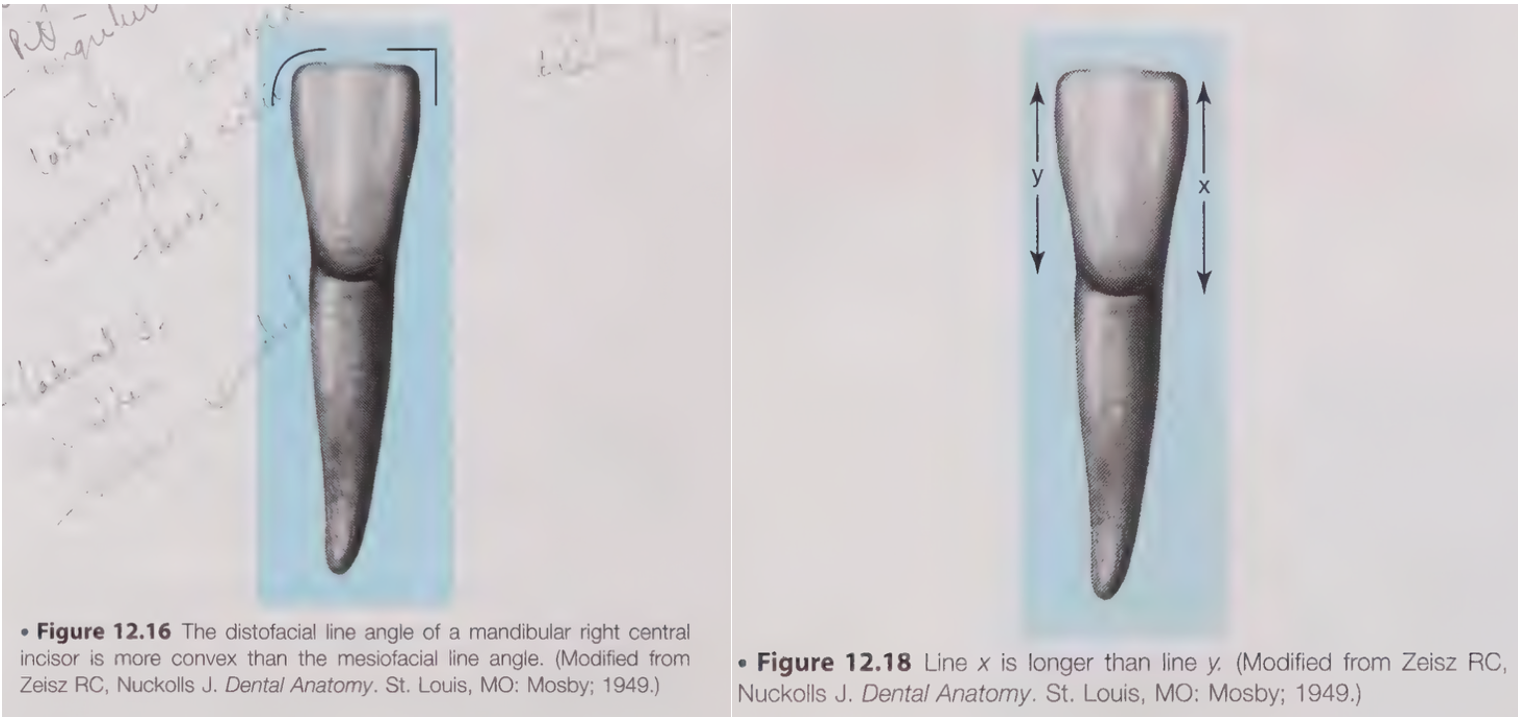
Distoincisal angle greater than mesioincisal angle
Distofacial LA more rounded than mesiofacial LA
Cervical line crests slightly toward distal side
Straight line drawn between the endpoints of the distofacial line angle (y) compared with a straight line drawn between the end points of the mesiofacial line angle (X) is shorter
So.. distal side is more rounded and shorter in height
Which teeth do mandibular central incisors occlude on?
ONLY maxillary central incisors
Out of all incisors, which typically have shallow fossa, no tubercles or lingual pits evident?
Mandibular central incisors
How does the mandibular central incisors slant/occlude?
facially
Mandibular Lateral incisors:
Evidence of calcification — ?
Eruption — ?
Root completion — ?
(same years as maxillary centrals)
Evidence of calcification — 4 months
Eruption — 7/8 years
Root completion — 10 years
How do you tell a mandibular central and mandibular lateral apart?
Mandibular laterals are bigger, and distolingual twist of the lateral
How do you tell a mandibular lateral and maxillary lateral apart?
Upper laterals have a larger distal lobe
T/F: For mandibular laterals, the endpoints of the mesiofacial line angle are further apart than the distofacial line angle
True, same as mandibular centrals
T/F: For mandibular laterals, the distal lobe is larger than the distal lobe of the mandibular central
True

What is that groove on the root called, on the mandibular lateral?
Proximal root
Describe the root of the mandibular lateral
The root is generally larger, thicker, and longer than that of the mandibular central incisor, and apex may point facially or distally
How many pulp horns do mandibular centrals and laterals have?
3
Which direction does the incisal edge of maxillary centrals tilt? Laterals?
Both lingually

What are the convex areas that form the mesial and distal border of the lingual side of the maxillary centrals?

What is the large depression on the lingual surface of the maxillary central?

For the maxillary central, which lobe is the longest and most prominent?

For the maxillary central, which lobe is usually depressed?
the Central lobe

For the maxillary canines/cuspid, which lobe is the longest, widest and most prominent?
central lobe

For the maxillary canine/cuspid, which lobe is the shorted and least prominent?
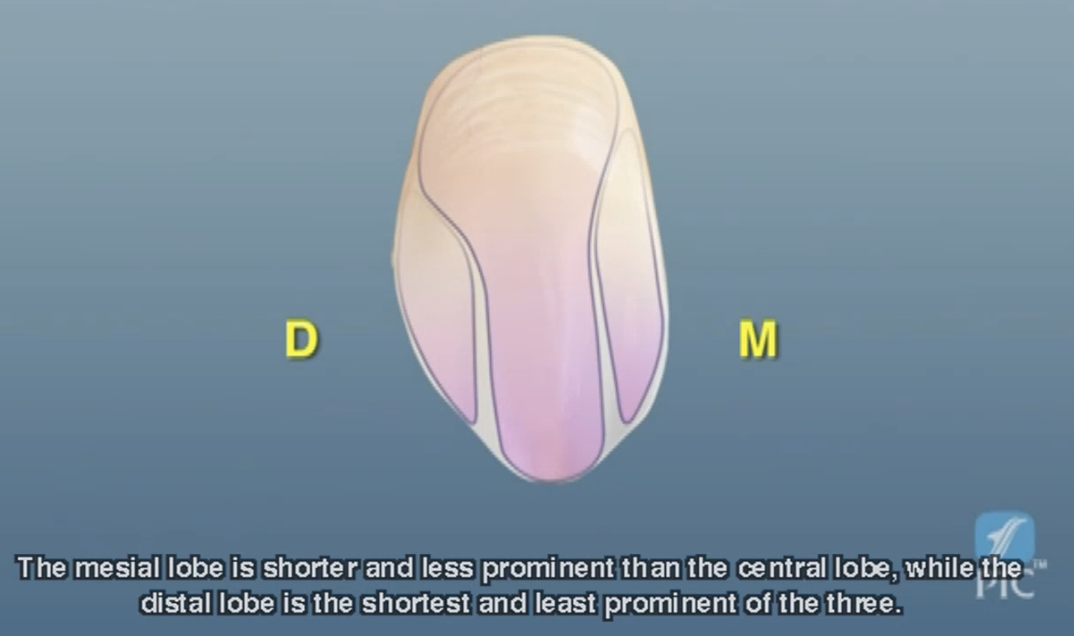
How is the cervical/gingival buldge formed?
Convergence of the facial lobes

What is the emergence profile?
The three-dimensional contour of a tooth as it exits the soft tissue (gums) and transitions into the oral cavity

Incisors: Which lobe DOES NOT blend into gingival/cervical buldge?
Distal lobe

Canine/cuspid: What separates the distal lobe from forming into the gingival/cervical buldge?
A depression
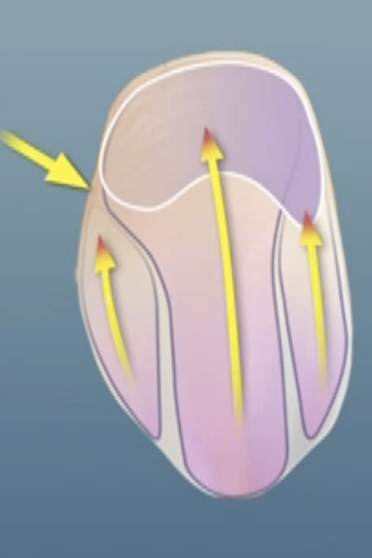
For the maxillary incisors, which developmental groove is longer?
Mesial developmental groove.
For laterals, this groove can even be diminished due to huge central lobe
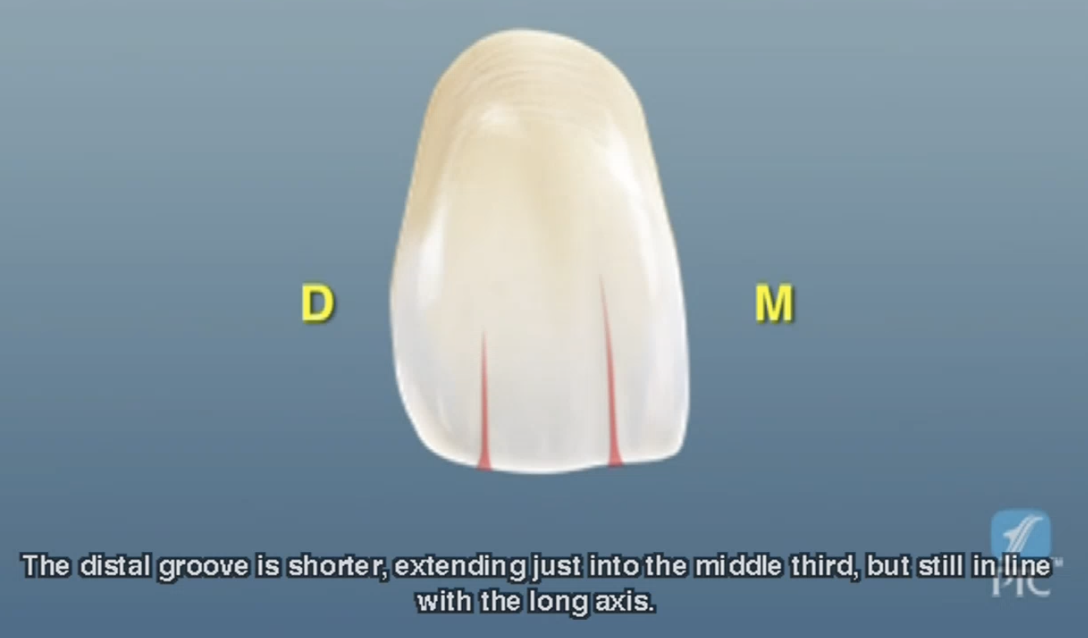
For the maxillary canine, which developmental groove is longer?
Distal

What is the Perikymata effect?
In new adult teeth

T/F: Marginal ridges blend into the cingulum
True
What is called when you’ve worn your incisal edge down from abrasion?
Wear facets, lowkey u know u have this
What is the angle in which abrasion occurs between upper and lower centrals?
35-40 degrees
Upper canines/cuspids: what incisal slope is longer?

What has a greater root-crown ratio, maxillary centrals or laterals?
Max centrals but i think its laterals; check this
T/F: Maxillary lateral roots are longer and more slender than maxillary centrals
True
What shape is cross section of mandibular incisors?
Oval
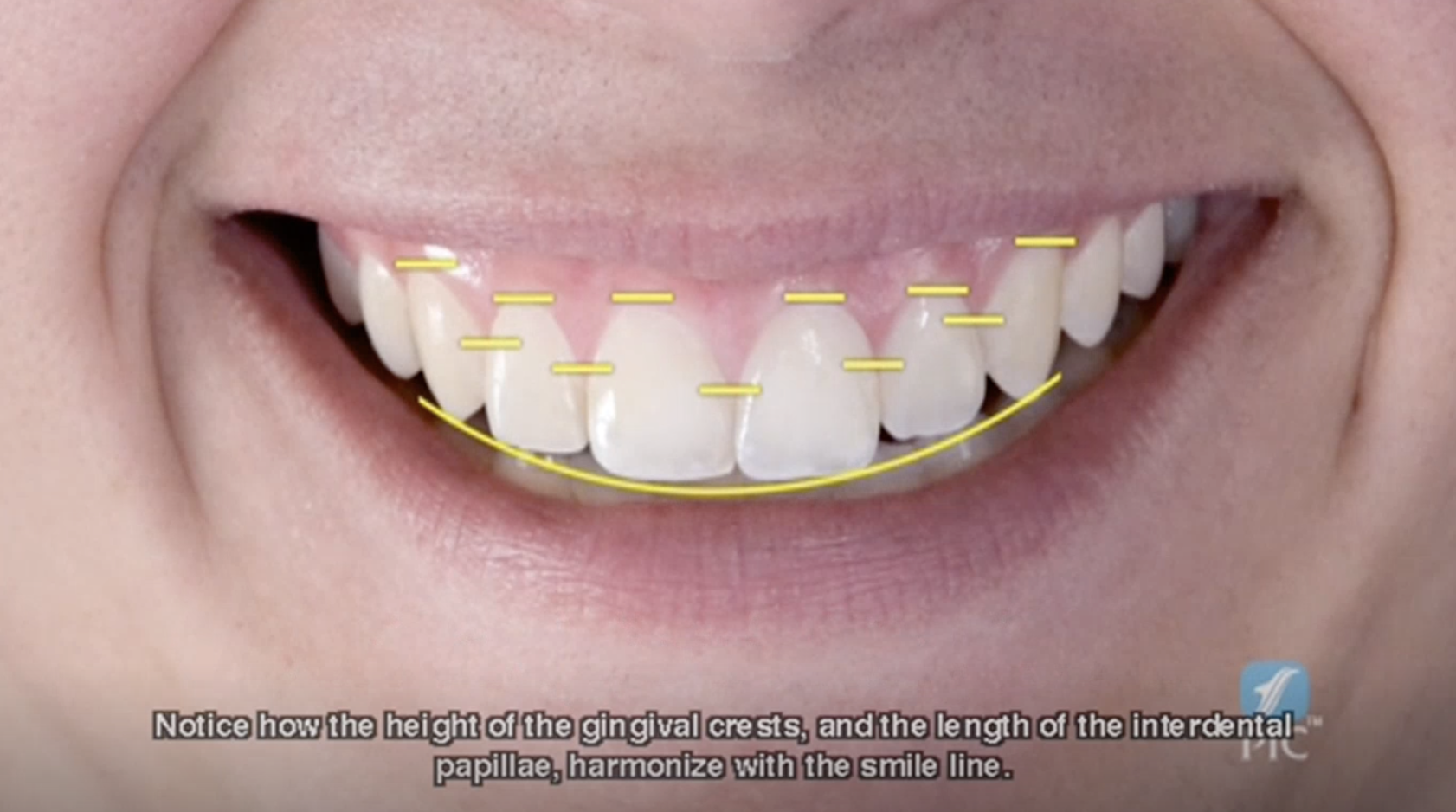
What are the ten key aesthetic concepts of a natural smile?
The Long Axis
Vertical Transition Line Angles
Primary Planes
Developmental Lobes and Grooves
S-Curves
Embrasures, Proximal Contacts, and Interdental Papilla
The Nine Axes for Communicating Tooth Position
The Aesthetic Composition Of A Natural Smile
Gingival Tissues And Aesthetics
The Smile Line and Buccal Corridors
What is the projection of the bone called that is made for canine area?
Canine eminence
Maxillary Canines:
Evidence of calcification — ?
Eruption — ?
Root completion — ?
Evidence of calcification — 4 months
Eruption — 11-12 years
Root completion — 13 to 15 years
T/F: Maxillary canines much wider labiolingually compared to their maxillary incisors, and have the largest cingulum of any other teeth
True
put contact area trends, and even buccal height of contour trends
Describe the lingual aspect of the maxillary canine
Prominent cingulum and marginal ridges, central ridge runs from cingulum to cusp tip
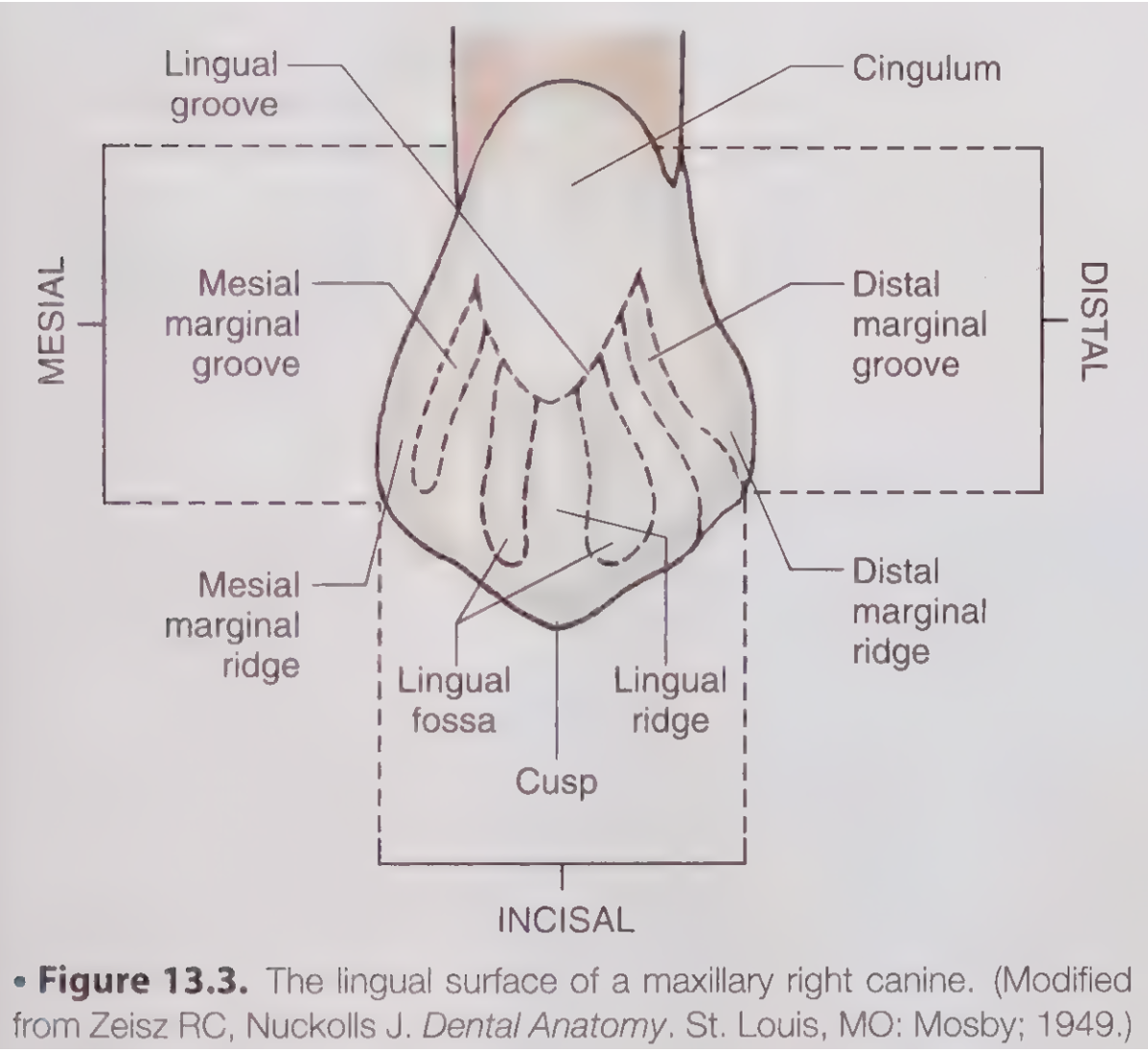
T/F: For maxillary canines, the greatest measurement labiolingually is at the cervical third, due to the size of the cingulum
True

For the maxillary canine root, which side shows developmental groove?
Mesial side
How many pulp horns does a maxillary canine have?
1
Mandibular Canines:
Evidence of calcification — ?
Eruption — ?
Root completion — ?
Evidence of calcification — 4 months
Eruption — 9-10yrs
Root completion — 13yrs
How mandibular canines differ from maxillary canines? Theres 6 main ones (out of 9 in the textbook)
Generally thinner and underdeveloped compared to upper
Crown is either the same or longer than the upper
Lingual surface is way smoother with less prominent ridges (see pic)
Cusp tip tips lingually and not as developed as upper
An anomoly is bifurcation of the apical third of the root
Distal contact more incisal compared to upper canine distal contact
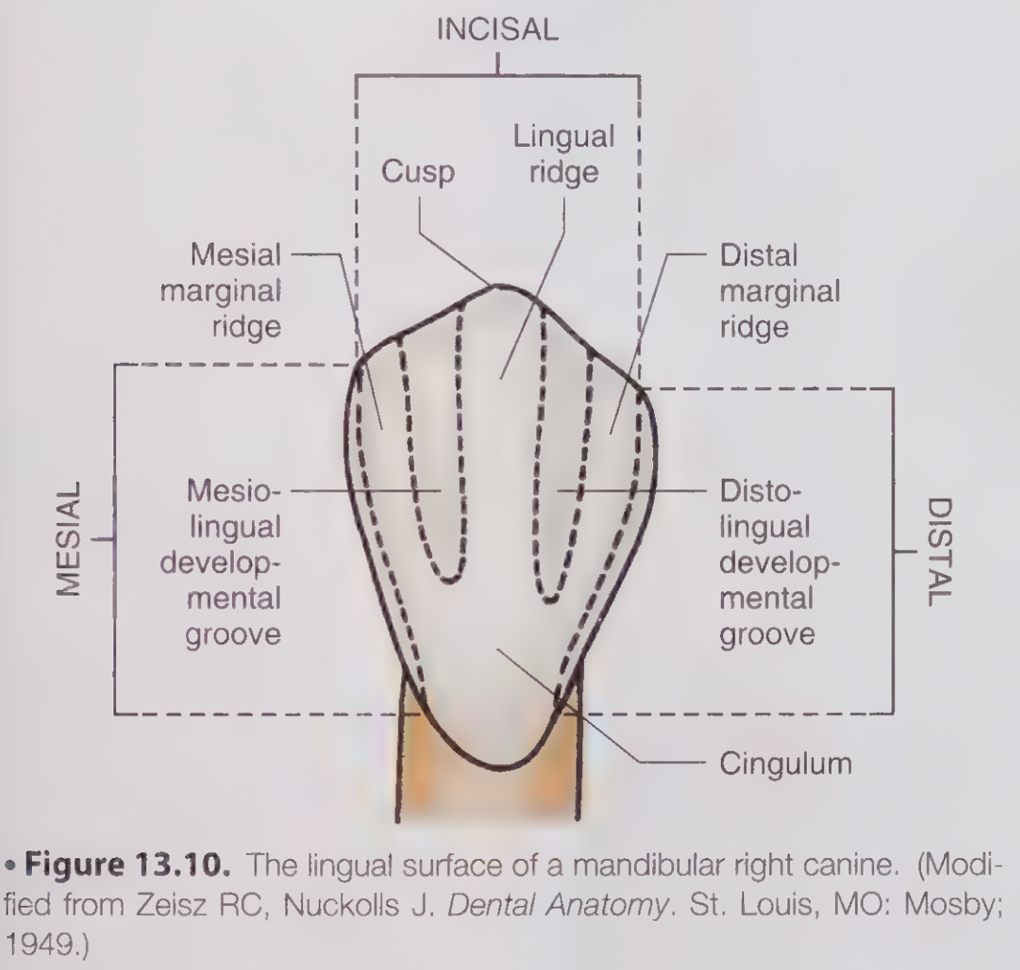
T/F: The root of the mandibular canine is wider labiolingually than mesiodistally
True
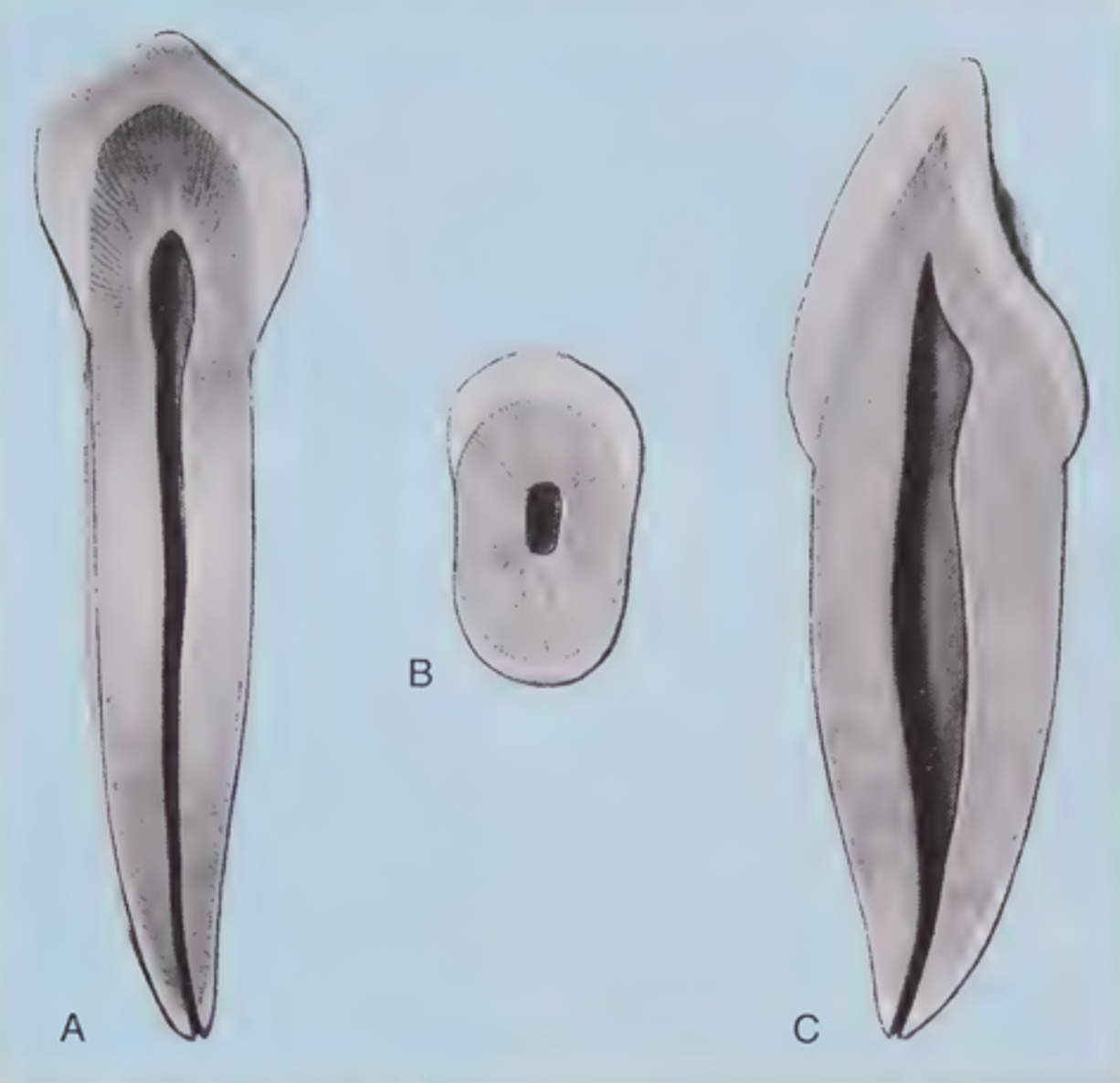
How many pulp horns does a mandibular canine have?
1; sometimes tho they can have 2 canals — 1 buccal and 1 lingual
T/F: The golden proportion states that the width of the laterals should be 2/3 the width of the centrals, and the canines/cuspid should be slightly narrower than the centrals
True
What are the key identification clue for:
Max Central
Max Lateral
Max Canine
Mand Central
Mand Lateral
Mand Canine
Max Central — largest anterior crown
Max Lateral — greatest variation, more rounded compared to centrals
Max Canine — longest root and strongest cusp tip
Mand Central — most symmetrical, smallest tooth
Mand Lateral — distolingual twist
Mand Canine — slender crown, less prominent lingual surface
T/F: Mesial contact areas are usually more incisal
True; makes sense cause the more posterior you go, the more cervical the contact areas are
The position of the maxillary primary planes are controlled by what?

T/F: The primary plane is a flat, slightly depressed area which has the effect of accentuating the mesial and distal lobes
True
What is the key differentiating factor which determine the prominence of developmental lobes?
Developmental grooves
Where does the S-curve start/end?

Rounded teeth shape vs square teeth shape; Which associate with a more youthful look?
Rounded teeth
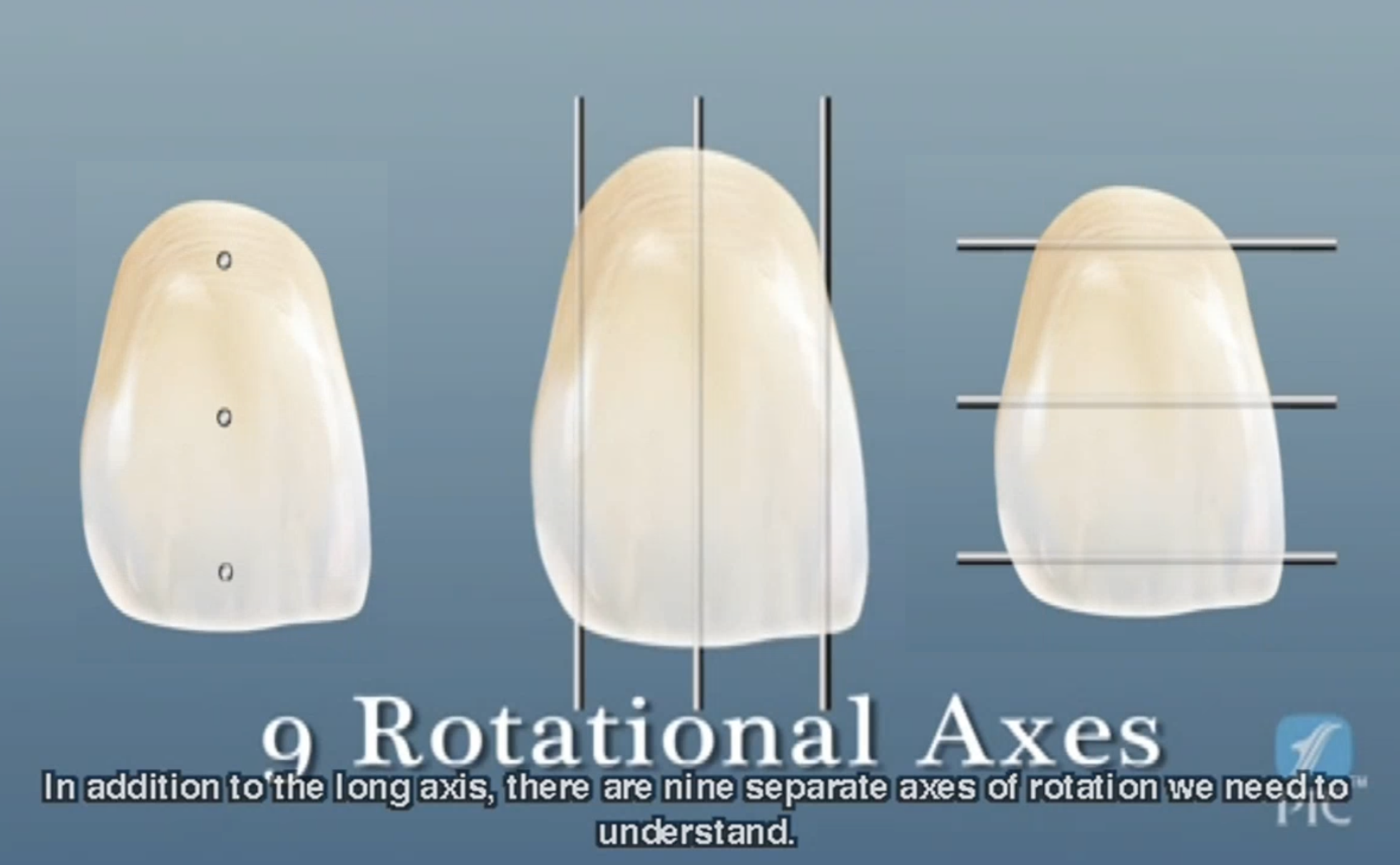
What are the 9 rotational axis of a tooth?
Mesial Vertical Axis
Distal Vertical Axis
Central Vertical Axis
Gingival Horizontal Axis
Incisal Horizontal Axis
Central Horiztonal Axis
Gingival Labiolingual Axis
Incisal Labiolingual Axis
Central Labiolingual Axis
Explain the difference between linguoversion vs. labioversion
like being proclined vs retroclined

What are the Esthetic Compositions?
Basic Esthetic Composition — Centrals and canine mesial lobe reflecting light: centrals vertical which can make distoinsical edge appear more forward, laterals will follow arch, canines rotated 3-5deg outwards on incisal horizontal axis emphasizing prominence at gingiva
Strong Esthetic Composition — centrals laterals and canine mesial/central reflecting light: centrals and laterals vertical, canines follow arch
Soft Esthetic Composition — centrals laterals and canine mesial reflecting light: centrals vertical, laterals rotated mesially on central horizontal axis (increasing curve of the smile), canines follow arch

Which tooth changes the personailty of a smile?
Laterals
just know this
