Unit 1 Biology AOS 2 - Functioning systems
 Call Kai
 Learn
Learn Practice Test
 Spaced Repetition
 Match
Match Flashcards
 Knowt Play
1/182

There's no tags or description
Looks like no tags are added yet.
Name | Mastery | Learn | Test | Matching | Spaced | Call with Kai | Chat |
|---|
No analytics yet
Send a link to your students to track their progress
183 Terms
What are the methods by which plants regulate and maintain water balance? Why do they need to do this?
Plants regulate water loss via transpiration and water uptake at the roots
The xylem losewater if transpiration outweighs water uptake
Water is essential to plants survival for metabolic reactions including photosynthesis and cellular respiration
What are the methods by which plants lose and gain water and how are they regulated?
Water loss: Transpiration
Regulated by guard cells that surround the stomata, opening the stoma when turgid and closing it when flaccid
Water gain: Water uptake at the roots
Regulated by the amount of active transport of solute at root hair cells that forms the concentration gradient for water
Where is the waxy cuticle located? How does it prevent water loss?
Waxy cuticle: A protective, hydrophobic layer located on the epidermis (the outer cell layer of leaves)
The waxy cuticle is located on the epidermis and prevents water loss as it is almost completely waterproof and airproof
What enables in water loss (transpiration) regulation of plants? Why must it be regulated?
Stomata regulate transpiration (water loss)
They’re generally found on the underside of leaves where there is less sunlight exposure to reduce transpiration
Stomata need to be open to enable gas exchange for photosynthesis however water is loss in the process
Hence balancing the rate of photosynthesis and transpiration is a compromise for plants to stay alive
What are the consequences for plants if they don’t balance photosynthesis and transpiration?
Reduced photosynthesis + transpiration:
Insufficient glucose production and reduced therefore cellular respiration which can lead to death
Increased photosynthesis + transpiration:
Viable when water availability is sufficient to replace water lost via transpiration, can lead to death if not
What causes stomata to be open or closed?
Open stomata:
Guard cells are turgid causing them to pull away and open the stomal pore
Vacuole absorbs water, increasing in size when guard cells are turgid
Closed stomata:
Guard cells are flaccid having lost turgid pressure
They collapse and move towards each other, closing the stoma
Stoma: The pore of the stomata regulated by the guard cells
What are the factors that affect plants’ rate of water loss? How can they be categorised?
Environmental factors: Temperature, humidity and wind speed
Structural factors: Number of stomata, location of stomata, surface area of leaf
What are the factors that affect plants’ rate of water loss and how do they affect transpiration rate?
Factor | Incorporates | Affect on transpiration when increased |
Number of stomata | Changing number to regulate water loss | Increased |
Location of stomata | Adaptations to minimise water loss | Location dependent |
SA of leaf | Large, curvy + flat leaves with greater SA | Increased |
Humidity | Water particles in the air | Decreased |
Temperature | Speed and energy of water particles | Increased |
Wind speed | Movement of water particles away | Increased |

How is water loss regulated by osmosis at the roots?
Regulate water absorption via the root system
Driven by the solute concentration gradient that determines the rate of osmosis
Active transport of mineral ions (solute) into the root hair cells causes water to follow

How do certain plant factors affect the rate of water absorption (osmosis at the roots)?
Factor | Incorporates | Effect on water absorption when increased |
Water availability | Amount of water in soil available for uptake | Increased absorption due to greater volume |
Mineral ion concentration | Concentration of ions in soil that form the gradient for osmosis | Increased absorption due to stronger gradient |
Energy availability in root hair cells | Number of mitochondria that produce ATP needed for active transport of solutes | Increased absorption due to stronger gradient from increased transport |
What are the factors that affect the rate of water absorption (osmosis at the roots)?
Includes: Water availability in soil, mineral ion concentration in soil, energy available in root hair cells
Root hair cells energy is dependent on the number of mitochondria
More mitochondria increase the rate of cellular respiration and therefore ATP production needed for active transport
What are vascular plants?
Tracheophytes
A large group of plants that have vascular tissue (xylem and phloem)
Vascular tissue conducts water and minerals throughout the plant's roots, stems and leaves
Includes: Flowering plants, ferns and conifers
What are the characterists of seeded vascular plants?
Includes conifers and flowering plants
Make up majority of plants on Earth due to easy distribution via seed distribution and flower pollination
What are the characterists of non-seeded vascular plants?
Ferns
Make up a small portion of plants as they can't survive in dry environments
Lack seeds, flowers and fruits and require moisture for reproduction
What are non-vascular plants?
Bryophytes
Lack vascular tissue system
Cycle between sexual and asexual reproduction
Get water directly from the environment via osmosis
Includes: Mosses, liverworts, hornworts
What are the functions of the shoot system?
Provide structural support: Hold leaves, flowers and buds
Connect roots to leaves: Transport water + minerals from the roots to the rest of the plant via xylem and sugars from the leaves (sinks) to sources
What are the functions of the root system?
Can be modified to absorb moisture and exchange gases
Majority are underground to maximise water absorption
Anchoring plant to the soil
Absorbing water and minerals: And transporting them upwards
Storing the products of photosynthesis: Made in the leaves, stored as tubers or bulb
What are the plant organs?
Flower
Leaf
Fruit
Stem
Root
What are the types of plant tissue?
Dermal (epidermal), ground and vascular
Why do plants need dermal tissue?
Outer protective layer of the plant
Protects from injury, pathogens and water loss
Consists of a single layer of epidermal cells that produce the waxy cuticle
Cells: Epidermal cells, stomata, trichomes
Why do plants need vascular tissue?
Consists of xylem and phloem
Control nutrient and water movement
Cells: Tracheids and vessel elements, sieve tubes and companion cells
Why do plants need ground tissue?
Forms the bulk of the plant
Located between dermal and vascular tissue
Function: Photosynthesis, structural support and sugar and water storages
Cells: Parenchyma, collenchyma, sclerenchyma
Why is the xylem made of non-living cells?
Xylem vessels are long continuous tube consisting of cells arranged end to end
Made up of tracheids and vessel elements that allow unidirectional flow of water
Tracheids and vessel elements are dead to be hollow
Xylem walls contain lignin that provide structural support
Walls are pitted to allow water exchange with neighbouring cells
What is the function of root hair cells?
Specialised epidermal cells with long, hair-like extensions that increase SA:V for water absorption
The site of mineral ion and water absorption via osmosis and active transport
Why do root hair cells have specialised structural features?
Thin semipermeable cell walls to allow efficient rate of diffusion
Large vacuole with high solute concentration to encourage water movement via osmosis
Abundant mitochondria for active transport of solutes
What are the 3 functions of the xylem?
Water uptake from the roots
Water movement through the stem
Loss of water at the leaves via transpiration
How are the xylem vessels part of water uptake?
Root hair cells actively transport mineral ions into the cells to create a high concentration gradient
Water follows the gradient into the cells, through the root cortex and into the xylem vessels
How do the xylem vessels transport water?
The xylem transports water and mineral ions unidirectionally from the roots to the leaves
This occurs through the cohesion and adhesion of water molecules driven by the transpiration pull
Why is the transpiration stream important?
The continuous, upwards flow of water upwards from the roots, through the xylem vessels to the leaves for transpiration
Essential for providing ions and nutrients to the leaves, water for photosynthesis, and cooling the plant
It is a passive process caused by the transpiration pull
How do water molecules cohede?
Water molecules form hydrogen bonds with each other causing them to stick together
Form a continuous unbroken chain of water that is draw up via the transpiration pull
How do water molecules adhede?
Water molecules form bonds with the hydrophilic (water fearing) cellulose walls of the vessels
Prevents the water column from slipping down and pulls it up the stem
How does water loss (transpiration) occur through the xylem?
Transpiration creates a negative pressure (tension) that pulls water up from the roots through the xylem vessels
What is transpiration?
The loss of water via evaporation at the leaves through stomata
Assists with the creation of the transpiration pull
What is the transpiration pull?
The negative pressure created by transpiration that continuously draws the water column up into the leaves
This creates the transpiration stream which is how water moves upwards
What is the function of stomata?
Allow gas exchange and the facilitation of photosynthesis (C02 in and O2 out)
Allow water loss to cool the plant
Assist with the transpiration pull, drawing water and minerals up into the leaves for metabolic processes
What is the structure of stomata?
Microscopic pores on the epidermis of leaves
Surrounded by guard cells that regulate their opening and closing
Contain epidermal cells that surround guard cells
What are guard cells?
Speciliased cells that surround the stomal pore and regulate it's opening and closing
When are the stomata open?
Occurs during the day when chloroplasts produce glucose via photosynthesis
This increases the solute concentration in guard cells (hypotonic)
Water osmoses into the guard cells, they become turgid and bend outwards to open the pore
When are the stomata closed?
Occurs at night when glucose is used for energy
Solute concentration in guard cells decrease (hypertonic), water osmoses out
Guard cells become flaccid and close the pore, remaining parallel and preventing water loss
What processes are involved in the transpiration stream?
Water enters xylem vessels through root hairs specialised to maximise water and mineral absorption
Water molecules undergo cohesion and adhesion
Adhesion: the unlike properties of xylem + water form an attraction
Cohesion: Water molecules attract to one another due to same properties of hydrogen
The water molecules rise due to this force
Water evaporates from the leaf surface through transpiration
Why is the phloem composed of living cells?
Composed of sieve element cells (living tissue) which connect to form a tube
Sieve cells share a sieve plate that allows sugars to pass through bidirectionally
Companion cells surround the sieve elements to provide structural support
Made of living cells to allow active transport of sugars
What is the function of phloem?
Phloem actively transports photosynthesis products bidirectionally from sources to sinks via translocation
Photosynthesis occurs at the leaves (sources) producing sugars glucose and sucrose
Translocation of sugars (sap) occurs from the leaves to the other parts of the plants (sinks)
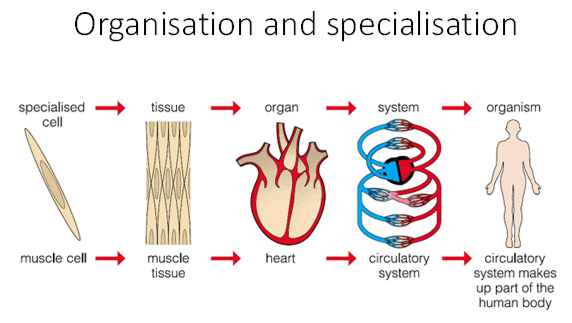
What is the order of organisation of specialisation?
Specialised cells: Cells with a specific structure for it's particular function
Tissues: A group of specialised cells functioning together for a specific purpose
Organs: A group of 2 or more tissues that work together for a specific purpose
Systems: A group of organs that work together for a specific purpose
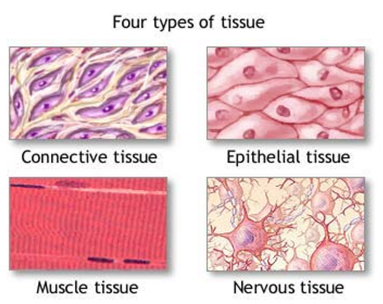
What are the 4 types of animal tissue?
4 types of animal tissue: Epithelial, Muscular, Connective and Nervous
What is epithelial tissue?
Tissue made of tightly packed cells that line surfaces
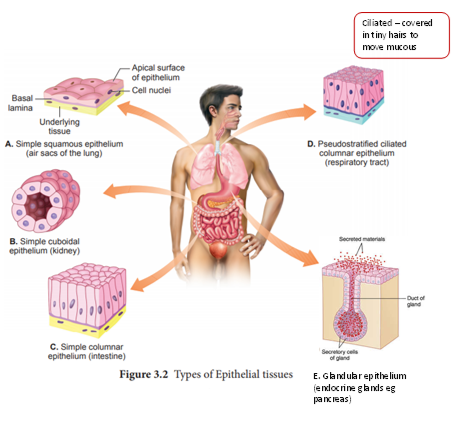
What are the 5 types of epithelial tissue?
Squamous (flattened): Alveoli and blood vessel linings
Cuboidal (cubical): Kidney and salivary gland linings
Columnar (pillar like): Small intestine, uterus, fallopian tubes
Ciliated (covered in tiny hairs to move mucous): Trachea - maybe good to remember for exam
Glandular (secretory): Endocrine glands
What is muscular tissue and what are the 3 types?
Tissue that makes up muscles and allows movement
Skeletal muscle (voluntary), smooth muscle and cardiac muscle (involuntary)
Why is skeletal muscle important?
Voluntary
Allows movement
Maintains posture
Stabilises joints
Maintains body temperature by producing heat via muscle contractions (shivering)
Why do we need smooth muscle?
Involuntary
Controls movement of substances through organs (peristalsis)
Produces the contractions during childbirth from the uterus
Regulates blood vessel diameter (vasodilation and constriction)
Regulates airway diameter
Why do we need cardiac muscle?
Involuntary
Pumps blood continuously through the heart
Produces rhythmic, coordinated contractions
What is connective tissue?
Tissue that binds and support other tissues and organs
Remember these types: Blood, bone and adipose
What are the roles of the 5 types of connective tissue?
Aerolar/loose: Found under the skin and surrounding vessels and organs, holding them in place EG Subcutaneous layer
Adipose: Fat tissue that stores energy
Fluid: Transports fluid, nutrients, wastes and hormones EG RBC, WBC, Platelets, plasma (blood) and lymph
Supporting: Provide structure and strength to body + soft tissues EG Tendon and ligaments
Skeletal: Provides structural support EG Cartilage and bone
What are the 5 types of connective tissue?
Aerolar/loose
Adipose
Fluid
Supporting
Skeletal
What is nervous tissue?
Tissue of the nervous system that transmits signals
Contains neurons and glial cells
What is the function of neurons and glial cells?
Neurons: Responsible for communication through electrical signals
Glial cells: Supporting cells that maintain the environment around the neurons
How do the effects of hypo and hyperglycaemia differ?
Hyperglycaemia: Damaged blood vessels which can lead to organ failure from inflammation
Hypoglycaemia: Cell death from insufficient glucose absorption which can cause organ failure
How does the pancreas’ functions differ in the endocrine and digestive system?
Endocrine: Regulates BGC through glucose receptors that monitor glucose in blood passing by
Exocrine: Produces digestive enzymes for the duodenum
What is the endocrine component of the pancreas?
The islets of langerhans: Small, scattered clusters of cells that contain Alpha and Beta cells
The cells are constantly monitoring BGC in blood to maintain homeostasis (levels are not static)
How does insulin affect blood glucose levels?
Glucose receptors detect high BGC
Beta cells secrete insulin into the bloodstream
Insulin causes absorption of glucose into muscle cells for immediate use, and excess glucose absorption in the liver for temporary storage as glycogen
What functions is glucose used for in it’s locations upon absorption?
Fuel: Brain and muscle cells immediately use it to complete cellular respiration for ATP
Temporary storage: Liver and muscle cells convert glucose into glycogen
Long term storage: Excess glucose that cannot be absrobed is converted into adipose tissue
When are hormones insulin and glucagon released?
Insulin: During the day after meals where BG rises due to carbohydrate breakdown
Glucagon: During fasting, between meals, exercise and sleeping
How does the hormone insulin affect cells?
Insulin binds to insulin receptors on cells (liver, muscle, fat)
This opens the glucose channel (protein carrier), allowing facilitated transport of it into the cell
How does glucagon affect blood glucose levels?
Glucose receptors detect low BGC
Alpha cells release glucagon into the bloodstream
Triggers the conversion of glycogen into glucose from the liver cells for release into the bloodstream to raise levels
Explain the process of a changing blood glucose concentration
Stimulus: Increase/decrease in BG concentration
Receptor: Glucose receptors detect the change
Control centre: Alpha or beta cells of the pancreas secret glucagon or insulin
Effector: Either the liver cells convert glycogen into glucose and into bloodstream or liver and muscle cells absorb glucose as glycogen for storage
Response: Decrease/increase in BG concentration
Negative feedback removes the stimulus
How do changing temperatures affect humans ?
Humans are endotherms, can be exposed to extreme temperatures for short amounts of time
However humans enzymes function optimally around 37 degrees
High temps: Dehydration, heat stroke and death
Low temps: Hypothermia and death
What is thermoregulation?
The maintainance of a stable core body temperature within narrow limits
How does the hypothalamus regulate thermoregulation?
Through thermoreceptors that constantly monitor the temperature and properties of blood passing by
When level exceed the tolerance limit, it activiates the stimulus response model to return homeostasis
How does the body increase or decrease heat loss from it’s surface?
Trapping more or less warm air
Sweating and shivering
Controlling blood flow by changing blood vessel diameter
How is trapping warm air for insulation a thermoregulatory mechanism?
Upright hairs on the skin trap more warm air
Tiny muscles on the skin contract to pull the hairs upright and relax to lay them flat
Upright hairs: Reduce heat loss by forming a layer of warm air (insulation) around the body
Flat hairs: Increase heat loss by allowing warm air surrounding the body to escape
Why do humans sweat as part of the homeostatic mechanism thermoregulation?
Involves evaporative cooling via sweat
When the body is too hot, sweat glands secrete sweat onto the skin surface
Increase heat loss as sweat evaporates off the skin and cools the skin and blood underneath
Sweating subsides when the body temp returns to homeostatic levels
What does shivering do to assist in maintaining homeostasis?
Involves rapid, involuntary muscle contractions and relaxations
Glucosed is used to produce ATP via cellular respiration to enable rapid contractions
Heat is released as a byproduct which warms the body
How does vasodilation increase heat loss?
Involves blood vessels widening to increase blood flow
Blood vessels supplying blood to the skin vasodilate, increasing blood diameter and therefore blood flow
Increases rate of heat loss as heat is carried to the skin surface and radiates into the cooler environment
How does vasoconstriction reduce heat loss?
Involves blood vessels narrowing to reduce blood flow
Blood vessels contract away from the skin surface, reducing heat loss via radiation
Keeps important, central organs warm and deprioritises extremeties
How does the body thermoregulate when too cold?
Hair muscles: Contract to pull hairs upright to trap a warm layer of air around the body to reduce heat loss
Shivering: Muscles rapidly contract and relax to produce heat as a byproduct of completing cellular respiration
Vasoconstriction: Blood vessels contract away from the skin surface to reduce heat loss via radiation
What are the thermoregulatory responses when the body is too hot?
Hair muscles: Relax to lay hairs flat and increase heat loss via radiation into the environment
Sweat glands: Secrete sweat onto the skin to cool the body as it evaporates
Vasodilation: Blood vessels widen at the skin surface to increase heat loss rate via radiation
Use a stimulus response model to describe the process of thermoregulation
Stimulus: Increase/decrease in body temperature
Receptor: Thermoreceptors in skin/hypothalamus detect the change in blood
Control centre: Hypothalamus determines appropriate response
Effector: Blood vessels, muscles and/or sweat glands initiate a response
Response: Decrease/increase in body temperature
Negative feedback removes the stimulus
How is sweating a limited thermoregulatory mechanism?
It relies on the environment being cooler than the body and low in humidity
High humidity reduces the effectiveness of sweating as there are already water particles in the air
Sweat remains as liquid on the skin, reducing cooling as evaporation is reduced
What are malfunctions in homeostatic mechanisms?
Diseases caused by the body’s failure to maintain homeostasis
What is Type I Diabetes characterised by?
A disease caused by the body’s inability to regulate blood glucose concentration
How does pancreas function differ in a Type I Diabetic?
The pancreas produces little to no insulin as the beta cells have been destroyed
Results in increased blood glucose concentration
No insulin to bind to the insulin receptors of liver and skeletal muscle cells to absorb glucose
How are Type I and II Diabetes different?
Type I is generally unpreventable, developed at a young age and genetic
Type II is developed over time with a poor lifestyle being a large contributing factor to it’s development
Where do the homeostatic malfunctions occur in Type I and Type II diabetes?
Type I: The pancreas produces little to no insulin due to the destruction of beta cells
Type II: The liver and skeletal muscle cells are become resistant to insulin, and the pancreas produces insufficient amounts to overcome it
Why is increased thirst a syptom of Type I diabetes?
Increased thirst: From increased urination to excrete glucose in attempt to lower levels
Blurry vision: Eye lens swells due to high levels
Extreme hunger: From inefficient glucose absorption
How does Type I diabetes affect cells?
Low insulin levels result in skeletal cells particularly to be unable to absorb glucose (no cellular respiration)
If untreated, can lead to organ failure and death as the cells become starved of energy
How is Type I diabetes treated?
Patients use prick tests to identify BG concentration
When high, insulin injections are used to lower BG concentration
Often injected when eating high sugar meals to correct the increase
What is the condition of Type II diabetes?
A chronic condition where the body is insulin resistant and fails to produce enough of it, resulting in high blood glucose levels (hyperglycaemia)
How does Type II Diabetes develop?
Lifestyle factors: Obesity, lack of phsyical exercise and poor diet heavily contribute
Results in insulin resistant body cells (fat,liver,muscle)
The pancreas cannot produce sufficent insulin to compensate which results in high BG
How are the symptoms of Type II diabetes treated?
Symptoms: Excessive hunger, thirst, tiredness and urination
Treatment: A combination of lifestyle changes to reduce BG levels and medication to improve cells’ insulin sensitivity
What is the condition of hypoglycaemia?
A condition where blood glucose levels drop below the tolerance range
What is the most common cause for hypoglycaemia?
Diabetes patients taking too much insulin or diabetes medication
Other causes:
Skipping meals/fasting
Intense, prolonged exercise
How are the symptoms of hypoglycaemia treated?
Symptoms: Fatigue, sweating, hunger, dizziness
Untreated symptoms: Fainting and seizures
Treatment: Glucagon injections and eating 15g of fast-acting carbohydrates to raise BG
What is hyperthyroidism?
A condition where the thyroid is overactive and produces excessive amounts of the thyroid hormone which accelerates the body’s metabolic rate
How does hyperthyroidism affect the body?
Bulging eyes and swollen thyroid (goiter)
Extreme hunger, weight loss
Elevated heart rate, BP and body temperature
Muscles cramps and weakness
Is hyperthyroidism caused by a variety of health issues?
Main cause is the autoimmune disease Grave’s
More common in men than women (especially 40+)
The body produces antibodies for the thyroid gland’s receptors
The antibodies mistakenly stimulate the thyroid gland, resulting in it’s overactivity
How is hyperthyroidism treated?
Medication is taken to inhibit the production of thyroid hormones to reduce metabolic rate

What is the structure and function of the excretory system?
Function: The removal of metabolic wastes and excess water from the body to maintain homeostasis
Wastes are mainly formed during digestion
Structure: Kidneys, renal vein, renal artery, ureter, bladder, sphincter and urethra
What is the function of the kidneys?
The removal of excretory products from the blood plasma in addition to urine production
How do the kidneys interact with the circulatory system?
They are connected to the circulatory system via the renal arteries and renal veins
Renal arteries carry unfiltered oxygenated blood to the kidneys
Renal veins carry deoxygenated blood to the heart

What is the structure of the kidneys and what are the main features?
Comprised of millions of nephrons (the functional unit of the kidney) that are embedded in loose connective tissue
Renal capsule: The layer of fibrous, connective tissue that encloses the kidneys
Renal cortex: The outer layer located between the medulla and capsule, where filtration begins
Medulla: The region containing 8-18 renal pyramids with renal columns in between
Papilla: The tip of a renal pyramid that connects into a minor calyx
Renal pelvis: Where urine collects from the calyxes

Describe the functional unit of the kidney, what is its functions in the excretory system?
Tissues embedded in loose connective tissue
The nephrons constantly interact with the surrounding capillary network, exchanging molecules between
3 main functions:
Filtration of blood
Reabsorption of required molecules and water
Secretion of unwanted waste molecules