AVIT 323 Block 1
 Call Kai
 Learn
Learn Practice Test
 Spaced Repetition
 Match
Match Flashcards
 Knowt Play
1/43

There's no tags or description
Looks like no tags are added yet.
Name | Mastery | Learn | Test | Matching | Spaced | Call with Kai | Chat |
|---|
No analytics yet
Send a link to your students to track their progress
44 Terms
Name the four turning tendencies of a propeller-driven airplane
1. P-Factor
2. Torque
3. Slipstream
4. Gyroscopic Precession
Name the three corrections for left turning tendencies that manufacturers often build into an airplane
1. Offset Engines
2. Offset Fin
3. Angle of Incidence Differential
When are you most likely to see P-Factor?
1. Slow Speeds
2. High Angle of Attack
Name the two elements of P-Factor
1. AOA Differential
2. Relative Wind

During a steep turn, name the two turning tendencies that pull the nose to the left
P-Factor and Torque
(slow airspeed, high angle of attack)
Why should your first clearing turn be made to the left?
To account for right of way rules, aircraft over-taking you will be flying to your right
During a Chandelle, what should the power be set to?
Enter 100 KIAS, then full power
True or False
During a Chandelle, the first half is changing pitch, the last half is changing bank
True
What causes an accidental spin?
Side-Slip during a stall
What causes a side-slip?
Uncoordinated Flight
What is the most common cause of an unintentional spin?
Slip during a stall
Explain the two causes of adverse yaw
Caused by both Ailerons (upward and downward facing)
Form drag anytime you force anything to change directions
True or False
Over-banking tendency happens partially because the raised wing is traveling at a higher speed than the lowered wing
True
What causes over-banking tendencies?
Lateral component of lift on the raised wing is greater than the vertical component of lift on the lower wing
Outer wing turns faster than inner wing (speed differential)
If I am at a 40-degree bank angle, will my load factor increase or decrease if I double my IAS?
It will not change
What is the definition of a stall?
Exceeding your critical angle of attack
Poor AOA control
What makes up total pressure?
Static pressure and Dynamic Pressure
What makes up total energy? Explain each item
Kinetic Energy -> energy in motion
Potential Energy -> stored energy
Explain each item of the lift equation (L=1/2p V^2 CL S)
p: air density (energy of motion of the slipstream)
V: velocity
CL: coefficient of lift (AOA/airfoil shape)
S: surface area (airfoil size)
High-lift devices tend to do one, two, or all of three things. Name them.
1. increase in camber
2. increase in surface area
3. increase in energy
How is angle of attack measured?
The angle between the chord line and the relative wind
Why do we not see human-powered airplanes as common transportation methods?
Human muscles are not made to produce the such high power and endurance that is required for flight
Draw an airfoil and label the following:
Adverse pressure gradient
Forward stagnation point
Aft stagnation point
Area of maximum change in airflow velocity
Center of lift
Mean camber line
Chord line

Draw a gliding airplane and label the following:
Vertical Lift
Total Lift
Forward Acting Component of Lift
Weight
Forward Acting Component of Weight
Normal Weight Plane
Airspeed
Horizontal plane
Drag
Rate of Descent
What gives you airspeed?
Forward Acting Component of Lift and Forward Acting Component of Weight
How is VGLIDE determined?
By flying the aircraft and testing it through trial and error
Draw and label the types of flow
1. Divergent
2. Convergent
3. Shear
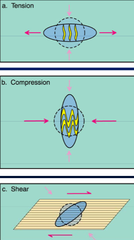
Draw and label the types of force
1. Compression
2. Tension
3. Shear
What is Newton's first law?
An object at rest stays at rest and an object in motion stays in motion with the same speed and in the same direction unless acted upon by an unbalanced force.
Whats Newton's second law?
(F= m x a)
Explain Newton's third law in relation to lift
"For every action there is an equal and opposite reaction"
The air that flows over the wing is forced downwards by the airfoil, the equal and opposite reaction of the air is to push upwards, which causes lift
What is Force Divergence?
At a speed above M-Crit, airflow will begin to separate from the wing similarly to during a stall. Increases Drag exponentially.
What is Mach Tuck?
As an aircraft approaches the speed of sound it creates a shockwave and its wing center of pressure moves aft. As it moves aft, it creates a pitch down moment which there by increases airspeed and worsens situation

Turbulent airflow....
is aerodynamically dead
Requirements for profit
1. Travel fast (depreciation costs)
2. Fly below the speed of sound (force divergence)
3. Coolest air possible
4. Shouldn't fly one foot higher than necessary
Work Equation
f x d = w
What is your L/D max?
An AOA
A 15 lb bowling ball is dropped off a 90 ft building. What is the potential energy at the instant of impact?
0 ft-lbs
(all energy in the object is lost on impact to other factors)
At any point of the objects fall (15 lb bowling ball off of a 90 ft building), what is the total energy?
Ep= w x h
1350 ft-lbs = 15lb x 90ft
My airplane has an IAS speed of 110 KTS and I'm in an 8 KT wind. What is my pivotal altitude if my elevation here is 745 ft?
(GS^2/11.3) + Elevation
Upwind:
(102^2/11.3) + 745 = 1665 MSL
Downwind:
(118^2/11.3) + 745 = 1977 MSL
(My airplane has a published Vs of 55 and a max gross weight of 3800 lbs) What is the new stall speed when I pull 1.3 G's?
Stall = Vs sqrt(n)
62 KIAS = 55 sqrt (1.3)
(My airplane has a published Vs of 55 and a max gross weight of 3800 lbs) If I pull back too far and stall at 72 KIAS, how many G's are on the plane?
(IAS/Vs)^2
(72/55)^2 = 1.71 G's
(My airplane has a published Vs of 55 and a max gross weight of 3800 lbs) I've overloaded my plane to 4100 lbs. What is my new stall speed?
Stall = Vs sqrt (Wactual/Wmaxgross)
57 KIAS = 55 sqrt (4100/3800)
My indicated airspeed is 77 and my descent rate is 550 fpm. What is my finesse ratio?
Finesse = (IAS x 100) / sinkrate
14 = (77 x 100) / 550