SLH 350 Test 2 Study Guide
 Call Kai
 Learn
 Practice Test
 Spaced Repetition
 Match
 Flashcards
 Knowt Play
1/173

There's no tags or description
Looks like no tags are added yet.
174 Terms
Which is the preferred term/concept: sensitive period or critical period?
sensitive period
Sensitive period
plasticity is elevated early in life but doesn’t shut off at a hard boundary
Different aspects of language (phonology vs. vocabulary vs. syntax) may show…
different sensitivity windows rather than one uniform cutoff.
Sensitive period theory states that…
plasticity is elevated early in life but fades gradually, not a strict cutoff.
Synaptic/Functional Plasticity
strengthening or weakening of existing synaptic connections
Synaptic/Functional Plasticity changes often rely on
modifying the number of sensitivity of neurotransmitter receptors on the post synaptic cell
Structural plasticity
physically changes anatomical structure through creation of new synapses, dendritic growth
Left hemisphere stroke in language areas can lead to…
aphasia
In some stroke cases during recovery, the
perilesional cortex and sometimes the right hemisphere reorganize to take over lost function
This reorganization after a stroke is not:
neuron regeneration and not fixed purely by genetic
This reorganization after a stroke relies on
strong connection in the corpus callosum
this reorganization after a stroke shows that
plasticity persists in adults
Adults show neuroplasticity for non-native speech sounds…
in the auditory brainstem after long-term training
Plasticity is not just…
a developmental phenomenon, it operates across the lifespan
The earlier the age of L2 acquisition, the
greater cortical thickness/gray matter in language and cognitive control regions
Bilingual word-finding slips reflect
phonological interference between the two languages' sound systems.
phonological interference
saying a phonologically related word instead of the target one - “reach” instead of “peach”
phonological interference can also occur
across languages
semantic interference
words in both languages belonging to same category—saying a semantically related word instead of the target one
Invasive Electrophysiology
Invasively record from neurons using an electrode - requires some kind of surgery
Invasive electrophysiology is usually only done in animals or
in very limited circumstances on people (ex: in tissue that will later be resected in a surgery)
Invasive electrophysiology records
action potentials! Can measure either cell voltage or currents flowing through the cell
single unit electrophysiology
mesures action potential of ONE neuron
multi-unit electrophysiology
measures action potential of more than one (approx. 10) neurons at a time
Invasive electrophysiology has ______ spatial, ______ temporal
high, high

ECoG
electrocorticography
ECoG procedure
A grid of electrodes is placed on the surface of the brain to localize seizures in people with drug resistant epilepsy
In ECoG, each electrode records
100-1000s of neurons near that electrode, this signal is called the local field potential (LFP)
Is ECoG invasive?
yes, the electrodes are surgically placed on the cortical surface
ECoG has ____ spatial and ____ temporal
excellent, excellent
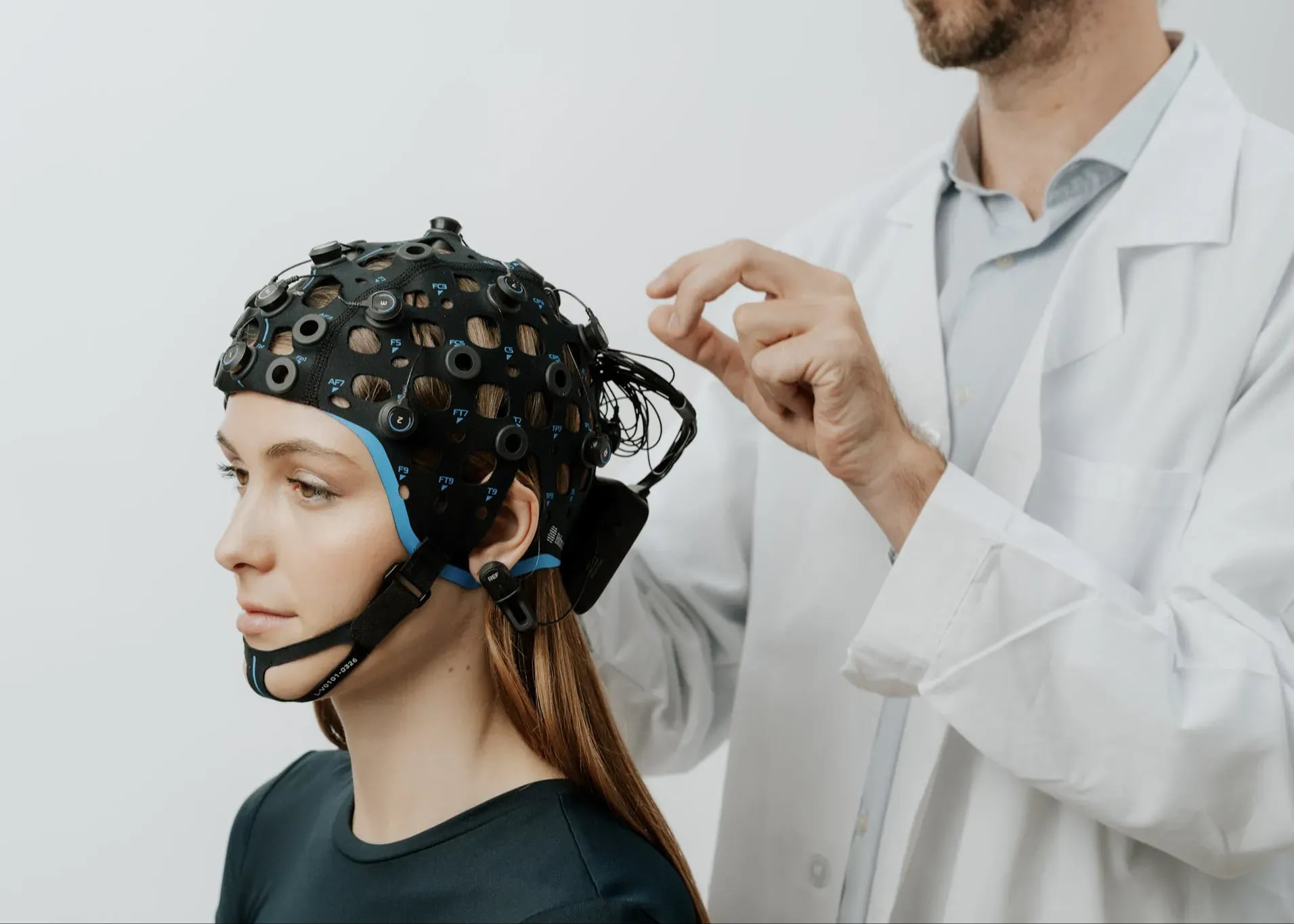
EEG
electroencephalography
What does EEG measure?
postsynaptic currents that reach the surface of the scalp in the form of voltage changes and magnetic fields
The voltage changes detected by EEG are generated by
approx. 500k to 1 million neurons
How is EEG recorded?
non-invasive scalp electrodes that are stuck to your scalp
EEG spatial resolution is
poor
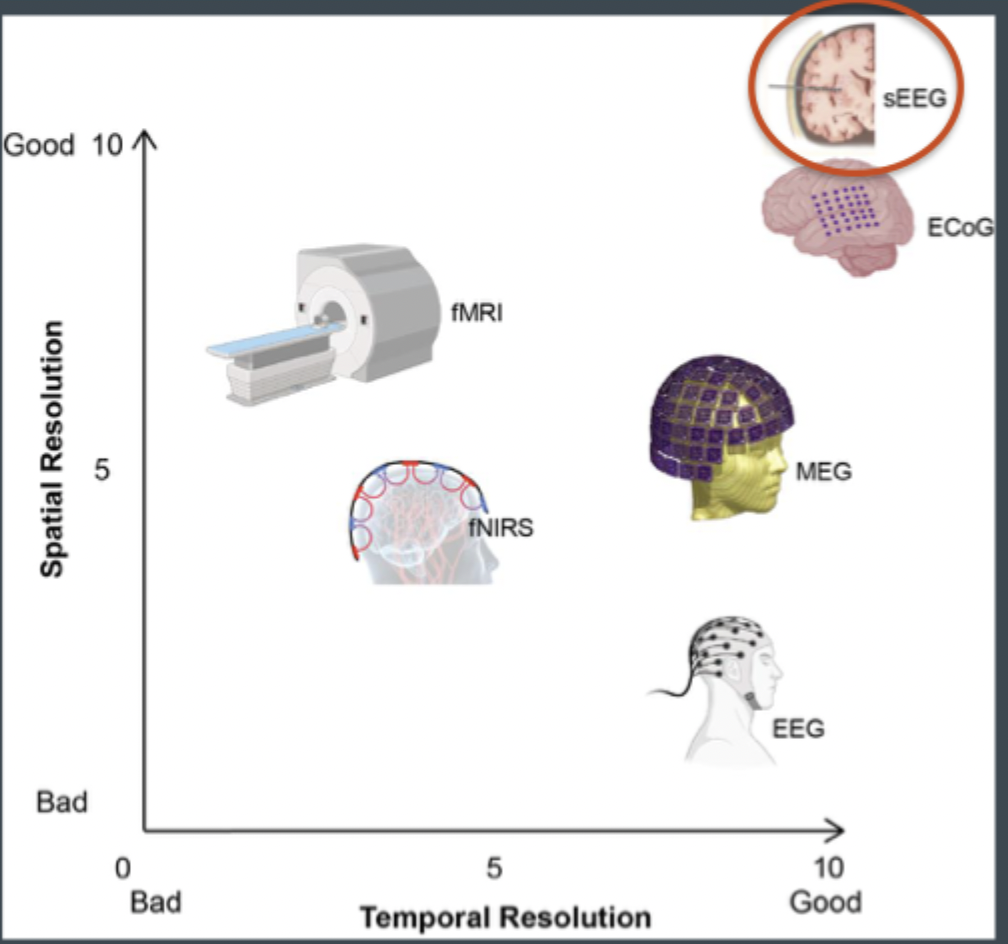
EEG temporal resolution is
excellent - you can look at things happening at the millisecond level
MEG
magnetoencephalography

MEG measures
tiny magnetic fields generated by neuron’s electrical currents
MEG is especially sensitive to
sulci sources, but not gyri
Why is MEG sensitive to sulci, but not gyri sources?
this is due to the orientation of magnetic fields relative to tangential currents (physics of the magnetic field)

MEG has _____ temporal resolution, _____ spatial resolution
high, medium
Is MEG invasive?
no, it is non-invasive
Why does MEG have better spatial resolution than EEG?
the skull doesn’t distort or blur magnetic fields
fMRI
functional magnetic resonance imaging

fMRI looks at
brain activity over time
a structural MRI looks at
anatomy and pathology of the brain
Is fMRI invasive?
no
Unlike EEG, MEG, intracranial neurophysiology, fMRI does NOT measure
electrical activity or magnetic fields
fMRI does not directly measure
neural activity
fMRI uses BOLD, which allows us to
figure out which brain areas are most active
Oxyhemoglobin (HbO+) and deoxyhemoglobin (HbO-) have
different magnetic properties
BOLD: resting brain tissue has
normal mixture of HbO+ and HbO-; LOW signal in fMRI
Active brain tissue calls for extra blood, which causes
big rush of HbO+, upsetting the ratio of HbO+ and HbO-
When the ratio of HbO+ and HbO- is upset, there is a
HIGH signal in fMRI
What does BOLD stand for?
blood-oxygen-level dependent
Advantages of fMRI
good spatial res
inherently 3D
measures the whole brain
disadvantages of fMRI
very expensive and complicated
poor temporal res
does not measure neural activity directly
cannot have metal in your body
fMRI contrast method step 1
subtract fMRI signal in one condition from fMRI signal in one condition from fMRI signal in other condition
fMRI contrast method step 2
use a statistical test to determine whether difference between conditions is significant
Contrast method can be used to
localize effects of interest (where they are in the brain)
fMRI science alternative approach
use natural stimuli (ex: a story) instead of controlled experiments, then build models that predict BOLD responses to new stimuli
fMRI has _____ spatial res and _____ temporal res
excellent, poor
fNIRS
functional near infrared spectroscopy

fNIRS measures
BOLD signal (like fMRI)
fNIRS uses _______, instead of huge magnets like fMRI uses
light emitters and detectors
fNIRS sends near infrared light from
emitter to detector

In fNIRS, the amount of diffused reflected light depends on
activity in underlying tissue
Oxygenated hemoglobin (HbO+) and deoxyhemoglobin (HbO-) absorb light at
different wavelengths
Why use fNIRS?
non-invasive
cost-effective
portable
fNIRS can measure
oxygenated hemoglobin and de-oxygenated hemoglobin
fNRIS can be analyzed through
evoked (task-related data) and resting
fNIRS has _____ temporal res, and _____ spatial res
low, low
Other pros of fNRIS
movement-tolerant and you can have metal in your body!
fNIRS detects
hemodynamic changes via light
TMS
transcranial magnetic stimulation

Is TMS invasive?
no
TMS uses magnetic fields to
stimulate nerve cells in the brain
In TMS, electromagnetic coil is placed against the scale, sending
magnetic pulses throughout the skull that create time electrical signals that “wake up” underactive neurons or calm overactive ones
TMS is used to
target specific brain regions
TMS mechanism of action
coil generates magnetic field
this induces a localized electric current in the cortical tissue, which causes depolarization
TMS clinical uses
treats depression (and other psychiatric conditions) and primary progressive aphasia
TMS clinical use to the dorsolateral prefrontal cortex
improved action naming in PPA
TMS summary
magnetic induction causes neurons to depolarize
casual method “virtual lesion” tool
tACS and tDCS
transcranial electrical stimulation

Direct current is
tDCS
alternating current is
tACS
tDCS mechanism of action
a weak, constant direct current is delivered through scalp electrodes (non invasive)
The tDCS current does not
directly trigger neuron firing, instead it subtly shifts the resting membrane potential of underlying neurons making them more or less likely to fire
tDCS polarity dependent effects of anodal stimulation
generally excitatory - depolarizing, shifting neurons closer to threshold (approx. -70 mV to +55 mV)
tDCS polarity dependent effects cathodal stimulation
generally inhibitory (hyperpolarizing)
tDCS summary
constant current, shifts overall excitability (anodal = excitatory, cathodal = inhibitory)
tDCS is similar to a ______ switch
dimmer
Is tDCS a casual method?
yes
tACS mechanism of action
an oscillating (alternating) current is delivered at a specific target frequency
tACS mechanism is designed to entrain or synchronize ongoing
neural oscillations to that frequency, not just simply exciting or inhibiting neuronal firing
tACS summary
oscillating current, entrains the TIMING of neural oscillations
tACS entrains the timing of neural oscillations, not
excitability level
is tACS a casual method?
yes
tDCS =
level of excitability (Can we shift excitability to help/hurt a task?)
tACS =
timing/rhythm (Can we casually confirm an oscillation’s timing matters?)