Psych 201 - Natural Science Test 1 Review
 Call Kai
 Learn
Learn Practice Test
 Spaced Repetition
 Match
Match Flashcards
 Knowt Play
1/88

There's no tags or description
Looks like no tags are added yet.
Name | Mastery | Learn | Test | Matching | Spaced | Call with Kai | Chat |
|---|
No analytics yet
Send a link to your students to track their progress
89 Terms
Hippocampus
Seahorse shape. Takes short term memory and transports it to long term memory. Even without we can still have long term memory.

Short-term memory
Activated memory that holds a few items briefly, such as the seven digits of a phone number while dialing, before the information is stored or forgotten.
Long-Term memory
the relatively permanent and limitless storehouse of the memory system. Includes knowledge, skills, and experiences.
Number of items for short term memory
7 +/- 2
How long should you rehearse to reform short term memory
30 seconds
Evolutionary Psychology
The study of the evolution of behavior and the mind, using principles of natural selection (ex. mating preferences, jealousy, aggression, sexual behaviour)
Forgetting Curve
A graph showing retention and forgetting over time. The better the memory the more shallow it becomes. The longer you wait between learning info and being tested the more likely you are to forget.
Correlational
Relationship between two variables, not cause and effect.
Experimental
Used to explore cause and effect, lab experiment doesn't apply to the real world (artificial)
Freud
Unconsciousness (the unconscious contains thoughts, memories, and desires that can have great influence on behavior), psychoanalysis theory (attempts to explain personality, motivation, and mental disorders by focusing on the unconscious), his theories were not falsifiable
Psychoanalysis Theory
Our thoughts, feelings, and actions are heavily influenced by the unconscious mind. These unconscious thoughts are caused from childhood experiences that shape your personality.
B.F. Skinner
Behaviorist that developed the theory of operant conditioning by training pigeons and rats.
Behaviorism
Study of observable behavior, not inner thoughts or feelings. Behavior is shaped by environment. Only visible actions.
Operant conditioning
Learning through rewards and punishments.
Equipotentiality
Stimulus can be associated with any response. Brain can form association with equal potential. (Behaviorist/ Skinner). Blank slate.
T/F Only 10% of the brain is used
FALSE
Conscious Introspection
Structuralist idea of looking inward to your own thoughts and feelings to understand your mental process.
Functionalism
Based on the belief that psychology should investigate the function or purpose of consciousness rather than its structure
Behavior
Actions and responses we can directly observe.
Mind
Internal states and processes that we cannot see.
Basic Research
Learning for the sake of knowledge, not for immediate or specific use. Broad concepts or ideas.n
Applied Research
scientific study that aims to solve practical problems, done to solve a specific problem.
Goals of Psychology
Describe, understand, predict, and influence.
Null Hypothesis (H0)
A statement that the value of a population parameter (such as proportion, mean, or standard deviation) is equal to some claimed value. Tested directly. Either reject H0 or fail to reject H0. Proposes that any pattern, change, or difference you see in your data happened purely by random chance.
Structuralism
an early school of psychology that used introspection to explore the elemental structure of the human mind. Breaking it down. (sensations, feelings, images)
Humanism
Human growth and free will, human behaviour is governed primarily by each individual’s sense of self.
Neurons
a nerve cell; the basic building block of the nervous system

Dendrites
Branchlike parts of a neuron that are specialized to receive information.

Axon
the extension of a neuron, ending in branching terminal fibers, through which messages pass to other neurons or to muscles or glands
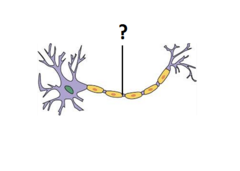
Soma
cell body of a neuron

What direction does information always flow in Neurons
Right
Glilal cells
cells in the nervous system that support, nourish, and protect neurons

Synapse
Tiny gap where neurons pass messages to the next cell.

Neurotransmitters
Chemical messengers that cross the synaptic gaps between neurons. (What is being passed). (key)

What catches the messages passed from neurotransmitters?
Neurotransmitter Receptors (lock)
Terminal buttons
Small knobs at the end of axons that secrete chemicals called neurotransmitters

Reuptake
When the sending neuron takes back the neurotransmitters that were released into the synapse. Done to clear the synapse and save resources.
How many neurons are there?
100 billion
How many synapses are there?
100-500 trillion
Sensory Neurons
Neurons that carry incoming information from the sensory receptors to the brain and spinal cord. Deal with your 5 senses. Actions from the outside world.
Motor Neurons
Motor neurons are the nerve cells that carry instructions from your brain and spinal cord out to your body. Tells your muscles when to contract and when to relax.
Interneurons
Neurons within the brain and spinal cord that communicate internally and intervene between the sensory inputs and motor outputs. Let the sensory neurons and motor neurons talk to each other.
Action Potential
a neural impulse; a brief electrical charge that travels down an axon. What a neuron uses to send a message.
Constant resting position of neurons
-70 millivolts
What can the action potential jump to?
-70 millivolts to +40 millivolts
Agonist
A chemical or drug that, by binding to a receptor site, stimulates a response or turns it on. Agonist is the key that opens up the receptor (the lock) to open up and make the cell respond.
Antagonist
a chemical or drug that binds to receptors in the brain and prevents an agonist from having a reaction. Like a broken key.
Reuptake inhibitors
Drugs that interfere with the reuptake of neurotransmitters in the synapse so that a greater amount remains in the synapse. Slows or stops the recycling process.
Two parts of the nervous system
central and peripheral
What makes up the central nervous system
brain and spinal cord.
What consists of the peripheral nervous system?
Automatic and Somatic controls.
Automatic controls
Involuntary control, things that happen automatically like organs, glands, and your heart.
Somatic controls
Voluntary control and things you choose to do dealing with your skeletal muscles. Like moving your arms, walking, or smiling.
spinal cord
Nerves that run up and down the length of the back and transmit most messages between the body and brain.

According to evolutionary psychology, what are three primary behavioral capabilities enabled by the evolution of an advanced central nervous system?
To have deception, decisions, and reflexes.
Spinal Reflexes
Simple pathways in the nervous system that rapidly generate muscle contractions.
Sensory Receptors
Sensory nerve endings that respond to stimuli. They detect things for your body like sight, sound, taste, touch, and smell.
Divisions of the brain
forebrain, midbrain, hindbrain
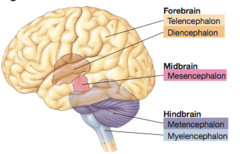
What consists of the hindbrain?
medulla, pons, cerebellum

Cerebellum
A large structure of the hindbrain that controls fine motor skills. Very densely packed. Exa: Flying a plane. In the Hindbrain.

What consists of the midbrain?
Tectum, tegmentum, and Superior Colliculus.
Superior Colliculus
The superior colliculus helps your eyes and head automatically turn toward sights and movements. Receives visual sensory input.

Cerebral Cortex
Wrinkly outer layer of the brain. The cerebral cortex is the brain's "control center" for higher thinking, sensing, and voluntary actions. Located in the midbrain

Amygdala
Small bean or almond shaped part of the brain that handles with emotions. Part of the limbic system.

Corpus callosum
Thick band of nerve fibers that connects the left and right sides of the brain.

Somatosensory cortex
Area at the front of the parietal lobes that registers and processes body touch and movement sensations.

Phineas Gage
Railroad worker who survived a severe brain injury in the frontal lobe that dramatically changed his personality and behavior; case played a role in the development of the understanding of the localization of brain function.
Frontal Lobe is important for what?
Personality, decision making, and self control.
Broca's Area
Small area in the frontal lobe of the brain to control how to produce speech.

Wernick's Area
Region in the temporal lobe of the brain to help us understand and comprehend language.

Contralateral organization
Left hemisphere controls right side of body and vice versa.

Observation
Information obtained through the senses.
Systematic Data Collection
Data collected in a uniform, consistent, or standard way. Exa: Surveys, questionnaires, experiments, and observations with a checklist.
Hypothesis
A testable prediction, often implied by a theory.
Theory
An explanation using an integrated set of principles that organizes observations and predicts behaviors or events
Experiment
A research method in which an investigator manipulates one or more factors to observe the effect on some behavior or mental process.
Generalization
The tendency, once a response has been conditioned, for stimuli similar to the conditioned stimulus to elicit similar responses.
Anterograde amnesia
An inability to form new memories.
Serotonin
Affects mood, hunger, sleep, and arousal
Job of the left brain
Logic and Language
Job of the right brain
Creativity, imagination, and art.
Resting Potential
The difference in electric charge between the inside and outside of a neuron's cell membrane
Thalmus
Relay station to the cerebral cortex, forebrain.
Hypothalamus
Regulator, keeps the body balanced, found near the base of the forebrain, lies beneath the thalamus
Madulla
Part of brain stem- controls heart beat and breathing

Falsifiable
A theory that makes specific, concrete predictions that could be proven wrong by a real-world test or observation. Basically means a theory should be testable.
Tectum function
Processes visual/ auditory reflexes, orienting responses
Tegmentum function:
Regulates arousal, movement, and reward pathways
What does modularity mean in the context of the brain?
The brain is organized into distinct, specialized regions or networks that handle specific tasks (like vision or language) independently