Attention
 Call Kai
 Learn
Learn Practice Test
 Spaced Repetition
 Match
Match Flashcards
 Knowt Play
1/31

There's no tags or description
Looks like no tags are added yet.
Name | Mastery | Learn | Test | Matching | Spaced | Call with Kai | Chat |
|---|
No analytics yet
Send a link to your students to track their progress
32 Terms
What was William James’ (1890) definition of attention?
“It is the taking possession by the mind, of 1 out of several simultaneously possible objects or trains of thought. Focalization, concentration, of consciousness are of its essence. It implies withdrawal from some things in order to deal effectively with others”
Selective + limited resources
Give a definition of visual attention
The selection of some visual stimulus or set of visual stimuli at the expense of others for further visual + cognitive analysis + often for the control of behaviour
What are the types of attention?
External
Internal
Overt
Covert
Divided
Sustained
What is external attention?
Attending to stimuli in the world
What is internal attention?
Attending to 1 line of though over another or selecting 1 response over another
What is overt attention?
Directing a sense organ towards a stimulus, like pointing your eyes/turning your head
What is covert attention?
Attending without directing sensory organs towards a stimulus
What is divided attention?
Splitting attention between 2 different stimuli
What is sustained attention?
Continuously monitoring some stimulus
Why do we need attention?
Translates (input) into info measures → each eye takes in ~1GB/s
What does the amount of sensory information we receive entail/impose? What is the upshot of this?
A requirement for multiple selective mechs → enables it to process info efficiently (e.g. spatial summation or spatial filters)
BUT not enough → further, attentive selection is needed to prevent overload + hitting capacity limits for transmission, processing + storage
What is selected?
Salient info → selected for bottom-up or top-down salience
What is bottom-up salience?
Salient aspects of the stimulus capture attention + drive the system from the bottom-up
What is top-down salience?
Internally determined (e.g. through motivation) salient content is selected form the top-down
How is salient information selected (different bases of attention)?
Location-based (spatial) attention
Feature-based attention
Object-based attention

What were the initial models of (spatial) attention?
Spotlight model (expanded by Posner, 1980)
Zoom lens model (Eriksen + Yeh, 1985)
What is the spotlight model of (spatial) attention (Posner, 1980)?
Attention is restricted in space + moves from 1 point to the next → areas within the spotlight receive extra processing

What is the zoom lens model of (spatial) attention (Eriksen + Yeh, 1985)?
The attended region can grow/shrink depending on the size of the area to be processed
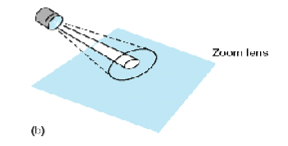
What is a criticism of initial models of (spatial) attention?
What about features → colour, motion + direction, orientation
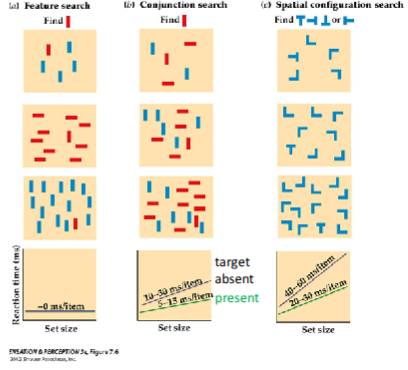
How do we find the location of a feature (visual search) (Triesman + Gelade, 1980)
Feature search → target defined by the presence off a single feature
Conjunction search → target defined by the co-occurrence of 2 or more features
Shape (spatial configuration) search → the target + distractors contain the same basic, spatial features
What have we learnt from visual search literature?
Provided methods of quantifying attentional efficiency
The efficiency of visual search = average increase in RT for each item added to the display
Measured in terms of search slope or ms/item
Large search slope → less efficient search
Some searches are efficient + have small slopes (parallel)
Some searches are inefficient + have large slopes (serial)
What question of perception did the methods of visual search provide a way to investigate?
How are objects represented?
What are colour, motion and orientation represented by?
Somewhat specialised brain regions → e.g. motion in dorsal, orientation + colour in ventral stream

How do we combine features of colour, motion and orientation when perceiving the bar?
Challenge of binding different attributes of visual stimuli (which are handled by somewhat different brain circuits) to the appropriate object → perceive a unified object
Feature integration theory (Treisman + Gelade, 1980)
What is feature integration theory (Treisman + Gelade, 1980)?
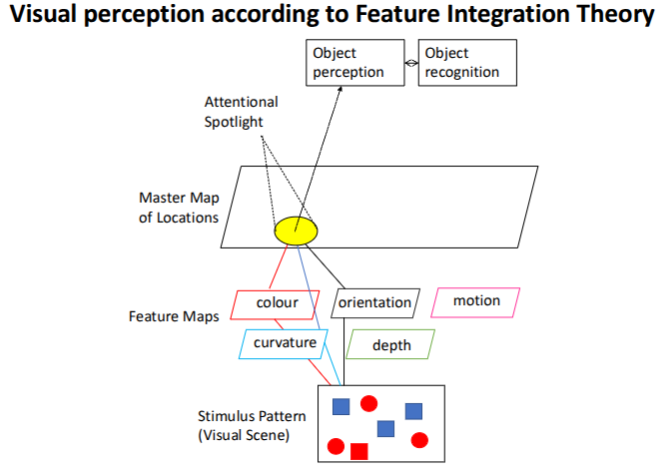
A limited set of basic sensory features (colour, size, oreintation etc) can be processed/coded in parallel pre-attentively by specialised modules
Pre-attentive stage → the processing of a stimulus that occurs before selective attention is deployed to that stimulus
BUT other properties (including the correct binding of features to objects) require attention
In feature integration theory, what do the specialised modules (which code sensory features in parallel) form?
2 kinds of “maps”
Feature maps → colour maps, orientation maps etc
Master map of locations

According to feature integration theory, what is the role of attention?
Moves within the location map
Selects whatever features are linked to that location
Features of other objects are excluded
Attended features are entered into the current temp object rep
What are the weaknesses of feature integration theory?
Visual search paradigm produced data that weren’t consistent with FIT
Search is very fast only when the objects look 3D even though they consist of the same elements (Enns + Rensink, 1991)
Can we easily define a feature?
Kristjansson + Tse (2001)

What was Kristjansson and Tse’s (2001) research info defining features?
Faster detection of presence than absence → BUT what is the feature when the 2 shapes are the same
Search asymmetries exist because the visual system is highly sensitives to only certain types of info + attention guidance is connected to memory reps
Suggests the visual system seeks out discontinuities in curvature
Uses them + other cues to obtain a How can of the 2D retinal image

How can feature integration theory be viewed from a contemporary perspective?
Is a comprehensive theory of visual processing (not just attention)
Starts with the earliest stages of sensory encoding (parallel, serial) + ends with nature of the internals reps implicated in object recognition (Quinlan, 2003)
Too simple in its assumptions that feature binding/object formation requires attention
BUT cross-dimensional feature binding is an attention-demanding process
BUT location doe splay a key role in attentional selection
What is cross-modal perception and attention?
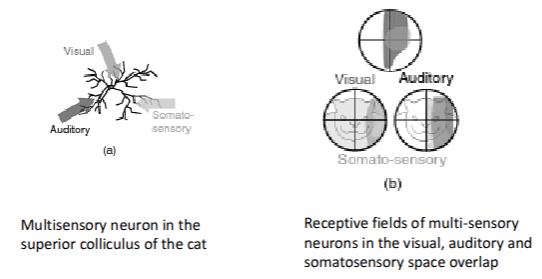
Integration of info from different senses → more reliable + coherent info about the world
Cross-modal cues are highly effective drivers of attention
What are social cues to attention?
Body language + eye gaze cues are highly salient drivers of attention → can also be sued for misdirection (Kuhn + Land, 2006)
