games & economic behavior final
 Call Kai
 Learn
 Practice Test
 Spaced Repetition
 Match
 Flashcards
 Knowt Play
1/57

There's no tags or description
Looks like no tags are added yet.
58 Terms
Your income is $250,000 with good luck (probability 0.7) and $90,000 with bad luck (probability 0.3). Your neighbor has a sure income of $150,000. You propose a contract: you pay your neighbor x when you have good luck, and your neighbor pays you $40,000 when you have bad luck (so you then have $130,000 and your neighbor $110,000). Both of you have the utility function u(y)= sqrt(y)
what is your expected utility with no contract?
EU: 440
Your income is $250,000 with good luck (probability 0.7) and $90,000 with bad luck (probability 0.3). Your neighbor has a sure income of $150,000. You propose a contract: you pay your neighbor x when you have good luck, and your neighbor pays you $40,000 when you have bad luck (so you then have $130,000 and your neighbor $110,000). Both of you have the utility function u(y)= sqrt(y)
what is your neighbor’s expected utility with the contract?
EU = 0.7 sqrt(150,000 + x) + 0.3 sqrt(110,000)
Your income is $250,000 with good luck (probability 0.7) and $90,000 with bad luck (probability 0.3). Your neighbor has a sure income of $150,000. You propose a contract: you pay your neighbor x when you have good luck, and your neighbor pays you $40,000 when you have bad luck (so you then have $130,000 and your neighbor $110,000). Both of you have the utility function u(y)= sqrt(y)
which inequality gives the smallest x at which your neighbor prefers the contract to no contract?
0.7 sqrt(150,000 + x) + 0.3 sqrt(110,000) > sqrt(150,000)
Your income is $250,000 with good luck (probability 0.7) and $90,000 with bad luck (probability 0.3). Your neighbor has a sure income of $150,000. You propose a contract: you pay your neighbor x when you have good luck, and your neighbor pays you $40,000 when you have bad luck (so you then have $130,000 and your neighbor $110,000). Both of you have the utility function u(y)= sqrt(y)
which inequality gives the largest x at which you prefer the contract to no contract?
0.7 sqrt(250,000 - x) + 0.3 sqrt(130,000) > 440
Used Pomelos come in two types. Buyers value an orange at $20,000 and a lemon at $8,000. Owners of an orange will sell for $14,000 or more; owners of a lemon will sell for $4,000 or more. Sellers know their car’s type; buyers only know the fraction f of oranges in the market.
If f=0.4, what is the most a risk-neutral buyer will pay for a Pomelo of unknown type?
$12,800
Used Pomelos come in two types. Buyers value an orange at $20,000 and a lemon at $8,000. Owners of an orange will sell for $14,000 or more; owners of a lemon will sell for $4,000 or more. Sellers know their car’s type; buyers only know the fraction f of oranges in the market.
If f=0.4, will any oranges be sold?
no oranges will be sold
Used Pomelos come in two types. Buyers value an orange at $20,000 and a lemon at $8,000. Owners of an orange will sell for $14,000 or more; owners of a lemon will sell for $4,000 or more. Sellers know their car’s type; buyers only know the fraction f of oranges in the market.
What is the smallest f at which oranges are sold?
0.5 / 50%
Used Pomelos come in two types. Buyers value an orange at $20,000 and a lemon at $8,000. Owners of an orange will sell for $14,000 or more; owners of a lemon will sell for $4,000 or more. Sellers know their car’s type; buyers only know the fraction f of oranges in the market.
If f=0.7, will any oranges be sold?
yes
Your income is $560,000 with good luck (probability 0.5) and $140,000 with bad luck (probability 0.5). Your neighbor has a sure income of $320,000. You propose a contract: you pay your neighbor x when you have good luck, and your neighbor pays you $120,000 when you have bad luck (so you then have $260,000 and your neighbor $200,000). Both of you have the utility function u(y) = sqrt(y).
What is your expected utility with no contract?
EU = 0.5 sqrt(560,000) + 0.5 sqrt(140,000)
Your income is $560,000 with good luck (probability 0.5) and $140,000 with bad luck (probability 0.5). Your neighbor has a sure income of $320,000. You propose a contract: you pay your neighbor x when you have good luck, and your neighbor pays you $120,000 when you have bad luck (so you then have $260,000 and your neighbor $200,000). Both of you have the utility function u(y) = sqrt(y).
what is your neighbor’s expected utility with the contract?
EU = 0.5 sqrt(320,000 + x) + 0.5 sqrt(200,000)
Your income is $560,000 with good luck (probability 0.5) and $140,000 with bad luck (probability 0.5). Your neighbor has a sure income of $320,000. You propose a contract: you pay your neighbor x when you have good luck, and your neighbor pays you $120,000 when you have bad luck (so you then have $260,000 and your neighbor $200,000). Both of you have the utility function u(y) = sqrt(y).
Which inequality describes the values of x for which your neighbor prefers the contract to no contract?
0.5 sqrt(320,000 + x) + 0.5 sqrt(200,000) > sqrt(320,000)
Your income is $560,000 with good luck (probability 0.5) and $140,000 with bad luck (probability 0.5). Your neighbor has a sure income of $320,000. You propose a contract: you pay your neighbor x when you have good luck, and your neighbor pays you $120,000 when you have bad luck (so you then have $260,000 and your neighbor $200,000). Both of you have the utility function u(y) = sqrt(y).
Which inequality describes the values of x for which you prefer the contract to no contract?
0.5 sqrt(560,000 - x) + 0.5 sqrt(260,000) > 0.5 sqrt(560,000) + 0.5 sqrt(140,000)
Used Sudachis come in two types. Buyers value an orange at $32,000 and a lemon at $12,000. Owners of an orange will sell for $24,000 or more; owners of a lemon will sell for $11,000 or more. Sellers know their car's type; buyers only know the fraction f of oranges in the market.
If both types were offered for sale and f = 0.2, what is the most a risk-neutral buyer would pay for a Sudachi of unknown type?
16,000
Used Sudachis come in two types. Buyers value an orange at $32,000 and a lemon at $12,000. Owners of an orange will sell for $24,000 or more; owners of a lemon will sell for $11,000 or more. Sellers know their car's type; buyers only know the fraction f of oranges in the market.
at a WTP of 16,000, would orange owners be willing to sell?
No: buyers would pay at most 16,000, below the 24,000 orange owners need
Used Sudachis come in two types. Buyers value an orange at $32,000 and a lemon at $12,000. Owners of an orange will sell for $24,000 or more; owners of a lemon will sell for $11,000 or more. Sellers know their car's type; buyers only know the fraction f of oranges in the market.
what is the smallest f for which buyers’ willingness to pay for the mixed pool reaches the minimum orange owners require?
0.6
Used Sudachis come in two types. Buyers value an orange at $32,000 and a lemon at $12,000. Owners of an orange will sell for $24,000 or more; owners of a lemon will sell for $11,000 or more. Sellers know their car's type; buyers only know the fraction f of oranges in the market.
if both types were offered for sale and f=0.7, would orange owners be willing to sell at buyer’s willingness to pay?
Yes: buyers would pay up to 26,000, at least the 24,000 orange owners need
An employer pays $100,000 in its high-paying job and $40,000 in its low-paying job. A college course costs an able worker $5,000 and a challenged worker $16,000. Able workers have an outside option worth $70,000; challenged workers’ outside option is worth $20,000. The employer cannot tell the types apart, so it gives the high-paying job only to applicants with at least n courses.
what is the smallest n at which challenged workers will not take the courses?
4
An employer pays $100,000 in its high-paying job and $40,000 in its low-paying job. A college course costs an able worker $5,000 and a challenged worker $16,000. Able workers have an outside option worth $70,000; challenged workers’ outside option is worth $20,000. The employer cannot tell the types apart, so it gives the high-paying job only to applicants with at least n courses.
What is the largest n at which able workers still take the courses rather than the low-paying job?
12
An employer pays $100,000 in its high-paying job and $40,000 in its low-paying job. A college course costs an able worker $5,000 and a challenged worker $16,000. Able workers have an outside option worth $70,000; challenged workers’ outside option is worth $20,000. The employer cannot tell the types apart, so it gives the high-paying job only to applicants with at least n courses.
What is the largest n at which able workers prefer the high-paying job to their outside option?
6
An employer pays $100,000 in its high-paying job and $40,000 in its low-paying job. A college course costs an able worker $5,000 and a challenged worker $16,000. Able workers have an outside option worth $70,000; challenged workers’ outside option is worth $20,000. The employer cannot tell the types apart, so it gives the high-paying job only to applicants with at least n courses.
At the smallest n that separates the types, what do able workers earn net of course costs?
$80,000
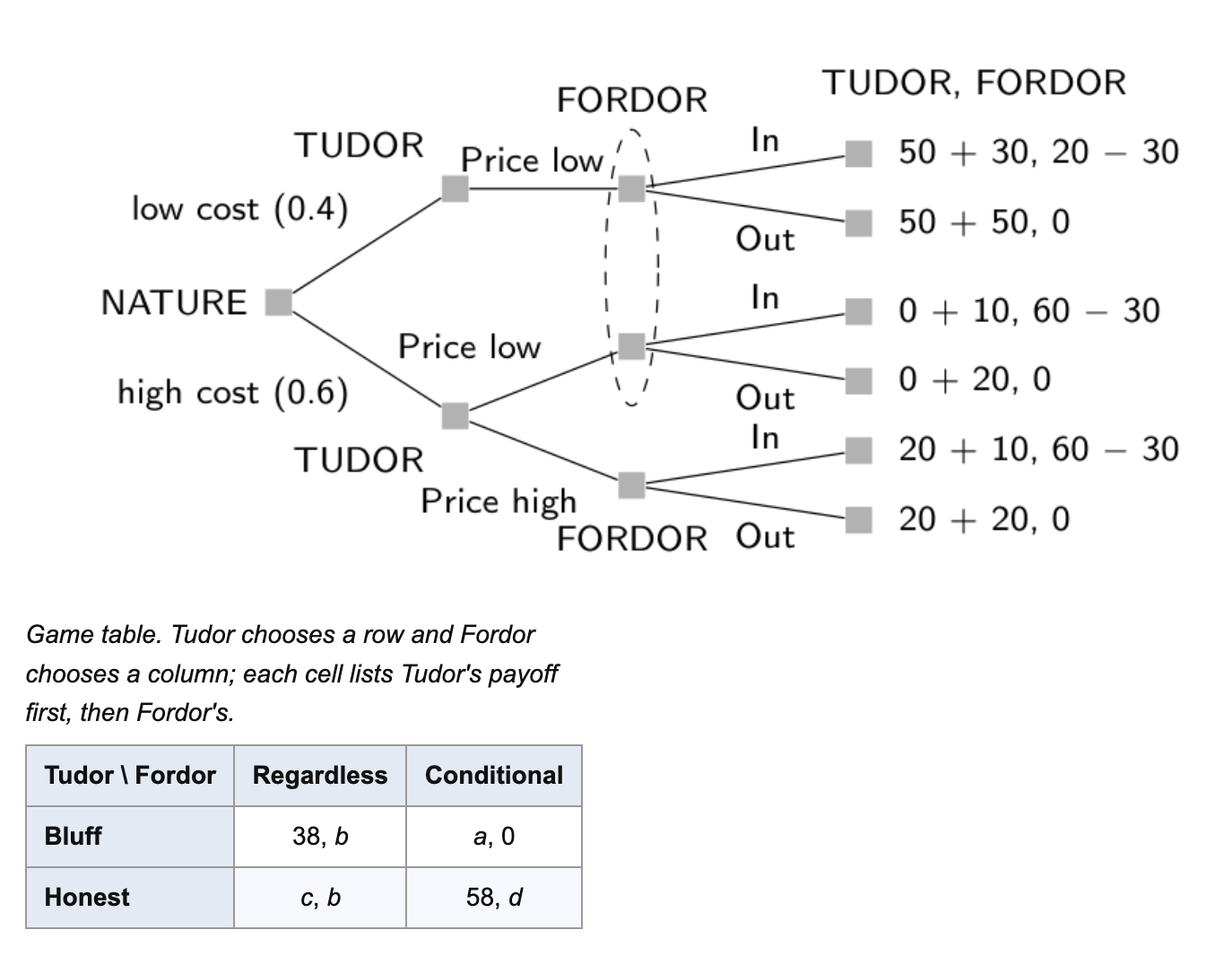
what are the missing payoffs at a, b, c, and d?
a= 52 b= 14 c= 50 d= 18

what is the nash equilibrium in pure strategies - and what kind of equilibrium is this
(honest, conditional)
separating equilibrium
Quarry Lane Software pays $115,000 in its high-paying job and $75,000 in its low-paying job. A college course costs an able worker $6,000 and a challenged worker $16,000. Able workers have an outside option worth $90,000; challenged workers' outside option is worth $40,000. Assume payoffs are determined solely by money received. Quarry Lane Software cannot tell the types apart, so it gives the high-paying job only to applicants with at least n courses.
what is the smallest n at which challenged workers will not take the courses?
3
Quarry Lane Software pays $115,000 in its high-paying job and $75,000 in its low-paying job. A college course costs an able worker $6,000 and a challenged worker $16,000. Able workers have an outside option worth $90,000; challenged workers' outside option is worth $40,000. Assume payoffs are determined solely by money received. Quarry Lane Software cannot tell the types apart, so it gives the high-paying job only to applicants with at least n courses.
what is the largest n at which able workers still take the courses rather than the low paying job
6
Quarry Lane Software pays $115,000 in its high-paying job and $75,000 in its low-paying job. A college course costs an able worker $6,000 and a challenged worker $16,000. Able workers have an outside option worth $90,000; challenged workers' outside option is worth $40,000. Assume payoffs are determined solely by money received. Quarry Lane Software cannot tell the types apart, so it gives the high-paying job only to applicants with at least n courses.
what is the largest n at which able workers prefer the high paying job to their outside option
4
Quarry Lane Software pays $115,000 in its high-paying job and $75,000 in its low-paying job. A college course costs an able worker $6,000 and a challenged worker $16,000. Able workers have an outside option worth $90,000; challenged workers' outside option is worth $40,000. Assume payoffs are determined solely by money received. Quarry Lane Software cannot tell the types apart, so it gives the high-paying job only to applicants with at least n courses.
at the smallest n that separates the types, what do able workers earn net of course costs?
97,000

Wanda's year is good with probability 0.7 and bad with probability 0.3. She knows which; the IRS does not. She owes $2,000 in tax after a good year and nothing after a bad year, and she reports High or Low. After a High report she pays $2,000 and the IRS does not move. After a Low report the IRS chooses Audit or Do not audit. An audit costs each side $1,800, and after a good year it also collects the $2,000 tax. Assume payoffs are determined solely by money received.
Wanda's strategies are Always low (LL: she reports Low after either year) and Honest (HL: she reports High after a good year and Low after a bad one).
what are the missing entries?
a= - 3,200 b= -400 c=-1,940 d= 1,400
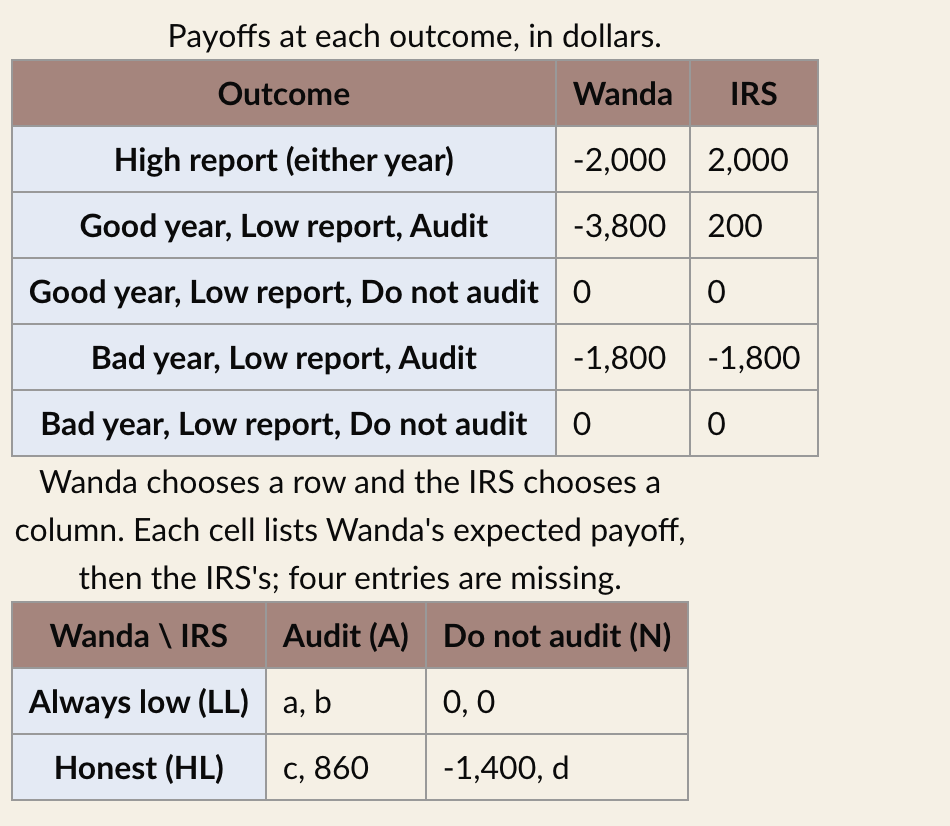
Wanda's year is good with probability 0.7 and bad with probability 0.3. She knows which; the IRS does not. She owes $2,000 in tax after a good year and nothing after a bad year, and she reports High or Low. After a High report she pays $2,000 and the IRS does not move. After a Low report the IRS chooses Audit or Do not audit. An audit costs each side $1,800, and after a good year it also collects the $2,000 tax. Assume payoffs are determined solely by money received.
Wanda's strategies are Always low (LL: she reports Low after either year) and Honest (HL: she reports High after a good year and Low after a bad one).
what is the nash equilibrium in pure strategies, and what type of equilibrium is it?
(always low, do not audit)
pooling
can a contingent strategy work here?
You rent an apartment on a 12-month lease with no option to renew. Each month you decide whether to report problems promptly and the landlord decides whether to fix them promptly.
no - known end date & backwards induction
can a contingent strategy work here?
You run one of two coffee shops on the same block. Both shops set prices every Monday morning and each can read the other’s board from across the street, and neither plans to close.
yes - indefinite repeated interaction
can a contingent strategy work here?
you supply produce to one restaurant, delivering once a month. the owner inspects every delivery and can switch suppliers at any time
yes - repeated interaction & credible punishment
can a contingent strategy work here?
You run a food truck that works a different festival every weekend, selling to people you will not see again. Each weekend you decide whether to skimp on portions.
no - no repeated interaction & weak threat of future punishment
the discount factor is s=0.8
what is $250 paid next period worth today?
$200
the discount factor is s=0.8
what is $60 paid every period, starting now, worth today?
$300
the discount factor is s=0.8
what is $40 paid every period, starting next period, worth today?
$160
the discount factor is s=0.8
is $100 now worth more than $30 every period, starting next period?
no , $100 < $120
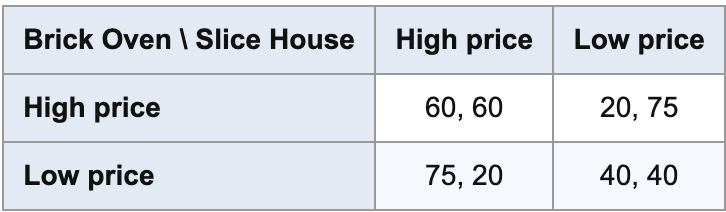
Brick Oven and Slice House set prices every month. Profits are in thousands of dollars per month. Pricing high is cooperating; pricing low is defecting.
if the other pizzeria prices high, how much more does a pizzeria earn in one month by pricing low?
15

Brick Oven and Slice House set prices every month. Profits are in thousands of dollars per month. Pricing high is cooperating; pricing low is defecting.
how much less does each pizzeria earn when both price low?
20

Brick Oven and Slice House set prices every month. Profits are in thousands of dollars per month. Pricing high is cooperating; pricing low is defecting.'
suppose instead a firm gains 30 once by defecting and then loses 12 every later month against grim trigger. the discount factor is 0.75. does defecting pay?
no, defecting does not pay. 30<36
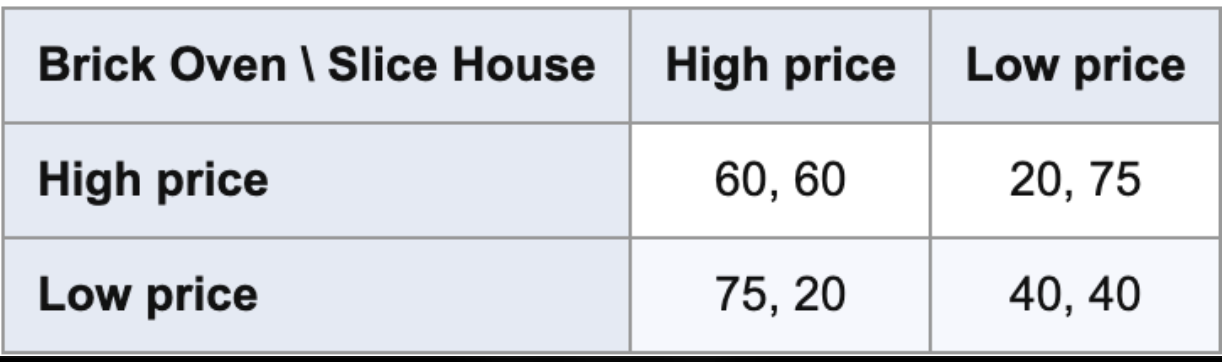
Brick Oven and Slice House set prices every month. Profits are in thousands of dollars per month. Pricing high is cooperating; pricing low is defecting.'
Suppose instead a firm gains 24 now by defecting once against copycat and loses 40 next month only. The discount factor is 0.7. Does defecting once pay?
no, defecting does not pay. 24<28
The discount factor is 0.6.
what is $210 paid next period worth today?
$126
The discount factor is 0.6.
What is $66 paid every period, starting now, worth today?
$165
The discount factor is 0.6.
What is $63 paid every period, starting next period, worth today?
$94.5
The discount factor is 0.6.
Is $62 now worth more than $39 every period, starting next period?
Yes, the stream is worth $58.50
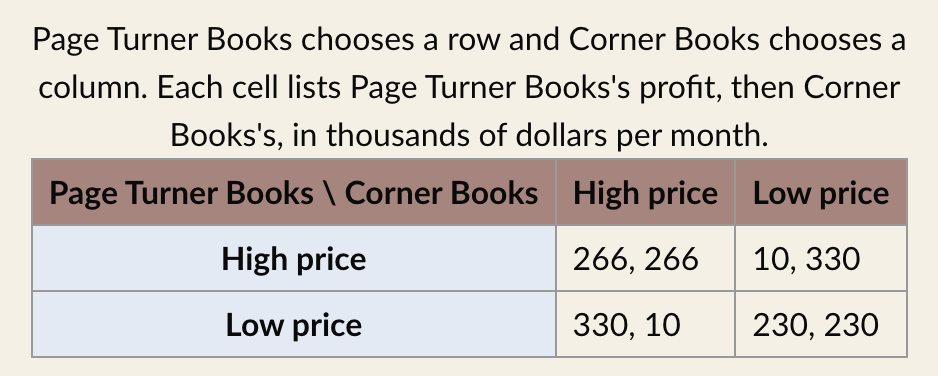
Page Turner Books and Corner Books set prices every month. Profits are in thousands of dollars per month. Pricing high is cooperating; pricing low is defecting.
if the other firm prices high, how much more does a firm earn in one month by pricing low?
64

Page Turner Books and Corner Books set prices every month. Profits are in thousands of dollars per month. Pricing high is cooperating; pricing low is defecting.
how much less does each firm earn every month when both price low rather than both price high
36

Page Turner Books and Corner Books set prices every month. Profits are in thousands of dollars per month. Pricing high is cooperating; pricing low is defecting.
against grim trigger, defecting pays only if S is below what value?
0.64

Page Turner Books and Corner Books set prices every month. Profits are in thousands of dollars per month. Pricing high is cooperating; pricing low is defecting.
Against copycat, defecting once pays only if S is below what value?
0.25

Ridge Coffee and Valley Coffee set prices every month. Profits are in thousands of dollars per month. Pricing high is cooperating; pricing low is defecting. Each month the market continues with probability p; the discount factor is δ.
when does defecting against grim trigger pay?
Defecting pays when pdelta <0.5455

Ridge Coffee and Valley Coffee set prices every month. Profits are in thousands of dollars per month. Pricing high is cooperating; pricing low is defecting. Each month the market continues with probability p; the discount factor is δ.
when does defecting once against copycat pay?
pdelta < 1.2

Ridge Coffee and Valley Coffee set prices every month. Profits are in thousands of dollars per month. Pricing high is cooperating; pricing low is defecting. Each month the market continues with probability p; the discount factor is δ.
let p = 0.8, when does defecting against grim trigger pay?
delta < 0.6818

Ridge Coffee and Valley Coffee set prices every month. Profits are in thousands of dollars per month. Pricing high is cooperating; pricing low is defecting. Each month the market continues with probability p; the discount factor is δ.
let delta = 0.5, when does defecting once against copycat pay?
p < 2.4
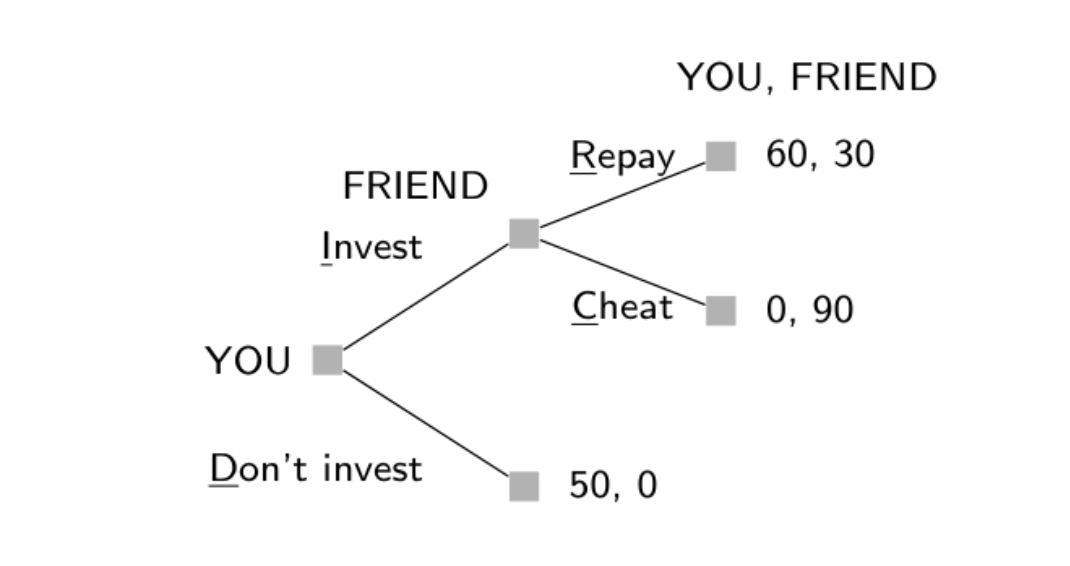
You can invest $50 with a friend, whose project turns it into $90. An honest friend repays you $60 and keeps $30; a cheating friend keeps all $90. Money not invested stays in your pocket.
what is the rollback outcome of the one-shot game?
don’t invest ; payoffs (50,0)

You can invest $50 with a friend, whose project turns it into $90. An honest friend repays you $60 and keeps $30; a cheating friend keeps all $90. Money not invested stays in your pocket.
what is the friend’s one time gain from cheating?
$60
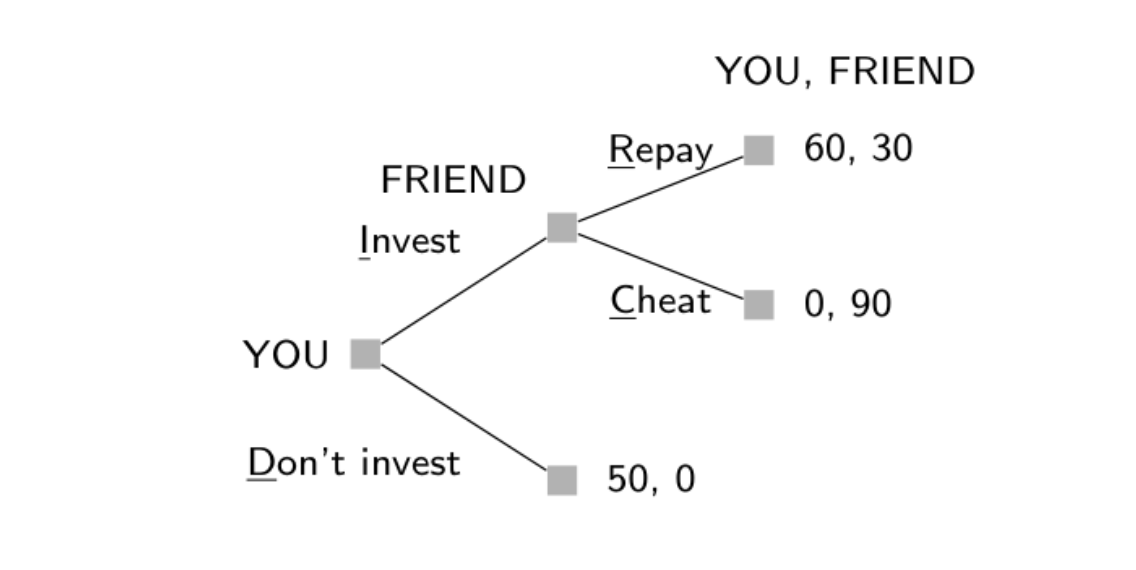
You can invest $50 with a friend, whose project turns it into $90. An honest friend repays you $60 and keeps $30; a cheating friend keeps all $90. Money not invested stays in your pocket.
You play grim trigger: after one cheat, you never invest again. what does the friend lose every later period?
$30

You can invest $50 with a friend, whose project turns it into $90. An honest friend repays you $60 and keeps $30; a cheating friend keeps all $90. Money not invested stays in your pocket.
the friend gains $32 once by cheating and loses $18 every later period. below what delta does cheating pay?
delta < 0.64

The mob punishes any confessor, equivalent to 20 years. Witness protection (WITSEC) replaces punishment with hardship equivalent to 5 years jail time. For each rule, write the new table, find the pure-strategy Nash equilibria, and say whether it is still a prisoners’ dilemma.
the U.S Attorney admits every confessor to WITSEC, both when both confess
NE: (confess, confess)
new payoff table: picture
PD?: yes
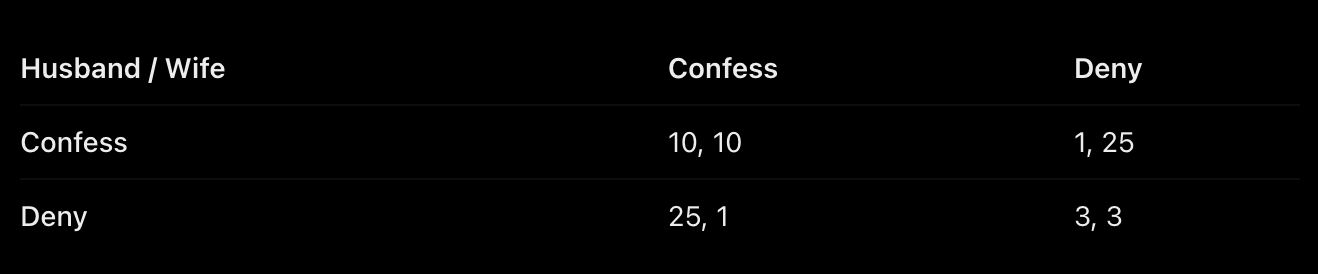

The mob punishes any confessor, equivalent to 20 years. Witness protection (WITSEC) replaces punishment with hardship equivalent to 5 years jail time. For each rule, write the new table, find the pure-strategy Nash equilibria, and say whether it is still a prisoners’ dilemma.
the U.S Attorney admits only a lone confessor. if both confess, neither is protected: 10 years each plus the mob’s punishment
NE: (confess, deny)
new payoff table: picture
PD?: no - this is now a game of chicken
