 Call Kai
 Learn
Learn Practice Test
 Spaced Repetition
 Match
Match Flashcards
 Knowt Play
1/49

There's no tags or description
Looks like no tags are added yet.
Name | Mastery | Learn | Test | Matching | Spaced | Call with Kai | Chat |
|---|
No analytics yet
Send a link to your students to track their progress
50 Terms
4 Main Elements on Earth
Nitrogen (N), Oxygen (O), Carbon (C), Hydrogen (H)
Non-polar Covalent Bonds
Electrons are shared equally and there is an equal pull within a bond. Atoms contain no charge. These bonds are easy to break.
Polar Covalent Bond
Electrons are shared unequally and there is an unequal pull within a bond. Atoms have a partial charge. These bonds are hard to break.
Hydrogen bonds
Extremely stable bond that can only be broken with very high energy.
Hydrophilic
Water loving, interacts with water.
Hydrophobic
Water hating. Does not interact with water. Tends to coalesce within aqueous solution.
Amino Group
A nitrogen bonded to two hydrogens.

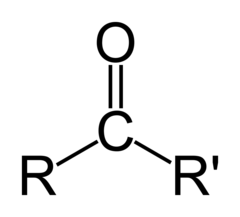
Carbonyl
Carbon double bonded to Oxygen
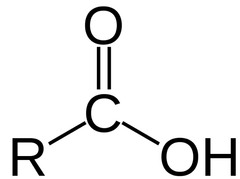
Carboxyl
Carbon double bonded to oxygens and a hydroxide. Act as an acid.
Sulfhydryl
Sulfur bonded to Hydrogen

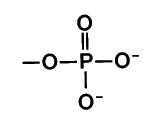
Phosphate
Phosphorous surrounded by Oxygen.
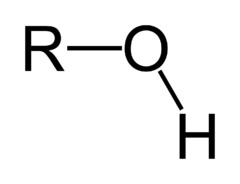
Hydroxyl
Hydrogen bonded to Oxygen.
Aldehyde
Found at the end of a carbon chain. Contains a Carbonyl bonded to a Hydrogen.

Ketone
A carbonyl found in the middle of a carbon chain.

Macromolecules
Large organic molecules made up of many smaller molecules.
Monomers
Single units of a molecule.
R-groups/Side chains
Make up an amino acid structure and makes 20 different amino acids unique.
Dehydration/Condensation Reaction
Creates a covalent glycosidic bond + 1 H2O molecule. Water is removed from a bond.
Hydrolysis
Water is added in order to break bonds.
Acid-Base Reaction
When an acid and base mix together, they transfer protons and neutralize creating a water and a salt.
Carbohydrates
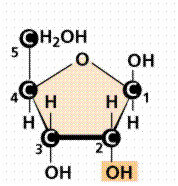
A macromolecule made up of C, H, and O molecules formed by dehydration/condensation reactions. Typically form a ring shape but this is not always the case.

Hexose
A type of carbohydrate that contains 6 carbons.

Pentose
A type of carbohydrate that contains 5 carbons
Proteins
Made up of amino acids and carboxyl groups. They are formed by covalent peptide bonds.

Peptide Bonds
Covalent bonds which link amino acids in proteins.
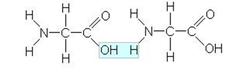
Glycosidic Bond
Covalent dehydration bond between two monosaccharides. Hydrolysis is used to break them.
Monosaccharides
Simple sugars (glucose, fructose, galactose)
Disaccharides
Two monosaccharides bonded with glycosidic bonds. H2O is removed during reaction.
Polysaccharides
Many monosaccharides bonded together to create long polymers. Function as energy storage and structure.
Oligosaccharides
3-10 monosaccharides bonded together to function for cell recognition and signalling.
Nucleotides
Basic unit of DNA. Made up of a sugar group, phosphate, and a nitrogenous base.

Ester Bonds
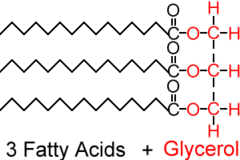
bonds between fatty acids and glycerol

Fatty Acid
Carboxyl group attached to a hydrocarbon chain. Usually non-polar and hydrophobic.

Lipid
Macromolecule mostly made of C and H atoms. Largely nonpolar and hydrophobic.
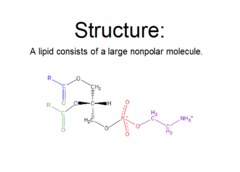
Amphipathic
Something that is both hydrophilic and hydrophobic. (Ex: Lipids have hydrophilic heads and hydrophobic tails)
Triglycerides
Contains 3 fatty acid chains bonded to a glycerol head.
Lipid Bilayer
Made when lipid molecules align in two sheets. They have selective permeability.
Permeability
The ability for a small molecule to pass through a lipid bilayer.
Unsaturated Lipids
Fatty acids where there are many bonds within a chain which makes them harder to stack. They are usually liquid at room temperature and have high permeability.
Saturated Lipids
Fatty acids where there are many unbonded Hydrogens. They are typically solid at room temperature and have low permeability.
Diffusion
Spontaneous movement of molecules and ions across a membrane.
Concentration gradient
A difference in the concentration of a solute.
Passive Transport
Substances can diffuse across a membrane without outside energy.
Active Transport
Substances can diffuse across a membrane with an outside energy source.
Equilibrium
A state of balance between molecules across a membrane. Molecules DO NOT stop moving at this state.
Osmosis
How water specifically moves across lipid bilayers.
Hypertonic
Outside solution has a higher concentration of solutes than the interior. Water leaves and the membrane will shrink.

Hypotonic
Outside solution has a lower concentration of solutes than the interior. Water enters and the membrane will swell.

Isotonic
Outside and inside solution have the same concentration of solutes. The membrane will keep its shape.
Aquaporin
A membrane that only water can pass through. It moves way faster through it.